Malaysia Construction and Mining Machinery Market Summary
The malaysia construction and mining machinery market was estimated at USD 355 Million in 2025 and is projected to reach USD 473 Million by 2032, growing at a CAGR of 5.8% from 2026 to 2032.
Malaysia Construction and Mining Machinery Market Year-wise Growth Rate and Key Drivers
This graph highlights how the Malaysia Construction and Mining Machinery Market has steadily grown over the past five years, supported by major growth factors.
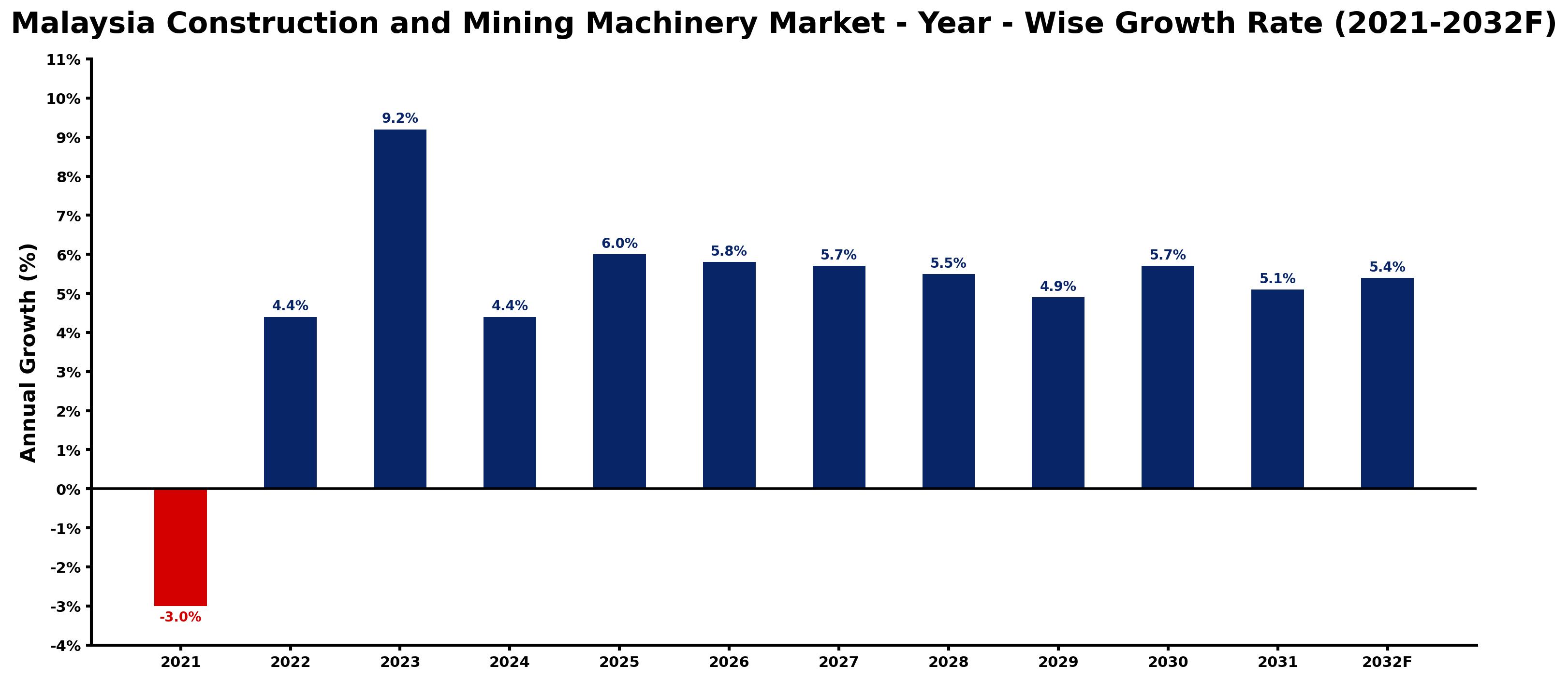
The table below presents the year wise growth rates along with the key drivers influencing the market
| Year | Growth Rate | Major Drivers |
| 2021 | -3.0% | Supply chain disruptions and labor shortages hindered project timelines, causing delays and reduced machinery demand. |
| 2022 | 4.4% | Urbanization trends escalate construction activities, boosting machinery demand significantly. |
| 2023 | 9.2% | Construction sector benefits from foreign investments, enhancing market competitiveness. |
| 2024 | 4.4% | Technological integration in machinery leads to improved efficiency and productivity. |
| 2025 | 6.0% | Increased focus on sustainable practices drives the adoption of eco-friendly machinery. |
| 2026 | 5.8% | Government infrastructure spending expands, targeting transportation and urban development. |
| 2027 | 5.7% | Rising labor costs prompt companies to invest in automation and machinery upgrades. |
| 2028 | 5.5% | Regional mining projects harness Malaysia's resources, stimulating machinery purchases. |
| 2029 | 4.9% | Urban redevelopment initiatives create demand for advanced construction equipment. |
| 2030 | 5.7% | A robust rental market emerges, enabling access to expensive machinery. |
| 2031 | 5.1% | Investment in green technology influences machinery design and operational standards. |
| 2032 | 5.4% | Continued economic growth fosters an environment conducive to construction innovation. |
Note - Market size estimations and growth projections presented in this report are based on 6Wresearch's advanced forecasting approach, validated with industry datasets as of June 2026.
Malaysia Construction and Mining Machinery Market Synopsis
The Malaysia Construction and Mining Machinery Market is projected to reach 5.8% and witness significant growth during the forecast period (2026-2032). This promising outlook stems from a combination of government initiatives, rapid urbanization, and increased foreign investments in infrastructure projects. As Malaysia continues to advance in both infrastructure development and technological innovation, the demand for modern construction and mining machinery is anticipated to grow steadily.
Malaysia Construction and Mining Machinery Market Growth Drivers
Several factors are driving the expansion of the Malaysia construction and mining machinery market. These include:
- Government initiatives aimed at infrastructure improvement, including the construction of airports, roads, and bridges, are creating a robust demand for machinery.
- Rapid urbanization has resulted in an increasing need for modernized equipment to meet the challenges posed by growing urban populations.
- Industrialization in Malaysia supports a higher demand for mining and construction activities, thus boosting the machinery market.
- Foreign investment in infrastructure projects is expected to create lucrative opportunities for the machinery sector, enhancing overall market growth.
- Technological advancements, including digital transformation in engineering processes, are leading to increased demand for sophisticated machinery and technology-driven solutions.
Malaysia Construction and Mining Machinery Market Challenges and Restraints
Despite the positive growth trajectory, the Malaysia construction and mining machinery market faces several challenges:
- Environmental concerns surrounding pollution from heavy machinery deployed in mining operations may act as a significant constraint on market growth.
- The high maintenance costs associated with advanced machinery could deter smaller companies from investing in new equipment.
- Regulatory standards related to emissions and noise pollution can impose additional operational costs on machinery operators.
- The need for skilled operators trained in the latest technology can create a gap in workforce availability, impacting operational efficiency.
- Market volatility in raw material prices can affect the overall profitability of machinery manufacturers, potentially stalling innovation and investment.
Malaysia Construction and Mining Machinery Market Government Investment and Initiatives
The Malaysian government has been proactive in fostering the development of the construction and mining sectors through various investment initiatives. Major public spending programs focus on infrastructure enhancement, ensuring the country remains competitive in the region. Key initiatives include:
- The Malaysia Vision 2020 and subsequent national development plans emphasize substantial investment in infrastructure, directly impacting the machinery market.
- Public-private partnerships are encouraged, allowing for collaborative investment in large-scale projects that require advanced machinery.
- Government grants and incentives aimed at adopting green technologies are paving the way for environmentally friendly machinery solutions.
- Legislative support for infrastructure projects includes expedited approvals and funding mechanisms, further stimulating market demand.
- Recent strategies such as the National Infrastructure Plan identify key projects that necessitate significant machinery investment, aligning public objectives with private sector capabilities.
Malaysia Construction and Mining Machinery Market Latest Developments (May 2025 - June 2026)
Recent developments in the Malaysia construction and mining machinery market from May 2025 to June 2026 have illustrated a clear shift towards technological integration and sustainability. Notable trends include:
- Increased adoption of automated machinery solutions as companies seek to enhance efficiency and reduce labor costs.
- Growing interest in electric and hybrid machinery options, aligning with global sustainability trends and reducing environmental impacts.
- Enhanced training programs for operators to ensure that the workforce is equipped to handle advanced technological systems.
- Collaborations between local firms and international technology providers are becoming more common, fostering knowledge transfer and innovation.
- Regulatory changes, promoting sustainability and operational safety, are encouraging investments in modern machinery that comply with new standards.
Malaysia Construction and Mining Machinery Market - Key Attractiveness of the Report
- 10 Years of Market Numbers
- Historical Data Starting from 2022 to 2025
- Base Year: 2025
- Forecast Data until 2032
- Key Performance Indicators Impacting the Market
- Major Upcoming Developments and Projects
Key Highlights of the Report:
- Malaysia Construction and Mining Machinery Market Outlook
- Market Size of Malaysia Construction and Mining Machinery Market, 2025
- Forecast of Malaysia Construction and Mining Machinery Market, 2032F
- Historical Data and Forecast of Malaysia Construction and Mining Machinery Revenues & Volume for the Period 2022-2032F
- Malaysia Construction and Mining Machinery Market Trend Evolution
- Malaysia Construction and Mining Machinery Market Drivers and Challenges
- Malaysia Construction and Mining Machinery Price Trends
- Malaysia Construction and Mining Machinery Porter's Five Forces
- Malaysia Construction and Mining Machinery Industry Life Cycle
- Historical Data and Forecast of Malaysia Construction and Mining Machinery Market Revenues & Volume By Product Types for the Period 2022-2032F
- Historical Data and Forecast of Malaysia Construction and Mining Machinery Market Revenues & Volume By Loaders for the Period 2022-2032F
- Historical Data and Forecast of Malaysia Construction and Mining Machinery Market Revenues & Volume By Dozers for the Period 2022-2032F
- Historical Data and Forecast of Malaysia Construction and Mining Machinery Market Revenues & Volume By Excavators for the Period 2022-2032F
- Historical Data and Forecast of Malaysia Construction and Mining Machinery Market Revenues & Volume By Crushing for the Period 2022-2032F
- Historical Data and Forecast of Malaysia Construction and Mining Machinery Market Revenues & Volume By Pulverizing & Screening Equipment for the Period 2022-2032F
- Historical Data and Forecast of Malaysia Construction and Mining Machinery Market Revenues & Volume By Others for the Period 2022-2032F
- Historical Data and Forecast of Malaysia Construction and Mining Machinery Market Revenues & Volume By Applications for the Period 2022-2032F
- Historical Data and Forecast of Malaysia Construction and Mining Machinery Market Revenues & Volume By Infrastructure for the Period 2022-2032F
- Historical Data and Forecast of Malaysia Construction and Mining Machinery Market Revenues & Volume By Mineral Mining for the Period 2022-2032F
- Historical Data and Forecast of Malaysia Construction and Mining Machinery Market Revenues & Volume By Residential Building for the Period 2022-2032F
- Historical Data and Forecast of Malaysia Construction and Mining Machinery Market Revenues & Volume By Metal Mining for the Period 2022-2032F
- Historical Data and Forecast of Malaysia Construction and Mining Machinery Market Revenues & Volume By Others for the Period 2022-2032F
- Malaysia Construction and Mining Machinery Import Export Trade Statistics
- Market Opportunity Assessment By Product Types
- Market Opportunity Assessment By Applications
- Malaysia Construction and Mining Machinery Top Companies Market Share
- Malaysia Construction and Mining Machinery Competitive Benchmarking By Technical and Operational Parameters
- Malaysia Construction and Mining Machinery Company Profiles
- Malaysia Construction and Mining Machinery Key Strategic Recommendations






































