Malaysia Consumer Battery Market Size, Share & Growth Rate
The Malaysia Consumer Battery Market was estimated at USD 524 Million in 2025 and is projected to reach USD 776 Million by 2032, growing at a CAGR of 5.8% from 2026 to 2032. This growth trajectory reflects a significant increase in the adoption of portable electronic devices among Malaysian consumers, as smartphones, tablets, and wireless accessories become everyday essentials. Furthermore, the rising environmental consciousness is prompting a shift toward sustainable and rechargeable battery options, enhancing market dynamics.
Malaysia Consumer Battery Market Year-wise Growth Rate and Key Drivers
This graph highlights how the Malaysia Consumer Battery Market has steadily grown over the years, supported by major growth factors.
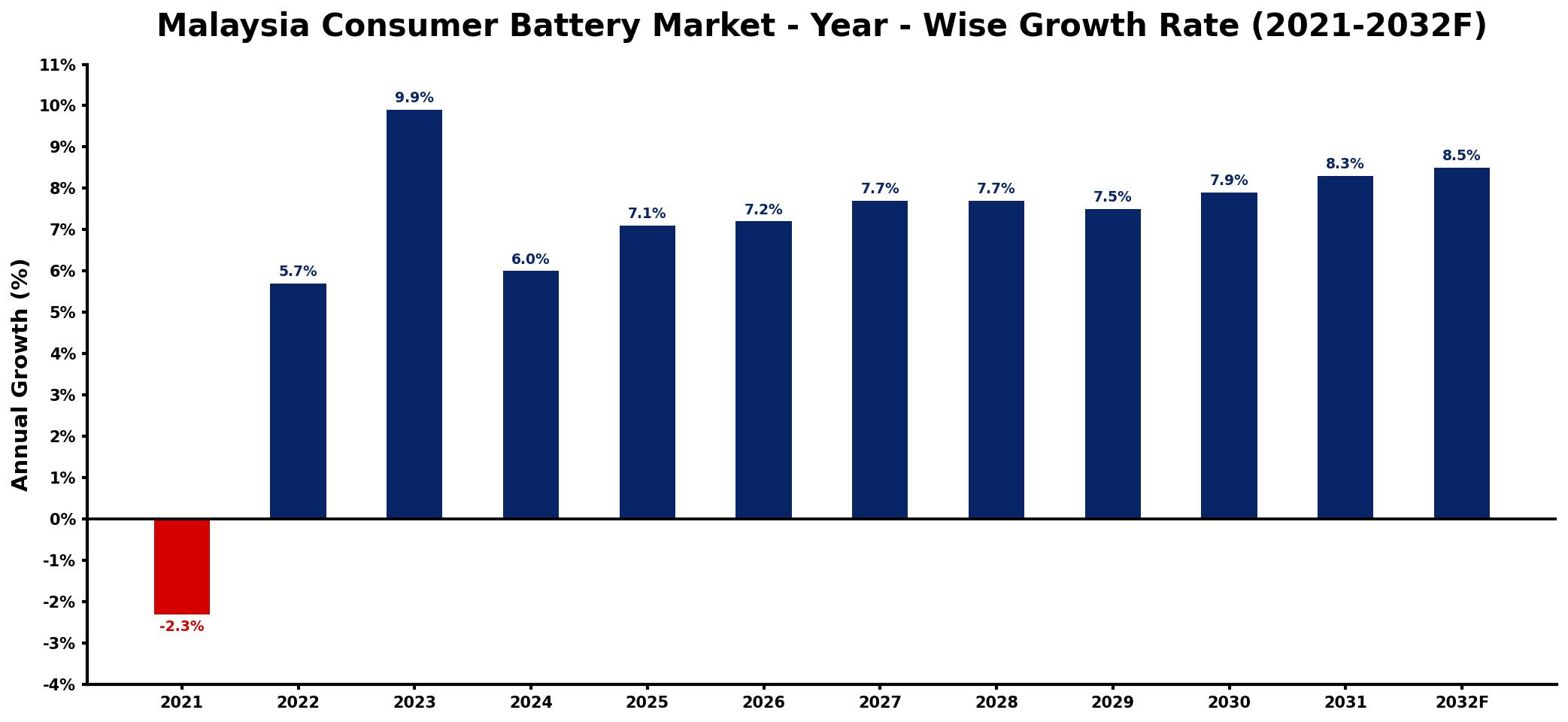
The table below presents the year‑wise growth rates along with the key drivers influencing the market
| Year | Growth Rate | Major Drivers |
| 2021 | -2.3% | decrease in disposable income levels |
| 2022 | 5.7% | rising demand for renewable energy |
| 2023 | 9.9% | increased adoption of electric vehicles |
| 2024 | 6.0% | growth in smart home technology |
| 2025 | 7.1% | expansion of portable electronics market |
| 2026 | 7.2% | investments in green technologies |
| 2027 | 7.7% | surge in outdoor recreational activities |
| 2028 | 7.7% | development of energy storage solutions |
| 2029 | 7.5% | strengthening underlying market demand |
| 2030 | 7.9% | increased focus on sustainability initiatives |
| 2031 | 8.3% | increased pharmaceutical industry usage |
| 2032 | 8.5% | advancements in energy efficiency technologies |
Note: Market size estimations and growth projections presented in this report are based on 6Wresearch's proprietary forecasting methodology, utilizing the latest available industry data, government publications, and primary research inputs.
Malaysia Consumer Battery Market Synopsis
As the consumer battery market in Malaysia evolves, it showcases a robust demand driven by the proliferation of portable electronics and household gadgets. This growing dependence is not merely a trend; it reflects a fundamental change in consumer behavior and lifestyle, further influenced by the growing popularity of online shopping platforms.
At the same time, consumers are increasingly drawn to eco-friendly alternatives, leading to greater interest in lithium-ion and nickel-metal hydride batteries. As this demand intensifies, manufacturers face the imperative to innovate and develop long-lasting, sustainable battery solutions to keep pace with the expectations of todays eco-conscious consumers.
Malaysia Consumer Battery Market Key Takeaways
- The market is witnessing a transition toward rechargeable and eco-friendly battery solutions.
- Increased usage of smartphones and portable devices significantly drives battery demand.
- Local manufacturers face strong competition from low-cost imported batteries.
- Research and development investments are crucial to overcoming challenges related to battery longevity and efficiency.
- Online shopping platforms are enhancing consumer access to various battery products.
Evaluation of Restraints in Malaysia Consumer Battery Market
Despite its promising outlook, the Malaysia consumer battery market grapples with significant constraints. A primary concern is the pressure to produce batteries that meet the growing consumer demand for longer lifespan and higher energy efficiency, which are crucial in a landscape dominated by rapidly advancing electronic devices. Furthermore, increasing awareness of environmental issues has raised expectations for manufacturers to adopt sustainable practices, which many traditional battery producers may find difficult to implement without significant investment. Lastly, the influx of competitively priced imported batteries adds additional pressure on local players, compelling them to enhance their product quality while maintaining competitive pricing.
Malaysia Consumer Battery Market Trends
A key trend shaping the consumer battery market in Malaysia is the shift towards sustainable energy solutions, with consumers increasingly seeking out rechargeable batteries to reduce waste. The rise of smart devices also promotes demand for high-performance lithium-ion batteries, as these technologies require reliable, long-lasting power sources. Furthermore, the evolving digital landscape fueled by e-commerce is making battery products more accessible than ever, encouraging higher consumer purchases.
Malaysia Consumer Battery Market Opportunities
The Malaysia consumer battery market presents lucrative growth opportunities particularly in the development of advanced battery technologies. The demand for sustainable and rechargeable battery solutions offers manufacturers a platform to innovate and diversify their product offerings. Moreover, expanding distribution networks through online platforms provides an effective way to reach a broader consumer base, tapping into the increasing trend of online shopping.
Government Initiatives in the Malaysia Consumer Battery Market
The Malaysian government has taken proactive steps to promote sustainable energy and environmentally-friendly practices. Various initiatives and programs aimed at fostering research and development in battery technology are encouraging local manufacturers to innovate. Additionally, public spending on green technology and incentives for companies investing in eco-friendly practices signal a supportive regulatory environment for the consumer battery market.
Future Insights of the Malaysia Consumer Battery Market
Looking ahead to 2026-2032, the Malaysia consumer battery market is set for dynamic growth driven by technological advancements and increasing consumer awareness regarding sustainability. As manufacturers focus on innovation, the advent of more efficient and eco-friendly battery technologies is likely to redefine the market landscape. The rising trend of smart homes and the integration of IoT devices will further fuel the demand for robust battery solutions, aligning with evolving consumer needs.
Malaysia Consumer Battery Market Latest Developments (2025 - 2026)
In recent months, the consumer battery industry in Malaysia has seen notable advancements focused on sustainability and performance enhancements. Companies are increasingly prioritizing the development of new battery technologies that extend lifespan and reduce environmental impact. Additionally, partnerships with e-commerce platforms are becoming more common, allowing manufacturers to expand their market reach and enhance consumer access to diverse battery options.
Malaysia Consumer Battery Market - Key Attractiveness of the Report
- 10 Years of Market Numbers
- Historical Data Starting from 2022 to 2025
- Base Year: 2025
- Forecast Data until 2032
- Key Performance Indicators Impacting the Market
- Major Upcoming Developments and Projects
Key Highlights of the Report:
- Malaysia Consumer Battery Market Outlook
- Market Size of Malaysia Consumer Battery Market, 2025
- Forecast of Malaysia Consumer Battery Market, 2032
- Historical Data and Forecast of Malaysia Consumer Battery Revenues & Volume for the Period 2022-2032F
- Malaysia Consumer Battery Market Trend Evolution
- Malaysia Consumer Battery Market Drivers and Challenges
- Malaysia Consumer Battery Price Trends
- Malaysia Consumer Battery Porter's Five Forces
- Malaysia Consumer Battery Industry Life Cycle
- Historical Data and Forecast of Malaysia Consumer Battery Market Revenues & Volume By Type for the Period 2022-2032F
- Historical Data and Forecast of Malaysia Consumer Battery Market Revenues & Volume By Lithium-ion Batteries for the Period 2022-2032F
- Historical Data and Forecast of Malaysia Consumer Battery Market Revenues & Volume By Zinc-Carbon Batteries for the Period 2022-2032F
- Historical Data and Forecast of Malaysia Consumer Battery Market Revenues & Volume By Alkaline Batteries for the Period 2022-2032F
- Historical Data and Forecast of Malaysia Consumer Battery Market Revenues & Volume By Nickel Metal Hydride for the Period 2022-2032F
- Historical Data and Forecast of Malaysia Consumer Battery Market Revenues & Volume By Nickel Cadmium for the Period 2022-2032F
- Historical Data and Forecast of Malaysia Consumer Battery Market Revenues & Volume By Others for the Period 2022-2032F
- Historical Data and Forecast of Malaysia Consumer Battery Market Revenues & Volume By End-User for the Period 2022-2032F
- Historical Data and Forecast of Malaysia Consumer Battery Market Revenues & Volume By Residential for the Period 2022-2032F
- Historical Data and Forecast of Malaysia Consumer Battery Market Revenues & Volume By Commercial for the Period 2022-2032F
- Malaysia Consumer Battery Import Export Trade Statistics
- Market Opportunity Assessment By Type
- Market Opportunity Assessment By End-User
- Malaysia Consumer Battery Top Companies Market Share
- Malaysia Consumer Battery Competitive Benchmarking By Technical and Operational Parameters
- Malaysia Consumer Battery Company Profiles
- Malaysia Consumer Battery Key Strategic Recommendations






































