Malaysia Container Security Market Size & Growth Rate (2026-2032)
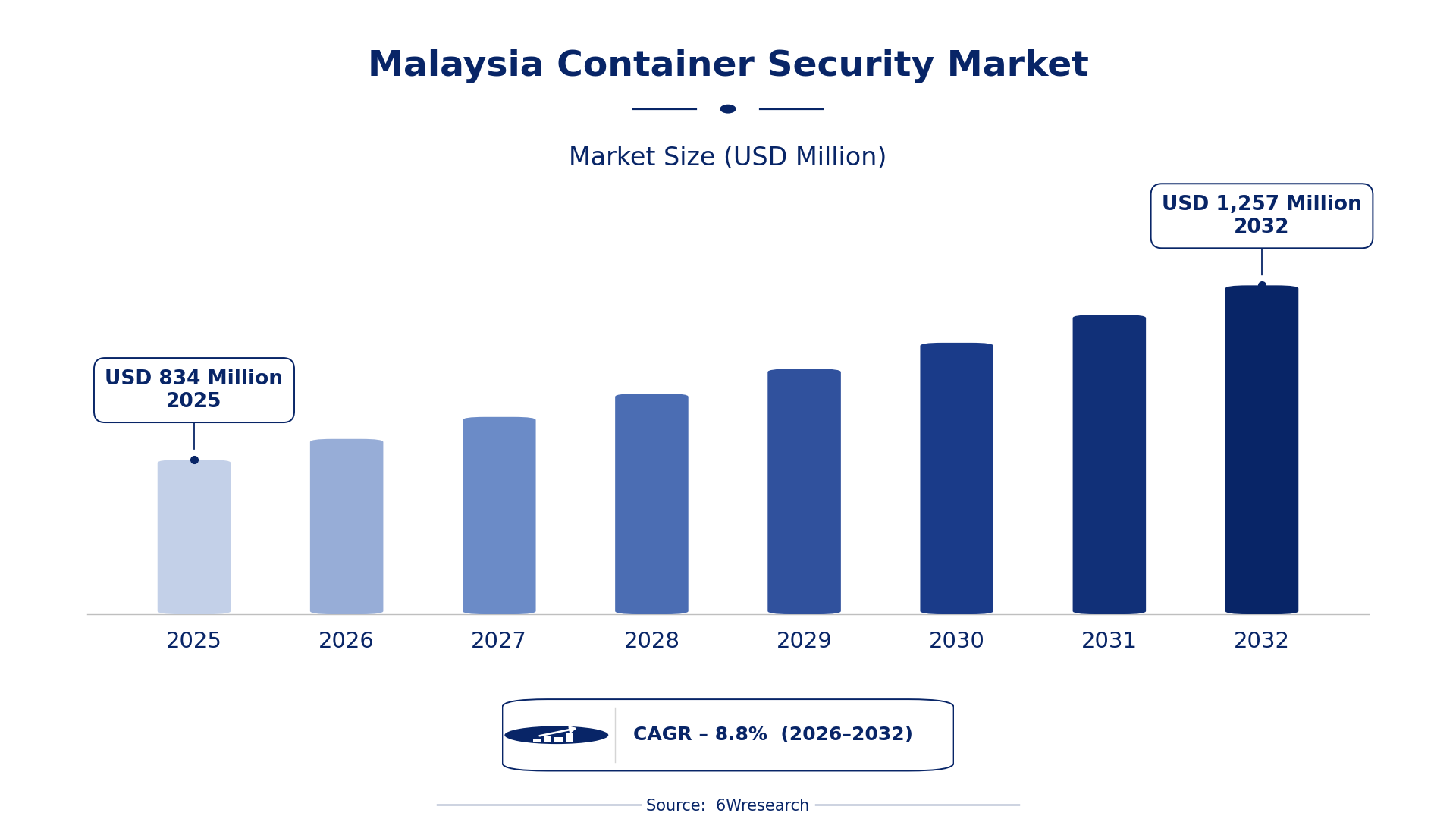
The Malaysia Container Security Market was estimated at USD 834 Million in 2025 and is projected to reach USD 1257 Million by 2032, growing at a CAGR of 8.8% from 2026 to 2032.
Malaysia Container Security Market Synopsis
As organizations across Malaysia embrace container technology, the demand for robust container security solutions is accelerating. Companies recognize that as they shift towards containerized applications, the need for safeguarding these environments becomes paramount, driven by potential vulnerabilities that could jeopardize operational integrity.
This surge in demand is further fueled by compliance requirements and regulatory standards aimed at securing software deployment processes. Businesses are not just looking at efficiency but also at risk mitigation, ensuring that their transition to microservices architectures is backed by comprehensive security measures.
Malaysia Container Security Market Year-wise Growth Rate and Key Drivers
This graph illustrates the annual growth rates of the Malaysia Container Security Market from 2021 to 2032, highlighting a steady upward trajectory and projected expansion over the forecast period.
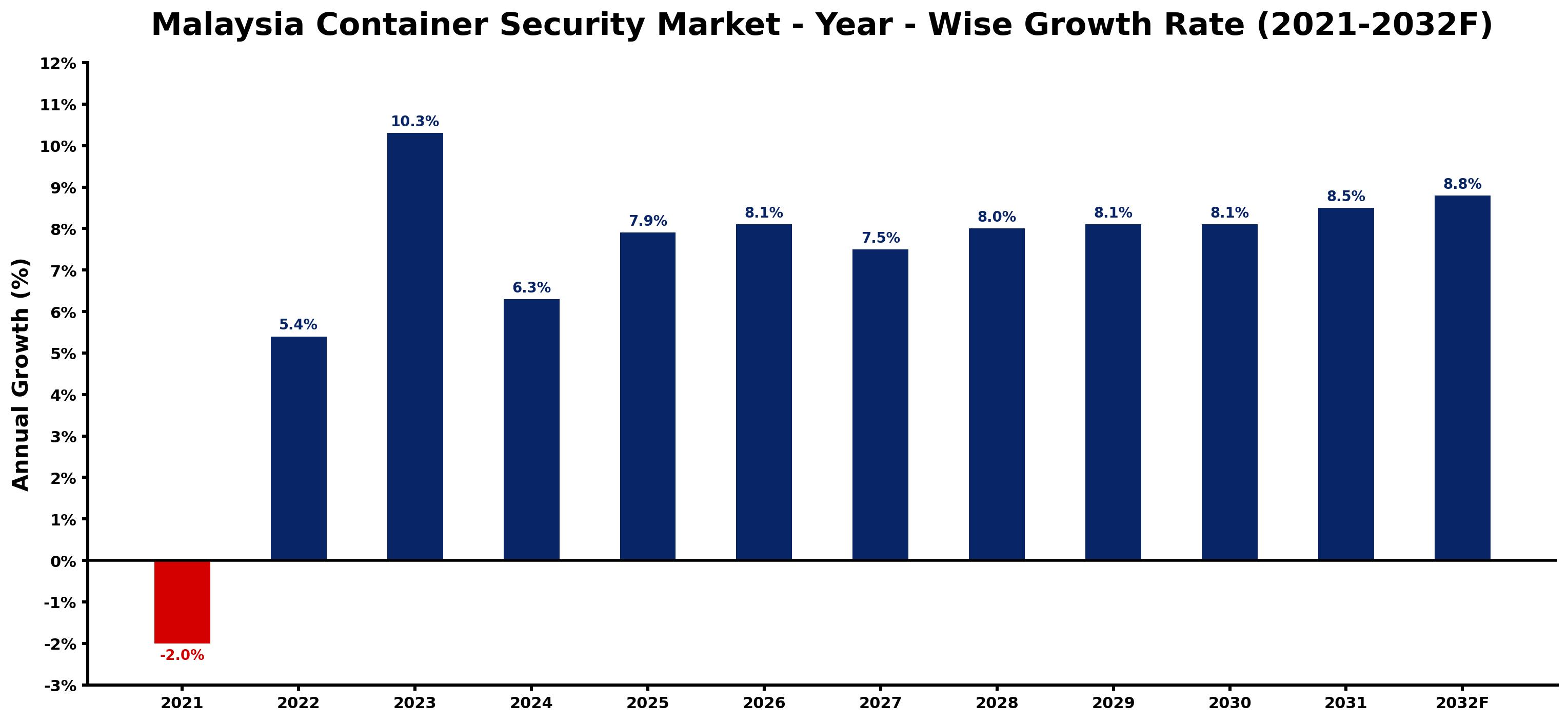
The table below presents the year‑wise growth rates along with the key drivers influencing the market
| Year | Growth Rate | Major Drivers |
| 2021 | -2.0% | Port Klang delays due to Customs compliance changes. |
| 2022 | 5.4% | Implementation of Malaysia's National Logistics Policy enhancing container security. |
| 2023 | 10.3% | Increased cybersecurity regulations by MCMC for supply chains. |
| 2024 | 6.3% | Growing freight theft incidents prompting tighter security protocols. |
| 2025 | 7.9% | Government incentives for tech adoption in container tracking. |
| 2026 | 8.1% | Launch of security training programs by MINDEF for logistics. |
| 2027 | 7.5% | Collaboration with international bodies to enhance security standards. |
| 2028 | 8.0% | Rising awareness of digital threats in maritime logistics. |
| 2029 | 8.1% | Introduction of biometrics for container access control measures. |
| 2030 | 8.1% | Enhanced customs policies prioritizing secure container handling. |
| 2031 | 8.5% | Growing maritime insurance requirements for secured container transport. |
| 2032 | 8.8% | Increased integration of AI technologies in container surveillance. |
Note: Market size estimations and growth projections presented in this report are based on 6Wresearch's proprietary forecasting methodology, utilizing the latest available industry data, government publications, and primary research inputs.
Malaysia Container Security Market Key Takeaways
Below are some of the specific key takeaways from the market, including:
- The increasing adoption of containerized applications is a primary driver for the growth of the market.
- Compliance mandates are pushing organizations to prioritize container security measures.
- Container environments pose unique security challenges, necessitating specialized expertise and solutions.
- The COVID-19 pandemic accelerated the shift towards containerization, boosting demand for security solutions.
- Market players are continuously innovating to address the dynamic nature of container deployment.
Evaluation of Restraints in Malaysia Container Security Market
Despite the positive growth trajectory, several restraints hinder the Malaysia Container Security Market. The rapidly changing nature of containerized environments makes it challenging for organizations to maintain consistent security protocols. Many companies struggle to balance security needs with the inherent agility and efficiency of container technology. Additionally, a lack of specialized security talent poses a risk, as organizations may find it difficult to address vulnerabilities effectively without the necessary expertise.
Malaysia Container Security Market Trends
The market is seeing trends that align with technological advancements. Automation in security processes is gaining traction, allowing organizations to respond to threats in real-time. The integration of artificial intelligence and machine learning in security solutions is becoming more prevalent, helping to identify vulnerabilities before they can be exploited. on top of that, the focus on regulatory compliance is driving the adoption of container security solutions that provide robust monitoring and reporting capabilities.
Malaysia Container Security Market Opportunities
There are substantial growth opportunities in the Malaysia Container Security Market. Organizations are increasingly investing in comprehensive security solutions that encompass the entire container lifecycle. With the ongoing expansion of cloud services, partnerships between cybersecurity providers and cloud service platforms can foster significant advancements. on top of that, developing localized solutions tailored to the Malaysian market's unique needs can enhance competitiveness and drive further adoption.
Government Initiatives in the Malaysia Container Security Market
The Malaysian government recognizes the importance of cybersecurity, especially within containerized environments, in enhancing national security and economic resilience. By implementing regulatory frameworks and fostering public-private partnerships, the government aims to bolster the container security infrastructure. Such initiatives are crucial, as they establish standards that organizations must adhere to while also promoting innovation in security solutions.
- A regulatory framework introduced in 2025 mandates heightened security measures for software development, specifically addressing containerized applications.
- A national digital infrastructure upgrade programme is currently underway, focusing on enhancing security protocols across various sectors, including logistics and technology.
- Future plans include a public-private initiative aimed at expanding cybersecurity training programs to develop local expertise in container security by 2028.
- In early 2025, the government launched a cybersecurity awareness campaign to educate businesses on the risks associated with containerized applications.
Future Insights of the Malaysia Container Security Market
Looking towards 2026-2032, the Malaysia Container Security Market is set for dynamic evolution. As businesses increasingly adopt containerization, the demand for integrated security solutions will rise. Organizations will prioritize the establishment of robust security frameworks that not only safeguard applications but also enhance overall operational efficiency. Investments in local talent development and strategic collaborations will be critical as the market seeks to address the complexity of container security challenges in a rapidly digitizing economy.
Malaysia Container Security Market Latest Developments
In recent months, the Malaysia Container Security Market has witnessed significant developments as organizations ramp up their security measures. Companies are actively pursuing innovative solutions to stay ahead of emerging threats while meeting compliance requirements. These activities reflect a strong commitment to enhancing container security amid a growing adoption of container technology.
- A major technology vendor launched an advanced container security platform in Q2 2025, integrating AI capabilities for improved threat detection.
- An initiative that began in early 2025 focuses on developing industry-wide security standards for containerized applications and is still ongoing.
- By mid-2025, a leading regional operator is expected to complete its rollout of container monitoring solutions across its logistics network.
- A new partnership between cybersecurity firms aimed at enhancing container security capabilities was announced in late 2025, with efforts currently underway.
Malaysia Container Security Market - Key Attractiveness of the Report
- 10 Years of Market Numbers
- Historical Data Starting from 2022 to 2025
- Base Year: 2025
- Forecast Data until 2032
- Key Performance Indicators Impacting the Market
- Major Upcoming Developments and Projects
Key Highlights of the Report:
- Malaysia Container Security Market Outlook
- Market Size of Malaysia Container Security Market, 2025
- Forecast of Malaysia Container Security Market, 2032
- Historical Data and Forecast of Malaysia Container Security Revenues & Volume for the Period 2022-2032F
- Malaysia Container Security Market Trend Evolution
- Malaysia Container Security Market Drivers and Challenges
- Malaysia Container Security Price Trends
- Malaysia Container Security Porter's Five Forces
- Malaysia Container Security Industry Life Cycle
- Historical Data and Forecast of Malaysia Container Security Market Revenues & Volume By Component for the Period 2022-2032F
- Historical Data and Forecast of Malaysia Container Security Market Revenues & Volume By Container Security Products for the Period 2022-2032F
- Historical Data and Forecast of Malaysia Container Security Market Revenues & Volume By Services (Professional, Managed) for the Period 2022-2032F
- Historical Data and Forecast of Malaysia Container Security Market Revenues & Volume By Deployment Type for the Period 2022-2032F
- Historical Data and Forecast of Malaysia Container Security Market Revenues & Volume By Cloud for the Period 2022-2032F
- Historical Data and Forecast of Malaysia Container Security Market Revenues & Volume By On-premises for the Period 2022-2032F
- Historical Data and Forecast of Malaysia Container Security Market Revenues & Volume By Vertical for the Period 2022-2032F
- Historical Data and Forecast of Malaysia Container Security Market Revenues & Volume By BFSI for the Period 2022-2032F
- Historical Data and Forecast of Malaysia Container Security Market Revenues & Volume By Retail for the Period 2022-2032F
- Historical Data and Forecast of Malaysia Container Security Market Revenues & Volume By Government for the Period 2022-2032F
- Historical Data and Forecast of Malaysia Container Security Market Revenues & Volume By Healthcare for the Period 2022-2032F
- Malaysia Container Security Import Export Trade Statistics
- Market Opportunity Assessment By Component
- Market Opportunity Assessment By Deployment Type
- Market Opportunity Assessment By Vertical
- Malaysia Container Security Top Companies Market Share
- Malaysia Container Security Competitive Benchmarking By Technical and Operational Parameters
- Malaysia Container Security Company Profiles
- Malaysia Container Security Key Strategic Recommendations






































