Malaysia Corticosteroid Market Size, Share & Growth Rate
The Malaysia Corticosteroid Market was estimated at USD 305 Million in 2025 and is projected to reach USD 396 Million by 2032, growing at a CAGR of 3.8% from 2026 to 2032. This promising growth trajectory is largely attributed to the rising incidence of skin disorders and inflammatory conditions that necessitate corticosteroid treatments. Additionally, the increasing awareness about skin health among the Malaysian population, combined with the expansion of healthcare access, further supports this upward trend.
Malaysia Corticosteroid Market Year-wise Growth Rate and Key Drivers
This graph highlights how the Malaysia Corticosteroid Market has steadily grown over the years, supported by major growth factors.
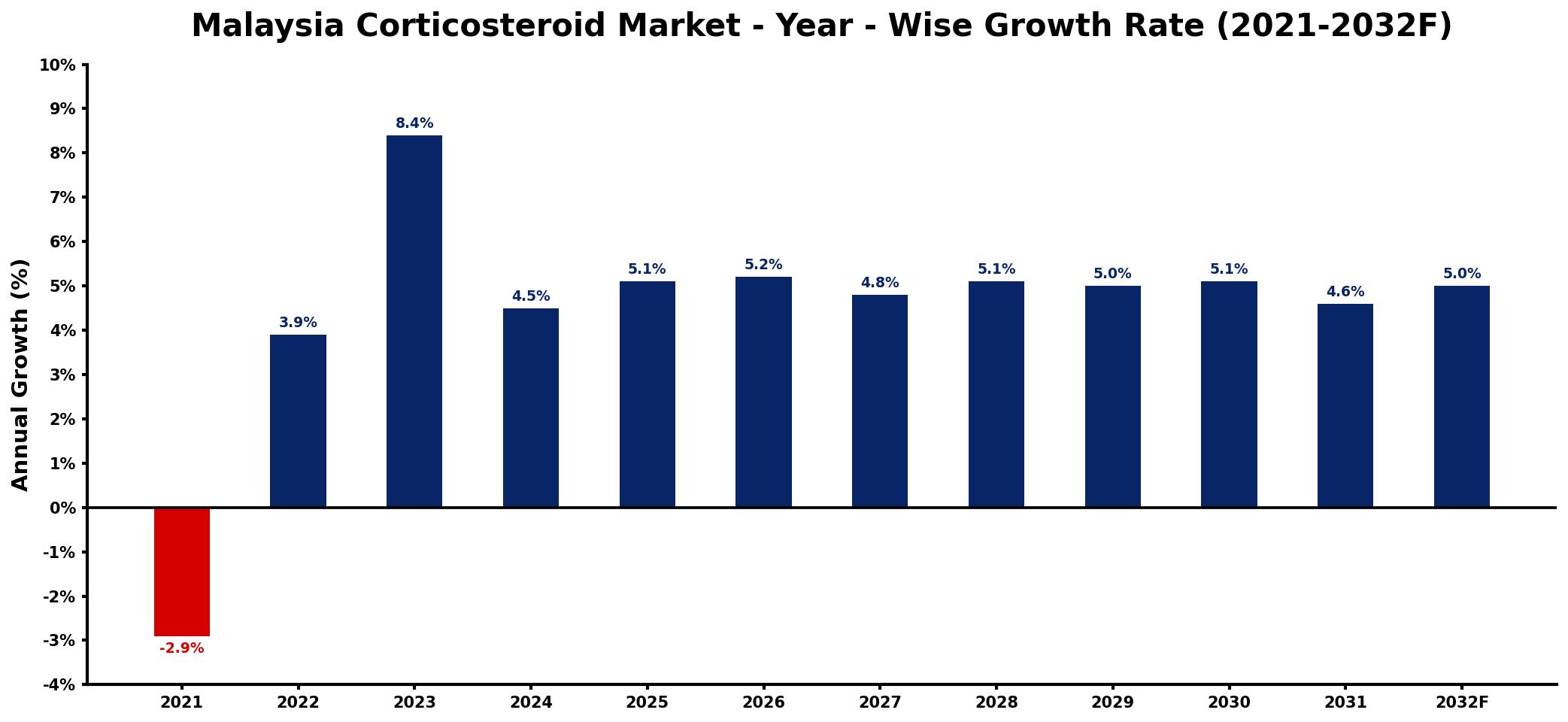
The table below presents the year‑wise growth rates along with the key drivers influencing the market
| Year | Growth Rate | Major Drivers |
| 2021 | -2.9% | decrease in healthcare spending allocations |
| 2022 | 3.9% | increased prevalence of chronic conditions |
| 2023 | 8.4% | growing investment in healthcare infrastructure |
| 2024 | 4.5% | expansion of telehealth services adoption |
| 2025 | 5.1% | rise in patient awareness programs |
| 2026 | 5.2% | development of advanced treatment protocols |
| 2027 | 4.8% | enhanced access to specialized care |
| 2028 | 5.1% | collaboration between healthcare stakeholders |
| 2029 | 5.0% | introduction of innovative treatment options |
| 2030 | 5.1% | rising demand from electronics |
| 2031 | 4.6% | increase in health insurance coverage |
| 2032 | 5.0% | growing focus on preventive healthcare |
Note: Market size estimations and growth projections presented in this report are based on 6Wresearch's proprietary forecasting methodology, utilizing the latest available industry data, government publications, and primary research inputs.
Malaysia Corticosteroid Market Synopsis
In Malaysia, the corticosteroid market is undergoing a significant transformation driven by an aging population and the prevalence of dermatological issues. These anti-inflammatory medications are commonly utilized in both medical and cosmetic applications, indicating a diverse demand landscape. As healthcare providers increasingly emphasize the management of chronic conditions, the role of corticosteroids is becoming more prominent.
The market is shaped by a blend of consumer awareness and the medical community's understanding of corticosteroids' benefits. As patients become more informed about treatment options, the demand for safe and effective corticosteroid formulations continues to rise. Nonetheless, this expansion is tempered by regulatory challenges and the need for ongoing research into the safety profiles of these drugs.
Malaysia Corticosteroid Market Key Takeaways
- The corticosteroid market is projected to experience steady growth driven by increasing healthcare access and awareness.
- Inflammatory and autoimmune diseases are significant contributors to the rising demand for corticosteroids in Malaysia.
- Regulatory hurdles and safety concerns surrounding corticosteroids may shape market dynamics going forward.
- Recent shifts in healthcare priorities following the COVID-19 pandemic are expected to influence market growth patterns.
- Cosmetic applications are becoming increasingly relevant in the corticosteroid landscape, broadening the scope of the market.
Evaluation of Restraints in Malaysia Corticosteroid Market
The Malaysian corticosteroid market faces several restraints that could impede its progress. Stringent regulatory requirements related to drug approval and marketing can slow down the introduction of new corticosteroid products into the market. Furthermore, growing concerns regarding the side effects associated with long-term corticosteroid use may lead to hesitancy among both patients and healthcare providers. These factors necessitate a focused approach from market players to ensure compliance while addressing safety concerns through continued research and innovation.
Malaysia Corticosteroid Market Trends
Several trends are shaping the corticosteroid market in Malaysia. The rise of telemedicine and digital health solutions is facilitating better access to dermatological consultations, leading to increased prescriptions of corticosteroids. Additionally, the emergence of novel formulations, including combination therapies that minimize side effects, is attracting interest from both consumers and healthcare professionals. These trends indicate a shift towards more personalized treatment approaches, underscoring the need for ongoing innovation in corticosteroid delivery systems.
Malaysia Corticosteroid Market Opportunities
There are substantial growth opportunities in the Malaysian corticosteroid market, particularly in the development of safer and more effective formulations. As awareness of dermatological health grows, investing in research and development for new corticosteroid applications, including non-traditional therapies, could yield significant returns. Furthermore, the potential for partnerships with local healthcare providers to enhance patient education and treatment compliance presents a promising avenue for market players.
Government Initiatives in the Malaysia Corticosteroid Market
The Malaysian government is increasingly focusing on improving healthcare access and quality, which includes addressing the treatment of skin disorders. Public health initiatives aimed at raising awareness about dermatological conditions and their treatment options are critical to fostering a supportive environment for the corticosteroid market. Furthermore, policies encouraging pharmaceutical innovation and research funding are expected to enhance the development and approval of new corticosteroid therapies.
Future Insights of the Malaysia Corticosteroid Market
Looking ahead to the 2026-2032 period, the Malaysia corticosteroid market is poised for steady growth, fueled by ongoing advancements in healthcare and a greater emphasis on preventive care. As the population continues to age and lifestyle-related skin conditions become more common, the demand for corticosteroids is likely to rise. Industry players will need to adapt to evolving regulatory environments and focus on enhancing safety and efficacy profiles to sustain their competitive edge.
Malaysia Corticosteroid Market Latest Developments (2025 - 2026)
Recent developments within the Malaysian corticosteroid market indicate a growing focus on addressing patient safety concerns. Pharmaceutical companies are launching initiatives to improve the transparency of corticosteroid formulations and their potential side effects. Concurrently, healthcare providers are enhancing their training on the use of corticosteroids, ensuring that patients receive informed and effective treatment options. Overall, these movements reflect a commitment to enhancing the quality of care in the corticosteroid domain.
Malaysia Corticosteroid Market - Key Attractiveness of the Report
- 10 Years of Market Numbers
- Historical Data Starting from 2022 to 2025
- Base Year: 2025
- Forecast Data until 2032
- Key Performance Indicators Impacting the Market
- Major Upcoming Developments and Projects
Key Highlights of the Report:
- Malaysia Corticosteroid Market Outlook
- Market Size of Malaysia Corticosteroid Market, 2025
- Forecast of Malaysia Corticosteroid Market, 2032
- Historical Data and Forecast of Malaysia Corticosteroid Revenues & Volume for the Period 2022-2032F
- Malaysia Corticosteroid Market Trend Evolution
- Malaysia Corticosteroid Market Drivers and Challenges
- Malaysia Corticosteroid Price Trends
- Malaysia Corticosteroid Porter's Five Forces
- Malaysia Corticosteroid Industry Life Cycle
- Historical Data and Forecast of Malaysia Corticosteroid Market Revenues & Volume By Product for the Period 2022-2032F
- Historical Data and Forecast of Malaysia Corticosteroid Market Revenues & Volume By Glucocorticoids for the Period 2022-2032F
- Historical Data and Forecast of Malaysia Corticosteroid Market Revenues & Volume By Mineralocorticoids for the Period 2022-2032F
- Historical Data and Forecast of Malaysia Corticosteroid Market Revenues & Volume By Administration for the Period 2022-2032F
- Historical Data and Forecast of Malaysia Corticosteroid Market Revenues & Volume By Topical Steroids for the Period 2022-2032F
- Historical Data and Forecast of Malaysia Corticosteroid Market Revenues & Volume By Inhaled Steroids for the Period 2022-2032F
- Historical Data and Forecast of Malaysia Corticosteroid Market Revenues & Volume By Oral Forms for the Period 2022-2032F
- Historical Data and Forecast of Malaysia Corticosteroid Market Revenues & Volume By Systemic Forms for the Period 2022-2032F
- Historical Data and Forecast of Malaysia Corticosteroid Market Revenues & Volume By Others for the Period 2022-2032F
- Historical Data and Forecast of Malaysia Corticosteroid Market Revenues & Volume By Application for the Period 2022-2032F
- Historical Data and Forecast of Malaysia Corticosteroid Market Revenues & Volume By Rheumatology Indications for the Period 2022-2032F
- Historical Data and Forecast of Malaysia Corticosteroid Market Revenues & Volume By Skin Allergies for the Period 2022-2032F
- Historical Data and Forecast of Malaysia Corticosteroid Market Revenues & Volume By Endocrinology for the Period 2022-2032F
- Historical Data and Forecast of Malaysia Corticosteroid Market Revenues & Volume By Gastroenterology for the Period 2022-2032F
- Historical Data and Forecast of Malaysia Corticosteroid Market Revenues & Volume By Acute Respiratory Diseases for the Period 2022-2032F
- Historical Data and Forecast of Malaysia Corticosteroid Market Revenues & Volume By Others for the Period 2022-2032F
- Malaysia Corticosteroid Import Export Trade Statistics
- Market Opportunity Assessment By Product
- Market Opportunity Assessment By Administration
- Market Opportunity Assessment By Application
- Malaysia Corticosteroid Top Companies Market Share
- Malaysia Corticosteroid Competitive Benchmarking By Technical and Operational Parameters
- Malaysia Corticosteroid Company Profiles
- Malaysia Corticosteroid Key Strategic Recommendations






































