Malaysia Critical Infrastructure Protection Market Size & Growth Rate (2026-2032)
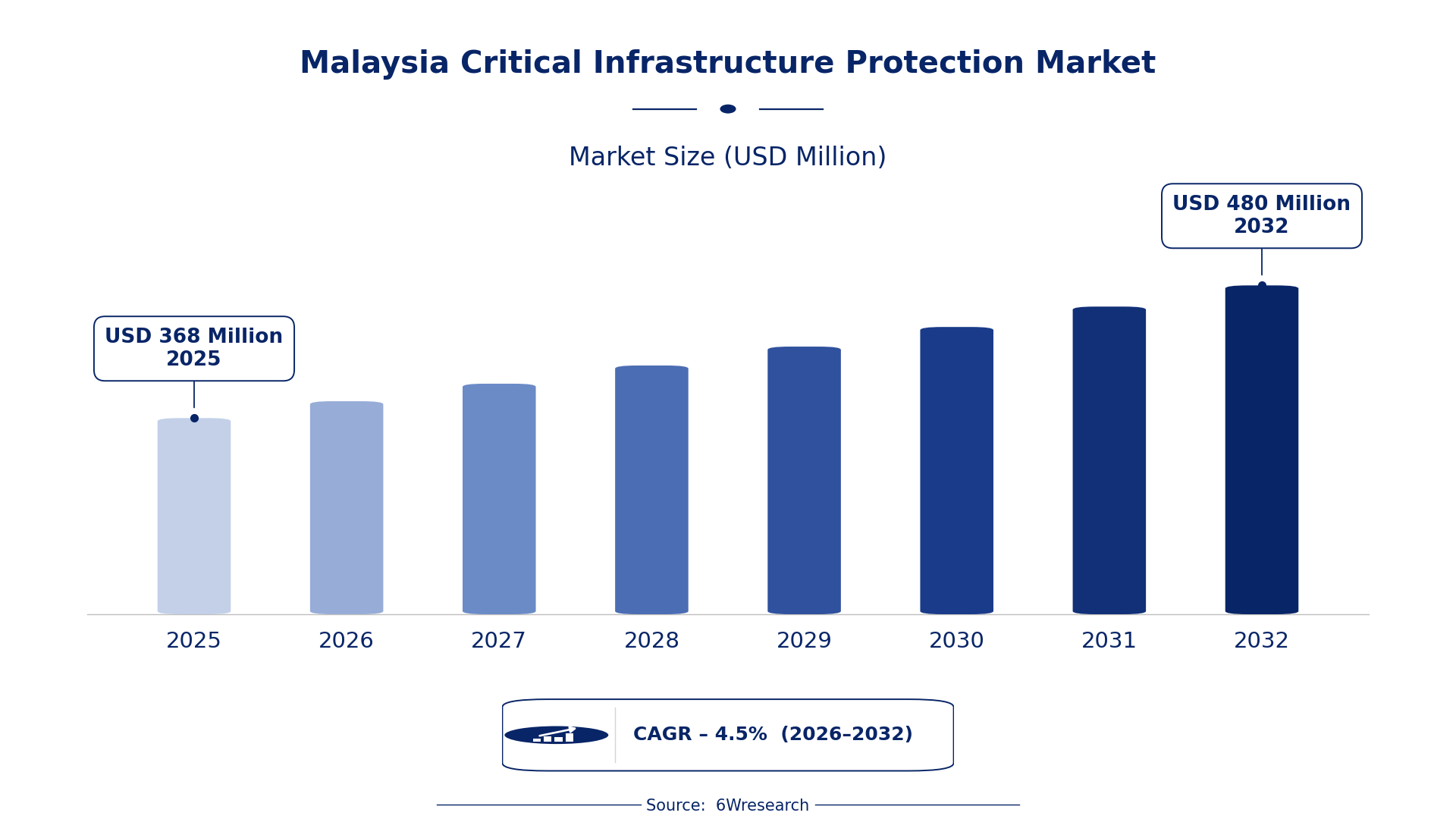
The Malaysia Critical Infrastructure Protection Market was estimated at USD 368 Million in 2025 and is projected to reach USD 480 Million by 2032, growing at a CAGR of 4.5% from 2026 to 2032.
Malaysia Critical Infrastructure Protection Market Synopsis
The Critical Infrastructure Protection market in Malaysia has seen significant growth, reflecting the nation’s increased focus on safeguarding essential services. With ongoing threats ranging from cyberattacks to physical sabotage, the demand for robust security measures has surged, leading to a flurry of investments aimed at enhancing resilience.
Looking ahead, the market is likely to evolve further, driven by advancing technologies and a heightened awareness of vulnerabilities across various sectors. Policymakers and businesses alike are recognizing that comprehensive protection strategies are essential for maintaining operational integrity in critical areas such as energy, transportation, and healthcare.
Malaysia Critical Infrastructure Protection Market Year-wise Growth Rate and Key Drivers
This graph illustrates the annual growth rates of the Malaysia Critical Infrastructure Protection Market from 2021 to 2032, highlighting a steady upward trajectory and projected expansion over the forecast period.
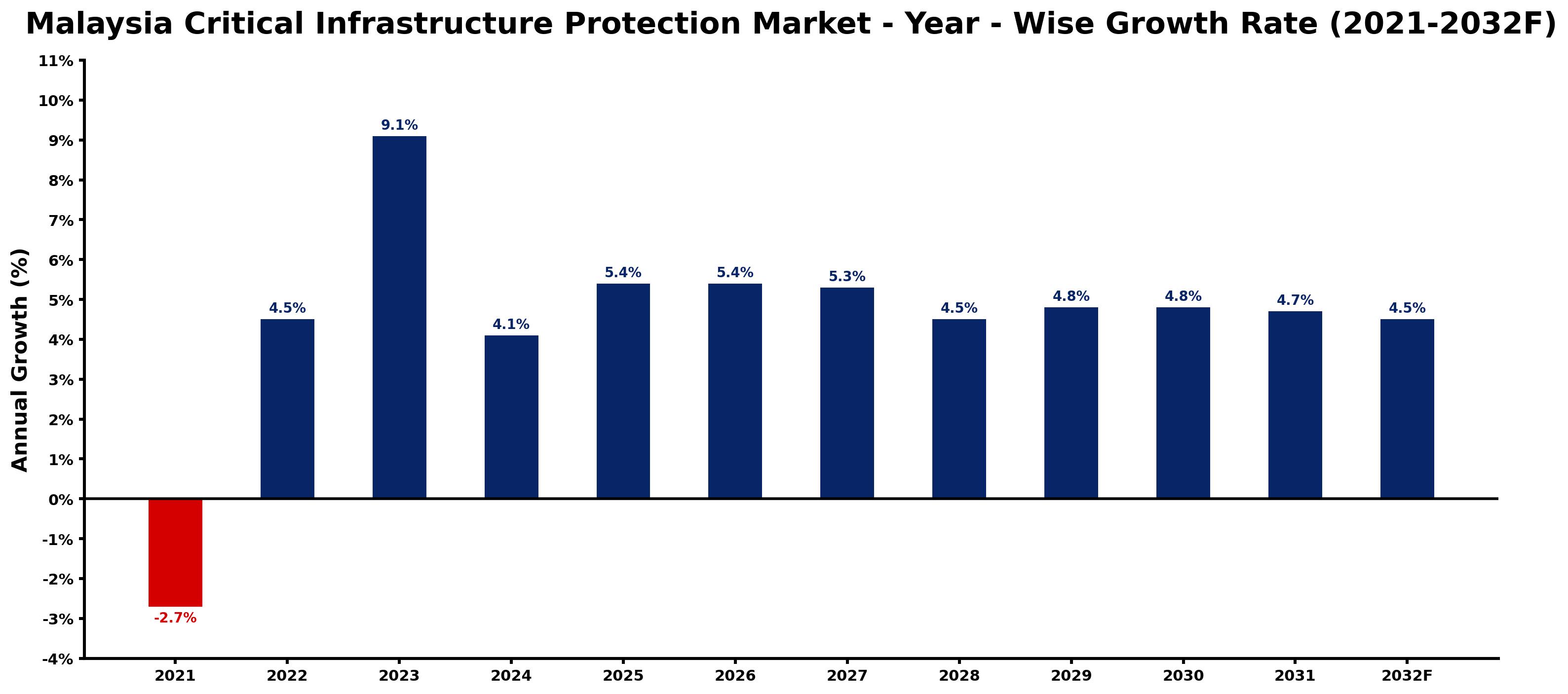
The table below presents the year‑wise growth rates along with the key drivers influencing the market
| Year | Growth Rate | Major Drivers |
| 2021 | -2.7% | Delayed government funding for infrastructure projects. |
| 2022 | 4.5% | Implementation of National Cyber Security Strategy enhancing protections. |
| 2023 | 9.1% | Rising incidents of cyber threats to national assets. |
| 2024 | 4.1% | Increased government budget allocation for infrastructure resilience. |
| 2025 | 5.4% | Strengthening regulations from CyberSecurity Malaysia for compliance. |
| 2026 | 5.4% | Launch of national initiatives addressing critical infrastructure vulnerabilities. |
| 2027 | 5.3% | Heightened awareness of physical security from recent attacks. |
| 2028 | 4.5% | Growing investment in surveillance technology for public safety. |
| 2029 | 4.8% | Partnerships between government and private sector for security solutions. |
| 2030 | 4.8% | Focus on securing transportation networks against potential threats. |
| 2031 | 4.7% | Local demand for enhanced energy grid security solutions. |
| 2032 | 4.5% | Emphasis on disaster recovery plans bolstering infrastructure security. |
Note: Market size estimations and growth projections presented in this report are based on 6Wresearch's proprietary forecasting methodology, utilizing the latest available industry data, government publications, and primary research inputs.
Malaysia Critical Infrastructure Protection Market Key Takeaways
Below are some of the specific key takeaways from the market, including:
- The market is increasingly influenced by government initiatives aimed at enhancing infrastructure security.
- Technological advancements, particularly in cybersecurity, are pivotal in shaping protection strategies.
- Awareness of vulnerabilities in critical sectors is driving demand for enhanced security measures.
- The ongoing evolution of threats necessitates continuous adaptation of protection strategies.
- Investment in disaster recovery solutions is critical for ensuring the reliability of essential services.
Evaluation of Restraints in Malaysia Critical Infrastructure Protection Market
Several factors are currently restraining the growth of the Critical Infrastructure Protection market in Malaysia. Coordination between public and private sectors remains a challenge, as varying priorities can lead to fragmented approaches. The lack of unified standards across industries creates inconsistencies in security measures. on top of that, organizations must keep pace with rapid technological advancements while managing budget constraints, which can limit their ability to implement comprehensive protective measures. These issues underscore the necessity for a more integrated framework to enhance overall security.
Malaysia Critical Infrastructure Protection Market Trends
Several trends are emerging in the Malaysia Critical Infrastructure Protection market. The integration of AI and machine learning in security protocols is gaining traction, enabling quicker identification and response to threats. Additionally, there’s a growing emphasis on data analytics to bolster decision-making in risk management. The shift towards a more interconnected infrastructure is also prompting organizations to consider comprehensive solutions that encompass both physical and cyber protection strategies. As a result, investments in training and awareness programs are becoming essential components of effective security plans.
Malaysia Critical Infrastructure Protection Market Opportunities
The potential for growth in this sector is considerable. The increasing reliance on technology presents a ripe opportunity for cybersecurity firms to introduce innovative solutions tailored for critical infrastructure. Additionally, the government's focus on infrastructure resilience creates avenues for public-private partnerships aimed at enhancing security measures. As threats become more sophisticated, there will be a corresponding demand for specialized services and technologies that cater to the unique challenges of safeguarding critical assets.
Government Initiatives in the Malaysia Critical Infrastructure Protection Market
Government policy is shaping the Malaysia Critical Infrastructure Protection market through a focus on enhancing the security of essential services. Recent initiatives reflect a commitment to increasing funding for protective measures and establishing frameworks for better coordination among sectors. Such efforts are vital in addressing vulnerabilities and ensuring that critical infrastructure remains resilient amidst growing threats.
- A national digital infrastructure upgrade programme that was completed in late 2023, enhancing cybersecurity measures across government facilities.
- Ongoing investment in a comprehensive cybersecurity training initiative aimed at public sector employees, expected to run through 2024.
- A planned regulatory framework to promote standardized security protocols in critical sectors, projected for rollout by 2026.
- Collaboration between various governmental agencies to create an integrated emergency response strategy that enhances coordination during crises, currently in the development phase.
- Upcoming policies to incentivize private-sector participation in critical infrastructure protection, expected to be introduced in 2025.
Future Insights of the Malaysia Critical Infrastructure Protection Market
As the Malaysia Critical Infrastructure Protection market approaches 2032, the emphasis on integrating advanced technologies will likely define its trajectory. Organizations will need to adopt proactive strategies to address evolving threats while ensuring compliance with regulatory standards. The growing interdependence of critical sectors will necessitate a collaborative approach, allowing stakeholders to share information and best practices. Ultimately, investment in innovative solutions and strategic partnerships will determine the resilience and effectiveness of Malaysia’s critical infrastructure.
Malaysia Critical Infrastructure Protection Market Latest Developments
In the past year, Malaysia has seen a surge in activity within the Critical Infrastructure Protection market. Organizations across various sectors are increasingly prioritizing security investments, prompting technology vendors to respond with new offerings. Collaborative efforts among private and public sectors are strengthening the market's foundation for future resilience.
- A major technology vendor launched a new cybersecurity platform tailored for critical infrastructure applications in Q3 2023, enhancing threat detection capabilities.
- An initiative aimed at integrating physical and cyber security measures within transportation hubs commenced in early 2024 and is currently ongoing.
- A service upgrade focused on disaster recovery solutions was completed in mid-2023, enhancing response times for critical sectors.
- A new partnership between regional operators and technology providers, aimed at improving surveillance capabilities, is expected to be finalized by late 2024.
- A forthcoming legislative review scheduled for early 2025 aims to streamline regulatory processes affecting critical infrastructure protection standards.
Malaysia Critical Infrastructure Protection Market - Key Attractiveness of the Report
- 10 Years of Market Numbers
- Historical Data Starting from 2022 to 2025
- Base Year: 2025
- Forecast Data until 2032
- Key Performance Indicators Impacting the Market
- Major Upcoming Developments and Projects
Key Highlights of the Report:
- Malaysia Critical Infrastructure Protection Market Outlook
- Market Size of Malaysia Critical Infrastructure Protection Market, 2025
- Forecast of Malaysia Critical Infrastructure Protection Market, 2032
- Historical Data and Forecast of Malaysia Critical Infrastructure Protection Revenues & Volume for the Period 2022-2032F
- Malaysia Critical Infrastructure Protection Market Trend Evolution
- Malaysia Critical Infrastructure Protection Market Drivers and Challenges
- Malaysia Critical Infrastructure Protection Price Trends
- Malaysia Critical Infrastructure Protection Porter's Five Forces
- Malaysia Critical Infrastructure Protection Industry Life Cycle
- Historical Data and Forecast of Malaysia Critical Infrastructure Protection Market Revenues & Volume By Solution for the Period 2022-2032F
- Historical Data and Forecast of Malaysia Critical Infrastructure Protection Market Revenues & Volume By Physical Safety for the Period 2022-2032F
- Historical Data and Forecast of Malaysia Critical Infrastructure Protection Market Revenues & Volume By Security Video Surveillance Systems for the Period 2022-2032F
- Historical Data and Forecast of Malaysia Critical Infrastructure Protection Market Revenues & Volume By Screening for the Period 2022-2032F
- Historical Data and Forecast of Malaysia Critical Infrastructure Protection Market Revenues & Volume By Scanning for the Period 2022-2032F
- Historical Data and Forecast of Malaysia Critical Infrastructure Protection Market Revenues & Volume By Cybersecurity for the Period 2022-2032F
- Historical Data and Forecast of Malaysia Critical Infrastructure Protection Market Revenues & Volume By Encryption for the Period 2022-2032F
- Historical Data and Forecast of Malaysia Critical Infrastructure Protection Market Revenues & Volume By Threat Intelligence for the Period 2022-2032F
- Historical Data and Forecast of Malaysia Critical Infrastructure Protection Market Revenues & Volume By Component for the Period 2022-2032F
- Historical Data and Forecast of Malaysia Critical Infrastructure Protection Market Revenues & Volume By Solution for the Period 2022-2032F
- Historical Data and Forecast of Malaysia Critical Infrastructure Protection Market Revenues & Volume By Services for the Period 2022-2032F
- Historical Data and Forecast of Malaysia Critical Infrastructure Protection Market Revenues & Volume By Vertical for the Period 2022-2032F
- Historical Data and Forecast of Malaysia Critical Infrastructure Protection Market Revenues & Volume By Financial Institutions for the Period 2022-2032F
- Historical Data and Forecast of Malaysia Critical Infrastructure Protection Market Revenues & Volume By Government for the Period 2022-2032F
- Historical Data and Forecast of Malaysia Critical Infrastructure Protection Market Revenues & Volume By Defense for the Period 2022-2032F
- Historical Data and Forecast of Malaysia Critical Infrastructure Protection Market Revenues & Volume By Transport and Logistics for the Period 2022-2032F
- Historical Data and Forecast of Malaysia Critical Infrastructure Protection Market Revenues & Volume By Energy and Power for the Period 2022-2032F
- Historical Data and Forecast of Malaysia Critical Infrastructure Protection Market Revenues & Volume By Commercial Sector for the Period 2022-2032F
- Historical Data and Forecast of Malaysia Critical Infrastructure Protection Market Revenues & Volume By Telecom for the Period 2022-2032F
- Historical Data and Forecast of Malaysia Critical Infrastructure Protection Market Revenues & Volume By Chemicals and Manufacturing for the Period 2022-2032F
- Malaysia Critical Infrastructure Protection Import Export Trade Statistics
- Market Opportunity Assessment By Solution
- Market Opportunity Assessment By Cybersecurity
- Market Opportunity Assessment By Component
- Market Opportunity Assessment By Vertical
- Malaysia Critical Infrastructure Protection Top Companies Market Share
- Malaysia Critical Infrastructure Protection Competitive Benchmarking By Technical and Operational Parameters
- Malaysia Critical Infrastructure Protection Company Profiles
- Malaysia Critical Infrastructure Protection Key Strategic Recommendations






































