Malaysia Crushed Stone Mining Market Size, Share & Growth Rate
The Malaysia Crushed Stone Mining Market was estimated at USD 438 Million in 2025 and is projected to reach USD 572 Million by 2032, growing at a CAGR of 3.9% from 2026 to 2032. This growth trajectory is predominantly driven by significant government investments in infrastructure projects and an ongoing trend of urbanization that fuels the demand for construction materials. As large-scale developments such as transportation networks and housing projects ramp up, the market is set to respond positively to these evolving demands.
Malaysia Crushed Stone Mining Market Year-wise Growth Rate and Key Drivers
This graph highlights how the Malaysia Crushed Stone Mining Market has steadily grown over the years, supported by major growth factors.
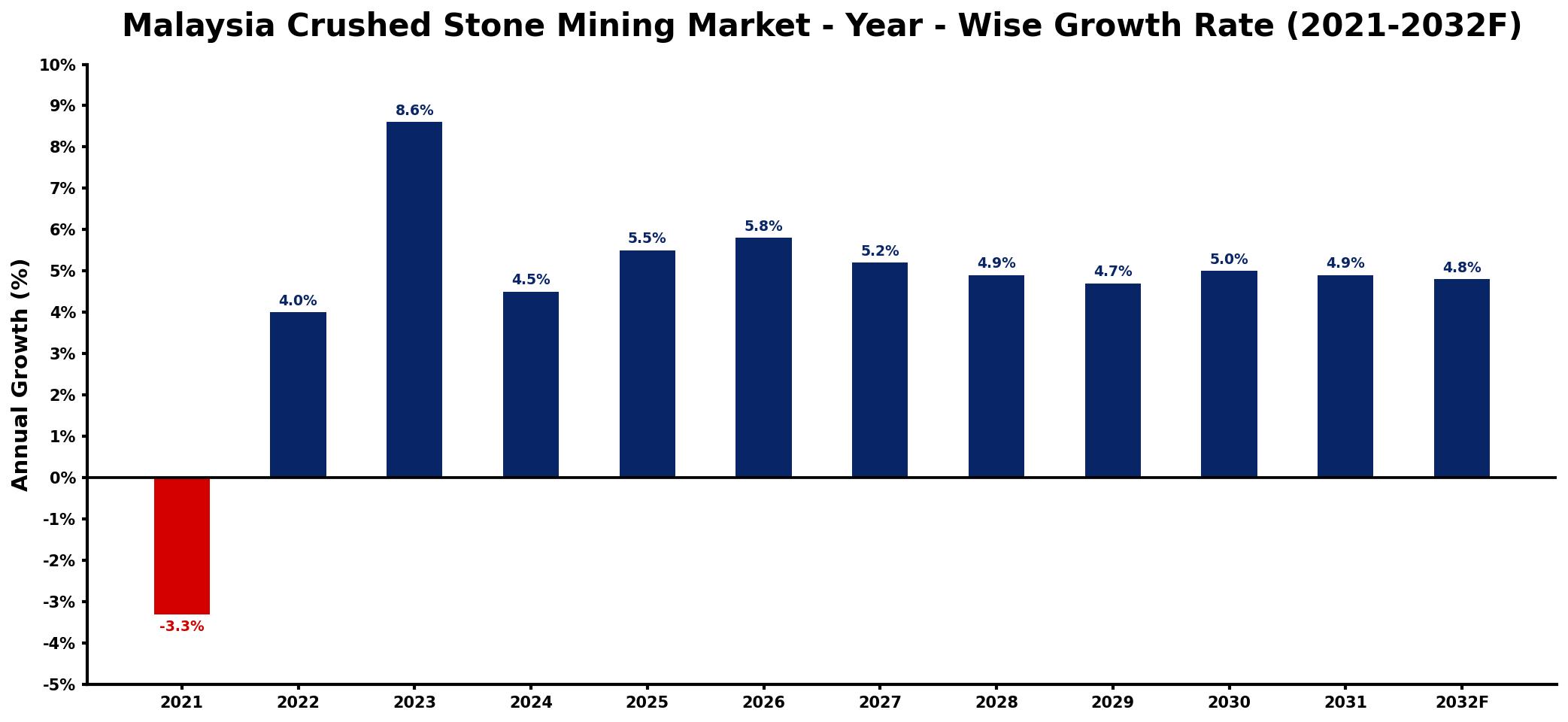
The table below presents the year‑wise growth rates along with the key drivers influencing the market
| Year | Growth Rate | Major Drivers |
| 2021 | -3.3% | decreased construction project funding |
| 2022 | 4.0% | rising infrastructure development projects |
| 2023 | 8.6% | increased demand from construction |
| 2024 | 4.5% | growing urbanization trends nationwide |
| 2025 | 5.5% | expansion in transportation infrastructure |
| 2026 | 5.8% | increased residential building activity |
| 2027 | 5.2% | strengthened regional construction initiatives |
| 2028 | 4.9% | higher public sector investments |
| 2029 | 4.7% | renewed focus on sustainability efforts |
| 2030 | 5.0% | growing industrial manufacturing needs |
| 2031 | 4.9% | expanding commercial real estate sector |
| 2032 | 4.8% | rising end-use demand growth |
Note: Market size estimations and growth projections presented in this report are based on 6Wresearch's proprietary forecasting methodology, utilizing the latest available industry data, government publications, and primary research inputs.
Malaysia Crushed Stone Mining Market Synopsis
The crushed stone mining sector in Malaysia is on a growth path, buoyed by the expanding construction industry that demands high-quality aggregates for infrastructure development. This pivotal segment of the economy relies heavily on crushed stone for various applications, from road construction to foundational support for urban buildings.
In recent years, the market has witnessed fluctuations due to external factors such as the COVID-19 pandemic, which temporarily slowed construction activities. Nevertheless, recovery is underway, driven by government initiatives aimed at revitalizing the economy through infrastructure enhancement and urban planning projects, positioning the crushed stone mining market for robust growth.
Malaysia Crushed Stone Mining Market Key Takeaways
- The market is experiencing a resurgence as construction activities rebound post-COVID-19.
- Government infrastructure projects, such as highways and urban developments, are key demand drivers.
- Environmental sustainability is a growing focus, prompting a shift towards responsible mining practices.
- Investment in large-scale projects is expected to offer substantial growth opportunities.
- Export potential to neighboring countries could further enhance market prospects.
Evaluation of Restraints in Malaysia Crushed Stone Mining Market
Despite the positive outlook, the Malaysia crushed stone mining market faces several constraints that can hinder its growth. Environmental sustainability remains a pressing issue; mining operations often pose threats to local ecosystems, resulting in habitat degradation and water quality concerns. Regulatory frameworks have tightened in response to these issues, necessitating mining companies to invest in sustainable practices and effective rehabilitation strategies. Additionally, demand volatility, influenced by fluctuating construction project timelines, can create uncertainty for industry stakeholders.
Malaysia Crushed Stone Mining Market Trends
Several trends are shaping the Malaysian crushed stone mining landscape. A notable shift towards eco-friendly practices is emerging, with companies increasingly adopting green mining technologies that minimize environmental impact. Furthermore, technological advancements in extraction and processing methods are improving efficiency and reducing costs. The integration of digital solutions, including data analytics for operational optimization, is also becoming common, enhancing decision-making processes across the sector.
Malaysia Crushed Stone Mining Market Opportunities
The future of the Malaysia crushed stone mining market presents several lucrative opportunities for growth and investment. The ongoing infrastructure boom, characterized by ambitious projects like the East Coast Rail Link and Pan Borneo Highway, promises sustained demand for aggregates. Furthermore, local miners may benefit from exporting crushed stone aggregates to regional markets, tapping into the increasing demand from neighboring countries as they embark on their own development projects. These avenues are poised to attract both local and foreign investment, fostering a competitive environment in the industry.
Government Initiatives in the Malaysia Crushed Stone Mining Market
The Malaysian government plays a crucial role in shaping the crushed stone mining market through various initiatives aimed at bolstering infrastructure development. Policies promoting sustainable mining practices are gaining traction, encouraging companies to adopt environmentally responsible methods. Furthermore, public spending on infrastructure projects continues to rise, providing a stable foundation for market growth. Government programs focused on urban development and transportation improvements are set to drive demand for crushed stone, ensuring the sector remains integral to the country's economic landscape.
Future Insights of the Malaysia Crushed Stone Mining Market
Looking ahead, the Malaysia crushed stone mining market is positioned for steady growth from 2026 to 2032. The successful execution of key infrastructure projects will likely stimulate demand, making it essential for companies to adapt to market trends, including sustainability and technological advancements. The government's commitment to enhancing transportation networks and urban infrastructure will further solidify the role of crushed stone in supporting Malaysia's economic ambitions, paving the way for sustained market development.
Malaysia Crushed Stone Mining Market Latest Developments (2025 - 2026)
In the recent months, the Malaysia crushed stone mining market has seen an uptick in activities as construction projects gain momentum post-pandemic. Companies are increasingly collaborating on large-scale initiatives, while new regulatory frameworks are introduced to ensure environmentally sustainable practices. Additionally, technological innovations in extraction methods are being integrated, leading to enhanced operational efficiency and lower environmental impacts, setting the stage for a more resilient market.
Malaysia Crushed Stone Mining Market - Key Attractiveness of the Report
- 10 Years of Market Numbers
- Historical Data Starting from 2022 to 2025
- Base Year: 2025
- Forecast Data until 2032
- Key Performance Indicators Impacting the Market
- Major Upcoming Developments and Projects
Key Highlights of the Report:
- Malaysia Crushed Stone Mining Market Outlook
- Market Size of Malaysia Crushed Stone Mining Market, 2025
- Forecast of Malaysia Crushed Stone Mining Market, 2032
- Historical Data and Forecast of Malaysia Crushed Stone Mining Revenues & Volume for the Period 2022-2032F
- Malaysia Crushed Stone Mining Market Trend Evolution
- Malaysia Crushed Stone Mining Market Drivers and Challenges
- Malaysia Crushed Stone Mining Price Trends
- Malaysia Crushed Stone Mining Porter's Five Forces
- Malaysia Crushed Stone Mining Industry Life Cycle
- Historical Data and Forecast of Malaysia Crushed Stone Mining Market Revenues & Volume By Type for the Period 2022-2032F
- Historical Data and Forecast of Malaysia Crushed Stone Mining Market Revenues & Volume By Limestone Mining for the Period 2022-2032F
- Historical Data and Forecast of Malaysia Crushed Stone Mining Market Revenues & Volume By Granite Mining for the Period 2022-2032F
- Historical Data and Forecast of Malaysia Crushed Stone Mining Market Revenues & Volume By Others for the Period 2022-2032F
- Historical Data and Forecast of Malaysia Crushed Stone Mining Market Revenues & Volume By Application for the Period 2022-2032F
- Historical Data and Forecast of Malaysia Crushed Stone Mining Market Revenues & Volume By Industrial for the Period 2022-2032F
- Historical Data and Forecast of Malaysia Crushed Stone Mining Market Revenues & Volume By Manufacture for the Period 2022-2032F
- Historical Data and Forecast of Malaysia Crushed Stone Mining Market Revenues & Volume By Construction for the Period 2022-2032F
- Historical Data and Forecast of Malaysia Crushed Stone Mining Market Revenues & Volume By Engineering for the Period 2022-2032F
- Historical Data and Forecast of Malaysia Crushed Stone Mining Market Revenues & Volume By Others for the Period 2022-2032F
- Malaysia Crushed Stone Mining Import Export Trade Statistics
- Market Opportunity Assessment By Type
- Market Opportunity Assessment By Application
- Malaysia Crushed Stone Mining Top Companies Market Share
- Malaysia Crushed Stone Mining Competitive Benchmarking By Technical and Operational Parameters
- Malaysia Crushed Stone Mining Company Profiles
- Malaysia Crushed Stone Mining Key Strategic Recommendations






































