Malaysia Cultured Meat Market Size, Share & Growth Rate
The Malaysia Cultured Meat Market was estimated at USD 479 Million in 2025 and is projected to reach USD 620 Million by 2032, growing at a CAGR of 3.8% from 2026 to 2032. This growth trajectory is primarily driven by an increasing consumer awareness of sustainability and animal welfare issues, leading to a stronger demand for cruelty-free and environmentally-friendly protein sources. As Malaysia navigates its food security challenges and environmental concerns, the potential for cultured meat to address these issues places it at the forefront of the evolving food landscape.
Malaysia Cultured Meat Market Year-wise Growth Rate and Key Drivers
This graph highlights how the Malaysia Cultured Meat Market has steadily grown over the years, supported by major growth factors.
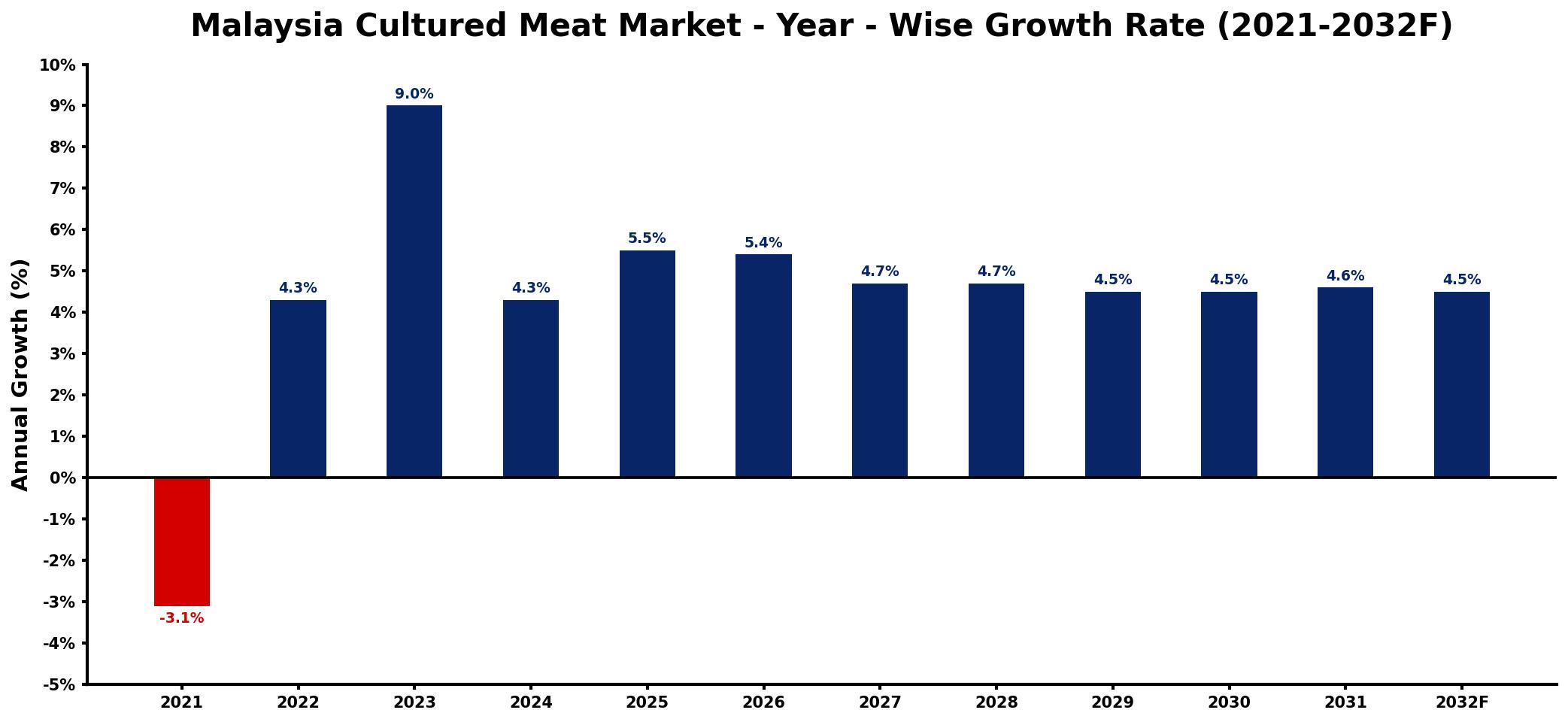
The table below presents the year‑wise growth rates along with the key drivers influencing the market
| Year | Growth Rate | Major Drivers |
| 2021 | -3.1% | Consumer interest in alternatives declines |
| 2022 | 4.3% | Rising investments in biotechnology sector |
| 2023 | 9.0% | Growing demand for sustainable options |
| 2024 | 4.3% | Increase in health-conscious consumers |
| 2025 | 5.5% | Expansion of production facilities planned |
| 2026 | 5.4% | Enhanced regulatory support for innovations |
| 2027 | 4.7% | Growing partnerships with food retailers |
| 2028 | 4.7% | Emerging technologies driving efficiency improvements |
| 2029 | 4.5% | Increased awareness of environmental impacts |
| 2030 | 4.5% | Strengthened consumer advocacy for alternatives |
| 2031 | 4.6% | Broader acceptance in culinary applications |
| 2032 | 4.5% | Rising global market opportunities identified |
Note: Market size estimations and growth projections presented in this report are based on 6Wresearch's proprietary forecasting methodology, utilizing the latest available industry data, government publications, and primary research inputs.
Malaysia Cultured Meat Market Synopsis
The most significant force shaping the Malaysia Cultured Meat Market right now is the rising consumer consciousness around ethical food choices. With many Malaysians becoming increasingly aware of the sustainability implications of traditional meat production, the interest in cultured meat is poised to grow. This sentiment is further supported by a push for innovation in the food sector, fostering an environment conducive to alternative protein sources.
As the market begins to mature, the pace of adoption will depend heavily on regulatory frameworks and consumer acceptance. The present nascent stage allows for the exploration of creative solutions in production and marketing strategies, setting the foundation for future growth in both urban and rural sectors across the country.
Malaysia Cultured Meat Market Key Takeaways
- The cultured meat market is experiencing a shift driven by consumer demand for sustainable and ethical alternatives.
- Regulatory frameworks and consumer acceptance play critical roles in determining market growth and expansion.
- As environmental concerns become more prominent, cultured meat is likely to become a staple in the Malaysian diet.
- Competition with traditional meat sources remains a challenge, impacting pricing and market penetration.
- Investment in production technology will be essential for scalability and cost-effectiveness.
Evaluation of Restraints in Malaysia Cultured Meat Market
Despite the promising landscape, several restraints hinder the rapid growth of the Malaysia Cultured Meat Market. A significant barrier is the regulatory landscape, where stringent approval processes can delay market entry for new products. Additionally, consumer acceptance poses a challenge; traditional meat consumption patterns are deeply rooted in Malaysian culture, which may lead to hesitation in embracing lab-grown alternatives. Lastly, production scalability and high initial costs also contribute to market barriers that need addressing for long-term success.
Malaysia Cultured Meat Market Trends
Several trends are shaping the Malaysia Cultured Meat Market today. A major trend is the increased collaboration between startups and established food corporations, fostering innovation in product development. Furthermore, health-conscious consumers are seeking transparency and clean labels, prompting cultured meat companies to focus on nutrition and ingredient sourcing. Lastly, the advent of plant-based and hybrid products is gaining traction, reflecting a broader trend towards diversifying protein sources to appeal to various consumer preferences.
Malaysia Cultured Meat Market Opportunities
There is significant potential for growth and investment within the Malaysia Cultured Meat Market. With rising demand for sustainable protein, companies can explore partnerships with foodservice providers and retailers to enhance product visibility. There is also an opportunity for educational campaigns aimed at consumers to raise awareness about the benefits of cultured meat, potentially accelerating acceptance. Additionally, as technology advances, reducing production costs will open the door to broader market penetration.
Government Initiatives in the Malaysia Cultured Meat Market
The Malaysian government has begun to recognize the importance of sustainable food practices, contributing to initiatives aimed at bolstering the cultured meat sector. Efforts include exploring funding opportunities for research and development in innovative food technologies, along with potential subsidies to support local startups in this field. Moreover, there is ongoing dialogue regarding the establishment of regulatory frameworks that would facilitate the approval processes for lab-grown meat products, thereby ensuring food safety while promoting innovation.
Future Insights of the Malaysia Cultured Meat Market
Looking forward to 2026-2032, the Malaysia Cultured Meat Market is expected to witness gradual but steady growth. As consumer attitudes shift towards more sustainable eating habits, demand for cultured meat will likely increase. Advancements in technology will not only enhance production efficiency but also improve product quality, thus driving consumer acceptance. With supportive government policies and increased investment in R&D, the market is well-positioned to evolve into a vital part of the Malaysian food landscape.
Malaysia Cultured Meat Market Latest Developments (2025 - 2026)
Recent developments in the Malaysia Cultured Meat Market indicate a growing interest from both consumers and investors alike. There have been notable collaborations between local startups and research institutions to expedite the development of lab-grown meat technologies. Efforts to raise awareness around sustainable food options are also on the rise, as various campaigns aim to educate consumers about the benefits of cultured meat. Additionally, the regulatory landscape is evolving, with discussions centered on creating clearer guidelines for market entry.
Malaysia Cultured Meat Market - Key Attractiveness of the Report
- 10 Years of Market Numbers
- Historical Data Starting from 2022 to 2025
- Base Year: 2025
- Forecast Data until 2032
- Key Performance Indicators Impacting the Market
- Major Upcoming Developments and Projects
Key Highlights of the Report:
- Malaysia Cultured Meat Market Outlook
- Market Size of Malaysia Cultured Meat Market, 2025
- Forecast of Malaysia Cultured Meat Market, 2032
- Historical Data and Forecast of Malaysia Cultured Meat Revenues & Volume for the Period 2022-2032F
- Malaysia Cultured Meat Market Trend Evolution
- Malaysia Cultured Meat Market Drivers and Challenges
- Malaysia Cultured Meat Price Trends
- Malaysia Cultured Meat Porter's Five Forces
- Malaysia Cultured Meat Industry Life Cycle
- Historical Data and Forecast of Malaysia Cultured Meat Market Revenues & Volume By Product Type for the Period 2022-2032F
- Historical Data and Forecast of Malaysia Cultured Meat Market Revenues & Volume By Poultry for the Period 2022-2032F
- Historical Data and Forecast of Malaysia Cultured Meat Market Revenues & Volume By Beef for the Period 2022-2032F
- Historical Data and Forecast of Malaysia Cultured Meat Market Revenues & Volume By Seafood for the Period 2022-2032F
- Historical Data and Forecast of Malaysia Cultured Meat Market Revenues & Volume By Pork for the Period 2022-2032F
- Historical Data and Forecast of Malaysia Cultured Meat Market Revenues & Volume By Duck for the Period 2022-2032F
- Historical Data and Forecast of Malaysia Cultured Meat Market Revenues & Volume By End-Use for the Period 2022-2032F
- Historical Data and Forecast of Malaysia Cultured Meat Market Revenues & Volume By Nuggets for the Period 2022-2032F
- Historical Data and Forecast of Malaysia Cultured Meat Market Revenues & Volume By Burgers for the Period 2022-2032F
- Historical Data and Forecast of Malaysia Cultured Meat Market Revenues & Volume By Meatballs for the Period 2022-2032F
- Historical Data and Forecast of Malaysia Cultured Meat Market Revenues & Volume By Sausage for the Period 2022-2032F
- Historical Data and Forecast of Malaysia Cultured Meat Market Revenues & Volume By Hot dogs for the Period 2022-2032F
- Historical Data and Forecast of Malaysia Cultured Meat Market Revenues & Volume By Others for the Period 2022-2032F
- Malaysia Cultured Meat Import Export Trade Statistics
- Market Opportunity Assessment By Product Type
- Market Opportunity Assessment By End-Use
- Malaysia Cultured Meat Top Companies Market Share
- Malaysia Cultured Meat Competitive Benchmarking By Technical and Operational Parameters
- Malaysia Cultured Meat Company Profiles
- Malaysia Cultured Meat Key Strategic Recommendations






































