Malaysia Curtains and Window Blinds Market Size, Share & Growth Rate
The Malaysia Curtains and Window Blinds Market was estimated at USD 1463 Million in 2025 and is projected to reach USD 2204 Million by 2032, growing at a CAGR of 6.0% from 2026 to 2032. This growth is primarily fueled by rapid urbanization and the booming real estate sector, which is transforming living spaces into more aesthetic and functional environments. Additionally, the rise in consumer preferences for stylish and energy-efficient window treatments further propels demand in this dynamic market.
Malaysia Curtains and Window Blinds Market Year-wise Growth Rate and Key Drivers
This graph highlights how the Malaysia Curtains and Window Blinds Market has steadily grown over the years, supported by major growth factors.
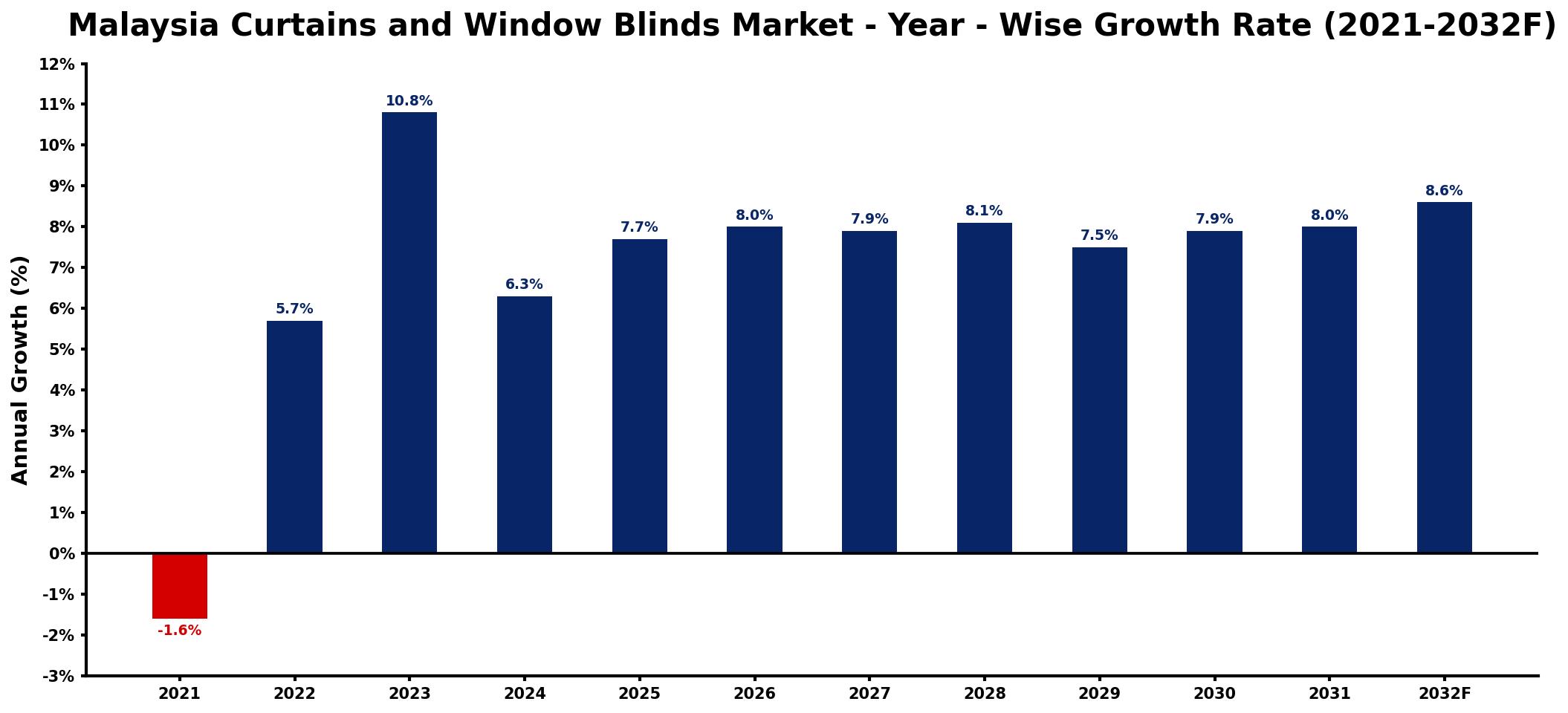
The table below presents the year‑wise growth rates along with the key drivers influencing the market
| Year | Growth Rate | Major Drivers |
| 2021 | -1.6% | decreased consumer spending on home |
| 2022 | 5.7% | increased demand for home decor |
| 2023 | 10.8% | growing residential construction activities |
| 2024 | 6.3% | rise in interior design trends |
| 2025 | 7.7% | expansion of online retail platforms |
| 2026 | 8.0% | increased disposable income levels |
| 2027 | 7.9% | growing interest in smart homes |
| 2028 | 8.1% | surge in urban population growth |
| 2029 | 7.5% | increased focus on sustainability initiatives |
| 2030 | 7.9% | rising consumer awareness on aesthetics |
| 2031 | 8.0% | growing demand for customization options |
| 2032 | 8.6% | growing downstream application demand |
Note: Market size estimations and growth projections presented in this report are based on 6Wresearch's proprietary forecasting methodology, utilizing the latest available industry data, government publications, and primary research inputs.
Malaysia Curtains and Window Blinds Market Synopsis
As urbanization continues to reshape Malaysias landscape, the curtains and window blinds market is evolving alongside it, reflecting changing consumer lifestyles. The demand for attractive and practical interior solutions is driving manufacturers to innovate in terms of materials, designs, and technology.
The impact of the COVID-19 pandemic has also reshaped the market dynamics. With more individuals investing in home improvement projects while spending increased time at home, there's been a significant uptick in the demand for high-quality window treatments. The market's outlook is optimistic, as consumers look for ways to enhance their living spaces.
Malaysia Curtains and Window Blinds Market Key Takeaways
- The market is experiencing robust growth driven by urbanization and a booming real estate sector.
- Innovative designs and smart technology integration are becoming essential for manufacturers to compete effectively.
- Consumer preferences are shifting towards aesthetic and energy-efficient window treatment solutions.
- COVID-19 accelerated home improvement trends, positively impacting demand for curtains and blinds.
- Digital marketing and e-commerce are crucial for businesses aiming to reach a wider customer base.
Evaluation of Restraints in Malaysia Curtains and Window Blinds Market
Despite the growth potential, the curtains and window blinds market faces several restraints. Customization demands can challenge manufacturers, as consumers increasingly seek personalized solutions tailored to their specific needs. Additionally, pricing pressures from competition can create hurdles in maintaining profitability. Companies must navigate these challenges effectively while striving to innovate and meet customer expectations.
Malaysia Curtains and Window Blinds Market Trends
Current trends in the Malaysian curtains and window blinds market are leaning heavily toward the adoption of smart technologies, enabling consumers to control their window treatments remotely. Sustainability is also gaining traction, with eco-friendly materials and energy-efficient designs becoming preferred choices among environmentally conscious consumers. Furthermore, the influence of contemporary and minimalist interior design styles is pushing manufacturers to create sleek, functional, and aesthetically pleasing products.
Malaysia Curtains and Window Blinds Market Opportunities
The market presents significant growth opportunities, especially for businesses that can leverage emerging technologies and consumer trends. As the demand for energy-efficient products rises, manufacturers have the potential to innovate by integrating smart features into their designs. Additionally, the growing trend of online shopping opens up new channels for reaching customers, enabling brands to expand their market presence effectively.
Government Initiatives in the Malaysia Curtains and Window Blinds Market
The Malaysian government continues to support the construction and home improvement sectors through various initiatives, including incentives for energy-efficient home upgrades. Policies aimed at promoting sustainability and environmental awareness further encourage consumers to invest in eco-friendly window treatment solutions. Such government support plays a crucial role in shaping the market landscape.
Future Insights of the Malaysia Curtains and Window Blinds Market
Looking ahead to 2026-2032, the Malaysian curtains and window blinds market is poised for continued expansion. Driven by urbanization and a persistent focus on interior design aesthetics, demand is expected to remain strong. Moreover, the integration of smart technologies and sustainable practices will likely be key factors in maintaining competitive advantages. The market is anticipated to evolve, presenting opportunities for companies willing to innovate and adapt to changing consumer preferences.
Malaysia Curtains and Window Blinds Market Latest Developments (2025 - 2026)
Recent developments in the Malaysian curtains and window blinds market indicate a significant shift towards digital channels as brands enhance their online presence. Many manufacturers are exploring collaborations with interior design platforms to showcase their products effectively. Additionally, ongoing innovations in materials and technology are being rolled out, aligning with the increasing consumer demand for smart home solutions.
Malaysia Curtains and Window Blinds Market - Key Attractiveness of the Report
- 10 Years of Market Numbers
- Historical Data Starting from 2022 to 2025
- Base Year: 2025
- Forecast Data until 2032
- Key Performance Indicators Impacting the Market
- Major Upcoming Developments and Projects
Key Highlights of the Report:
- Malaysia Curtains and Window Blinds Market Outlook
- Market Size of Malaysia Curtains and Window Blinds Market, 2025
- Forecast of Malaysia Curtains and Window Blinds Market, 2032
- Historical Data and Forecast of Malaysia Curtains and Window Blinds Revenues & Volume for the Period 2022-2032F
- Malaysia Curtains and Window Blinds Market Trend Evolution
- Malaysia Curtains and Window Blinds Market Drivers and Challenges
- Malaysia Curtains and Window Blinds Price Trends
- Malaysia Curtains and Window Blinds Porter's Five Forces
- Malaysia Curtains and Window Blinds Industry Life Cycle
- Historical Data and Forecast of Malaysia Curtains and Window Blinds Market Revenues & Volume By Materials for the Period 2022-2032F
- Historical Data and Forecast of Malaysia Curtains and Window Blinds Market Revenues & Volume By Curtains (Cotton, Linen, Polyester) for the Period 2022-2032F
- Historical Data and Forecast of Malaysia Curtains and Window Blinds Market Revenues & Volume By Window Blinds (Cotton, Linen, Wood, PVC, Metal) for the Period 2022-2032F
- Historical Data and Forecast of Malaysia Curtains and Window Blinds Market Revenues & Volume By Product for the Period 2022-2032F
- Historical Data and Forecast of Malaysia Curtains and Window Blinds Market Revenues & Volume By Curtains (Box pleat curtains, Pinch pleat curtains & drapery, Goblet pleat curtains & drapery, Eyelet curtains & drapery) for the Period 2022-2032F
- Historical Data and Forecast of Malaysia Curtains and Window Blinds Market Revenues & Volume By Window Blinds (Window Shades,, Window Screens, Connected) for the Period 2022-2032F
- Historical Data and Forecast of Malaysia Curtains and Window Blinds Market Revenues & Volume By Distribution Channel for the Period 2022-2032F
- Historical Data and Forecast of Malaysia Curtains and Window Blinds Market Revenues & Volume By B2B for the Period 2022-2032F
- Historical Data and Forecast of Malaysia Curtains and Window Blinds Market Revenues & Volume By B2C for the Period 2022-2032F
- Historical Data and Forecast of Malaysia Curtains and Window Blinds Market Revenues & Volume By E-commerce for the Period 2022-2032F
- Historical Data and Forecast of Malaysia Curtains and Window Blinds Market Revenues & Volume By Price Range for the Period 2022-2032F
- Historical Data and Forecast of Malaysia Curtains and Window Blinds Market Revenues & Volume By High for the Period 2022-2032F
- Historical Data and Forecast of Malaysia Curtains and Window Blinds Market Revenues & Volume By Medium for the Period 2022-2032F
- Historical Data and Forecast of Malaysia Curtains and Window Blinds Market Revenues & Volume By Low for the Period 2022-2032F
- Malaysia Curtains and Window Blinds Import Export Trade Statistics
- Market Opportunity Assessment By Materials
- Market Opportunity Assessment By Product
- Market Opportunity Assessment By Distribution Channel
- Market Opportunity Assessment By Price Range
- Malaysia Curtains and Window Blinds Top Companies Market Share
- Malaysia Curtains and Window Blinds Competitive Benchmarking By Technical and Operational Parameters
- Malaysia Curtains and Window Blinds Company Profiles
- Malaysia Curtains and Window Blinds Key Strategic Recommendations






































