Malaysia Cutting Equipment Market Size, Share & Growth Rate
The Malaysia Cutting Equipment Market was estimated at USD 469 Million in 2025 and is projected to reach USD 617 Million by 2032, growing at a CAGR of 4.0% from 2026 to 2032. This growth trajectory is primarily driven by the burgeoning manufacturing sector, which is witnessing increasing demands for advanced machinery that ensures precision and efficiency. Additionally, the ongoing technological advancements and a focus on automation across industries such as automotive and aerospace further bolster the market's potential.
Malaysia Cutting Equipment Market Year-wise Growth Rate and Key Drivers
This graph highlights how the Malaysia Cutting Equipment Market has steadily grown over the years, supported by major growth factors.
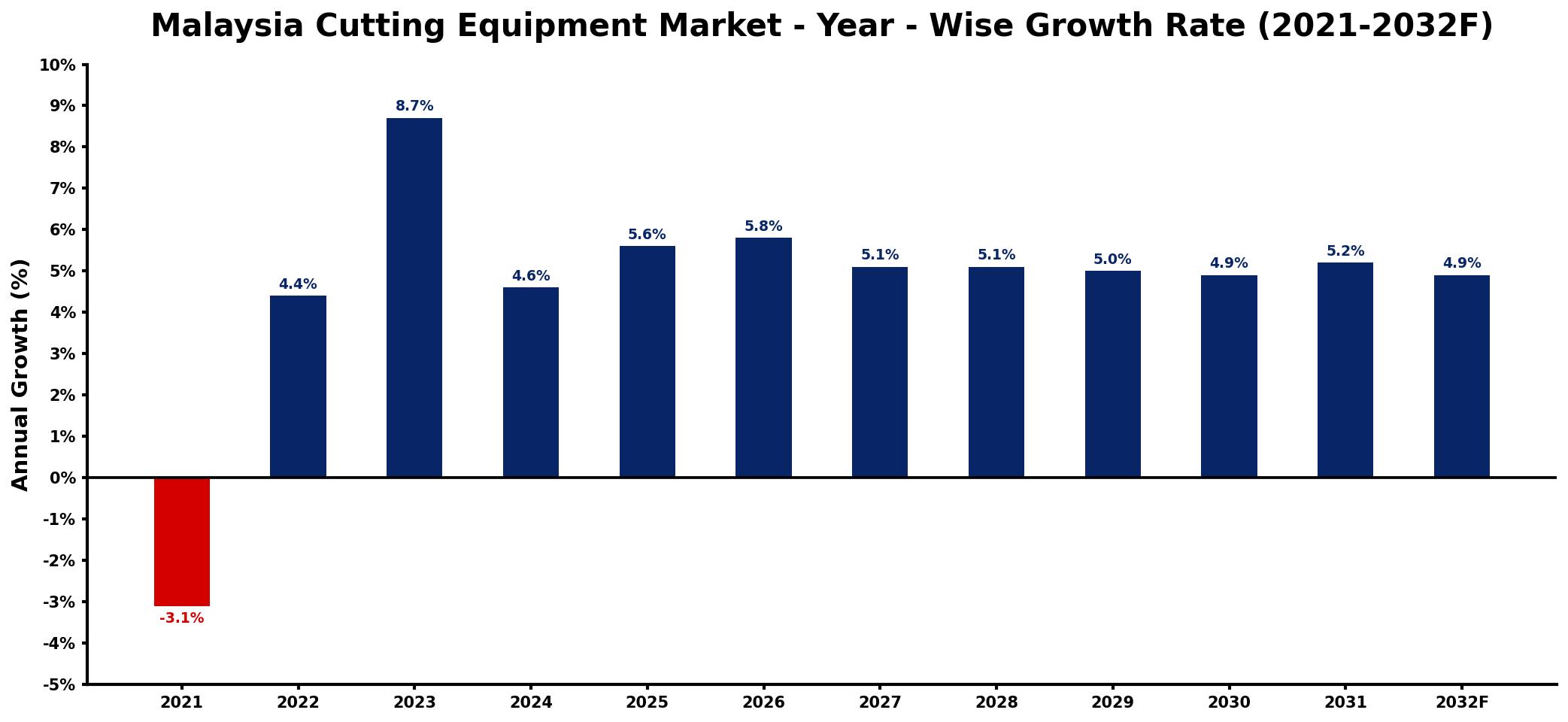
The table below presents the year‑wise growth rates along with the key drivers influencing the market
| Year | Growth Rate | Major Drivers |
| 2021 | -3.1% | decreased industrial production activities |
| 2022 | 4.4% | increased demand from construction sector |
| 2023 | 8.7% | growth in manufacturing investments |
| 2024 | 4.6% | expansion of automotive industry |
| 2025 | 5.6% | rising consumer electronics production |
| 2026 | 5.8% | surge in renewable energy projects |
| 2027 | 5.1% | enhanced infrastructure development plans |
| 2028 | 5.1% | growing demand for precision tools |
| 2029 | 5.0% | increased automation in factories |
| 2030 | 4.9% | advancements in technology integration |
| 2031 | 5.2% | increased production capacity utilization |
| 2032 | 4.9% | increased focus on sustainability initiatives |
Note: Market size estimations and growth projections presented in this report are based on 6Wresearch's proprietary forecasting methodology, utilizing the latest available industry data, government publications, and primary research inputs.
Malaysia Cutting Equipment Market Synopsis
Recent trends indicate a revitalization in the Malaysia Cutting Equipment market, which had faced challenges during the pandemic. As manufacturing and construction activities resume, the market is poised for recovery and growth, fueled by the demand for innovative cutting technologies. The shift toward precision engineering across various industries continues to redefine market dynamics, presenting both opportunities and challenges for stakeholders.
Looking ahead, the market is expected to capitalize on advancements in cutting technologies, such as laser and waterjet cutting. This progress aligns with the broader industrial strategies aimed at enhancing production efficiency and reducing costs, particularly in sectors that require high-precision components.
Malaysia Cutting Equipment Market Key Takeaways
- The Malaysian Cutting Equipment market is witnessing a revival as manufacturing activities gain momentum post-pandemic.
- Technological advancements are central to meeting the evolving demands of precision engineering across key industries.
- The growth is underpinned by a strong manufacturing sector, driven by both local and international demands.
- Emerging trends in automation and digital manufacturing are shaping the future landscape of the cutting equipment market.
- Government initiatives to bolster infrastructure and manufacturing capacity are anticipated to provide a supportive environment for market growth.
Evaluation of Restraints in Malaysia Cutting Equipment Market
Despite the promising growth trajectory, several restraints persist within the Malaysia Cutting Equipment market. Companies face significant pressure to continually innovate and upgrade technologies to remain competitive, which can be both resource-intensive and costly. Additionally, compliance with safety regulations and standards poses an ongoing challenge for manufacturers, necessitating investments in training and operational adjustments. The rising energy costs further complicate operational profitability, while the shortage of skilled operators can hinder the effective use of advanced cutting technologies.
Malaysia Cutting Equipment Market Trends
Several trends are currently reshaping the Malaysia Cutting Equipment market. Firstly, there is an increasing shift towards automation, as manufacturers seek to improve efficiency and reduce operational costs. Furthermore, the adoption of Industry 4.0 principles is gaining traction, encouraging the integration of IoT and data analytics into cutting processes. Additionally, as industries focus on sustainability, eco-friendly cutting solutions and energy-efficient machines are becoming more prevalent, reflecting a broader commitment to environmental responsibility.
Malaysia Cutting Equipment Market Opportunities
Opportunities for growth in the Malaysia Cutting Equipment market are substantial, particularly in sectors such as aerospace and healthcare, where precision is paramount. The expansion of smart factories and the integration of advanced manufacturing technologies present a pathway for investment. Moreover, as regional demand for cutting equipment increases, there is room for foreign direct investment, fostering innovation and partnerships that can enhance technological capabilities.
Government Initiatives in the Malaysia Cutting Equipment Market
The Malaysian government has introduced various initiatives aimed at enhancing the manufacturing landscape, thereby supporting the cutting equipment market. These include funding programs for technological upgrades, incentives for automation adoption, and initiatives to strengthen skill development in the workforce. Additionally, public spending on infrastructure projects is expected to generate increased demand for cutting equipment, creating a favorable environment for growth.
Future Insights of the Malaysia Cutting Equipment Market
Looking towards 2026-2032, the Malaysia Cutting Equipment market is anticipated to evolve significantly. The demand for high-precision cutting technologies will likely escalate, driven by advancements in manufacturing processes and materials. Increased investments in research and development will spur innovation, leading to the introduction of cutting-edge solutions tailored to specific industry needs. As Malaysia continues to position itself as a manufacturing hub in Southeast Asia, the cutting equipment market stands to benefit from both domestic and international growth opportunities.
Malaysia Cutting Equipment Market Latest Developments (2025 - 2026)
In recent months, the Malaysia Cutting Equipment market has experienced a series of developments that reflect the sector's recovery and growth. Companies are increasingly investing in advanced machinery and technologies to enhance production efficiency. There is also a notable trend toward collaborating with technology providers to integrate smart manufacturing solutions. Additionally, industry events and exhibitions have resumed, facilitating knowledge exchange and showcasing innovations in cutting technologies.
Malaysia Cutting Equipment Market - Key Attractiveness of the Report
- 10 Years of Market Numbers
- Historical Data Starting from 2022 to 2025
- Base Year: 2025
- Forecast Data until 2032
- Key Performance Indicators Impacting the Market
- Major Upcoming Developments and Projects
Key Highlights of the Report:
- Malaysia Cutting Equipment Market Outlook
- Market Size of Malaysia Cutting Equipment Market, 2025
- Forecast of Malaysia Cutting Equipment Market, 2032
- Historical Data and Forecast of Malaysia Cutting Equipment Revenues & Volume for the Period 2022-2032F
- Malaysia Cutting Equipment Market Trend Evolution
- Malaysia Cutting Equipment Market Drivers and Challenges
- Malaysia Cutting Equipment Price Trends
- Malaysia Cutting Equipment Porter's Five Forces
- Malaysia Cutting Equipment Industry Life Cycle
- Historical Data and Forecast of Malaysia Cutting Equipment Market Revenues & Volume By Equipment Type for the Period 2022-2032F
- Historical Data and Forecast of Malaysia Cutting Equipment Market Revenues & Volume By Manual for the Period 2022-2032F
- Historical Data and Forecast of Malaysia Cutting Equipment Market Revenues & Volume By Mechanized for the Period 2022-2032F
- Historical Data and Forecast of Malaysia Cutting Equipment Market Revenues & Volume By Cutting Technology for the Period 2022-2032F
- Historical Data and Forecast of Malaysia Cutting Equipment Market Revenues & Volume By Plasma cutting for the Period 2022-2032F
- Historical Data and Forecast of Malaysia Cutting Equipment Market Revenues & Volume By Oxy-fuel cutting for the Period 2022-2032F
- Historical Data and Forecast of Malaysia Cutting Equipment Market Revenues & Volume By Laser cutting for the Period 2022-2032F
- Historical Data and Forecast of Malaysia Cutting Equipment Market Revenues & Volume By Waterjet cutting for the Period 2022-2032F
- Historical Data and Forecast of Malaysia Cutting Equipment Market Revenues & Volume By Carbon arc cutting for the Period 2022-2032F
- Historical Data and Forecast of Malaysia Cutting Equipment Market Revenues & Volume By End Use Industry for the Period 2022-2032F
- Historical Data and Forecast of Malaysia Cutting Equipment Market Revenues & Volume By Construction for the Period 2022-2032F
- Historical Data and Forecast of Malaysia Cutting Equipment Market Revenues & Volume By Heavy metal fabrication for the Period 2022-2032F
- Historical Data and Forecast of Malaysia Cutting Equipment Market Revenues & Volume By Shipbuilding & offshore for the Period 2022-2032F
- Historical Data and Forecast of Malaysia Cutting Equipment Market Revenues & Volume By Automotive for the Period 2022-2032F
- Historical Data and Forecast of Malaysia Cutting Equipment Market Revenues & Volume By Others for the Period 2022-2032F
- Historical Data and Forecast of Malaysia Cutting Equipment Market Revenues & Volume By Type for the Period 2022-2032F
- Historical Data and Forecast of Malaysia Cutting Equipment Market Revenues & Volume By Equipment for the Period 2022-2032F
- Historical Data and Forecast of Malaysia Cutting Equipment Market Revenues & Volume By Consumables/Accessories for the Period 2022-2032F
- Malaysia Cutting Equipment Import Export Trade Statistics
- Market Opportunity Assessment By Equipment Type
- Market Opportunity Assessment By Cutting Technology
- Market Opportunity Assessment By End Use Industry
- Market Opportunity Assessment By Type
- Malaysia Cutting Equipment Top Companies Market Share
- Malaysia Cutting Equipment Competitive Benchmarking By Technical and Operational Parameters
- Malaysia Cutting Equipment Company Profiles
- Malaysia Cutting Equipment Key Strategic Recommendations






































