Malaysia Dairy products Market Size Growth Rate
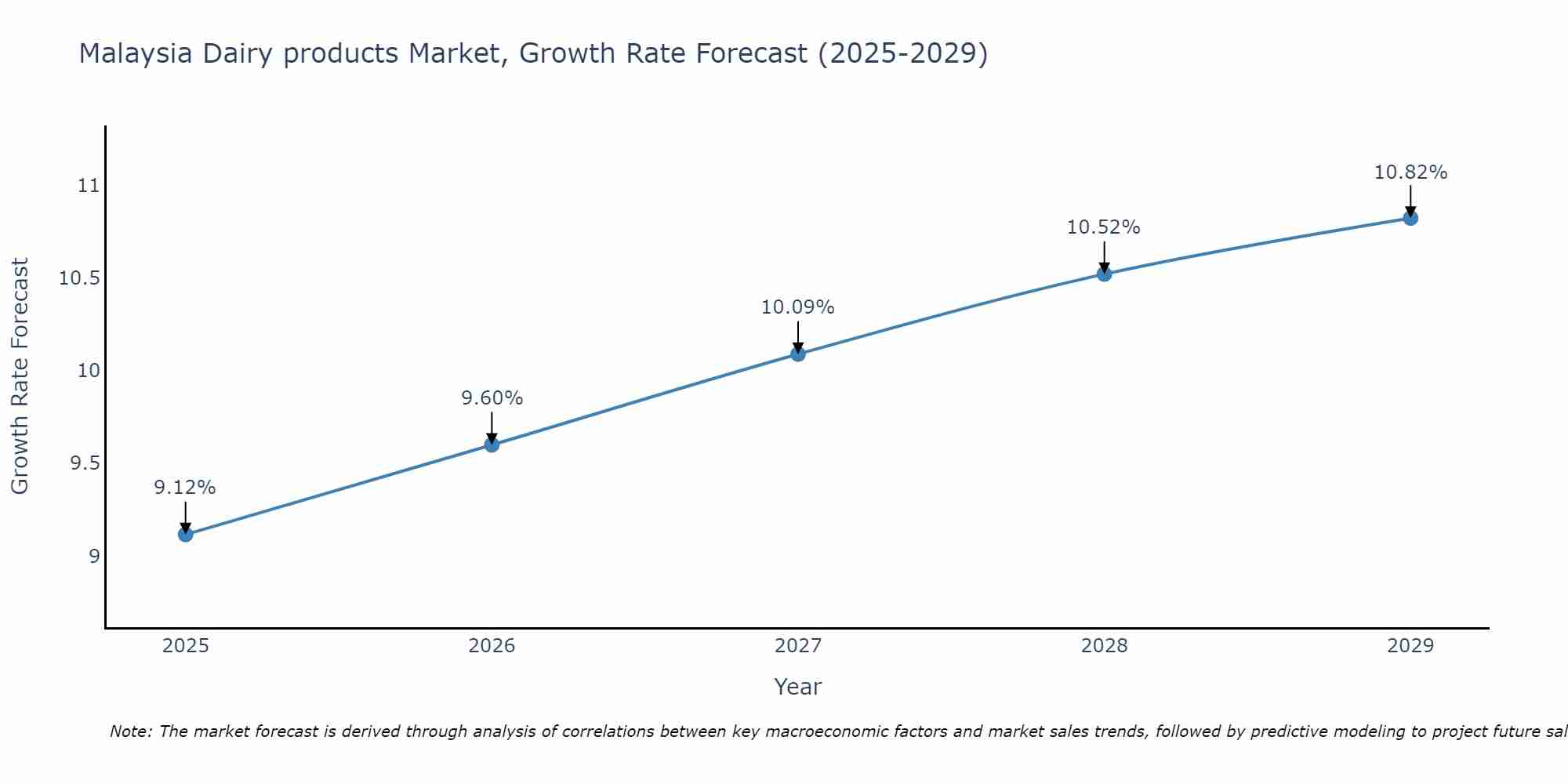
The Malaysia Dairy products Market is likely to experience consistent growth rate gains over the period 2025 to 2029. The growth rate starts at 9.12% in 2025 and reaches 10.82% by 2029.
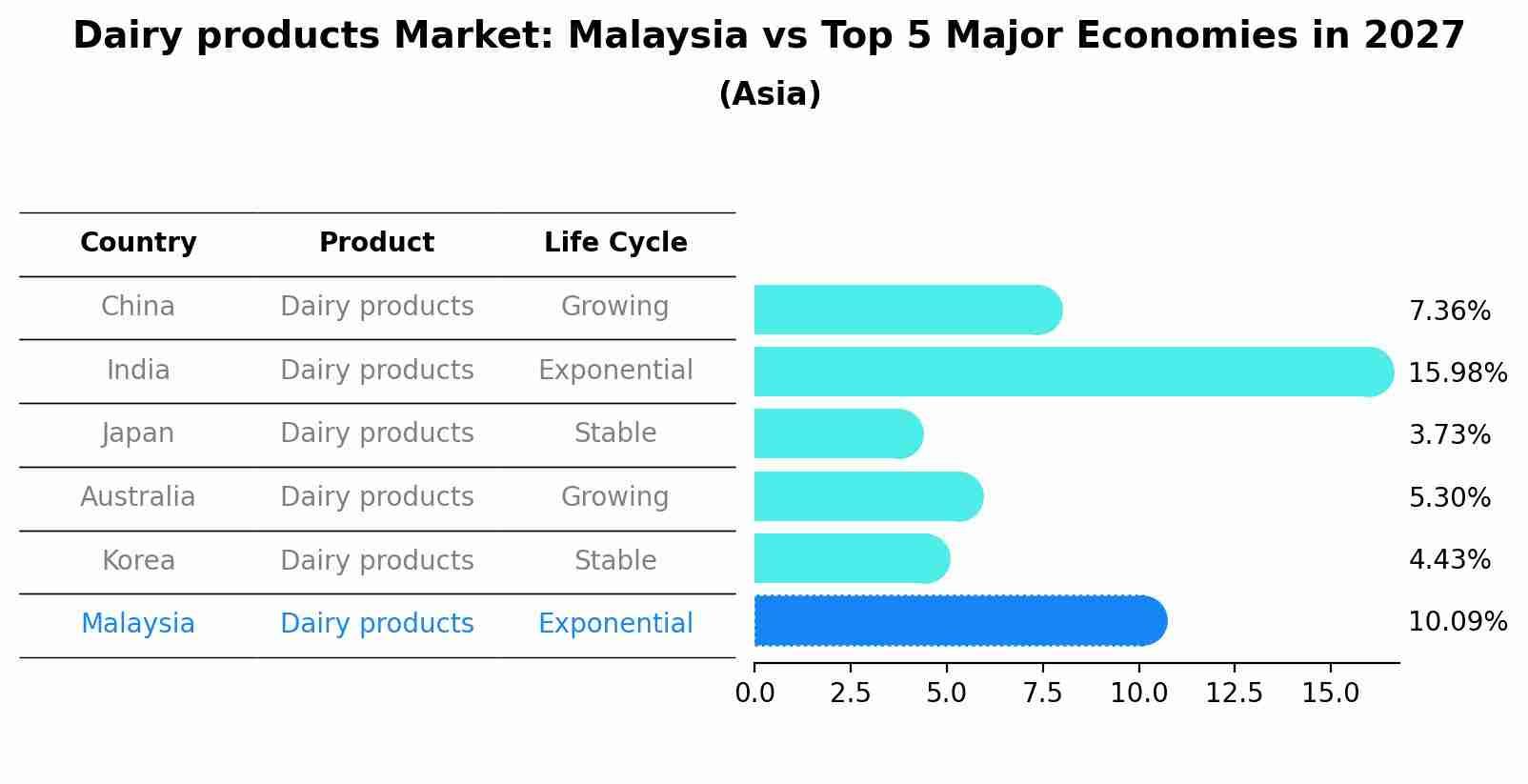
Dairy products Market: Malaysia vs Top 5 Major Economies in 2027 (Asia)
The Dairy products market in Malaysia is projected to grow at a high growth rate of 10.09% by 2027, within the Asia region led by China, along with other countries like India, Japan, Australia and South Korea, collectively shaping a dynamic and evolving market environment driven by innovation and increasing adoption of emerging technologies.
Malaysia Dairy Products Market Growth Rate
According to 6Wresearch internal database and industry insights, the Malaysia Dairy Products Market is projected to grow at a compound annual growth rate (CAGR) of 5.9% during the forecast period 2026–2032.
Topics Covered in the Malaysia Dairy Products Market Report
The Malaysia Dairy Products Market report thoroughly covers the market by product type, distribution channel, and end-user. It provides an unbiased and detailed analysis of ongoing market trends, opportunities, challenges, and market drivers, helping stakeholders align their strategies with current and future market dynamics.
Malaysia Dairy Products Market Highlights
| Report Name | Malaysia Dairy Products Market |
| Forecast Period | 2026–2032 |
| CAGR | 5.9% |
| Growing Sector | Lactose-Free Dairy Products |
Malaysia Dairy Products Market Synopsis
The Malaysia Dairy Products Market is expected to witness steady growth due to rising health-conscious consumers, the growing preference for organic and lactose-free dairy products and expanding retail channels. The market is being driven by technological advancements, better cold chain logistics, and government initiatives supporting the dairy sector's growth. Dairy products are becoming a staple in Malaysian diets due to the increasing urban population and growing middle class with higher disposable income. Furthermore, the demand for premium dairy products is surging in urban markets.
Evaluation of Growth Drivers in Malaysia Dairy Products Market
Below mentioned are some prominent drivers and their influence on Malaysia Dairy Products Market dynamics:
| Drivers | Primary Segment Affected | Why It Matters (Evidence) |
| Health & Wellness Trends | Lactose-Free Dairy Products | The growing awareness of health benefits has fuelled the demand for lactose-free and organic dairy, attracting more health-conscious consumers. |
| Government Support | Dairy Producers | Government programs offering subsidies to local farmers are boosting the growth of the dairy industry. |
| E-Commerce Expansion | All Segments | The increase in online shopping for dairy products has increased the market obtainment. |
| Rising Urbanization | All Segments | The need for high-quality dairy products is proliferating owing to urban consumers of cities such as Kuala Lumpur. |
| Technological Advancements | Dairy Producers | Creative innovations in dairy production technologies are making dairy products more obtainable. |
The Malaysia Dairy Products Market is projected to grow at a CAGR of 5.9% from 2026 to 2032. Owing to the rising need for healthier dairy options and growing government investments in dairy farming the Malaysia Dairy Products Market Growth is proliferating. The market gives ample opportunities for local and international dairy companies a favourable regulatory environment and rising urbanization, The deployment of advanced dairy technologies and the growth of retail channels will continue to propel growth in the sector.
Evaluation of Restraints in Malaysia Dairy Products Market
Below mentioned are some major restraints and their influence on Malaysia Dairy Products Market dynamics:
| Restraints | Primary Segment Affected | What This Means (Evidence) |
| Price Sensitivity | Small Enterprises | High operational costs, especially for SMEs in the dairy sector, can lead to higher prices, which may limit the affordability for price-sensitive consumers. |
| Regulatory Challenges | Dairy Producers | The complex regulatory environment around food safety standards and labeling can impose higher compliance costs for dairy producers. |
| Competition from Plant-Based Alternatives | Dairy Products | The rising popularity of plant-based milk may affect the growth of traditional dairy products in the market. |
| Supply Chain Disruptions | All Segments | Any disruptions in the cold chain logistics, owing to natural disasters or regulatory restrictions, can obstruct the timely supply of fresh dairy products. |
| Limited Domestic Production | Dairy Producers | Local production could get affected owing to Malaysia’s reliability on imports for certain dairy products. |
Malaysia Dairy Products Market Challenges
Malaysia Dairy Products Industry goes through many challenges. It consists of rising competition from plant-based alternatives, regulatory barriers, and cost sensitivity among consumers. Owing to logistical issues and the problems of domestic production the industry also goes through disruptions in supply chains. Small dairy businesses struggle to keep up with larger players, needing allocation of funds in new technologies and innovations to remain competitive. In order to get through these challenges, huge concentration on consumer education will be needed and augmentation of local production capabilities as well.
Malaysia Dairy Products Market Trends
Several notable trends are shaping the Malaysia Dairy Products Market dynamics:
- Cloud Adoption: For more efficient dairy product distribution retailers are increasingly adopting e-commerce and cloud-based solutions, this will help in reaching a broader customer base.
- Lactose-Free Products: Innovation in dairy formulations is proliferating owing to the rising need for lactose-free dairy products, this is happening as consumers are becoming more health-conscious.
- Premium Dairy Consumption: Consumers in urban centres are inclining towards toward high-quality dairy products, consisting of organic and fortified dairy products, as their disposable incomes rises.
- Plant-Based Alternatives: The popularity of plant-based alternatives, such as oat milk and soy milk, persist to challenge the traditional dairy segment, providing both competition and collaboration opportunities.
Investment Opportunities in the Malaysia Dairy Industry
Some notable investment opportunities in the Malaysia Dairy Industry are:
- Lactose-Free Dairy Products: As health-conscious consumers want substitutes to traditional dairy ,fund allocation in lactose-free dairy products is important.
- E-Commerce and Retail: For better distribution there is a rising opportunity to allocate funds in e-commerce platforms with rising online shopping trends.
- Government Partnerships: To make avenues for funding, partnering with the government on dairy initiatives will help.
Top 5 Leading Players in the Malaysia Dairy Products Market
Below is the list of prominent companies leading in the Malaysia Dairy Products Market:
1. Dutch Lady Milk Industries Berhad (Royal FrieslandCampina)
| Company Name | Dutch Lady Milk Industries Berhad (Royal FrieslandCampina) |
|---|---|
| Established Year | 1963 |
| Headquarters | Petaling Jaya, Malaysia |
| Official Website | Click Here |
Dutch Lady is one of Malaysia’s leading dairy brands, giving a variety of milk and dairy products.
2. Fraser & Neave Holdings Bhd (F&N)
| Company Name | Fraser & Neave Holdings Bhd (F&N) |
|---|---|
| Established Year | 1959 |
| Headquarters | Kuala Lumpur, Malaysia |
| Official Website | Click Here |
F&N Dairies is a major player in the Malaysian dairy market, providing a diverse range of high-quality dairy products, consisting of sweetened condensed milk, evaporated milk, and yogurt.
3. Nestle (Malaysia) Berhad
| Company Name | Nestle (Malaysia) Berhad |
|---|---|
| Established Year | 1912 |
| Headquarters | Selangor, Malaysia |
| Official Website | Click Here |
Nestle Malaysia is a leading force in the dairy market, offering a wide array of dairy products, including milk, yogurt, and infant formulas.
4. Fonterra Co-operative Group
| Company Name | Fonterra Co-operative Group |
|---|---|
| Established Year | 2001 |
| Headquarters | Auckland, New Zealand |
| Official Website | Click Here |
Fonterra is a worldwide dairy cooperative and a major supplier in Malaysia. It concentrates on high-quality dairy products and has a robust presence in both the consumer and foodservice markets.
5. Farm Fresh Bhd
| Company Name | Farm Fresh Bhd |
|---|---|
| Established Year | 2009 |
| Headquarters | Seremban, Malaysia |
| Official Website | Click Here |
Farm Fresh Bhd provides a range of locally sourced dairy products, including milk, yogurt, and ice cream.
Government Regulations Introduced in the Malaysia Dairy Market
According to Malaysian government data, several regulations and initiatives to support the growth of the dairy industry has been implemented. One of the major regulations is the National Dairy Industry Policy. This regulation has the objective to augment self-sufficiency and innovation within the local dairy sector, and this policy consist of subsidies for local dairy farmers, assisting to boost domestic production and decrease dependency on imports. The Food Safety and Quality Act 2009 plays an important role in regulating the safety and quality of dairy products. This act ensures that all dairy products meet stringent international standards, guaranteeing their safety for consumers.
Future Insights of the Malaysia Dairy Products Market
The Malaysia Dairy Products Market is anticipated to undergo steady growth. It is proliferated by a rise in health-conscious consumers, government initiatives, and technological innovations in dairy production and with the need for lactose-free dairy, plant-based alternatives, and high-quality dairy offerings the market will persist to evolve. Market opportunities will expand as government's policies and focus on infrastructure will support local production and greater innovation. The expansion of modern retail channels and e-commerce platforms will further enhance product accessibility and consumer reach across the country.
Market Segmentation Analysis
The report offers a comprehensive study of the following market segments and their leading categories:
By Product Type - Milk to dominate the market
According to Lakshita, Senior Research Analyst, 6Wresearch, Milk is expected to lead the Malaysia Dairy Products Market Share owing to its widespread consumption across households, food service, and beverage sectors.
By Distribution Channel - Supermarkets & Hypermarkets to dominate the market
Supermarkets & Hypermarkets are projected to dominate the distribution of dairy products in Malaysia, and these retail outlets provide a wide variety of dairy products in convenient locations, making them the preferred choice for consumers.
Key Attractiveness of the Report
- 10 Years of Market Numbers.
- Historical Data Starting from 2022 to 2025.
- Base Year: 2025.
- Forecast Data until 2032.
- Key Performance Indicators Impacting the Market.
- Major Upcoming Developments and Projects.
Key Highlights of the Report:
- Malaysia Dairy products Market Outlook
- Market Size of Malaysia Dairy products Market, 2025
- Forecast of Malaysia Dairy products Market, 2032
- Historical Data and Forecast of Malaysia Dairy products Revenues & Volume for the Period 2022-2032
- Malaysia Dairy products Market Trend Evolution
- Malaysia Dairy products Market Drivers and Challenges
- Malaysia Dairy products Price Trends
- Malaysia Dairy products Porter's Five Forces
- Malaysia Dairy products Industry Life Cycle
- Historical Data and Forecast of Malaysia Dairy products Market Revenues & Volume By Product Type for the Period 2022-2032
- Historical Data and Forecast of Malaysia Dairy products Market Revenues & Volume By Butter for the Period 2022-2032
- Historical Data and Forecast of Malaysia Dairy products Market Revenues & Volume By Cheese for the Period 2022-2032
- Historical Data and Forecast of Malaysia Dairy products Market Revenues & Volume By Milk for the Period 2022-2032
- Historical Data and Forecast of Malaysia Dairy products Market Revenues & Volume By Cream for the Period 2022-2032
- Historical Data and Forecast of Malaysia Dairy products Market Revenues & Volume By Yoghurt for the Period 2022-2032
- Historical Data and Forecast of Malaysia Dairy products Market Revenues & Volume By Buttermilk for the Period 2022-2032
- Historical Data and Forecast of Malaysia Dairy products Market Revenues & Volume By Ice Cream for the Period 2022-2032
- Historical Data and Forecast of Malaysia Butter Dairy products Market Revenues & Volume By Lactose-Free Dairy Products for the Period 2022-2032
- Historical Data and Forecast of Malaysia Dairy products Market Revenues & Volume By Distribution Channel for the Period 2022-2032
- Historical Data and Forecast of Malaysia Dairy products Market Revenues & Volume By Supermarkets & Hypermarkets for the Period 2022-2032
- Historical Data and Forecast of Malaysia Dairy products Market Revenues & Volume By Convenience Store for the Period 2022-2032
- Historical Data and Forecast of Malaysia Dairy products Market Revenues & Volume By Online for the Period 2022-2032
- Malaysia Dairy products Import Export Trade Statistics
- Market Opportunity Assessment By Product Type
- Market Opportunity Assessment By Distribution Channel
- Malaysia Dairy products Top Companies Market Share
- Malaysia Dairy products Competitive Benchmarking By Technical and Operational Parameters
- Malaysia Dairy products Company Profiles
- Malaysia Dairy products Key Strategic Recommendations
Market Covered
The report offers a comprehensive study of the following Malaysia Dairy Products Market segments:
By Product Type
- Butter
- Cheese
- Milk
- Cream
- Yoghurt
- Buttermilk
- Ice Cream
- Lactose-Free Dairy Products
By Distribution Channel
- Supermarkets & Hypermarkets
- Convenience Store
- Online






































