Malaysia Data Catalog Market Size & Growth Rate (2026-2032)
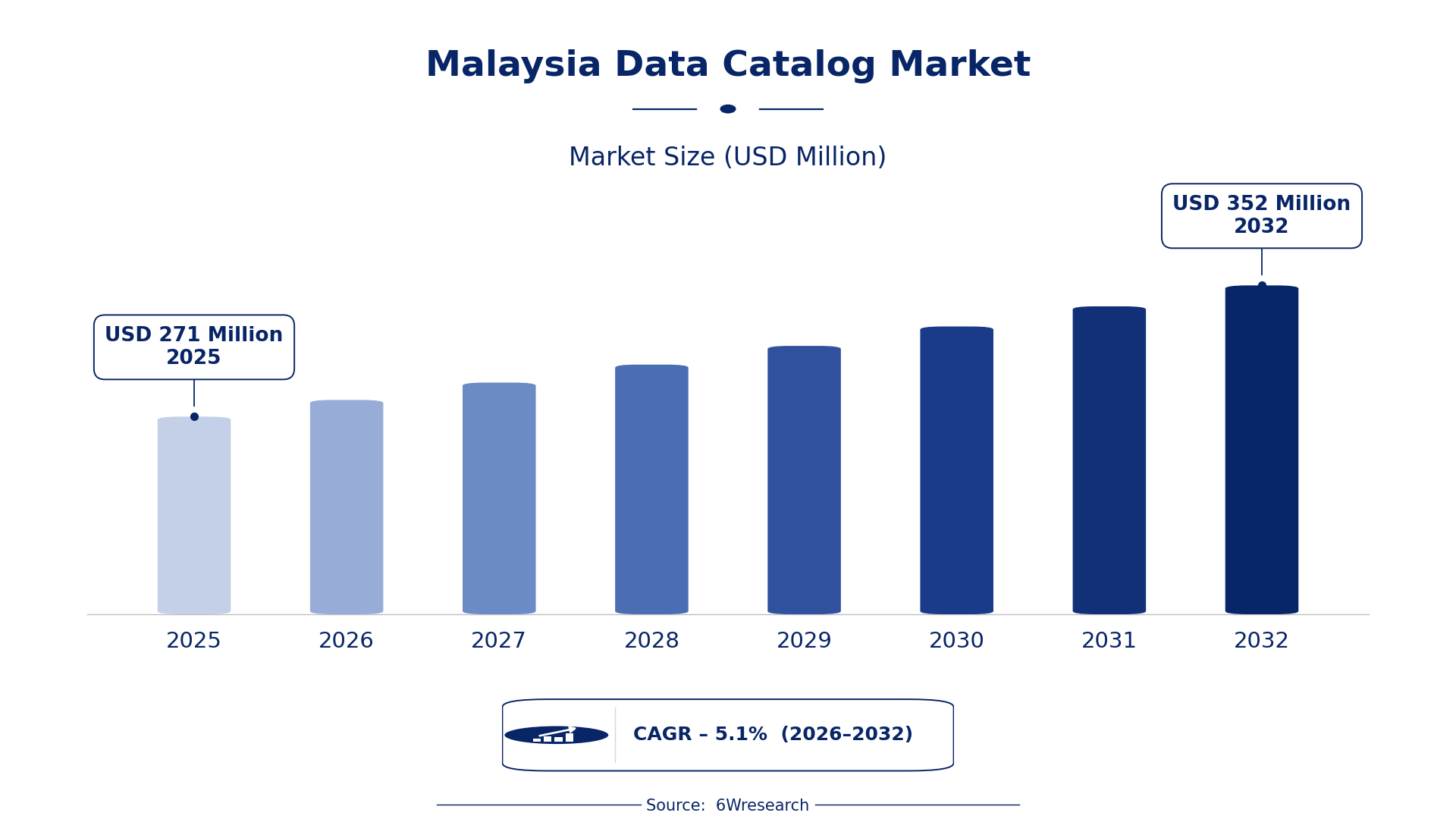
The Malaysia Data Catalog Market was estimated at USD 271 Million in 2025 and is projected to reach USD 352 Million by 2032, growing at a CAGR of 5.1% from 2026 to 2032.
Malaysia Data Catalog Market Synopsis
The increasing complexity of data management across various sectors in Malaysia is driving the adoption of data catalog solutions. Businesses are striving to harness their data effectively, realizing that organized data is key to unlocking insights and enhancing decision-making.
Amid the surge in big data utilization, organizations are prioritizing the implementation of data catalogs. This focus not only aids in data discoverability but also ensures compliance and governance, which are essential in the current data-driven environment.
Malaysia Data Catalog Market Year-wise Growth Rate and Key Drivers
This graph illustrates the annual growth rates of the Malaysia Data Catalog Market from 2021 to 2032, highlighting a steady upward trajectory and projected expansion over the forecast period.
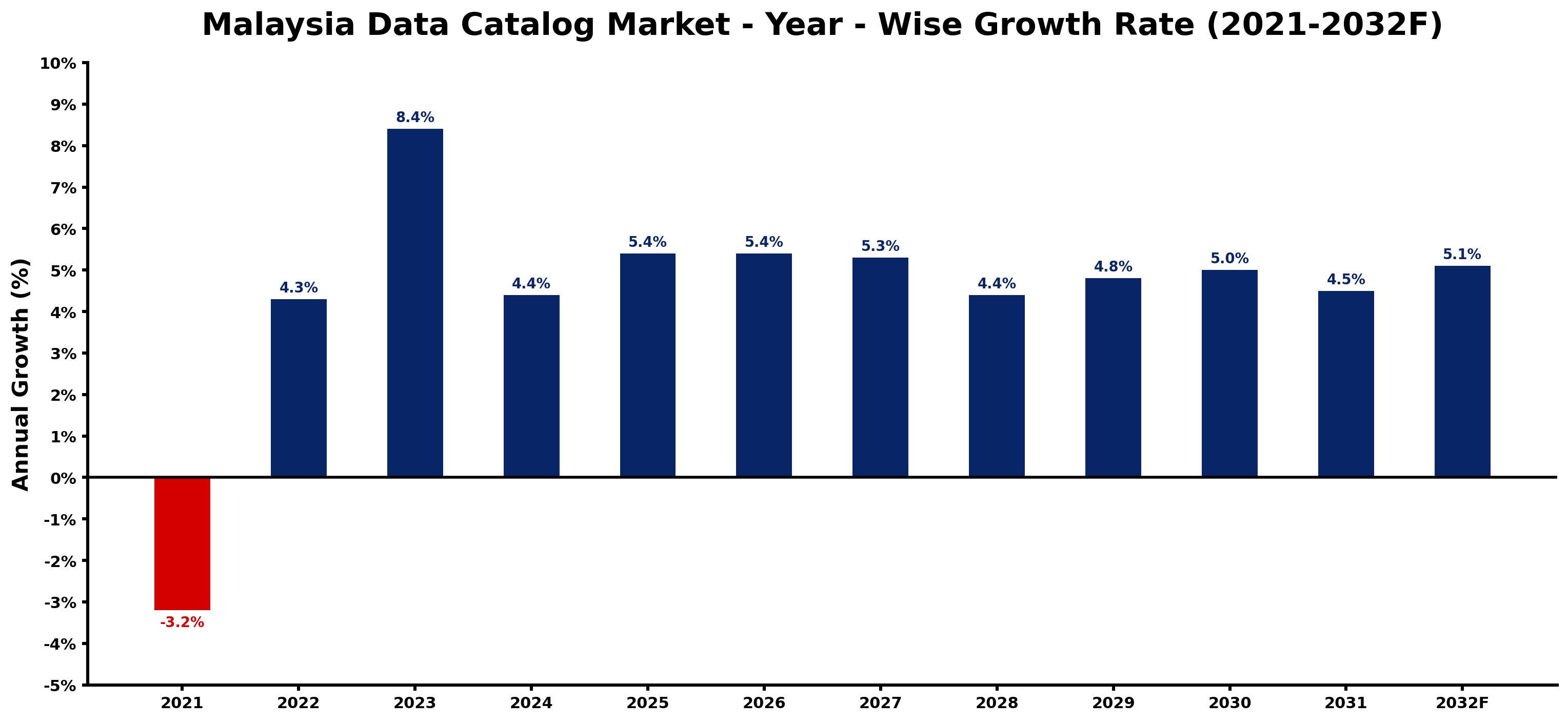
The table below presents the year‑wise growth rates along with the key drivers influencing the market
| Year | Growth Rate | Major Drivers |
| 2021 | -3.2% | Government's MCMC data privacy regulations limited access. |
| 2022 | 4.3% | Launch of Malaysia's Digital Economy Blueprint initiative |
| 2023 | 8.4% | Increase in government funding for AI data projects |
| 2024 | 4.4% | Rise in mobile internet penetration enhancing data access |
| 2025 | 5.4% | Adoption of open data initiatives by Malaysian government |
| 2026 | 5.4% | Growing interest in data-driven decision-making among SMEs |
| 2027 | 5.3% | Supportive policies from Malaysia Digital Economy Corporation |
| 2028 | 4.4% | Implementation of data governance frameworks by regulators |
| 2029 | 4.8% | Surge in demand for data transparency in businesses |
| 2030 | 5.0% | Increased collaboration among educational institutions on data science |
| 2031 | 4.5% | Emergence of data literacy programs across Malaysian universities |
| 2032 | 5.1% | Focus on sustainable development data initiatives by government |
Note: Market size estimations and growth projections presented in this report are based on 6Wresearch's proprietary forecasting methodology, utilizing the latest available industry data, government publications, and primary research inputs.
Malaysia Data Catalog Market Key Takeaways
Below are some of the specific key takeaways from the market, including:
- The need for efficient data management is pushing organizations to invest in data catalog solutions.
- Data quality, accessibility, and governance are at the forefront of business priorities.
- The COVID-19 pandemic has accelerated the demand for centralized data management tools.
- Challenges remain around data governance and fostering a culture of data literacy.
- The market is projected to grow steadily, reflecting the increasing importance of data in decision-making.
Evaluation of Restraints in Malaysia Data Catalog Market
Several factors are hindering the growth of the Malaysia Data Catalog Market. A major concern is the complexity involved in establishing comprehensive data catalogs that are secure and effective. Many organizations struggle with ensuring data quality and integrity while adapting to evolving compliance requirements.
Additionally, resistance to adopting new technologies can be a barrier. Encouraging a culture of data literacy within organizations is essential, yet it often meets with pushback. This cultural aspect is a critical challenge that needs to be addressed for successful data catalog implementation.
Malaysia Data Catalog Market Trends
A notable trend in the Malaysia Data Catalog Market is the integration of artificial intelligence and machine learning technologies to enhance data classification and discovery. This technological advancement allows organizations to automate processes, thereby improving efficiency and accuracy.
on top of that, businesses are increasingly focusing on data governance frameworks. As regulations become stricter, organizations are prioritizing compliance and security, which are driving the demand for advanced data catalog solutions.
Malaysia Data Catalog Market Opportunities
The growth trajectory of the Malaysia Data Catalog Market presents numerous investment opportunities. Companies can capitalize on the rising demand for data management solutions by developing innovative and user-friendly platforms tailored to local business needs.
on top of that, partnerships between technology vendors and local enterprises can enhance the reach and effectiveness of data catalog solutions. This collaboration can bridge gaps in data literacy and foster a more data-driven culture within organizations.
Government Initiatives in the Malaysia Data Catalog Market
The Malaysian government is actively shaping the Data Catalog Market through several initiatives aimed at improving data governance and management. These policies reflect a commitment to enhancing the country’s digital economy while ensuring that organizations can effectively manage their data assets.
- A recently launched initiative focused on upgrading national data infrastructure to enhance accessibility and security.
- Current efforts include the development of a regulatory framework to standardize data catalog practices across various sectors.
- Ongoing public-private partnerships aim to foster innovation in data management technologies.
- A planned initiative set for 2026 aims to promote data literacy across organizations through comprehensive training programs.
- A framework introduced in 2025 mandates improved data transparency and accessibility for public sector data.
Future Insights of the Malaysia Data Catalog Market
Looking ahead, the Malaysia Data Catalog Market is on track for steady growth. As organizations increasingly rely on data for strategic decision-making, the demand for effective cataloging solutions will only intensify. Companies that can adapt to the evolving technological landscape and address challenges surrounding data governance will be well-positioned for success.
on top of that, as regulations become stricter and data privacy concerns escalate, organizations will need to invest more in robust data catalog solutions. This creates a fertile ground for innovation and the development of new services tailored to meet these emerging demands.
Malaysia Data Catalog Market Latest Developments
In the last 12-14 months, the Malaysia Data Catalog Market has seen a flurry of activity as organizations seek to enhance their data management capabilities. The urgency created by the pandemic has only amplified the need for effective data catalog solutions.
- A major technology vendor announced a new data catalog solution tailored for Malaysian businesses, launched in Q1 2025 and receiving positive feedback.
- An ongoing collaboration between local universities and tech firms aims to enhance data literacy, with workshops currently underway.
- A rollout expected to begin in late 2025 will focus on integrating AI capabilities into existing data catalog platforms.
- In early 2025, a consortium of businesses was formed to drive innovation in data governance practices.
- A planned initiative for 2026 aims to introduce new standards for data management across the public sector.
Malaysia Data Catalog Market - Key Attractiveness of the Report
- 10 Years of Market Numbers
- Historical Data Starting from 2022 to 2025
- Base Year: 2025
- Forecast Data until 2032
- Key Performance Indicators Impacting the Market
- Major Upcoming Developments and Projects
Key Highlights of the Report:
- Malaysia Data Catalog Market Outlook
- Market Size of Malaysia Data Catalog Market, 2025
- Forecast of Malaysia Data Catalog Market, 2032
- Historical Data and Forecast of Malaysia Data Catalog Revenues & Volume for the Period 2022-2032F
- Malaysia Data Catalog Market Trend Evolution
- Malaysia Data Catalog Market Drivers and Challenges
- Malaysia Data Catalog Price Trends
- Malaysia Data Catalog Porter's Five Forces
- Malaysia Data Catalog Industry Life Cycle
- Historical Data and Forecast of Malaysia Data Catalog Market Revenues & Volume By Component for the Period 2022-2032F
- Historical Data and Forecast of Malaysia Data Catalog Market Revenues & Volume By Solutions for the Period 2022-2032F
- Historical Data and Forecast of Malaysia Data Catalog Market Revenues & Volume By Services for the Period 2022-2032F
- Historical Data and Forecast of Malaysia Data Catalog Market Revenues & Volume By Data Consumer for the Period 2022-2032F
- Historical Data and Forecast of Malaysia Data Catalog Market Revenues & Volume By Business Intelligence tools for the Period 2022-2032F
- Historical Data and Forecast of Malaysia Data Catalog Market Revenues & Volume By Enterprise Applications for the Period 2022-2032F
- Historical Data and Forecast of Malaysia Data Catalog Market Revenues & Volume By Mobile and Web Applications for the Period 2022-2032F
- Historical Data and Forecast of Malaysia Data Catalog Market Revenues & Volume By Deployment Mode for the Period 2022-2032F
- Historical Data and Forecast of Malaysia Data Catalog Market Revenues & Volume By Cloud for the Period 2022-2032F
- Historical Data and Forecast of Malaysia Data Catalog Market Revenues & Volume By On-premises for the Period 2022-2032F
- Historical Data and Forecast of Malaysia Data Catalog Market Revenues & Volume By Metadata Type for the Period 2022-2032F
- Historical Data and Forecast of Malaysia Data Catalog Market Revenues & Volume By Technical Metadata for the Period 2022-2032F
- Historical Data and Forecast of Malaysia Data Catalog Market Revenues & Volume By Business Metadata for the Period 2022-2032F
- Historical Data and Forecast of Malaysia Data Catalog Market Revenues & Volume By Organization Size for the Period 2022-2032F
- Historical Data and Forecast of Malaysia Data Catalog Market Revenues & Volume By SMEs for the Period 2022-2032F
- Historical Data and Forecast of Malaysia Data Catalog Market Revenues & Volume By Large Enterprises for the Period 2022-2032F
- Historical Data and Forecast of Malaysia Data Catalog Market Revenues & Volume By Vertical for the Period 2022-2032F
- Historical Data and Forecast of Malaysia Data Catalog Market Revenues & Volume By BFSI for the Period 2022-2032F
- Historical Data and Forecast of Malaysia Data Catalog Market Revenues & Volume By Retail and eCommerce for the Period 2022-2032F
- Historical Data and Forecast of Malaysia Data Catalog Market Revenues & Volume By Manufacturing for the Period 2022-2032F
- Historical Data and Forecast of Malaysia Data Catalog Market Revenues & Volume By Government and Defence for the Period 2022-2032F
- Historical Data and Forecast of Malaysia Data Catalog Market Revenues & Volume By Healthcare and Life Sciences for the Period 2022-2032F
- Historical Data and Forecast of Malaysia Data Catalog Market Revenues & Volume By Telecom for the Period 2022-2032F
- Historical Data and Forecast of Malaysia Data Catalog Market Revenues & Volume By Media and Entertainment for the Period 2022-2032F
- Historical Data and Forecast of Malaysia Data Catalog Market Revenues & Volume By Transportation and Logistics for the Period 2022-2032F
- Malaysia Data Catalog Import Export Trade Statistics
- Market Opportunity Assessment By Component
- Market Opportunity Assessment By Data Consumer
- Market Opportunity Assessment By Deployment Mode
- Market Opportunity Assessment By Metadata Type
- Market Opportunity Assessment By Organization Size
- Market Opportunity Assessment By Vertical
- Malaysia Data Catalog Top Companies Market Share
- Malaysia Data Catalog Competitive Benchmarking By Technical and Operational Parameters
- Malaysia Data Catalog Company Profiles
- Malaysia Data Catalog Key Strategic Recommendations






































