Malaysia Data Center Networking Market Size & Growth Rate (2026-2032)
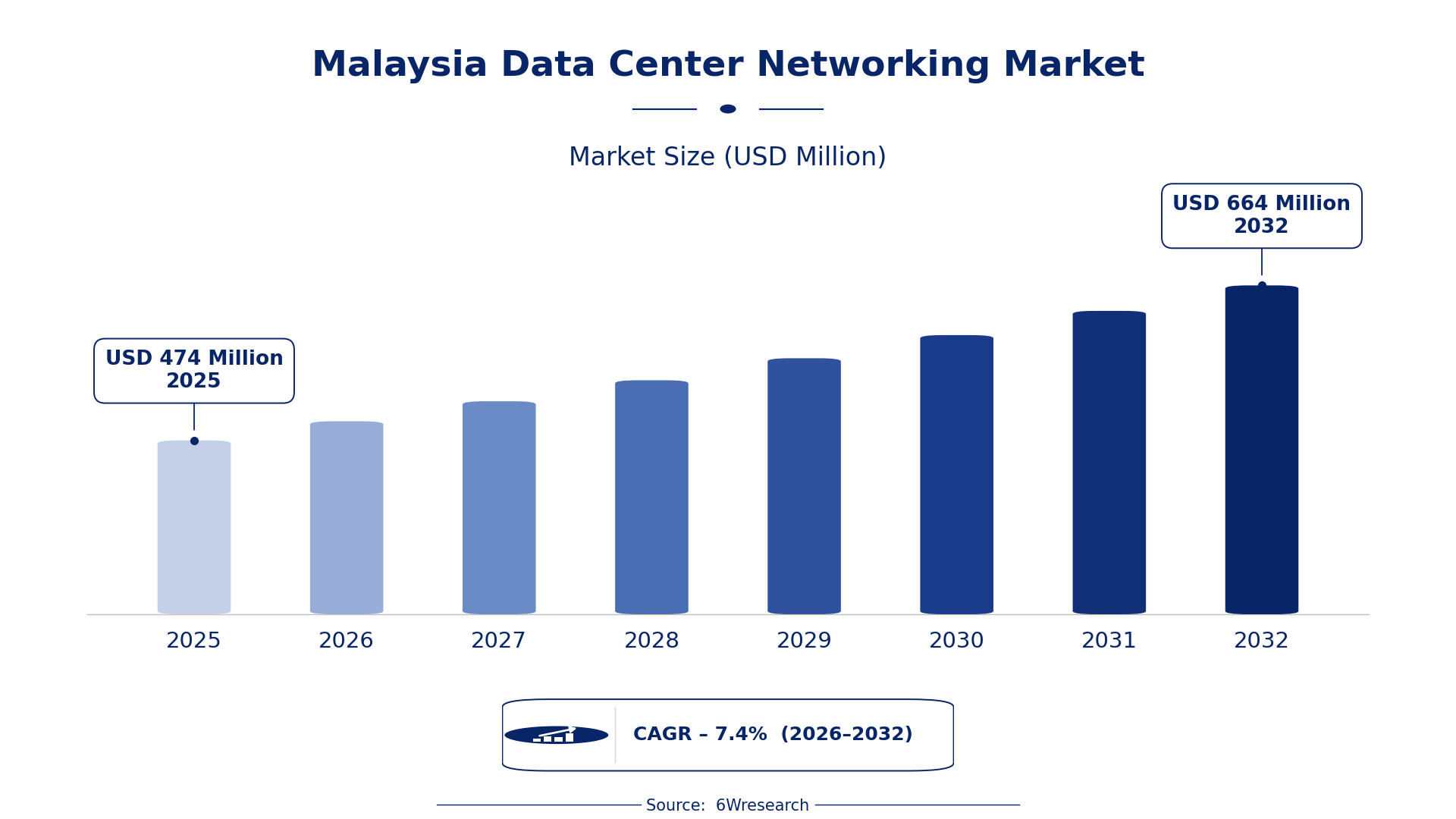
The Malaysia Data Center Networking Market was estimated at USD 474 Million in 2025 and is projected to reach USD 664 Million by 2032, growing at a CAGR of 7.4% from 2026 to 2032.
Malaysia Data Center Networking Market Synopsis
The surge in digital transformation initiatives is the most influential factor driving the Malaysia Data Center Networking Market. As organizations increasingly embrace cloud computing and edge computing, the demand for high-speed, reliable data connections is at an all-time high.
The need for low-latency, high-bandwidth networking solutions is reshaping the competitive environment. Companies are pouring investments into advanced technologies, focusing on optimizing performance and scalability while ensuring data security remains a top priority.
Malaysia Data Center Networking Market Year-wise Growth Rate and Key Drivers
This graph illustrates the annual growth rates of the Malaysia Data Center Networking Market from 2021 to 2032, highlighting a steady upward trajectory and projected expansion over the forecast period.
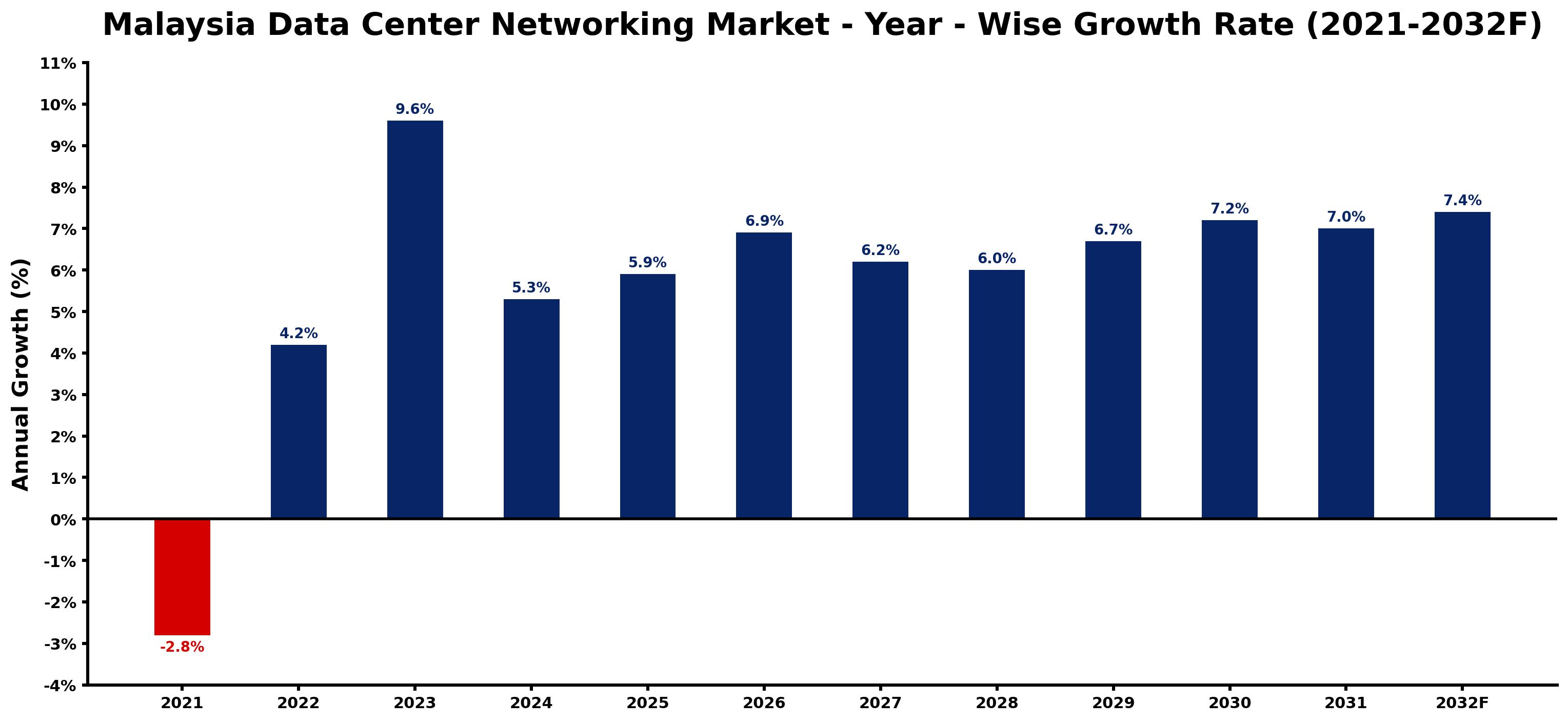
The table below presents the year‑wise growth rates along with the key drivers influencing the market
| Year | Growth Rate | Major Drivers |
| 2021 | -2.8% | MDEC's bandwidth regulations limited data center expansion. |
| 2022 | 4.2% | Increased demand for low-latency cloud services in Malaysia. |
| 2023 | 9.6% | 5G rollout enhancing data center network infrastructural needs. |
| 2024 | 5.3% | Growing e-commerce market driving data traffic surge. |
| 2025 | 5.9% | Investment in AI technologies boosting data center operations. |
| 2026 | 6.9% | Government backing for digital economy initiatives fueling growth. |
| 2027 | 6.2% | Rise in remote work increasing data bandwidth requirements. |
| 2028 | 6.0% | Data protection regulations spurring network security upgrades. |
| 2029 | 6.7% | Focus on smart city projects driving connectivity demands. |
| 2030 | 7.2% | Data localization laws encouraging local data center expansion. |
| 2031 | 7.0% | Emerging fintech sector requiring advanced networking solutions. |
| 2032 | 7.4% | Government digital transformation initiatives boosting cloud adoption. |
Note: Market size estimations and growth projections presented in this report are based on 6Wresearch's proprietary forecasting methodology, utilizing the latest available industry data, government publications, and primary research inputs.
Malaysia Data Center Networking Market Key Takeaways
Below are some of the specific key takeaways from the market, including:
- The market is experiencing steady growth fueled by increasing data traffic and the need for robust networking solutions.
- Cloud computing adoption remains a critical driver, pushing organizations to upgrade their networking capabilities.
- Edge computing is gaining traction, necessitating low-latency solutions that cater to real-time data processing.
- Investment in cybersecurity measures is becoming essential to protect sensitive information within data centers.
- Government initiatives aimed at enhancing digital infrastructure will significantly influence market dynamics.
Evaluation of Restraints in Malaysia Data Center Networking Market
Despite its growth potential, the Malaysia Data Center Networking Market faces notable constraints. A significant challenge lies in optimizing performance to meet the burgeoning data traffic without compromising security. This requires substantial investments in infrastructure and technology that can be daunting for many organizations. Additionally, data privacy concerns continue to loom large, demanding ongoing attention to ensure compliance with regulations and protect sensitive information from breaches.
Malaysia Data Center Networking Market Trends
Several key trends are shaping the Malaysia Data Center Networking Market. First, there’s a marked shift towards software-defined networking (SDN), which allows for greater flexibility and control over network resources. Second, the rise of artificial intelligence and machine learning is enabling predictive analytics for network management, improving efficiency. Finally, the integration of 5G technology is paving the way for faster data transfer rates and enhanced connectivity, further driving demand.
Malaysia Data Center Networking Market Opportunities
The market is ripe with opportunities for growth and investment. Companies can capitalize on the increasing demand for hybrid cloud solutions, which blend on-premise and cloud-based services. Additionally, the expansion of Internet of Things (IoT) applications necessitates advanced networking solutions capable of handling vast data streams. Partnerships with local governments for infrastructure projects present further avenues for growth, especially in underserved regions.
Government Initiatives in the Malaysia Data Center Networking Market
Government policies play a crucial role in shaping the Malaysia Data Center Networking Market. Authorities are prioritizing the enhancement of digital infrastructure to facilitate economic growth and technological advancement. By implementing supportive regulations and funding initiatives, the government is encouraging private sector investment in high-speed networking solutions.
- A national digital infrastructure upgrade programme now in its rollout phase aims to expand connectivity across urban and rural areas.
- A regulatory framework introduced in 2025 mandates transparency in data management practices for data center operators.
- A planned public-private initiative is expected to enhance access to networking technologies by 2028, focusing on underserved regions.
- Current collaborations between government agencies and tech firms aim to bolster cybersecurity measures within the data center ecosystem.
Future Insights of the Malaysia Data Center Networking Market
Looking ahead to 2026-2032, the Malaysia Data Center Networking Market is expected to witness substantial transformation. As digitalization accelerates, organizations will prioritize investments in advanced networking solutions to support their evolving needs. The ongoing rollout of 5G technology will likely act as a catalyst for further market expansion, enhancing connectivity and enabling new applications. on top of that, a strong focus on sustainability will drive innovation, with companies exploring energy-efficient solutions and practices.
Malaysia Data Center Networking Market Latest Developments
Recent activity in the Malaysia Data Center Networking Market has been dynamic, with various developments signaling growth and adaptation to changing demands. Organizations are increasingly investing in next-generation technologies to maintain competitiveness.
- A major technology vendor launched a new suite of networking solutions aimed at improving cloud connectivity in early 2025.
- An initiative that began in mid-2025 and remains underway focuses on upgrading existing data center infrastructures to enhance performance.
- A partnership between regional operators was established in Q3 2025 to create a dedicated high-speed network for enterprise customers.
- A rollout expected to begin in the second half of 2026 aims to introduce advanced SDN capabilities across several data centers in Malaysia.
Malaysia Data Center Networking Market - Key Attractiveness of the Report
- 10 Years of Market Numbers
- Historical Data Starting from 2022 to 2025
- Base Year: 2025
- Forecast Data until 2032
- Key Performance Indicators Impacting the Market
- Major Upcoming Developments and Projects
Key Highlights of the Report:
- Malaysia Data Center Networking Market Outlook
- Market Size of Malaysia Data Center Networking Market, 2025
- Forecast of Malaysia Data Center Networking Market, 2032
- Historical Data and Forecast of Malaysia Data Center Networking Revenues & Volume for the Period 2022-2032F
- Malaysia Data Center Networking Market Trend Evolution
- Malaysia Data Center Networking Market Drivers and Challenges
- Malaysia Data Center Networking Price Trends
- Malaysia Data Center Networking Porter's Five Forces
- Malaysia Data Center Networking Industry Life Cycle
- Historical Data and Forecast of Malaysia Data Center Networking Market Revenues & Volume By Component for the Period 2022-2032F
- Historical Data and Forecast of Malaysia Data Center Networking Market Revenues & Volume By Solution for the Period 2022-2032F
- Historical Data and Forecast of Malaysia Data Center Networking Market Revenues & Volume By Services for the Period 2022-2032F
- Historical Data and Forecast of Malaysia Data Center Networking Market Revenues & Volume By End User for the Period 2022-2032F
- Historical Data and Forecast of Malaysia Data Center Networking Market Revenues & Volume By IT and telecom for the Period 2022-2032F
- Historical Data and Forecast of Malaysia Data Center Networking Market Revenues & Volume By Retail for the Period 2022-2032F
- Historical Data and Forecast of Malaysia Data Center Networking Market Revenues & Volume By BFSI for the Period 2022-2032F
- Historical Data and Forecast of Malaysia Data Center Networking Market Revenues & Volume By Public sector and utilities for the Period 2022-2032F
- Historical Data and Forecast of Malaysia Data Center Networking Market Revenues & Volume By Energy for the Period 2022-2032F
- Historical Data and Forecast of Malaysia Data Center Networking Market Revenues & Volume By Manufacturing for the Period 2022-2032F
- Historical Data and Forecast of Malaysia Data Center Networking Market Revenues & Volume By Healthcare for the Period 2022-2032F
- Historical Data and Forecast of Malaysia Data Center Networking Market Revenues & Volume By Others for the Period 2022-2032F
- Malaysia Data Center Networking Import Export Trade Statistics
- Market Opportunity Assessment By Component
- Market Opportunity Assessment By End User
- Malaysia Data Center Networking Top Companies Market Share
- Malaysia Data Center Networking Competitive Benchmarking By Technical and Operational Parameters
- Malaysia Data Center Networking Company Profiles
- Malaysia Data Center Networking Key Strategic Recommendations






































