Malaysia Data Classification Market Size & Growth Rate (2026-2032)
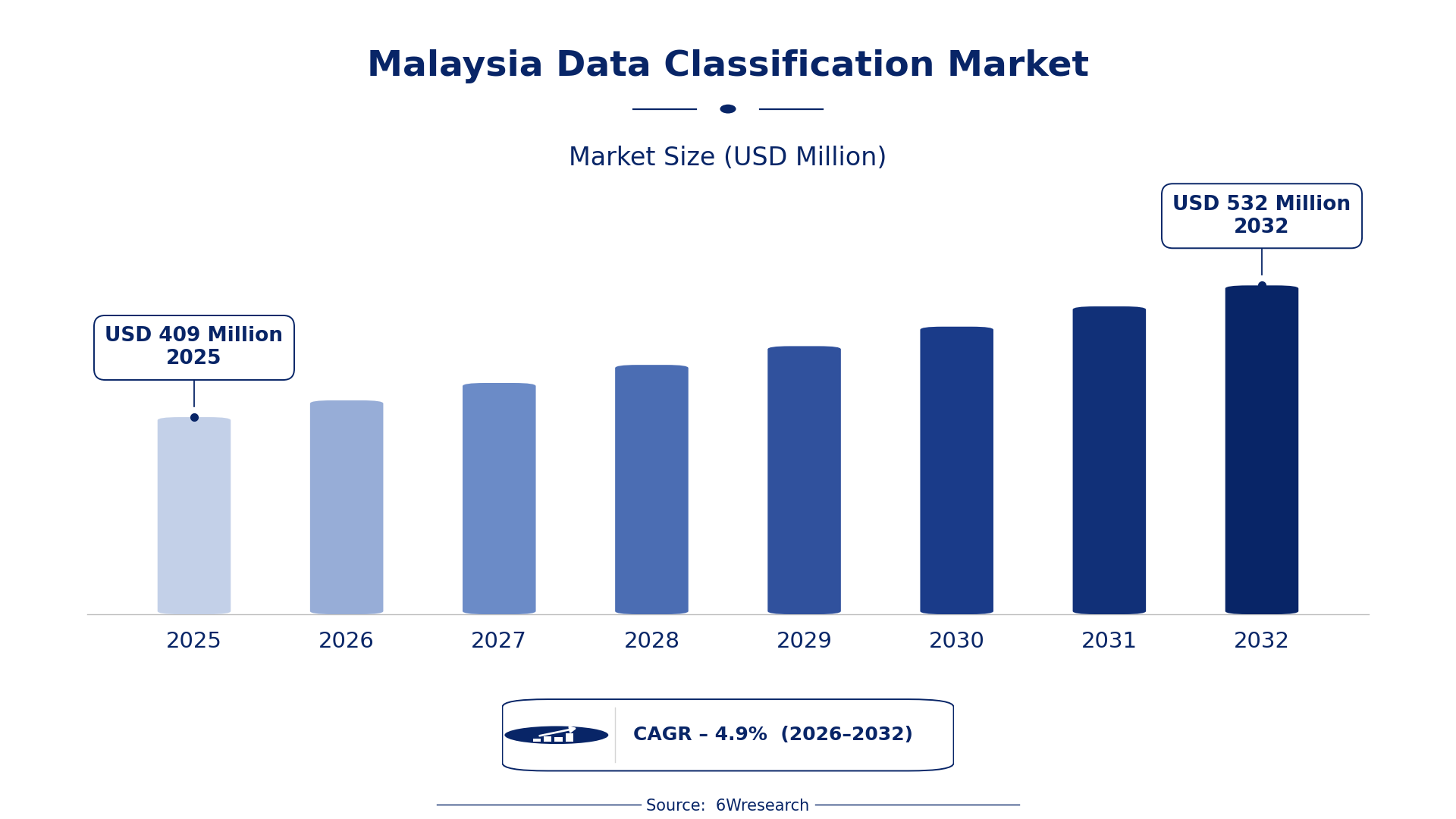
The Malaysia Data Classification Market was estimated at USD 409 Million in 2025 and is projected to reach USD 532 Million by 2032, growing at a CAGR of 4.9% from 2026 to 2032.
Malaysia Data Classification Market Synopsis
The Malaysia Data Classification Market is experiencing notable growth as organizations realize the importance of effectively organizing and securing their data assets. With an unprecedented surge in data generation, businesses are compelled to adopt data classification solutions for better management, compliance, and protection of sensitive information.
As concerns about data breaches and regulatory compliance continue to escalate, organizations are prioritizing the classification of their data. This trend underscores the crucial role that data classification plays in safeguarding critical assets and driving a strategic approach to data governance.
Malaysia Data Classification Market Year-wise Growth Rate and Key Drivers
This graph illustrates the annual growth rates of the Malaysia Data Classification Market from 2021 to 2032, highlighting a steady upward trajectory and projected expansion over the forecast period.
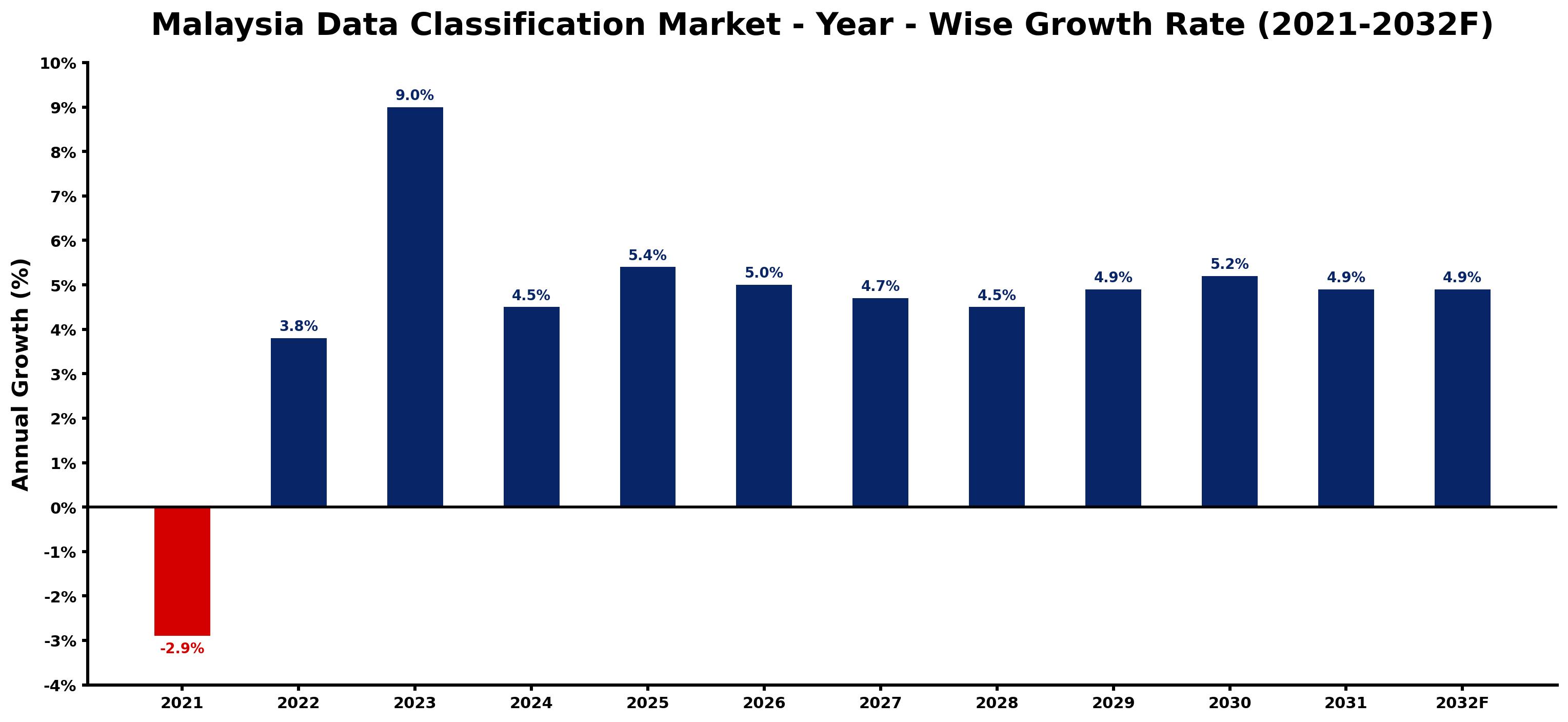
The table below presents the year‑wise growth rates along with the key drivers influencing the market
| Year | Growth Rate | Major Drivers |
| 2021 | -2.9% | MySejahtera app security concerns deterred user adoption. |
| 2022 | 3.8% | Cybersecurity policy strengthening by CyberSecurity Malaysia agency |
| 2023 | 9.0% | Increased demand for compliance with Personal Data Protection Act |
| 2024 | 4.5% | Growth in cloud adoption driving data security needs |
| 2025 | 5.4% | Government push for digital economy initiatives accelerates data management |
| 2026 | 5.0% | Rise in data breaches increases need for classification services |
| 2027 | 4.7% | Adoption of AI technologies necessitates enhanced data governance |
| 2028 | 4.5% | Emergence of fintech sector boosts data protection requirements |
| 2029 | 4.9% | Growing awareness of data privacy fuels classification demand |
| 2030 | 5.2% | Regulatory changes promote stricter data handling protocols |
| 2031 | 4.9% | Local firms investing more in data-driven decision making |
| 2032 | 4.9% | E-commerce growth drives need for categorized customer data |
Note: Market size estimations and growth projections presented in this report are based on 6Wresearch's proprietary forecasting methodology, utilizing the latest available industry data, government publications, and primary research inputs.
Malaysia Data Classification Market Key Takeaways
Below are some of the specific key takeaways from the market, including:
- The increasing volume of unstructured data is intensifying the demand for effective classification solutions.
- Compliance with regulations is a major driving force behind the adoption of data classification strategies.
- Organizations are increasingly investing in training and resources to overcome user resistance to data classification.
- COVID-19 has accelerated the emphasis on remote data access and management, pushing data classification to the forefront.
- Local technology providers are emerging as significant contributors to the market's growth trajectory.
Evaluation of Restraints in Malaysia Data Classification Market
Despite the growth potential, several restraints hinder the Malaysia Data Classification Market. A primary challenge is the complex nature of effectively classifying vast amounts of unstructured data across diverse storage systems. Many organizations struggle with implementing consistent data classification protocols, leading to gaps in compliance and protection. Additionally, user resistance to changes in data handling practices often slows down the adoption of classification solutions. Addressing these hurdles is essential for realizing the market's full potential.
Malaysia Data Classification Market Trends
Key trends are shaping the Malaysia Data Classification Market, including heightened awareness of cybersecurity threats and a push towards automation in classification processes. Businesses are now seeking solutions that integrate machine learning and artificial intelligence to streamline classification efforts and improve accuracy. As organizations transition to cloud environments, there's also a marked increase in demand for classification tools that cater to hybrid data environments, ensuring compliance and security across various platforms.
Malaysia Data Classification Market Opportunities
Growth opportunities abound within the Malaysia Data Classification Market. As regulatory frameworks become more stringent, enterprises are looking for ways to enhance compliance measures through robust data classification systems. The rise of advanced analytics and automated classification tools presents businesses with the chance to innovate and improve their data governance frameworks. on top of that, local partnerships between technology firms and organizations are expected to foster the development of tailored solutions, creating new avenues for investment.
Government Initiatives in the Malaysia Data Classification Market
Government policies are playing a critical role in shaping the Malaysia Data Classification Market. Recognizing the urgency of data security, authorities are implementing regulations and frameworks to guide organizations in the effective classification of sensitive information. This proactive approach is essential for maintaining compliance and ensuring that businesses are equipped to handle data responsibly and securely.
- A recent initiative launched by the Malaysian government focused on enhancing data protection regulations in response to rising cybersecurity threats.
- Current ongoing efforts include the establishment of a national data governance framework aimed at standardizing classification practices across various industries.
- A planned public-private partnership is set to introduce specialized training programs for employees on effective data classification and management by 2026.
- Ongoing collaboration between regulatory bodies and technology providers seeks to create resources for businesses to better understand compliance requirements.
Future Insights of the Malaysia Data Classification Market
From 2026 to 2032, the Malaysia Data Classification Market is expected to evolve significantly. As data continues to proliferate, organizations will increasingly recognize the value of sophisticated classification solutions that not only enhance security but also provide actionable insights. The focus will shift from merely compliance to strategic data governance, where classification becomes integral to business intelligence and decision-making processes. As a result, we can anticipate a market characterized by innovation and tailored solutions addressing the unique challenges faced by Malaysian enterprises.
Malaysia Data Classification Market Latest Developments
In the last 12-14 months, the Malaysia Data Classification Market has seen several noteworthy developments as organizations ramp up their efforts to secure data and comply with regulations. Companies are increasingly integrating advanced technology into their classification processes, while public policies are evolving to support these initiatives.
- A major technology vendor launched a cloud-based data classification solution in early 2023, designed to enhance data security for enterprises transitioning to cloud infrastructure.
- In mid-2023, a local firm initiated a partnership with international cybersecurity experts to develop customized classification tools targeting the Malaysian market.
- A regulatory framework mandating stricter data classification protocols was introduced in late 2022, with organizations currently adapting to new compliance standards.
- Ongoing outreach programs by government agencies aim to educate businesses on the importance of data classification, enhancing awareness throughout 2023.
Malaysia Data Classification Market - Key Attractiveness of the Report
- 10 Years of Market Numbers
- Historical Data Starting from 2022 to 2025
- Base Year: 2025
- Forecast Data until 2032
- Key Performance Indicators Impacting the Market
- Major Upcoming Developments and Projects
Key Highlights of the Report:
- Malaysia Data Classification Market Outlook
- Market Size of Malaysia Data Classification Market, 2025
- Forecast of Malaysia Data Classification Market, 2032
- Historical Data and Forecast of Malaysia Data Classification Revenues & Volume for the Period 2022-2032F
- Malaysia Data Classification Market Trend Evolution
- Malaysia Data Classification Market Drivers and Challenges
- Malaysia Data Classification Price Trends
- Malaysia Data Classification Porter's Five Forces
- Malaysia Data Classification Industry Life Cycle
- Historical Data and Forecast of Malaysia Data Classification Market Revenues & Volume By Component for the Period 2022-2032F
- Historical Data and Forecast of Malaysia Data Classification Market Revenues & Volume By Solutions (Standalone and Integrated) for the Period 2022-2032F
- Historical Data and Forecast of Malaysia Data Classification Market Revenues & Volume By Services for the Period 2022-2032F
- Historical Data and Forecast of Malaysia Data Classification Market Revenues & Volume By Application for the Period 2022-2032F
- Historical Data and Forecast of Malaysia Data Classification Market Revenues & Volume By Access Control for the Period 2022-2032F
- Historical Data and Forecast of Malaysia Data Classification Market Revenues & Volume By GRC for the Period 2022-2032F
- Historical Data and Forecast of Malaysia Data Classification Market Revenues & Volume By Web for the Period 2022-2032F
- Historical Data and Forecast of Malaysia Data Classification Market Revenues & Volume By Mobile & Email Protection for the Period 2022-2032F
- Historical Data and Forecast of Malaysia Data Classification Market Revenues & Volume By Centralized Management for the Period 2022-2032F
- Historical Data and Forecast of Malaysia Data Classification Market Revenues & Volume By Methodology for the Period 2022-2032F
- Historical Data and Forecast of Malaysia Data Classification Market Revenues & Volume By Content-based Classification for the Period 2022-2032F
- Historical Data and Forecast of Malaysia Data Classification Market Revenues & Volume By Context-based Classification for the Period 2022-2032F
- Historical Data and Forecast of Malaysia Data Classification Market Revenues & Volume By User-based Classification for the Period 2022-2032F
- Historical Data and Forecast of Malaysia Data Classification Market Revenues & Volume By Vertical for the Period 2022-2032F
- Historical Data and Forecast of Malaysia Data Classification Market Revenues & Volume By BFSI for the Period 2022-2032F
- Historical Data and Forecast of Malaysia Data Classification Market Revenues & Volume By Healthcare and Lifesciences for the Period 2022-2032F
- Historical Data and Forecast of Malaysia Data Classification Market Revenues & Volume By Government and Defense for the Period 2022-2032F
- Historical Data and Forecast of Malaysia Data Classification Market Revenues & Volume By Education for the Period 2022-2032F
- Historical Data and Forecast of Malaysia Data Classification Market Revenues & Volume By Telecom for the Period 2022-2032F
- Historical Data and Forecast of Malaysia Data Classification Market Revenues & Volume By Media and Entertainment for the Period 2022-2032F
- Historical Data and Forecast of Malaysia Data Classification Market Revenues & Volume By Others (Retail and Ecommerce, Manufacturing, and Energy and Utilities) for the Period 2022-2032F
- Malaysia Data Classification Import Export Trade Statistics
- Market Opportunity Assessment By Component
- Market Opportunity Assessment By Application
- Market Opportunity Assessment By Methodology
- Market Opportunity Assessment By Vertical
- Malaysia Data Classification Top Companies Market Share
- Malaysia Data Classification Competitive Benchmarking By Technical and Operational Parameters
- Malaysia Data Classification Company Profiles
- Malaysia Data Classification Key Strategic Recommendations






































