Malaysia Delicatessen Meats Market Summary
The malaysia delicatessen meats market was estimated at USD 497 Million in 2025 and is projected to reach USD 645 Million by 2032, growing at a CAGR of 5.1% from 2026 to 2032.
Malaysia Delicatessen Meats Market Year-wise Growth Rate and Key Drivers
This graph highlights how the Malaysia Delicatessen Meats Market has steadily grown over the past five years, supported by major growth factors.
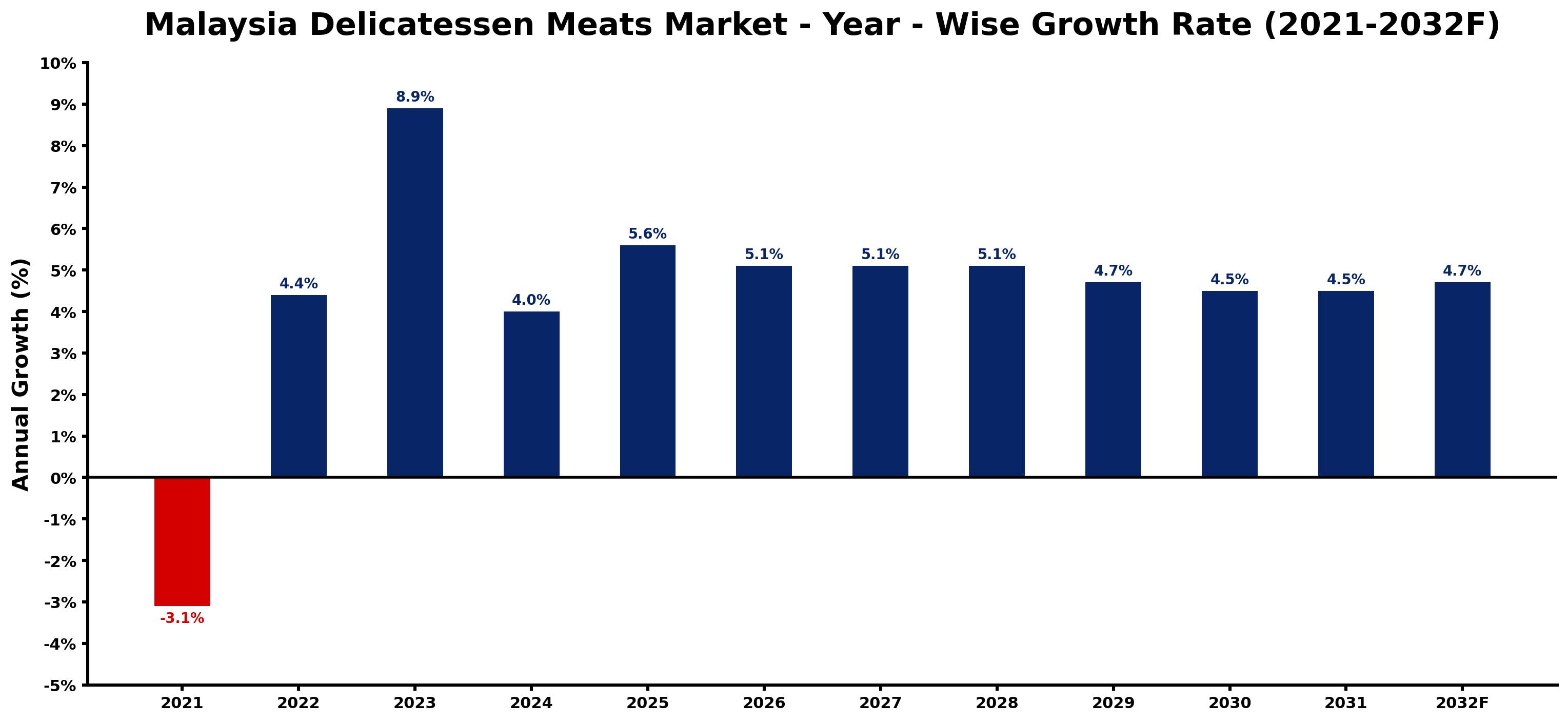
The table below presents the year wise growth rates along with the key drivers influencing the market
| Year | Growth Rate | Major Drivers |
| 2021 | -3.1% | Heightened health concerns over processed meats led to a shift towards plantbased alternatives among consumers. |
| 2022 | 4.4% | Emerging food trends highlighted the significance of local sourcing and organic options. |
| 2023 | 8.9% | Culinary tourism's growth amplified the demand for traditional Malaysian delicatessen meats. |
| 2024 | 4.0% | Health-conscious consumers increasingly gravitated towards leaner, preservative-free meat options. |
| 2025 | 5.6% | Expanding e-commerce platforms facilitated easier access to specialty delicatessen products. |
| 2026 | 5.1% | Cultural diversity within Malaysia created a rich tapestry for unique meat offerings. |
| 2027 | 5.1% | Artisan producers began collaborating with chefs to enhance product visibility and prestige. |
| 2028 | 5.1% | Social media influencers played a pivotal role in promoting delicatessen brands' visibility. |
| 2029 | 4.7% | Sustainability concerns sparked interest in ethically-raised and environmentally-friendly meat varieties. |
| 2030 | 4.5% | Innovative packaging solutions emerged, extending shelf life and improving product presentation. |
| 2031 | 4.5% | The rise in home cooking led to increased experimentation with delicatessen meats. |
| 2032 | 4.7% | Fragmented retail landscapes prompted local delicatessens to adapt and thrive amid competition. |
Note - Market size estimations and growth projections presented in this report are based on 6Wresearch's advanced forecasting approach, validated with industry datasets as of June 2026.
Malaysia Delicatessen Meats Market Synopsis
The Malaysia Delicatessen Meats Market is projected to reach 5.1% and witness significant growth during the forecast period (2026-2032). The growth trajectory of the market is shaped by the increasing consumer demand for processed snack foods, ready-to-eat meals, and convenience food products. Millennials are particularly influencing market trends with their heightened health consciousness, steering choices towards healthier variants such as low-fat or reduced-salt options. The industry's response has been to innovate with delicious yet nutritious offerings, an endeavor that further stimulates market expansion.
Malaysia Delicatessen Meats Market Growth Drivers
Several key factors are driving the growth of the Malaysia Delicatessen Meats Market. First, the rise in urbanization has led to changing dietary habits, with consumers increasingly seeking out convenient meal options that fit their busy lifestyles. Second, the popularity of international cuisines has boosted demand for diverse delicatessen meat products, enhancing the market's appeal. Third, evolving retail landscapes, with the proliferation of modern grocery stores and online shopping platforms, have made these products more accessible to consumers. Fourth, health trends are prompting manufacturers to fortify their offerings with added nutrients, catering to a health-conscious demographic. Lastly, effective marketing strategies and promotional activities are enhancing product visibility and consumer engagement.
Malaysia Delicatessen Meats Market Challenges and Restraints
Despite the favorable growth outlook, the Malaysia Delicatessen Meats Market faces several challenges. The high production costs associated with premium-quality delicatessen meats can deter price-sensitive consumers. Additionally, growing concerns regarding animal welfare and ethical sourcing practices may impact consumer perceptions and purchasing decisions. The market also grapples with instances of adulterated meat and fish being sold under well-known brand names, which can undermine consumer trust and adversely affect sales. Moreover, maintaining the balance between taste and health aspects in product development presents a constant challenge for manufacturers aiming to meet diverse consumer preferences.
Malaysia Delicatessen Meats Market Trends and Opportunities
The Malaysia Delicatessen Meats Market is poised to capitalize on various emerging trends and opportunities. The rising trend of meal customization among consumers opens avenues for delicatessen meats to be offered as part of tailored meal solutions. Additionally, there is a growing demand for premium and artisanal delicatessen products, which can drive innovation in flavors and preparation methods. The expansion of health-focused products, such as organic and preservative-free options, presents an opportunity for brands to appeal to a more discerning consumer base. Furthermore, advancements in packaging technology that extend shelf life while maintaining quality can enhance product appeal and reduce food waste. Lastly, fostering partnerships with local producers can enhance the authenticity and freshness of offerings, thereby improving market positioning.
Malaysia Delicatessen Meats Market Government Investment and Initiatives
Government investment and initiatives play a pivotal role in the Malaysia Delicatessen Meats Market. Policymakers have recognized the importance of the food sector in promoting economic growth and food security. Various development plans are underway to enhance food processing capabilities and improve supply chain logistics, thereby supporting rapid market growth. Additionally, incentives for adopting sustainable practices within the delicatessen meat sector are encouraging manufacturers to focus on ethical sourcing and production methods. The government is also investing in public health campaigns aimed at raising awareness of balanced diets, which indirectly supports the market by emphasizing the inclusion of quality protein sources such as delicatessen meats. Overall, these initiatives are expected to create a conducive environment for market players to thrive.
Malaysia Delicatessen Meats Market Latest Developments (May 2025 - June 2026)
The period from May 2025 to June 2026 has seen a flurry of activity within the Malaysia Delicatessen Meats Market, indicative of ongoing industry evolution. Innovations in product formulations have been noted, with several companies introducing plant-based or hybrid meat products to cater to shifting consumer preferences. There has also been an uptick in collaborations between producers and food technology firms aimed at enhancing product safety and quality. Retailers have shifted focus towards e-commerce platforms, leading to the establishment of direct-to-consumer sales channels that provide convenience and broaden reach. Moreover, sustainability initiatives have gained momentum, with a noticeable push towards eco-friendly packaging solutions. These developments collectively indicate a dynamic sector adapting to contemporary consumer demands and market dynamics.
Malaysia Delicatessen Meats Market - Key Attractiveness of the Report
- 10 Years of Market Numbers
- Historical Data Starting from 2022 to 2025
- Base Year: 2025
- Forecast Data until 2032
- Key Performance Indicators Impacting the Market
- Major Upcoming Developments and Projects
Key Highlights of the Report:
- Malaysia Delicatessen Meats Market Outlook
- Market Size of Malaysia Delicatessen Meats Market, 2025
- Forecast of Malaysia Delicatessen Meats Market, 2032F
- Historical Data and Forecast of Malaysia Delicatessen Meats Revenues & Volume for the Period 2022-2032F
- Malaysia Delicatessen Meats Market Trend Evolution
- Malaysia Delicatessen Meats Market Drivers and Challenges
- Malaysia Delicatessen Meats Price Trends
- Malaysia Delicatessen Meats Porter's Five Forces
- Malaysia Delicatessen Meats Industry Life Cycle
- Historical Data and Forecast of Malaysia Delicatessen Meats Market Revenues & Volume By Product Type for the Period 2022-2032F
- Historical Data and Forecast of Malaysia Delicatessen Meats Market Revenues & Volume By Cured deli meat for the Period 2022-2032F
- Historical Data and Forecast of Malaysia Delicatessen Meats Market Revenues & Volume By Uncured deli meat for the Period 2022-2032F
- Historical Data and Forecast of Malaysia Delicatessen Meats Market Revenues & Volume By Applications for the Period 2022-2032F
- Historical Data and Forecast of Malaysia Delicatessen Meats Market Revenues & Volume By Restaurant for the Period 2022-2032F
- Historical Data and Forecast of Malaysia Delicatessen Meats Market Revenues & Volume By Customer for the Period 2022-2032F
- Historical Data and Forecast of Malaysia Delicatessen Meats Market Revenues & Volume By Retailer for the Period 2022-2032F
- Historical Data and Forecast of Malaysia Delicatessen Meats Market Revenues & Volume By Others for the Period 2022-2032F
- Malaysia Delicatessen Meats Import Export Trade Statistics
- Market Opportunity Assessment By Product Type
- Market Opportunity Assessment By Applications
- Malaysia Delicatessen Meats Top Companies Market Share
- Malaysia Delicatessen Meats Competitive Benchmarking By Technical and Operational Parameters
- Malaysia Delicatessen Meats Company Profiles
- Malaysia Delicatessen Meats Key Strategic Recommendations






































