Malaysia Digital Market Size & Growth Rate (2026-2032)
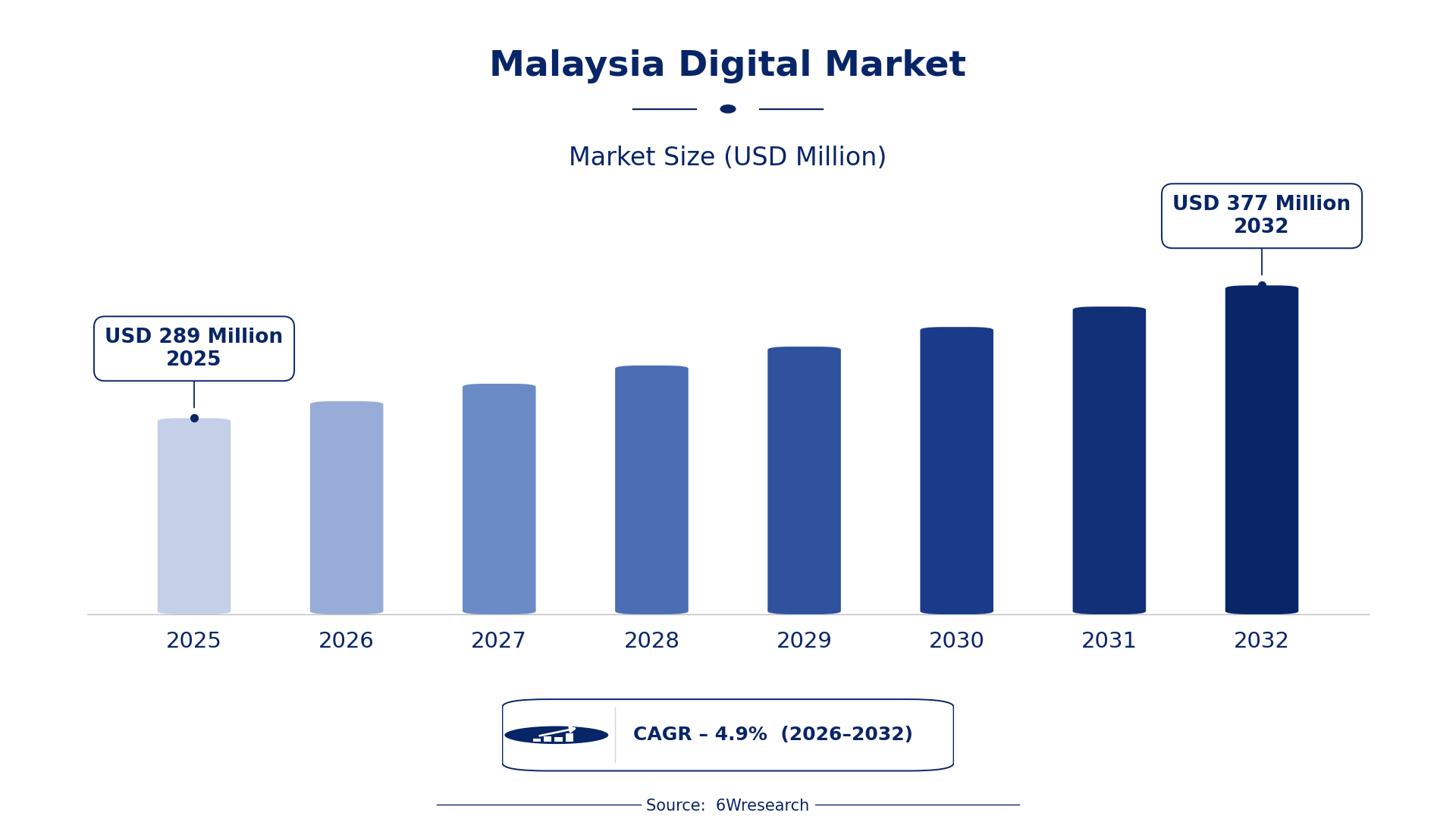
The Malaysia Digital Market was estimated at USD 289 Million in 2025 and is projected to reach USD 377 Million by 2032, growing at a CAGR of 4.9% from 2026 to 2032.
Malaysia Digital Market Synopsis
The primary force driving the Malaysia Digital Market is the rapid increase in internet penetration, connecting a greater portion of the population to digital services and platforms. This connectivity is facilitating a shift in consumer behavior, pushing businesses to adapt and innovate in response to rising digital demand.
Additionally, the government's commitment to digital transformation, especially through initiatives related to Industry 4.0, is creating a fertile ground for growth. As businesses increasingly adopt digital technologies, the market is evolving, presenting both opportunities and challenges for all stakeholders involved.
Malaysia Digital Market Year-wise Growth Rate and Key Drivers
This graph illustrates the annual growth rates of the Malaysia Digital Market from 2021 to 2032, highlighting a steady upward trajectory and projected expansion over the forecast period.
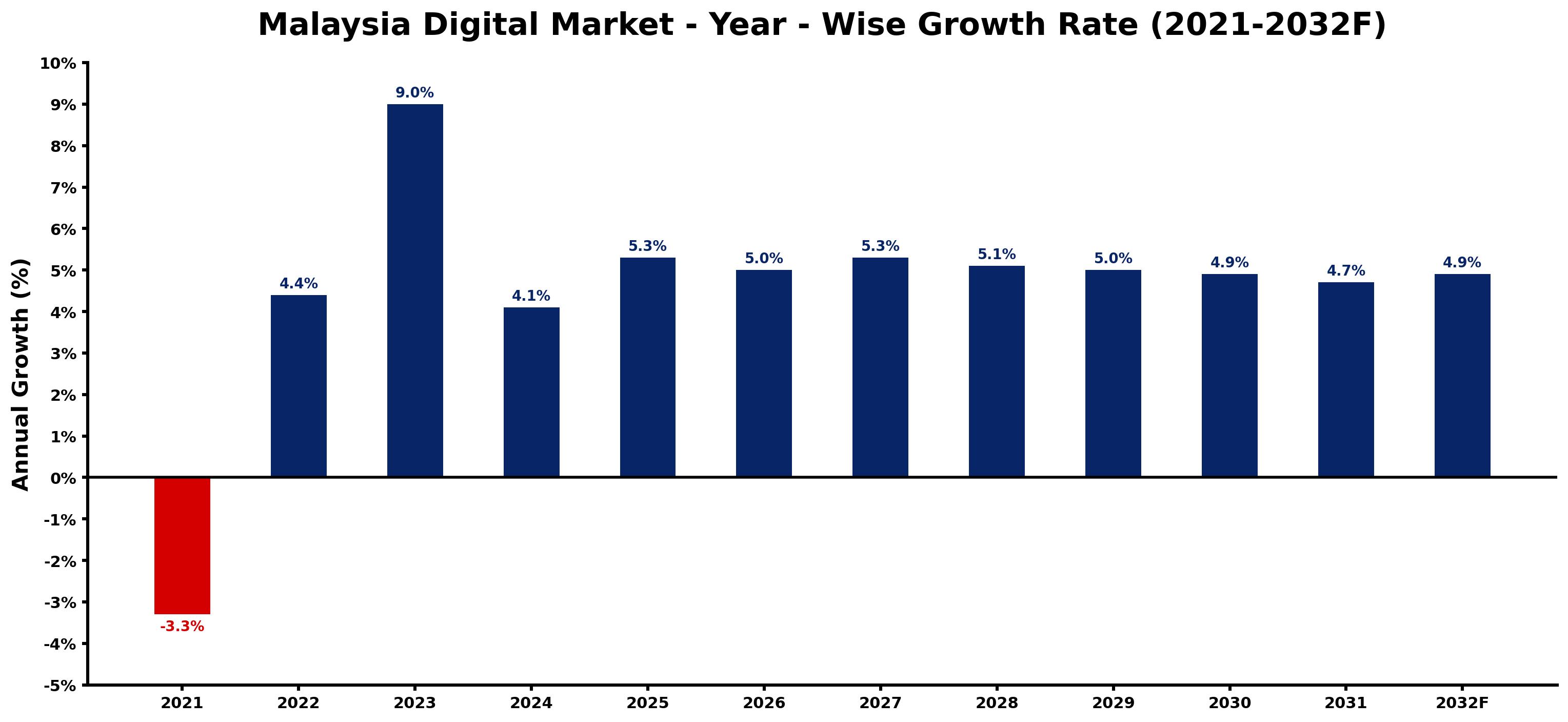
The table below presents the year‑wise growth rates along with the key drivers influencing the market
| Year | Growth Rate | Major Drivers |
| 2021 | -3.3% | MCO restrictions limited e-commerce's growth potential. |
| 2022 | 4.4% | Boost from Malaysia's JENDELA broadband plan implementation |
| 2023 | 9.0% | Growing interest in fintech innovations post-COVID recovery |
| 2024 | 4.1% | Surge in mobile payment adoption among Malaysian consumers |
| 2025 | 5.3% | Government's Digital Economy Blueprint enhancing local startups |
| 2026 | 5.0% | Rise in digital content consumption amid changing lifestyles |
| 2027 | 5.3% | Increased digital marketing spending by local businesses |
| 2028 | 5.1% | Interest in e-sports and online gaming expanding user base |
| 2029 | 5.0% | Enhancements in cybersecurity regulations fostering online activity |
| 2030 | 4.9% | Investment in digital infrastructure by Malaysian tech firms |
| 2031 | 4.7% | Increase in remote working driving demand for collaboration tools |
| 2032 | 4.9% | Growing trend of social commerce among younger demographics |
Note: Market size estimations and growth projections presented in this report are based on 6Wresearch's proprietary forecasting methodology, utilizing the latest available industry data, government publications, and primary research inputs.
Malaysia Digital Market Key Takeaways
Below are some of the specific key takeaways from the market, including:
- The digital market is significantly influenced by the high rate of internet connectivity across Malaysia.
- Government policies are actively promoting digital adoption and innovation across various sectors.
- The e-commerce sector is growing rapidly, particularly among younger consumers.
- Digital transformation is reshaping traditional business models and consumer interactions.
- Cybersecurity remains a critical focus area as businesses transition to digital platforms.
Evaluation of Restraints in Malaysia Digital Market
Despite its growth potential, the Malaysia Digital Market faces several restraints. Resistance to change within organizations can hinder digital transformation efforts, as employees and management may be reluctant to adapt to new technologies. on top of that, integrating legacy systems with modern digital solutions poses a considerable challenge. Companies must also grapple with persistent cybersecurity threats, which require ongoing vigilance and investment in protective measures. In this competitive environment, standing out and retaining customer loyalty is an ongoing battle for businesses.
Malaysia Digital Market Trends
Key trends are emerging in the Malaysia Digital Market, including the increasing use of artificial intelligence and machine learning to enhance customer experiences and streamline operations. E-commerce continues to thrive, driven by a tech-savvy younger demographic, while mobile app development sees accelerated growth. The rise of digital payment solutions is also shaping consumer preferences, making transactions easier and more secure.
Malaysia Digital Market Opportunities
The market presents numerous opportunities for investment and growth. Businesses can capitalize on the expanding e-commerce sector by developing innovative online platforms and services. Additionally, the demand for cloud computing solutions is on the rise as companies seek scalable and efficient infrastructure. There is also a growing need for cybersecurity solutions, which opens avenues for specialized service providers to offer protection against evolving threats.
Government Initiatives in the Malaysia Digital Market
The Malaysian government is actively fostering a conducive environment for digital growth through various initiatives. Regulatory frameworks and public policies are designed to enhance digital transformation across industries, which is crucial for the country's economic evolution. By focusing on technology adoption and innovation, the government is laying the groundwork for a vibrant digital economy.
- A recently completed national digital infrastructure upgrade program aimed at enhancing connectivity across rural and urban areas.
- Current initiatives include ongoing support for digital skills training programs targeting the workforce to better equip them for the digital age.
- Planned initiatives involve a public-private partnership aimed at expanding access to high-speed internet by 2028.
- The establishment of a regulatory framework in 2025 to ensure transparency and fairness in digital transactions.
- Upcoming policies designed to promote investment in emerging technologies, such as AI and IoT, are expected to be introduced by 2026.
Future Insights of the Malaysia Digital Market
Looking ahead to 2026-2032, the Malaysia Digital Market is set for continued growth, driven by rising internet penetration and government support. The push for digital transformation will likely create new business models and revenue streams, particularly in e-commerce and digital services. As consumer behavior shifts toward online platforms, businesses that embrace innovation and adaptability will find themselves at the forefront of this burgeoning market.
Malaysia Digital Market Latest Developments
Recent developments in the Malaysia Digital Market indicate a strong momentum in technology adoption and digital services. Over the past year, businesses have accelerated their digital initiatives in response to shifting consumer demands and competitive pressures.
- A leading technology provider launched a new e-commerce platform in early 2025, aiming to enhance user experience and streamline transactions.
- An initiative began in mid-2025 to implement advanced analytics tools in local businesses, enhancing their operational efficiency.
- A major telecommunications operator is currently expanding its 5G infrastructure, with the rollout expected to continue through 2026.
- Upcoming plans for a comprehensive digital marketing strategy were announced by a prominent regional company, scheduled to begin in late 2026.
- A recent partnership between a major financial service provider and a tech firm aims to enhance digital payment solutions, initiated in Q2 2025.
Malaysia Digital Market - Key Attractiveness of the Report
- 10 Years of Market Numbers
- Historical Data Starting from 2022 to 2025
- Base Year: 2025
- Forecast Data until 2032
- Key Performance Indicators Impacting the Market
- Major Upcoming Developments and Projects
Key Highlights of the Report:
- Malaysia Digital Market Outlook
- Market Size of Malaysia Digital Market, 2025
- Forecast of Malaysia Digital Market, 2032
- Historical Data and Forecast of Malaysia Digital Revenues & Volume for the Period 2022-2032F
- Malaysia Digital Market Trend Evolution
- Malaysia Digital Market Drivers and Challenges
- Malaysia Digital Price Trends
- Malaysia Digital Porter's Five Forces
- Malaysia Digital Industry Life Cycle
- Historical Data and Forecast of Malaysia Digital Market Revenues & Volume By Software for the Period 2022-2032F
- Historical Data and Forecast of Malaysia Digital Market Revenues & Volume By CRM Software for the Period 2022-2032F
- Historical Data and Forecast of Malaysia Digital Market Revenues & Volume By Email Marketing Software for the Period 2022-2032F
- Historical Data and Forecast of Malaysia Digital Market Revenues & Volume By Social Media Advertising for the Period 2022-2032F
- Malaysia Digital Import Export Trade Statistics
- Market Opportunity Assessment By Software
- Malaysia Digital Top Companies Market Share
- Malaysia Digital Competitive Benchmarking By Technical and Operational Parameters
- Malaysia Digital Company Profiles
- Malaysia Digital Key Strategic Recommendations






































