Malaysia Donkey Milk Market Size, Share & Growth Rate
The Malaysia Donkey Milk Market was estimated at USD 177 Million in 2025 and is projected to reach USD 229 Million by 2032, growing at a CAGR of 3.7% from 2026 to 2032. This growth trajectory is driven by a burgeoning interest in alternative dairy products, spurred by consumers increasing awareness of the nutritional advantages of donkey milk. The market's expansion is complemented by its rising incorporation into health-oriented skincare products, further appealing to health-conscious consumers.
Malaysia Donkey Milk Market Year-wise Growth Rate and Key Drivers
This graph highlights how the Malaysia Donkey Milk Market has steadily grown over the years, supported by major growth factors.
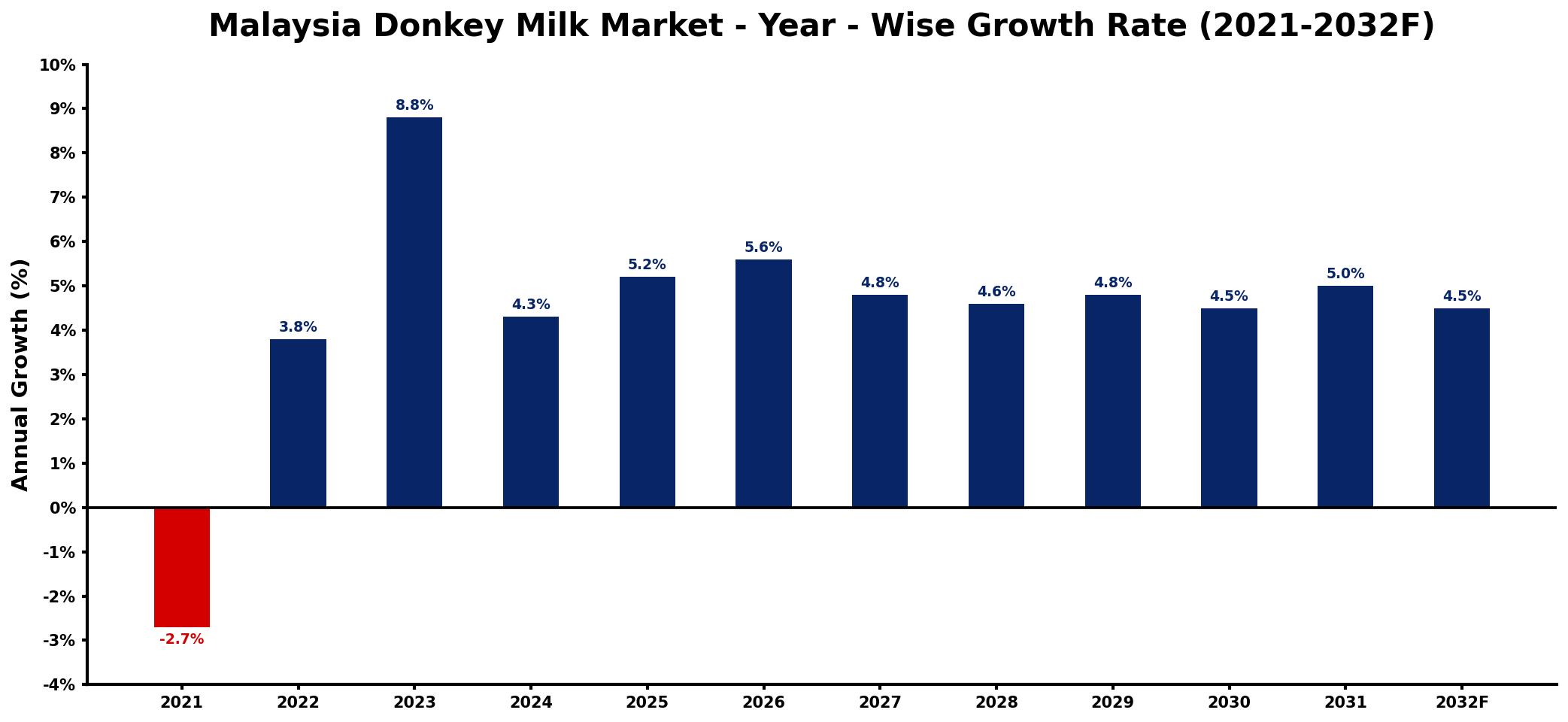
The table below presents the year‑wise growth rates along with the key drivers influencing the market
| Year | Growth Rate | Major Drivers |
| 2021 | -2.7% | Consumer interest in alternatives declines |
| 2022 | 3.8% | Emerging wellness trends drive demand |
| 2023 | 8.8% | Increased health awareness among consumers |
| 2024 | 4.3% | Rise in organic product popularity |
| 2025 | 5.2% | Expansion of retail distribution channels |
| 2026 | 5.6% | Investment in sustainable farming practices |
| 2027 | 4.8% | Growing global market for alternatives |
| 2028 | 4.6% | Enhanced marketing strategies boost sales |
| 2029 | 4.8% | Collaboration with health professionals increases |
| 2030 | 4.5% | Diversification of product offerings expands |
| 2031 | 5.0% | Increased online shopping convenience enhances |
| 2032 | 4.5% | Rising interest in nutritional benefits |
Note: Market size estimations and growth projections presented in this report are based on 6Wresearch's proprietary forecasting methodology, utilizing the latest available industry data, government publications, and primary research inputs.
Malaysia Donkey Milk Market Synopsis
The unique nutritional profile of donkey milk positions it as a desirable alternative to more conventional dairy options in Malaysia. Rich in vitamins, minerals, and antioxidants, its appeal is bolstered by a growing segment of the population seeking natural and organic food sources.
Moreover, the cosmetic sector is increasingly turning to donkey milk for its purported skin benefits, which is enhancing its market presence. However, the challenges related to limited production capabilities and distribution systems pose significant hurdles that require attention for sustained growth.
Malaysia Donkey Milk Market Key Takeaways
- The market is increasingly recognized for its health benefits and nutritional richness.
- Demand for natural and organic products continues to drive market growth.
- Cosmetic applications are emerging as a significant source of demand.
- Production capacity and distribution remain key challenges for expansion.
- Consumer education on the benefits of donkey milk is essential for market penetration.
Evaluation of Restraints in Malaysia Donkey Milk Market
Despite promising growth, the Malaysia Donkey Milk Market faces real constraints that inhibit its potential. Ethical treatment of donkeys is paramount; consumers are increasingly conscious of animal welfare issues. Ensuring product authenticity is vital for maintaining consumer trust, especially in a niche market where misinformation can easily spread. Furthermore, a lack of robust distribution networks limits accessibility, restricting consumer exposure to donkey milk products and their benefits. As such, establishing sustainable farming practices and effectively educating consumers will be crucial in overcoming these barriers.
Malaysia Donkey Milk Market Trends
Several notable trends are currently shaping the Malaysia Donkey Milk Market. The rise in health consciousness among consumers has paved the way for alternative dairy options, with donkey milk becoming increasingly mainstream. Additionally, innovative marketing strategies, focusing on the exotic and nutrient-dense nature of donkey milk, are helping to attract a broader audience. Moreover, as more players enter the market, product diversification—from beverages to skincare—will likely enhance consumer engagement and stimulate growth.
Malaysia Donkey Milk Market Opportunities
The future of the Malaysia Donkey Milk Market holds numerous growth opportunities. With the increasing shift towards natural and organic products, there is substantial potential for expanding the product range. Companies can explore fortified versions of donkey milk or unique flavors to entice consumers. Additionally, forming partnerships with health and wellness influencers could amplify market visibility and credibility. The cosmetic industry, too, represents a lucrative opportunity as brands look to capitalize on the market's health benefits.
Government Initiatives in the Malaysia Donkey Milk Market
The Malaysian government is focusing on enhancing the agricultural sector, including niche markets like donkey milk. Public spending initiatives aim to support sustainable farming practices, ensuring ethical treatment of animals and promoting local production. There is also an emphasis on educational programs designed to increase consumer awareness regarding the nutritional benefits of donkey milk. Such initiatives can pave the way for more robust supply chains and foster a healthier market environment.
Future Insights of the Malaysia Donkey Milk Market
Looking ahead to 2026-2032, the Malaysia Donkey Milk Market is poised for continued growth, driven by rising consumer awareness and demand for alternative dairy products. As consumers become increasingly health-conscious, donkey milk's unique nutritional profile will likely attract more attention. Furthermore, as production processes become more efficient and distribution networks expand, market accessibility will improve, allowing for broader consumer engagement. Innovations in product development will also play a key role in sustaining this upward trajectory.
Malaysia Donkey Milk Market Latest Developments (2025 - 2026)
In recent months, the donkey milk market in Malaysia has experienced a noticeable uptick in consumer interest, largely driven by health trends emphasizing natural alternatives. Companies are increasingly introducing new products that highlight the unique properties of donkey milk, including fortified beverages and skincare lines. Additionally, collaborations with health experts and influencers are becoming more common, enhancing the overall market visibility and consumer trust in donkey milk products.
Malaysia Donkey Milk Market - Key Attractiveness of the Report
- 10 Years of Market Numbers
- Historical Data Starting from 2022 to 2025
- Base Year: 2025
- Forecast Data until 2032
- Key Performance Indicators Impacting the Market
- Major Upcoming Developments and Projects
Key Highlights of the Report:
- Malaysia Donkey Milk Market Outlook
- Market Size of Malaysia Donkey Milk Market, 2025
- Forecast of Malaysia Donkey Milk Market, 2032
- Historical Data and Forecast of Malaysia Donkey Milk Revenues & Volume for the Period 2022-2032F
- Malaysia Donkey Milk Market Trend Evolution
- Malaysia Donkey Milk Market Drivers and Challenges
- Malaysia Donkey Milk Price Trends
- Malaysia Donkey Milk Porter's Five Forces
- Malaysia Donkey Milk Industry Life Cycle
- Historical Data and Forecast of Malaysia Donkey Milk Market Revenues & Volume By Application for the Period 2022-2032F
- Historical Data and Forecast of Malaysia Donkey Milk Market Revenues & Volume By Cosmetics and Personal Care for the Period 2022-2032F
- Historical Data and Forecast of Malaysia Donkey Milk Market Revenues & Volume By Food & Beverages for the Period 2022-2032F
- Historical Data and Forecast of Malaysia Donkey Milk Market Revenues & Volume By Form for the Period 2022-2032F
- Historical Data and Forecast of Malaysia Donkey Milk Market Revenues & Volume By Liquid for the Period 2022-2032F
- Historical Data and Forecast of Malaysia Donkey Milk Market Revenues & Volume By Powder for the Period 2022-2032F
- Malaysia Donkey Milk Import Export Trade Statistics
- Market Opportunity Assessment By Application
- Market Opportunity Assessment By Form
- Malaysia Donkey Milk Top Companies Market Share
- Malaysia Donkey Milk Competitive Benchmarking By Technical and Operational Parameters
- Malaysia Donkey Milk Company Profiles
- Malaysia Donkey Milk Key Strategic Recommendations






































