Malaysia Edible Beans Market Size, Share & Growth Rate
The Malaysia Edible Beans Market was estimated at USD 221 Million in 2025 and is projected to reach USD 287 Million by 2032, growing at a CAGR of 3.8% from 2026 to 2032. This growth trajectory is underpinned by the increasing health consciousness among Malaysian consumers, who are gravitating towards plant-based diets rich in protein. The demand is further fueled by a diverse culinary landscape, where edible beans are embraced for their versatility in traditional and modern dishes.
Malaysia Edible Beans Market Year-wise Growth Rate and Key Drivers
This graph highlights how the Malaysia Edible Beans Market has steadily grown over the years, supported by major growth factors.
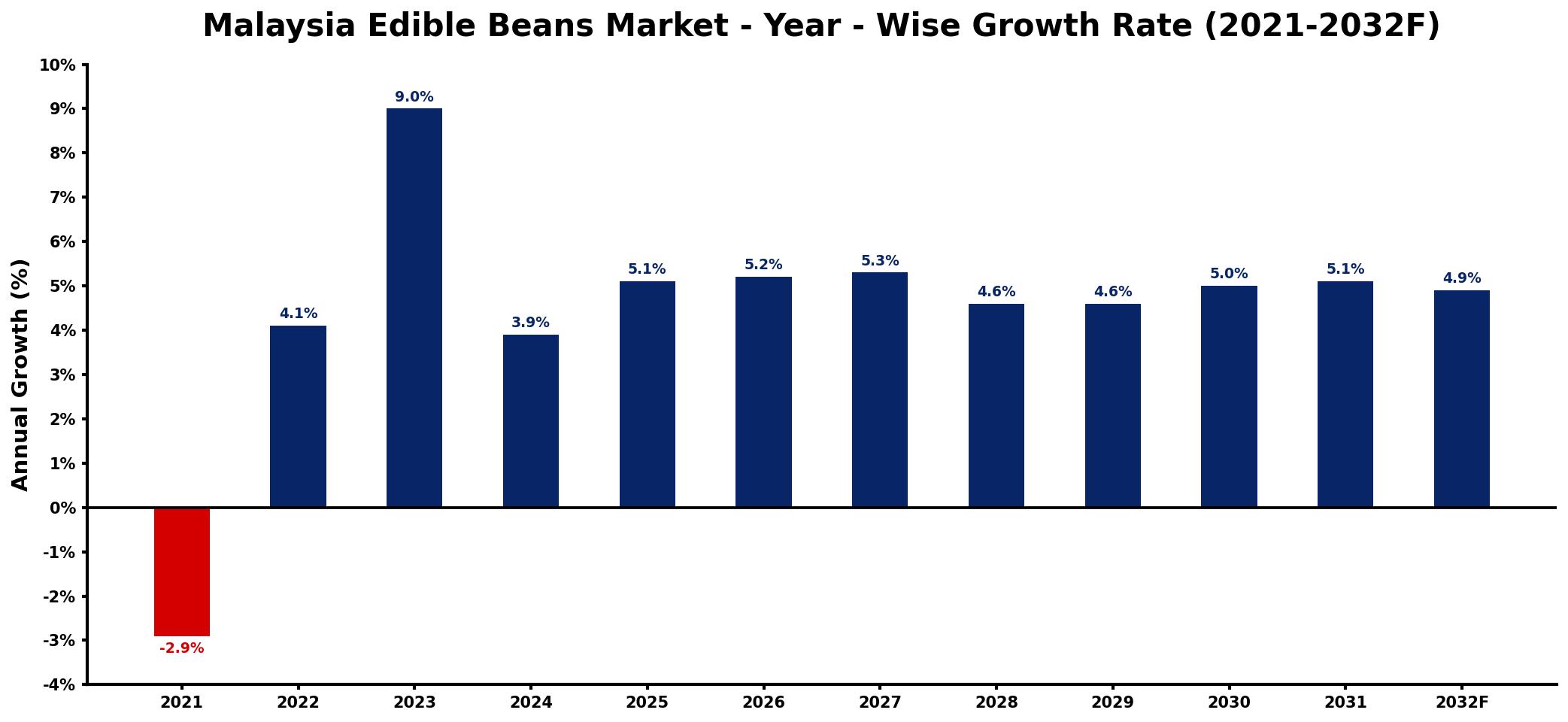
The table below presents the year‑wise growth rates along with the key drivers influencing the market
| Year | Growth Rate | Major Drivers |
| 2021 | -2.9% | decreased consumer purchasing power |
| 2022 | 4.1% | rising health consciousness among consumers |
| 2023 | 9.0% | increased investment in agriculture technology |
| 2024 | 3.9% | growing demand for plant-based proteins |
| 2025 | 5.1% | expansion of food processing facilities |
| 2026 | 5.2% | increased exports to regional markets |
| 2027 | 5.3% | growing popularity of vegetarian diets |
| 2028 | 4.6% | enhanced distribution network efficiency |
| 2029 | 4.6% | increased awareness of nutritional benefits |
| 2030 | 5.0% | strengthening underlying market demand |
| 2031 | 5.1% | development of organic farming methods |
| 2032 | 4.9% | increased capital investment inflows |
Note: Market size estimations and growth projections presented in this report are based on 6Wresearch's proprietary forecasting methodology, utilizing the latest available industry data, government publications, and primary research inputs.
Malaysia Edible Beans Market Synopsis
In Malaysia, the edible beans market is significantly reliant on imports, particularly for soybeans, kidney beans, and black beans, to satisfy local demand. This dependency reflects not only consumer preferences but also an emerging trend toward organic and sustainable farming practices as local agriculture begins to adapt to these evolving consumer needs.
As plant-based diets become increasingly popular, Malaysian consumers are recognizing the nutritional advantages of beans. Factors such as government support for agricultural development and food security further highlight the market's potential, positioning it for consistent growth in the coming years.
Malaysia Edible Beans Market Key Takeaways
- The market is primarily driven by a surge in health awareness and a shift towards plant-based protein sources.
- Malaysia's diverse cuisine is enhancing the acceptance and popularity of edible beans among consumers.
- Government initiatives aimed at improving agricultural output are expected to bolster bean production.
- Import dependence poses a challenge, prompting local growers to explore sustainable practices.
- The versatility of beans in culinary applications is crucial for sustaining their demand in the market.
Evaluation of Restraints in Malaysia Edible Beans Market
The Malaysian edible beans market faces several restraints that could limit its growth. Primarily, climate change poses a substantial risk to crop yields, making supply chain resilience a crucial consideration. Additionally, the increasing competition from alternative protein sources can shift consumer preferences away from beans, necessitating effective marketing strategies that highlight the unique benefits of beans. Compliance with food safety and quality standards also remains a top priority, especially as the market looks to expand exports.
Malaysia Edible Beans Market Trends
Several trends are emerging within the Malaysia edible beans market. Notably, the demand for organic and sustainably produced beans is rising as consumers become more environmentally conscious. Innovations in food processing are leading to new products that cater to health-focused consumers, including ready-to-eat meals featuring beans. Furthermore, the popularity of plant-based protein is being bolstered by a growing number of eateries incorporating beans into their menus, thereby enhancing their mainstream appeal.
Malaysia Edible Beans Market Opportunities
Significant growth opportunities lie within the Malaysia edible beans market for both local producers and investors. There is a notable potential for expanding organic bean farming, meeting the growing consumer demand for healthier food options. Additionally, as restaurants and food manufacturers continue to explore innovative bean-based products, the market could witness a surge in investment towards research and development in this sector. This presents an avenue for partnerships that could enhance supply chain efficiencies and product offerings.
Government Initiatives in the Malaysia Edible Beans Market
The Malaysian government has rolled out various initiatives to support the agricultural sector, particularly in promoting food security and enhancing local production capabilities. Programs aimed at improving agricultural practices through research, training, and funding are being prioritized. Furthermore, incentives for sustainable farming practices aim to increase the production of edible beans domestically, thus reducing dependency on imports and ensuring that local farmers can meet rising consumer demand.
Future Insights of the Malaysia Edible Beans Market
Looking towards 2026-2032, the Malaysia edible beans market is expected to continue its upward trajectory. Driven by consumer preferences for healthier and sustainable food options, alongside government support for agricultural innovation, the market is poised for expansion. The increasing emphasis on plant-based diets will likely open new avenues for product development, establishing beans as a staple in both home and commercial kitchens across the nation.
Malaysia Edible Beans Market Latest Developments (2025 - 2026)
In recent months, there has been a noticeable shift in the edible beans market towards product innovation, with manufacturers launching new, convenient offerings aimed at health-conscious consumers. Additionally, partnerships between local producers and international distributors are emerging, helping to improve supply chain efficiencies. The focus on sustainability has also intensified, with more growers adopting organic practices in response to consumer demand.
Malaysia Edible Beans Market - Key Attractiveness of the Report
- 10 Years of Market Numbers
- Historical Data Starting from 2022 to 2025
- Base Year: 2025
- Forecast Data until 2032
- Key Performance Indicators Impacting the Market
- Major Upcoming Developments and Projects
Key Highlights of the Report:
- Malaysia Edible Beans Market Outlook
- Market Size of Malaysia Edible Beans Market, 2025
- Forecast of Malaysia Edible Beans Market, 2032
- Historical Data and Forecast of Malaysia Edible Beans Revenues & Volume for the Period 2022-2032F
- Malaysia Edible Beans Market Trend Evolution
- Malaysia Edible Beans Market Drivers and Challenges
- Malaysia Edible Beans Price Trends
- Malaysia Edible Beans Porter's Five Forces
- Malaysia Edible Beans Industry Life Cycle
- Historical Data and Forecast of Malaysia Edible Beans Market Revenues & Volume By Product Type for the Period 2022-2032F
- Historical Data and Forecast of Malaysia Edible Beans Market Revenues & Volume By Pinto Beans for the Period 2022-2032F
- Historical Data and Forecast of Malaysia Edible Beans Market Revenues & Volume By Navy Beans for the Period 2022-2032F
- Historical Data and Forecast of Malaysia Edible Beans Market Revenues & Volume By Great Northern Beans for the Period 2022-2032F
- Historical Data and Forecast of Malaysia Edible Beans Market Revenues & Volume By Red Kidney Beans for the Period 2022-2032F
- Historical Data and Forecast of Malaysia Edible Beans Market Revenues & Volume By Black Beans for the Period 2022-2032F
- Historical Data and Forecast of Malaysia Edible Beans Market Revenues & Volume By Yellow Beans for the Period 2022-2032F
- Historical Data and Forecast of Malaysia Edible Beans Market Revenues & Volume By Others for the Period 2022-2032F
- Historical Data and Forecast of Malaysia Edible Beans Market Revenues & Volume By Distribution Channel for the Period 2022-2032F
- Historical Data and Forecast of Malaysia Edible Beans Market Revenues & Volume By Supermarket/Hypermarket for the Period 2022-2032F
- Historical Data and Forecast of Malaysia Edible Beans Market Revenues & Volume By Online Stores for the Period 2022-2032F
- Historical Data and Forecast of Malaysia Edible Beans Market Revenues & Volume By Specialty Stores for the Period 2022-2032F
- Historical Data and Forecast of Malaysia Edible Beans Market Revenues & Volume By Other for the Period 2022-2032F
- Historical Data and Forecast of Malaysia Edible Beans Market Revenues & Volume By Application for the Period 2022-2032F
- Historical Data and Forecast of Malaysia Edible Beans Market Revenues & Volume By Household for the Period 2022-2032F
- Historical Data and Forecast of Malaysia Edible Beans Market Revenues & Volume By Restaurants for the Period 2022-2032F
- Historical Data and Forecast of Malaysia Edible Beans Market Revenues & Volume By Others for the Period 2022-2032F
- Malaysia Edible Beans Import Export Trade Statistics
- Market Opportunity Assessment By Product Type
- Market Opportunity Assessment By Distribution Channel
- Market Opportunity Assessment By Application
- Malaysia Edible Beans Top Companies Market Share
- Malaysia Edible Beans Competitive Benchmarking By Technical and Operational Parameters
- Malaysia Edible Beans Company Profiles
- Malaysia Edible Beans Key Strategic Recommendations






































