Malaysia Electric Vehicle Charging Infrastructure Market Growth Rate
According to 6Wresearch internal database and industry insights, the Malaysia Electric Vehicle Charging Infrastructure Market is projected to expand at a CAGR of approximately 7.8% during 2026–2032.
Malaysia Electric Vehicle Charging Infrastructure Market Year-wise Growth Rate and Key Drivers (2022–2032)
This graph illustrates the annual growth rates of the Malaysia Electric Vehicle Charging Infrastructure Market from 2022 to 2032, highlighting gradual market development and stronger expansion during the forecast period.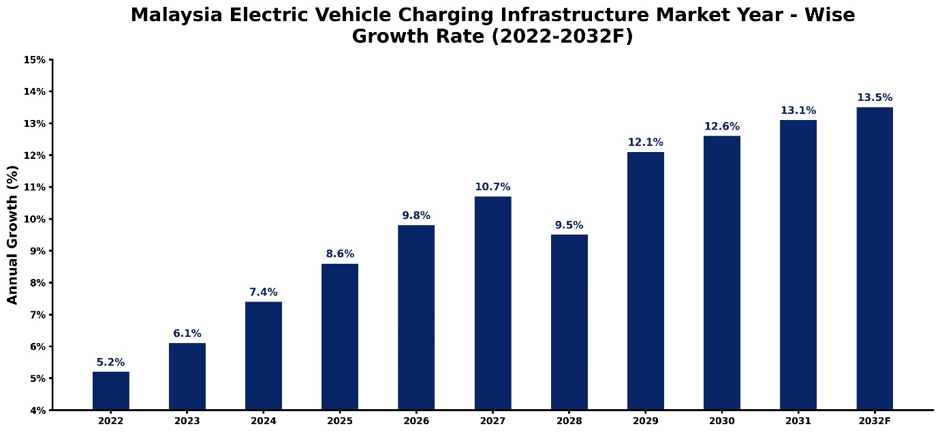 The following table presents the estimated annual growth rates of the market for each year, along with the key factors influencing market performance during the respective period. The values are intended to highlight year-wise drivers rather than provide a direct comparison between individual years.
| Year | Estimated Annual Growth (%) | Market Rationale |
| 2022 | 5.2% | Early expansion of EV adoption and government-backed charging infrastructure programs supported market development. |
| 2023 | 6.1% | Rising EV registrations and increasing investment in public charging facilities strengthened infrastructure demand. |
| 2024 | 7.4% | EV registrations increased substantially, while charging deployments expanded across major urban and highway locations. |
| 2025 | 8.6% | Continued EV adoption and the national charging-network expansion target accelerated infrastructure investment. |
| 2026 | 9.8% | Growing demand for DC fast charging and improved intercity connectivity supports market expansion. |
| 2027 | 10.7% | Expansion of charging networks beyond major urban centres increases accessibility and utilization. |
| 2028 | 9.5% | Higher EV penetration and investments in smart charging infrastructure strengthen market growth. |
| 2029 | 12.1% | Increasing deployment of high-power chargers and charging hubs supports faster market development. |
| 2030 | 12.6% | Wider EV adoption, fleet electrification, and commercial charging requirements create additional demand. |
| 2031 | 13.1% | Greater integration of digital payment, connected charging, and energy-management technologies accelerates adoption. |
| 2032 | 13.5% | A more mature EV ecosystem and nationwide charging coverage sustain long-term infrastructure expansion. |
Topics Covered in the Malaysia Electric Vehicle Charging Infrastructure Market Report
The Malaysia Electric Vehicle Charging Infrastructure Market report provides detailed analysis across Charger Types and End Consumers. The report provides detailed analysis of ongoing market trends, opportunities/high-growth areas, and market drivers that will help stakeholders align strategies based on current and future market dynamics.
Malaysia Electric Vehicle Charging Infrastructure Market Highlights
| Report Name | Malaysia Electric Vehicle Charging Infrastructure Market |
| Forecast period | 2026-2032 |
| CAGR | 7.8% |
| Growing Sector | Automotive and Transportation |
Malaysia Electric Vehicle Charging Infrastructure Market Synopsis
The Malaysia Electric Vehicle Charging Infrastructure Market is estimated to proliferate in the coming years owing to some important factors, such as the increasing EV adoption, government-supported charging targets, expanding urban mobility, and growing investment in charging networks. The market is also shifting toward faster DC charging, connected charging systems, and strategically located highway infrastructure as consumers increasingly prioritize charging availability and reduced charging time.
Evaluation of Drivers in Malaysia Electric Vehicle Charging Infrastructure Market (2026–2032)
Below mentioned are some major drivers and their influence on market dynamics:
| Market Driver | Primary Segment Affected | Why It Matters (Evidence) |
| Rapid growth in EV registrations | Public, Private | Malaysia recorded more than 28,000 EV registrations, increasing charging demand across residential, commercial, and public locations. |
| Surge of national charging infrastructure | Public | The government has maintained a target of around 10,000 charging stations, which creates opportunities for infrastructure deployment. |
| Increasing demand for DC fast charging | DC Charger | DC fast chargers are increasingly required for highways and long-distance travel where shorter charging times are important. |
| Government incentives and EV policies | Public, Private | Charging network growth is driven by EV adoption policies, charging infrastructure targets and investment incentives. |
| Growing urban and intercity EV mobility | Public | Expansion of EV use across major cities and highways is increasing the need for strategically distributed charging infrastructure. |
The Malaysia Electric Vehicle Charging Infrastructure Market is projected to grow at a CAGR of around 7.8% during 2026-2032, driven by some important factors, such as the rising EV adoption, expanding public charging networks, government targets for 10,000 charging stations, and increasing demand for convenient and faster charging solutions. Growing deployment of DC fast chargers, expansion of highway charging corridors, increasing private and workplace charging, and investments by energy and automotive companies are further supporting infrastructure development.
Evaluation of Restraints in Malaysia Electric Vehicle Charging Infrastructure Market
Below mentioned are some major restraints and their influence on market dynamics:
| Market Restraint | Primary Segment Affected | Why It Matters (Evidence) |
| High installation and equipment costs | DC Charger, Public | High-power charging infrastructure requires significant investment in equipment, grid connections, land, and maintenance. |
| Uneven charging-network distribution | Public | Charging availability remains concentrated in major urban areas, while several regions have comparatively limited infrastructure. |
| Grid capacity and electricity-management constraints | DC Charger | High-power charging can place additional pressure on local electricity networks and require grid upgrades. |
| Low utilization at selected locations | Public, Private | If charging stations are situated in low EV density locations, usage may be lower, which can extend the payback period. |
| Interoperability and payment-system fragmentation | Public | Different charging operators and platforms can create problems in locating, accessing, and paying for charging services. |
Challenges in the Malaysia Electric Vehicle Charging Infrastructure Market
Some of the challenges faced by the Malaysia Electric Vehicle Charging Infrastructure Market are high costs of installation & maintenance, uneven distribution of charging stations, limited infrastructure outside major urban centers, and grid-capacity constraints for high-power charging. User convenience may also be affected by interoperability issues between charging networks, fractured payment systems, limited availability of suitable locations, and differing charging standards. Besides this, lower utilization rates in emerging areas may extend investment payback periods, while lack of skilled technicians and the need for regular infrastructure upgrades can increase operational complexity for charging providers.
Trends in Malaysia Electric Vehicle Charging Infrastructure Market
Below mentioned are some of the numerous trends that impact the market:
- Expansion of DC Fast Charging: Increasing demand for shorter charging times is encouraging deployment of high-power DC chargers along highways and commercial corridors.
- Growth of Smart Charging: Connected chargers, remote monitoring, digital payments, and load-management technologies are becoming increasingly important.
- Public-Private Infrastructure Development: To expand charging networks, Charging operators, energy companies, property developers, and automotive companies are increasingly collaborating.
Investment Opportunities in the Malaysia Electric Vehicle Charging Infrastructure Market
Some of the areas where investments can be made in the Malaysia Electric Vehicle Charging Infrastructure Market are:
- DC Fast-Charging Networks: Opportunities for deploying high-power charging include highway corridors, urban charging hubs, and commercial sites.
- Private Charging Infrastructure: There are a rising residential communities, offices, hotels, shopping centres, and corporate fleets in the country which represent potential growth areas.
- Solar-Powered & Storage Supported Charging Facilities: Grid flexible renewable energy integrated solutions can help optimize charging infrastructure.
Leading Players in Malaysia Electric Vehicle Charging Infrastructure Market
Stated below are some of the leading companies contributing significantly to the Malaysia Electric Vehicle Charging Infrastructure Market share:
Malaysia Electric Vehicle Charging Infrastructure Market: Government Initiatives
Government of Malaysia has introduced a number of initiatives to increase the adoption rate of EVs and development of charging infrastructure in the country. 10,000 EV charging stations The Low Carbon Mobility Blueprint 2021-2030 (LCMB) The National Energy Transition Roadmap (NETR) The NETR provides a broader foundation for electrification and low-carbon mobility targets. To improve the coordination of the charging network, the government has also established committees and digital infrastructure projects for EVs. In addition to this, incentives for EVs, charging equipment, and related investments are encouraging private-sector participation, while national planning platforms are being developed especially to improve charging accessibility and interoperability.
Future Outlook of Malaysia Electric Vehicle Charging Infrastructure Market
The Malaysia Electric Vehicle Charging Infrastructure Market is expected to remain strong owing to an increase in EV registrations and increasing consumer's demand for faster and more convenient charging. Growth will be influenced by DC fast-charger deployment, highway electrification, smart charging, private charging facilities, fleet electrification, and renewable-energy integration. The increasing number of EV models and continued investment by energy companies, charging operators, automotive manufacturers, and property developers should further strengthen infrastructure deployment.
Market Segmentation Analysis
The report offers a comprehensive study of the following market segments and their leading categories in the market:
By Charger Type – AC Charger Dominated the Market, DC Charger Expected to Witness Strong Growth
According to Sumit Sagar, Senior Research Analyst, 6Wresearch, the AC Charger segment accounted for the largest share of approximately 69.8% of the Malaysia Electric Vehicle Charging Infrastructure Market in 2025, supported by lower installation costs. Meanwhile, the DC Charger segment is expected to witness stronger growth during 2026–2032, with an estimated CAGR of 13.6%, driven by rising demand for rapid charging and commercial EV fleets.
By End Consumers – Public Segment Dominated the Market, Private Segment Expected to Witness Strong Growth
The Public segment accounted for the dominant share of approximately 62.4% of the Malaysia Electric Vehicle Charging Infrastructure Market in 2025, supported by government infrastructure targets. However, the Private segment is expected to record stronger growth during 2026–2032, with an estimated CAGR of 12.9%, driven by increasing home charging adoption and workplace charging facilities.
Note: Market size estimations and growth projections presented in this report are based on 6Wresearch's proprietary forecasting methodology, utilizing the latest available industry data, government publications, and primary research inputs.
Key Attractiveness of the Report
- 10 Years of Market Numbers
- Historical Data Starting from 2022 to 2025
- Base Year: 2025
- Forecast Data until 2032
- Key Performance Indicators Impacting the Market
- Major Upcoming Developments and Projects
Key Highlights of the Report:
- Malaysia Electric Vehicle Charging Infrastructure Market Outlook
- Market Size of Malaysia Electric Vehicle Charging Infrastructure Market, 2025
- Forecast of Malaysia Electric Vehicle Charging Infrastructure Market, 2032
- Historical Data and Forecast of Malaysia Electric Vehicle Charging Infrastructure Market Revenues & Volume for the Period 2022–2032
- Malaysia Electric Vehicle Charging Infrastructure Market Trend Evolution
- Malaysia Electric Vehicle Charging Infrastructure Market Drivers and Challenges
- Malaysia Electric Vehicle Charging Infrastructure Market Price Trends
- Malaysia Electric Vehicle Charging Infrastructure Market Porter's Five Forces
- Malaysia Electric Vehicle Charging Infrastructure Industry Life Cycle
- Historical Data and Forecast of Malaysia Electric Vehicle Charging Infrastructure Market Revenues & Volume By Charger Types for the Period 2022–2032
- Historical Data and Forecast of Malaysia Electric Vehicle Charging Infrastructure Market Revenues & Volume By AC Charger for the Period 2022–2032
- Historical Data and Forecast of Malaysia Electric Vehicle Charging Infrastructure Market Revenues & Volume By DC Charger for the Period 2022–2032
- Historical Data and Forecast of Malaysia Electric Vehicle Charging Infrastructure Market Revenues & Volume By End Consumers for the Period 2022–2032
- Historical Data and Forecast of Malaysia Electric Vehicle Charging Infrastructure Market Revenues & Volume By Public for the Period 2022–2032
- Historical Data and Forecast of Malaysia Electric Vehicle Charging Infrastructure Market Revenues & Volume By Private for the Period 2022–2032
- Malaysia Electric Vehicle Charging Infrastructure Import Export Trade Statistics
- Market Opportunity Assessment By Charger Types
- Market Opportunity Assessment By End Consumers
- Malaysia Electric Vehicle Charging Infrastructure Top Companies Market Share
- Malaysia Electric Vehicle Charging Infrastructure Competitive Benchmarking By Technical and Operational Parameters
- Malaysia Electric Vehicle Charging Infrastructure Company Profiles
- Malaysia Electric Vehicle Charging Infrastructure Key Strategic Recommendations
Market Covered
The report offers a comprehensive study of the subsequent market segments:
By Charger Types
- AC Charger
- DC Charger
By End Consumers
- Public
- Private































