Malaysia Electrical Components Market Size, Share & Growth Rate
The Malaysia Electrical Components Market was estimated at USD 175 Million in 2025 and is projected to reach USD 227 Million by 2032, growing at a CAGR of 3.8% from 2026 to 2032. This growth trajectory is being propelled by the ongoing advancements in technology and the increasing emphasis on automation across various sectors, notably manufacturing and infrastructure. As companies evolve to meet modern demands, the call for efficient and reliable electrical components is becoming more pronounced.
Malaysia Electrical Components Market Year-wise Growth Rate and Key Drivers
This graph highlights how the Malaysia Electrical Components Market has steadily grown over the years, supported by major growth factors.
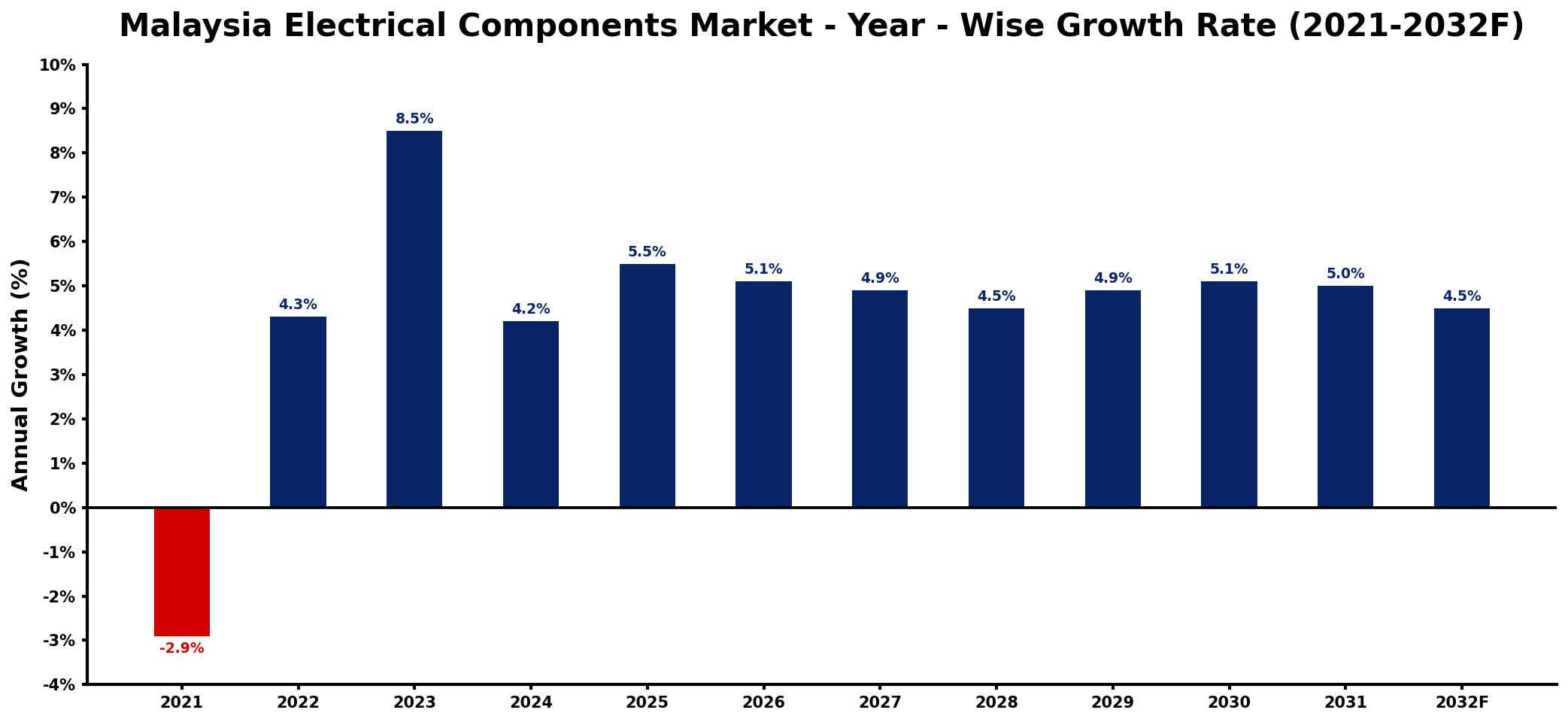
The table below presents the year‑wise growth rates along with the key drivers influencing the market
| Year | Growth Rate | Major Drivers |
| 2021 | -2.9% | Decreased investments in infrastructure projects |
| 2022 | 4.3% | Rising demand for renewable energy |
| 2023 | 8.5% | Expansion of smart city initiatives |
| 2024 | 4.2% | Increased adoption of automation technologies |
| 2025 | 5.5% | Growth in residential construction activities |
| 2026 | 5.1% | Surge in electric vehicle infrastructure |
| 2027 | 4.9% | Strengthening of manufacturing sector recovery |
| 2028 | 4.5% | Boost in green technology investments |
| 2029 | 4.9% | Rising consumer electronics demand |
| 2030 | 5.1% | increased domestic production output |
| 2031 | 5.0% | increased production capacity utilization |
| 2032 | 4.5% | Increased focus on energy efficiency |
Note: Market size estimations and growth projections presented in this report are based on 6Wresearch's proprietary forecasting methodology, utilizing the latest available industry data, government publications, and primary research inputs.
Malaysia Electrical Components Market Synopsis
In Malaysia, the electrical components market plays a pivotal role in supporting critical industries, from electronics to manufacturing. The robust infrastructure initiatives underway are generating significant demand for components like circuit boards and connectors, essential for seamless operations. As these sectors expand, so too does the reliance on high-quality electrical components, underscoring the market's significance in driving economic growth.
The impact of technological advancements is evident, with a marked shift towards automation influencing product development and applications. As industries strive for greater efficiency and reliability, manufacturers must stay agile, aligning their offerings with emerging trends and changing customer needs. This landscape presents a wealth of opportunities for innovation and growth in the electrical components segment.
Malaysia Electrical Components Market Key Takeaways
- The market is on an upward trajectory, expected to reach USD 227 Million by 2032.
- Strong ties between the electrical components market and the manufacturing sector drive demand.
- Technological advancements are catalyzing a shift towards automation, influencing product offerings.
- Infrastructure development remains a critical factor in market growth.
- Ongoing compliance with safety standards is essential to sustaining market operations.
Evaluation of Restraints in Malaysia Electrical Components Market
Despite the positive outlook for the Malaysia Electrical Components Market, several restraints could impede progress. Fluctuating demand often leads to unpredictability, affecting production schedules and inventory management. Supply chain disruptions, whether due to global factors or local inefficiencies, pose significant challenges as well. Furthermore, the industry's need for compliance with stringent safety and technological standards necessitates constant investment in quality assurance, which can strain smaller manufacturers and inhibit competitiveness.
Malaysia Electrical Components Market Trends
Current trends in the Malaysia Electrical Components Market highlight a growing demand for smarter, more connected solutions. The rise of the Internet of Things (IoT) is shaping product development, pushing manufacturers to create components that offer advanced functionalities and interoperability. Additionally, green technology is becoming increasingly prevalent, with a focus on sustainable manufacturing practices that reduce environmental impact. This shift is prompting innovations in materials and processes, marking a significant evolution within the sector.
Malaysia Electrical Components Market Opportunities
The market presents numerous investment opportunities, particularly in the realm of automation and smart technologies. As businesses seek to enhance operational efficiency, there is a growing appetite for advanced electrical components that support automation initiatives. Additionally, the government's ongoing commitment to infrastructure development is creating a favorable environment for manufacturers to expand their offerings. Companies that invest in research and development can position themselves to meet the evolving demands of the market.
Government Initiatives in the Malaysia Electrical Components Market
The Malaysian government has been proactive in supporting the electrical components sector through various policies aimed at enhancing manufacturing capabilities. Public spending on infrastructure projects has surged, creating a need for high-quality electrical components. Moreover, initiatives aimed at fostering innovation, such as funding for research and development, are encouraging companies to explore cutting-edge technologies. Regulatory frameworks are also evolving to ensure compliance with international safety and environmental standards, ultimately benefiting the industry as a whole.
Future Insights of the Malaysia Electrical Components Market
Looking ahead to 2026-2032, the Malaysia Electrical Components Market is poised for sustained growth driven by technological advancements and increased industrial activity. With the ongoing emphasis on automation and smart technologies, manufacturers that can adapt quickly to changing demands will likely thrive. The market will continue to benefit from infrastructure investments and a solid manufacturing foundation, setting the stage for innovation and collaboration among industry players.
Malaysia Electrical Components Market Latest Developments (2025 - 2026)
Recent developments in the Malaysia Electrical Components Market showcase an industry increasingly aligned with global trends in technology and sustainability. Innovations in product design focused on energy efficiency are becoming prevalent, reflecting a shift in consumer preferences towards greener solutions. Additionally, collaborations between manufacturers and tech companies are emerging, aimed at enhancing product capabilities and supporting automation trends. These moves indicate a market actively positioning itself for future growth.
Malaysia Electrical Components Market - Key Attractiveness of the Report
- 10 Years of Market Numbers
- Historical Data Starting from 2022 to 2025
- Base Year: 2025
- Forecast Data until 2032
- Key Performance Indicators Impacting the Market
- Major Upcoming Developments and Projects
Key Highlights of the Report:
- Malaysia Electrical Components Market Outlook
- Market Size of Malaysia Electrical Components Market, 2025
- Forecast of Malaysia Electrical Components Market, 2032
- Historical Data and Forecast of Malaysia Electrical Components Revenues & Volume for the Period 2022-2032F
- Malaysia Electrical Components Market Trend Evolution
- Malaysia Electrical Components Market Drivers and Challenges
- Malaysia Electrical Components Price Trends
- Malaysia Electrical Components Porter's Five Forces
- Malaysia Electrical Components Industry Life Cycle
- Historical Data and Forecast of Malaysia Electrical Components Market Revenues & Volume By Building Automation for the Period 2022-2032F
- Historical Data and Forecast of Malaysia Electrical Components Market Revenues & Volume By Datacom Accessories for the Period 2022-2032F
- Historical Data and Forecast of Malaysia Electrical Components Market Revenues & Volume By Security & wiring Accessories for the Period 2022-2032F
- Historical Data and Forecast of Malaysia Electrical Components Market Revenues & Volume By Cables & Wires for the Period 2022-2032F
- Historical Data and Forecast of Malaysia Electrical Components Market Revenues & Volume By Datacom Cables for the Period 2022-2032F
- Historical Data and Forecast of Malaysia Electrical Components Market Revenues & Volume By LV Cables for the Period 2022-2032F
- Historical Data and Forecast of Malaysia Electrical Components Market Revenues & Volume By MV&HV Cables for the Period 2022-2032F
- Historical Data and Forecast of Malaysia Electrical Components Market Revenues & Volume By Special Cables for the Period 2022-2032F
- Historical Data and Forecast of Malaysia Electrical Components Market Revenues & Volume By Industrial Automation for the Period 2022-2032F
- Historical Data and Forecast of Malaysia Electrical Components Market Revenues & Volume By Automation Controls for the Period 2022-2032F
- Historical Data and Forecast of Malaysia Electrical Components Market Revenues & Volume By Auxiliary Controls for the Period 2022-2032F
- Historical Data and Forecast of Malaysia Electrical Components Market Revenues & Volume By Drives & Motion Controls for the Period 2022-2032F
- Historical Data and Forecast of Malaysia Electrical Components Market Revenues & Volume By Measurement Controls and Relays for the Period 2022-2032F
- Historical Data and Forecast of Malaysia Electrical Components Market Revenues & Volume By Lighting for the Period 2022-2032F
- Historical Data and Forecast of Malaysia Electrical Components Market Revenues & Volume By Fixtures for the Period 2022-2032F
- Historical Data and Forecast of Malaysia Electrical Components Market Revenues & Volume By Lamps & LEDs for the Period 2022-2032F
- Historical Data and Forecast of Malaysia Electrical Components Market Revenues & Volume By Power Distribution for the Period 2022-2032F
- Historical Data and Forecast of Malaysia Electrical Components Market Revenues & Volume By Cable Management for the Period 2022-2032F
- Historical Data and Forecast of Malaysia Electrical Components Market Revenues & Volume By Enclosures & Panels for the Period 2022-2032F
- Historical Data and Forecast of Malaysia Electrical Components Market Revenues & Volume By LV Electrical Distribution for the Period 2022-2032F
- Historical Data and Forecast of Malaysia Electrical Components Market Revenues & Volume By Renewable Energies for the Period 2022-2032F
- Historical Data and Forecast of Malaysia Electrical Components Market Revenues & Volume By HVAC for the Period 2022-2032F
- Historical Data and Forecast of Malaysia Electrical Components Market Revenues & Volume By Renewable energy for the Period 2022-2032F
- Historical Data and Forecast of Malaysia Electrical Components Market Revenues & Volume By Safety & Tools for the Period 2022-2032F
- Historical Data and Forecast of Malaysia Electrical Components Market Revenues & Volume By Safety Equipment for the Period 2022-2032F
- Historical Data and Forecast of Malaysia Electrical Components Market Revenues & Volume By Working Tools & Accessories for the Period 2022-2032F
- Malaysia Electrical Components Import Export Trade Statistics
- Market Opportunity Assessment By Building Automation
- Market Opportunity Assessment By Cables & Wires
- Market Opportunity Assessment By Industrial Automation
- Market Opportunity Assessment By Lighting
- Market Opportunity Assessment By Power Distribution
- Market Opportunity Assessment By Renewable Energies
- Market Opportunity Assessment By Safety & Tools
- Malaysia Electrical Components Top Companies Market Share
- Malaysia Electrical Components Competitive Benchmarking By Technical and Operational Parameters
- Malaysia Electrical Components Company Profiles
- Malaysia Electrical Components Key Strategic Recommendations






































