Malaysia Electrocardiographs Market Size, Share & Growth Rate
The Malaysia Electrocardiographs Market was estimated at USD 327 Million in 2025 and is projected to reach USD 426 Million by 2032, growing at a CAGR of 3.9% from 2026 to 2032. This growth trajectory is primarily driven by technological advancements in ECG equipment, alongside an increasing focus on preventative healthcare measures. The rising prevalence of cardiovascular diseases among the aging population in Malaysia further contributes to the expanding demand for effective diagnostic tools like electrocardiographs.
Malaysia Electrocardiographs Market Year-wise Growth Rate and Key Drivers
This graph highlights how the Malaysia Electrocardiographs Market has steadily grown over the years, supported by major growth factors.
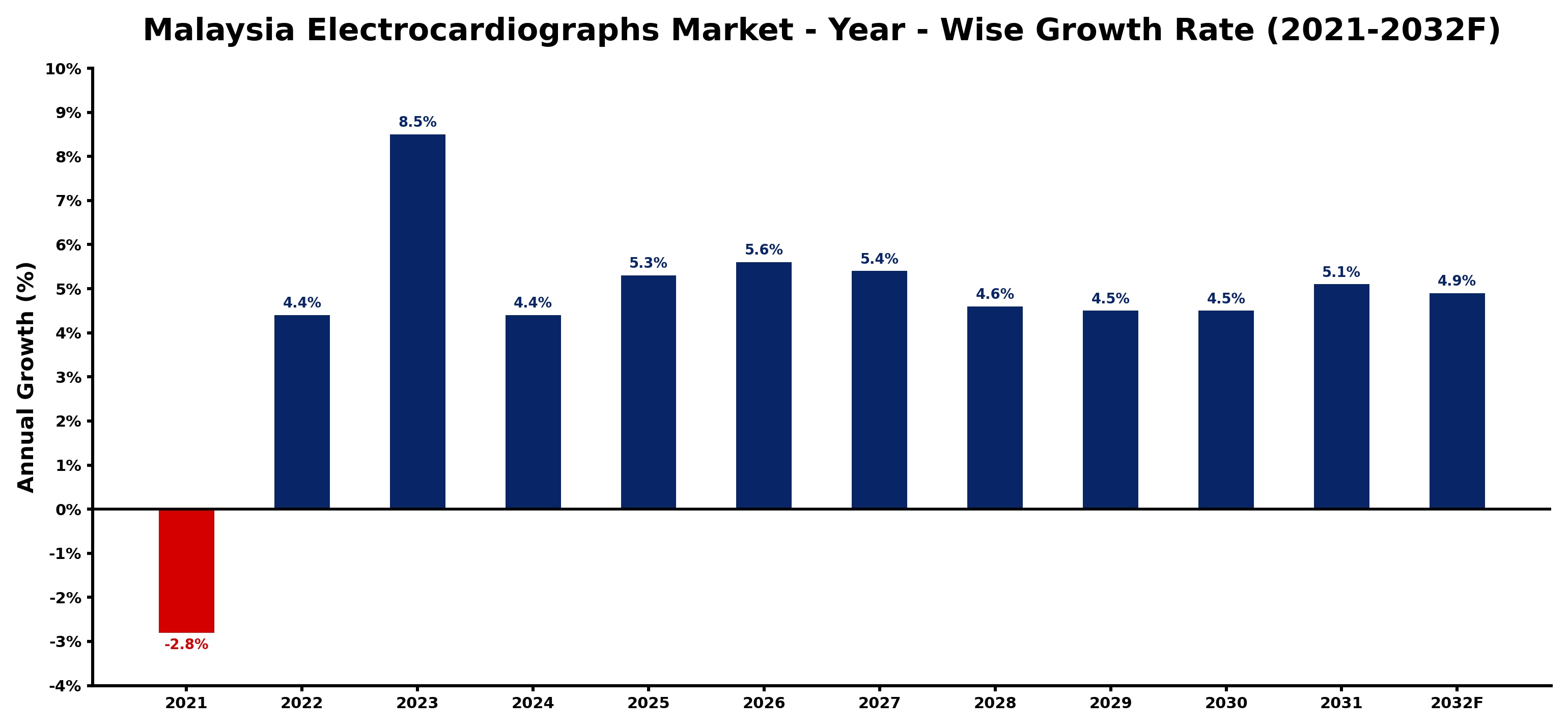
The table below presents the year‑wise growth rates along with the key drivers influencing the market
| Year | Growth Rate | Major Drivers |
| 2021 | -2.8% | Weak global demand curtailed Malaysia's electrocardiograph manufacturing output |
| 2022 | 4.4% | Precision engineering investments bolster Malaysia's ECG device manufacturing capacity |
| 2023 | 8.5% | Precision engineering investments boosted electrocardiograph export capabilities |
| 2024 | 4.4% | Technological advancements in automation boost electrocardiograph manufacturing efficiency |
| 2025 | 5.3% | Precision engineering advancements boosted electrocardiograph production efficiency |
| 2026 | 5.6% | Automation investments enhance production efficiency in ECG device manufacturing |
| 2027 | 5.4% | Electrocardiograph manufacturing upgrades enhanced export competitiveness in Malaysia |
| 2028 | 4.6% | Precision engineering investments boosted Malaysia's ECG manufacturing capabilities |
| 2029 | 4.5% | Precision engineering advancements drive electrocardiograph manufacturing investment opportunities |
| 2030 | 4.5% | Precision engineering firms adopt advanced robotics for enhanced productivity |
| 2031 | 5.1% | Precision engineering advancements boost electrocardiograph assembly line efficiency |
| 2032 | 4.9% | Domestic hospitals upgraded equipment, driving electrocardiograph production demand |
Note - Market size estimations and growth projections presented in this report are based on 6Wresearch’s advanced forecasting approach, validated with industry datasets as of June 2026.
Malaysia Electrocardiographs Market Synopsis
In recent years, the demand for electrocardiographs in Malaysia has experienced a notable increase, reflecting a growing awareness of cardiovascular health among the population. This trend can be attributed to enhanced healthcare access and investment in medical technology, positioning ECG devices as indispensable tools in both public and private healthcare settings.
The Malaysian healthcare landscape is evolving, marked by significant investments in advanced medical equipment. Electrocardiographs play a pivotal role in diagnosing and monitoring cardiac conditions, as healthcare providers recognize the importance of accurate and timely cardiac assessments in improving patient outcomes.
Malaysia Electrocardiographs Market Key Takeaways
- The market is anticipated to witness robust growth driven by technological advancements and increased healthcare spending.
- Rising awareness of cardiovascular health among the aging population is propelling demand for electrocardiograph devices.
- Investment in healthcare infrastructure is improving accessibility to ECG technology across Malaysia.
- Challenges related to equipment costs and the need for skilled professionals may impact market growth.
- Ongoing developments in ECG technology are likely to enhance the capabilities and accuracy of cardiac monitoring devices.
Evaluation of Restraints in Malaysia Electrocardiographs Market
The Malaysia Electrocardiographs Market faces several real restraints that can hinder its expansion. One of the primary limitations is the high cost associated with advanced ECG equipment, which often makes it difficult for smaller healthcare facilities to adopt the latest technologies. This gap in access can limit the overall reach of electrocardiography services, particularly in rural areas. Additionally, the rapid pace of technological innovation can lead to product obsolescence, leaving manufacturers under pressure to continually update their offerings. Moreover, there remains a shortage of skilled healthcare professionals proficient in the interpretation of ECG results, further complicating the effective implementation of these diagnostic tools in clinical settings.
Malaysia Electrocardiographs Market Trends
The current landscape of the Malaysia Electrocardiographs Market is characterized by several emerging trends. One significant trend is the integration of telemedicine capabilities within ECG devices, allowing remote monitoring and consultation, which is particularly relevant in the context of recent global health challenges. Furthermore, there is a noticeable shift towards portable ECG solutions, enabling greater flexibility and ease of use for both healthcare providers and patients. The rise of artificial intelligence in ECG analysis is also enhancing diagnostic accuracy, potentially transforming the way cardiac health is monitored and managed.
Malaysia Electrocardiographs Market Opportunities
There are substantial growth and investment opportunities within the Malaysia Electrocardiographs Market. Expanding healthcare infrastructure initiatives present avenues for increased ECG device deployment, particularly in underserved regions. Additionally, as public awareness of cardiovascular health rises, there is a potential to develop and market innovative ECG solutions tailored to meet local healthcare needs. The collaboration between technology firms and healthcare providers could yield advancements in ECG technology, driving further innovation and accessibility.
Government Initiatives in the Malaysia Electrocardiographs Market
The Malaysian government has been proactive in enhancing the country's healthcare framework, fostering initiatives aimed at improving medical technology access, including electrocardiographs. Various programs are in place to promote public health awareness and the adoption of advanced medical devices, thereby supporting the integration of ECG technologies into the healthcare system. Public spending on health infrastructure is being prioritized, ensuring that more facilities can offer essential diagnostic services like ECG, ultimately contributing to better patient outcomes.
Future Insights of the Malaysia Electrocardiographs Market
Looking ahead to 2026-2032, the Malaysia Electrocardiographs Market is poised for significant growth fueled by the ongoing modernization of healthcare services. As the healthcare sector continues to evolve, the focus will likely remain on improving diagnostic accuracy and patient care efficiency. Enhanced regulatory support and increasing collaboration among stakeholders will further drive the adoption of innovative ECG technologies. Ultimately, the market is expected to reflect the broader trends of digital health transformation, positioning electrocardiographs as integral components of Malaysia's healthcare ecosystem.
Malaysia Electrocardiographs Market Latest Developments (May 2025 - June 2026)
Recent developments in the Malaysia Electrocardiographs Market indicate a growing interest in next-generation ECG devices equipped with advanced features such as real-time monitoring and mobile connectivity. The focus has been on enhancing usability and integrating these devices into broader health management systems. There is an emerging trend of partnerships between tech firms and healthcare providers aimed at developing more sophisticated ECG solutions, reflecting the ongoing push for innovation within the market.
Malaysia Electrocardiographs Market - Key Attractiveness of the Report
- 10 Years of Market Numbers
- Historical Data Starting from 2022 to 2025
- Base Year: 2025
- Forecast Data until 2032
- Key Performance Indicators Impacting the Market
- Major Upcoming Developments and Projects
Key Highlights of the Report:
- Malaysia Electrocardiographs Market Outlook
- Market Size of Malaysia Electrocardiographs Market, 2025
- Forecast of Malaysia Electrocardiographs Market, 2032
- Historical Data and Forecast of Malaysia Electrocardiographs Revenues & Volume for the Period 2022-2032F
- Malaysia Electrocardiographs Market Trend Evolution
- Malaysia Electrocardiographs Market Drivers and Challenges
- Malaysia Electrocardiographs Price Trends
- Malaysia Electrocardiographs Porter's Five Forces
- Malaysia Electrocardiographs Industry Life Cycle
- Historical Data and Forecast of Malaysia Electrocardiographs Market Revenues & Volume By Product for the Period 2022-2032F
- Historical Data and Forecast of Malaysia Electrocardiographs Market Revenues & Volume By Resting ECG for the Period 2022-2032F
- Historical Data and Forecast of Malaysia Electrocardiographs Market Revenues & Volume By Stress ECG for the Period 2022-2032F
- Historical Data and Forecast of Malaysia Electrocardiographs Market Revenues & Volume By Holter Monitors for the Period 2022-2032F
- Historical Data and Forecast of Malaysia Electrocardiographs Market Revenues & Volume By Lead Type for the Period 2022-2032F
- Historical Data and Forecast of Malaysia Electrocardiographs Market Revenues & Volume By Single Lead for the Period 2022-2032F
- Historical Data and Forecast of Malaysia Electrocardiographs Market Revenues & Volume By 3-6 Lead for the Period 2022-2032F
- Historical Data and Forecast of Malaysia Electrocardiographs Market Revenues & Volume By 12-Lead for the Period 2022-2032F
- Historical Data and Forecast of Malaysia Electrocardiographs Market Revenues & Volume By End User for the Period 2022-2032F
- Historical Data and Forecast of Malaysia Electrocardiographs Market Revenues & Volume By Hospitals & Clinics for the Period 2022-2032F
- Historical Data and Forecast of Malaysia Electrocardiographs Market Revenues & Volume By Home Settings & Ambulatory Surgical Centers (ASCs) for the Period 2022-2032F
- Historical Data and Forecast of Malaysia Electrocardiographs Market Revenues & Volume By Others for the Period 2022-2032F
- Malaysia Electrocardiographs Import Export Trade Statistics
- Market Opportunity Assessment By Product
- Market Opportunity Assessment By Lead Type
- Market Opportunity Assessment By End User
- Malaysia Electrocardiographs Top Companies Market Share
- Malaysia Electrocardiographs Competitive Benchmarking By Technical and Operational Parameters
- Malaysia Electrocardiographs Company Profiles
- Malaysia Electrocardiographs Key Strategic Recommendations






































