Malaysia Energy Saving & Fluorescent Market Summary
The malaysia energy saving & fluorescent market was estimated at USD 388 Million in 2025 and is projected to reach USD 506 Million by 2032, growing at a CAGR of 5.5% from 2026 to 2032.
Malaysia Energy Saving & Fluorescent Market Year-wise Growth Rate and Key Drivers
This graph highlights how the Malaysia Energy Saving & Fluorescent Market has steadily grown over the past five years, supported by major growth factors.
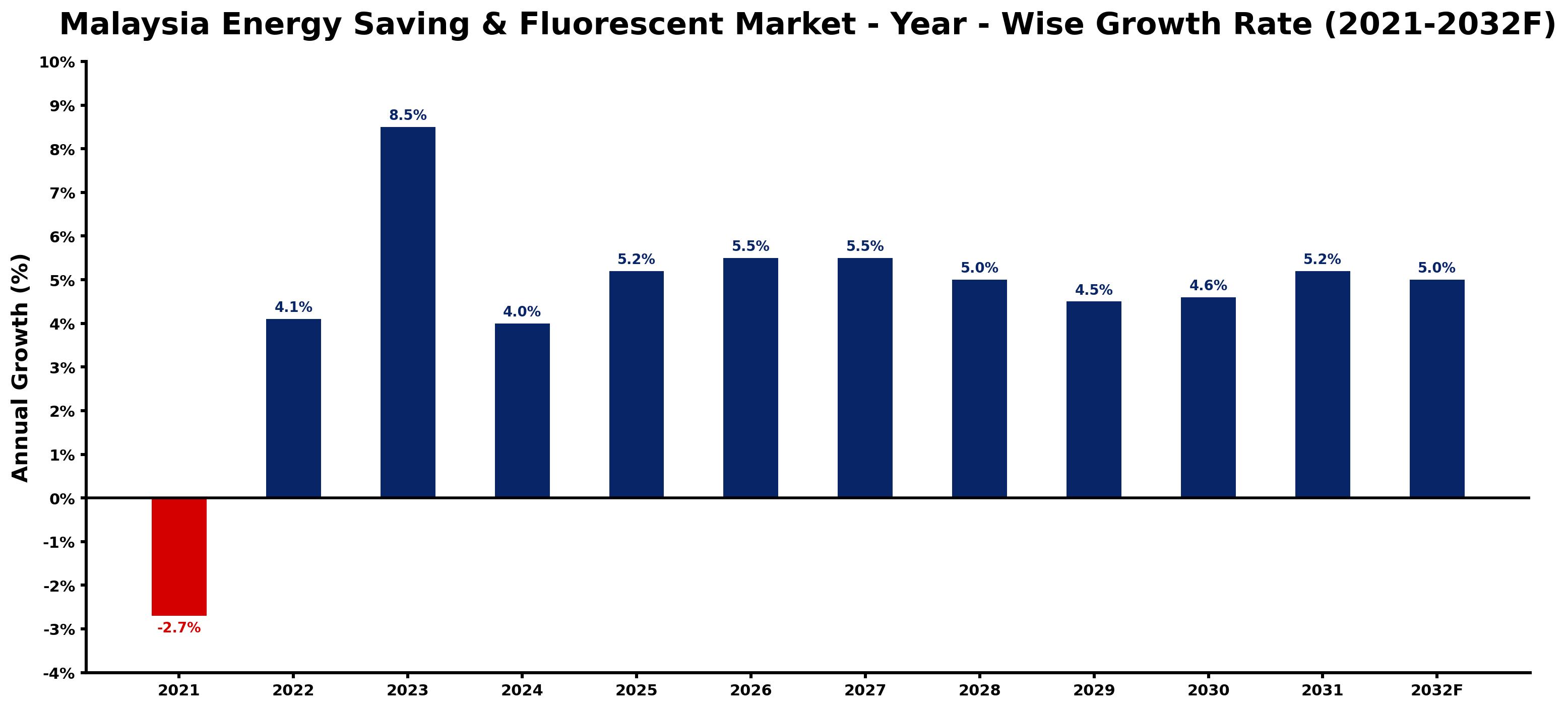
The table below presents the year wise growth rates along with the key drivers influencing the market
| Year | Growth Rate | Major Drivers |
| 2021 | -2.7% | Heightened awareness of environmental concerns led consumers to favor alternative lighting solutions over fluorescent options. |
| 2022 | 4.1% | The Malaysian government unveiled plans to enhance energy efficiency in urban environments. |
| 2023 | 8.5% | Emerging eco-conscious consumer behavior led businesses to invest in sustainable lighting options. |
| 2024 | 4.0% | Technological improvements reduced the costs associated with energy-saving fluorescent products significantly. |
| 2025 | 5.2% | Corporate sustainability programs encouraged companies to prioritize energy-efficient lighting installations. |
| 2026 | 5.5% | Collaborations between private firms and universities advanced research on energy-saving technologies. |
| 2027 | 5.5% | Escalating electricity prices prompted residential sectors to seek effective energy-saving solutions. |
| 2028 | 5.0% | Increasing urbanization in Malaysia created a heightened need for efficient lighting infrastructure. |
| 2029 | 4.5% | Smart city initiatives integrated energy-saving technologies into urban planning and lighting systems. |
| 2030 | 4.6% | Awareness campaigns highlighted the long-term cost benefits of energy-efficient lighting systems. |
| 2031 | 5.2% | Competitive pressures within the lighting industry led to innovative fluorescent product launches. |
| 2032 | 5.0% | National energy policies increasingly emphasized sustainability, driving market growth for energy-saving products. |
Note - Market size estimations and growth projections presented in this report are based on 6Wresearch's advanced forecasting approach, validated with industry datasets as of June 2026.
Malaysia Energy Saving & Fluorescent Market Synopsis
The Malaysia Energy Saving Fluorescent Market is projected to reach 5.5% and witness significant growth during the forecast period (2026-2032). The increasing demand for energy-efficient lighting solutions, primarily driven by heightened awareness surrounding environmental sustainability and the rising cost of electricity, serves as a fundamental catalyst for the market's expansion. Government measures, including green building regulations and Energy Efficiency Certification Programmes, further encourage the adoption of energy-saving technologies, specifically LED lighting. Alongside these initiatives, technological advancements, particularly in smart lighting control systems and Internet of Things (IoT) enabled lighting solutions, are expected to provide lucrative opportunities for market participants in the upcoming years.
Malaysia Energy Saving & Fluorescent Market Growth Drivers
The market dynamics are greatly influenced by several growth drivers that shape the Malaysia Energy Saving & Fluorescent Market.
- The growing awareness of climate change and energy conservation has fostered a significant increase in demand for energy-efficient lighting solutions across various sectors, including residential, commercial, and industrial.
- Rising electricity costs are forcing businesses and households to seek cost-effective lighting alternatives, prompting a shift towards energy-saving technologies that promise long-term savings.
- Government initiatives, like the establishment of mandatory energy efficiency regulations, play a crucial role in encouraging the adoption of energy-efficient lighting systems within Malaysia.
- Technological advancements in lighting technology, such as smart lighting systems that improve energy management and reduce waste, are gaining traction in the market.
- Increasing investments in infrastructure development and the construction of green buildings present an opportunity for the market, leading to greater demand for energy-efficient lighting solutions.
Malaysia Energy Saving & Fluorescent Market Trends and Opportunities
The Malaysia Energy Saving & Fluorescent Market is witnessing pivotal trends that indicate a promising future for energy-efficient lighting solutions.
- The shift towards smart lighting technologies, incorporating IoT and artificial intelligence, is transforming the market landscape, allowing for more efficient energy management and light control.
- Increased collaboration between government bodies and private sectors to promote sustainable practices is expected to bolster market growth and innovation.
- Growing urbanization is leading to an upsurge in new construction projects, which are increasingly inclined towards implementing energy-efficient solutions from the outset.
- Consumer preferences are evolving, with a significant inclination towards eco-friendly products, pushing manufacturers to innovate and provide sustainable alternatives.
- The focus on retrofitting existing lighting systems with energy-efficient solutions presents considerable opportunities for companies, as businesses look to reduce operational costs.
Malaysia Energy Saving & Fluorescent Market Challenges and Restraints
Despite the promising outlook, the Malaysia Energy Saving & Fluorescent Market faces certain challenges that could impede its growth.
- The initial investment cost associated with energy-efficient technologies can be a barrier for many consumers and businesses, deterring widespread adoption.
- A lack of awareness and understanding regarding the benefits of energy-saving solutions among the general public can slow market penetration.
- Limited availability of quality products and competition from cheaper, less efficient alternatives may affect consumer choices.
- The rapid pace of technological change can pose a challenge for manufacturers in keeping up with innovations and adapting their products accordingly.
- Regulatory hurdles and the need for compliance with various standards can create complications for market participants looking to launch new products.
Malaysia Energy Saving & Fluorescent Market Government Investment and Initiatives
The Malaysian government is actively promoting energy efficiency and sustainability within the energy-saving lighting sector through various initiatives and policy frameworks.
- Green building regulations aim to mandate the use of energy-efficient lighting solutions in new constructions, driving demand in both residential and commercial sectors.
- The Energy Efficiency Certification Programme incentivizes the adoption of energy-efficient technologies by providing endorsements that highlight compliance with energy standards.
- Government-led public awareness campaigns target both consumers and businesses, educating them on the importance and benefits of energy-efficient lighting.
- Investment in research and development for energy-efficient technologies is emphasized within national energy policies, ensuring continuous advancement and innovation.
- Collaboration with international organizations to enhance local standards and practices related to energy efficiency contributes to an improved framework for the market.
Malaysia Energy Saving & Fluorescent Market Latest Developments (May 2025 - June 2026)
Recent developments in the Malaysia Energy Saving & Fluorescent Market indicate a proactive approach towards enhancing energy efficiency and sustainability.
- Increased partnerships between technology companies and construction firms to integrate smart lighting solutions into new buildings have gained momentum, indicating a shift towards smarter infrastructures.
- The implementation of stricter energy efficiency regulations has prompted more businesses to evaluate their lighting systems and seek energy-saving alternatives.
- Emerging startups focused on innovative lighting solutions are entering the market, boosting competitive dynamics and encouraging technological advancements.
- Public sector initiatives aiming to retrofit existing infrastructure with state-of-the-art energy-efficient lighting have begun to materialize, showcasing a commitment to sustainability.
- Growth in e-commerce platforms is facilitating easier access to energy-efficient lighting products, expanding consumer choices and market reach.
Malaysia Energy Saving & Fluorescent Market - Key Attractiveness of the Report
- 10 Years of Market Numbers
- Historical Data Starting from 2022 to 2025
- Base Year: 2025
- Forecast Data until 2032
- Key Performance Indicators Impacting the Market
- Major Upcoming Developments and Projects
Key Highlights of the Report:
- Malaysia Energy Saving & Fluorescent Market Outlook
- Market Size of Malaysia Energy Saving & Fluorescent Market, 2025
- Forecast of Malaysia Energy Saving & Fluorescent Market, 2032
- Historical Data and Forecast of Malaysia Energy Saving & Fluorescent Revenues & Volume for the Period 2022-2032
- Malaysia Energy Saving & Fluorescent Market Trend Evolution
- Malaysia Energy Saving & Fluorescent Market Drivers and Challenges
- Malaysia Energy Saving & Fluorescent Price Trends
- Malaysia Energy Saving & Fluorescent Porter's Five Forces
- Malaysia Energy Saving & Fluorescent Industry Life Cycle
- Historical Data and Forecast of Malaysia Energy Saving & Fluorescent Market Revenues & Volume By Sources for the Period 2022-2032
- Historical Data and Forecast of Malaysia Energy Saving & Fluorescent Market Revenues & Volume By High-Intensity Discharge Lamps (HID) for the Period 2022-2032
- Historical Data and Forecast of Malaysia Energy Saving & Fluorescent Market Revenues & Volume By Linear Fluorescent Lamps (LFL) for the Period 2022-2032
- Historical Data and Forecast of Malaysia Energy Saving & Fluorescent Market Revenues & Volume By Light Emitting Diodes (LED) for the Period 2022-2032
- Historical Data and Forecast of Malaysia Energy Saving & Fluorescent Market Revenues & Volume By Applications for the Period 2022-2032
- Historical Data and Forecast of Malaysia Energy Saving & Fluorescent Market Revenues & Volume By Commercial for the Period 2022-2032
- Historical Data and Forecast of Malaysia Energy Saving & Fluorescent Market Revenues & Volume By Residential for the Period 2022-2032
- Historical Data and Forecast of Malaysia Energy Saving & Fluorescent Market Revenues & Volume By Government for the Period 2022-2032
- Malaysia Energy Saving & Fluorescent Import Export Trade Statistics
- Market Opportunity Assessment By Sources
- Market Opportunity Assessment By Applications
- Malaysia Energy Saving & Fluorescent Top Companies Market Share
- Malaysia Energy Saving & Fluorescent Competitive Benchmarking By Technical and Operational Parameters
- Malaysia Energy Saving & Fluorescent Company Profiles
- Malaysia Energy Saving & Fluorescent Key Strategic Recommendations






































