Malaysia Enterprise Application Integration Market Size & Growth Rate (2026-2032)
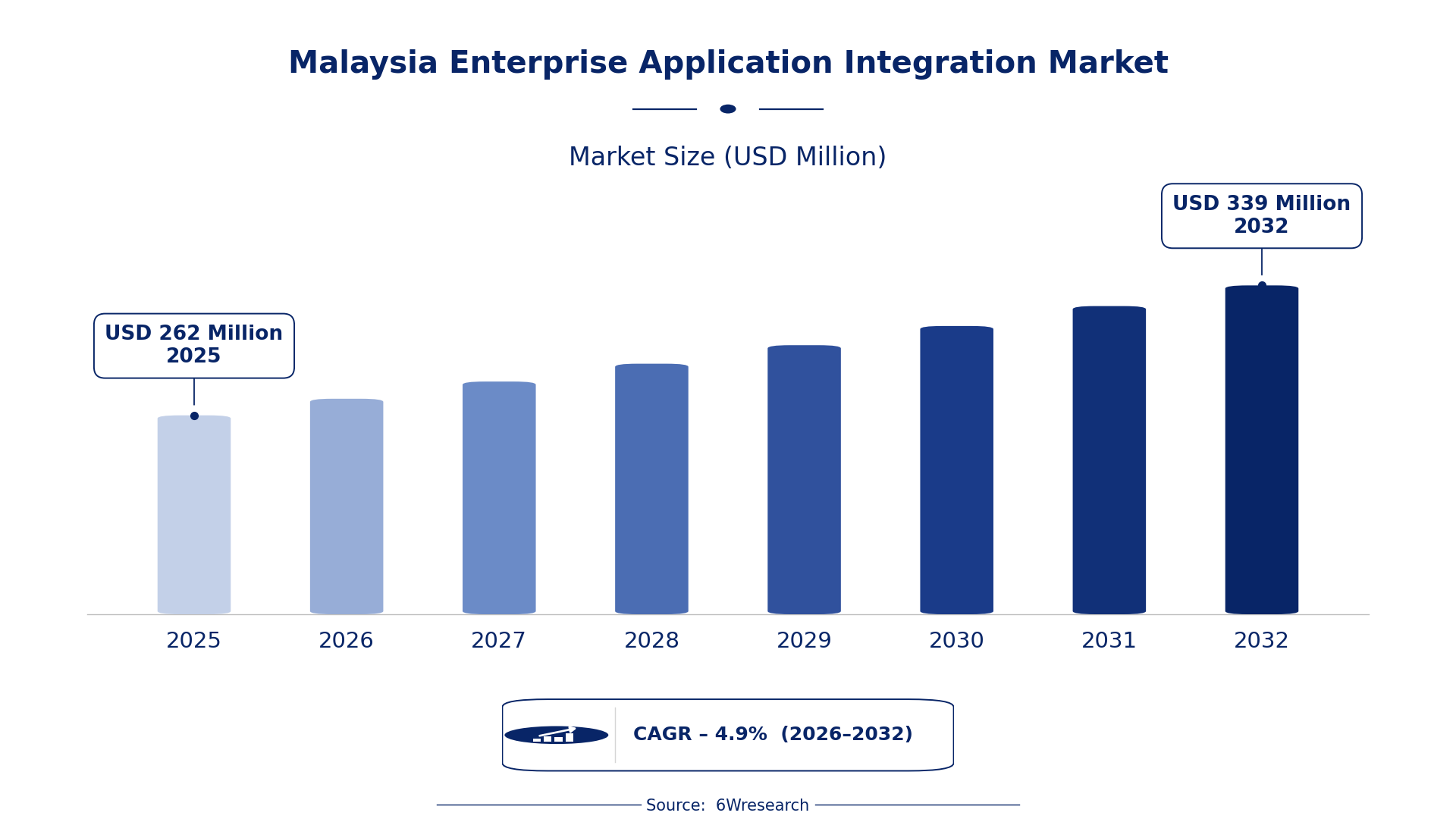
The Malaysia Enterprise Application Integration Market was estimated at USD 262 Million in 2025 and is projected to reach USD 339 Million by 2032, growing at a CAGR of 4.9% from 2026 to 2032.
Malaysia Enterprise Application Integration Market Synopsis
As organizations in Malaysia increasingly embrace digital transformation, the demand for enterprise application integration solutions is surging. Companies are now focused on enhancing interoperability among their software systems, which is essential for effective data management and operational efficiency.
The rise of cloud computing has further fueled this trend, as businesses adopt multiple cloud-based applications. This shift has created an urgent need for integration platforms that can seamlessly connect these diverse systems, enabling automated processes and improved agility.
Malaysia Enterprise Application Integration Market Year-wise Growth Rate and Key Drivers
This graph illustrates the annual growth rates of the Malaysia Enterprise Application Integration Market from 2021 to 2032, highlighting a steady upward trajectory and projected expansion over the forecast period.
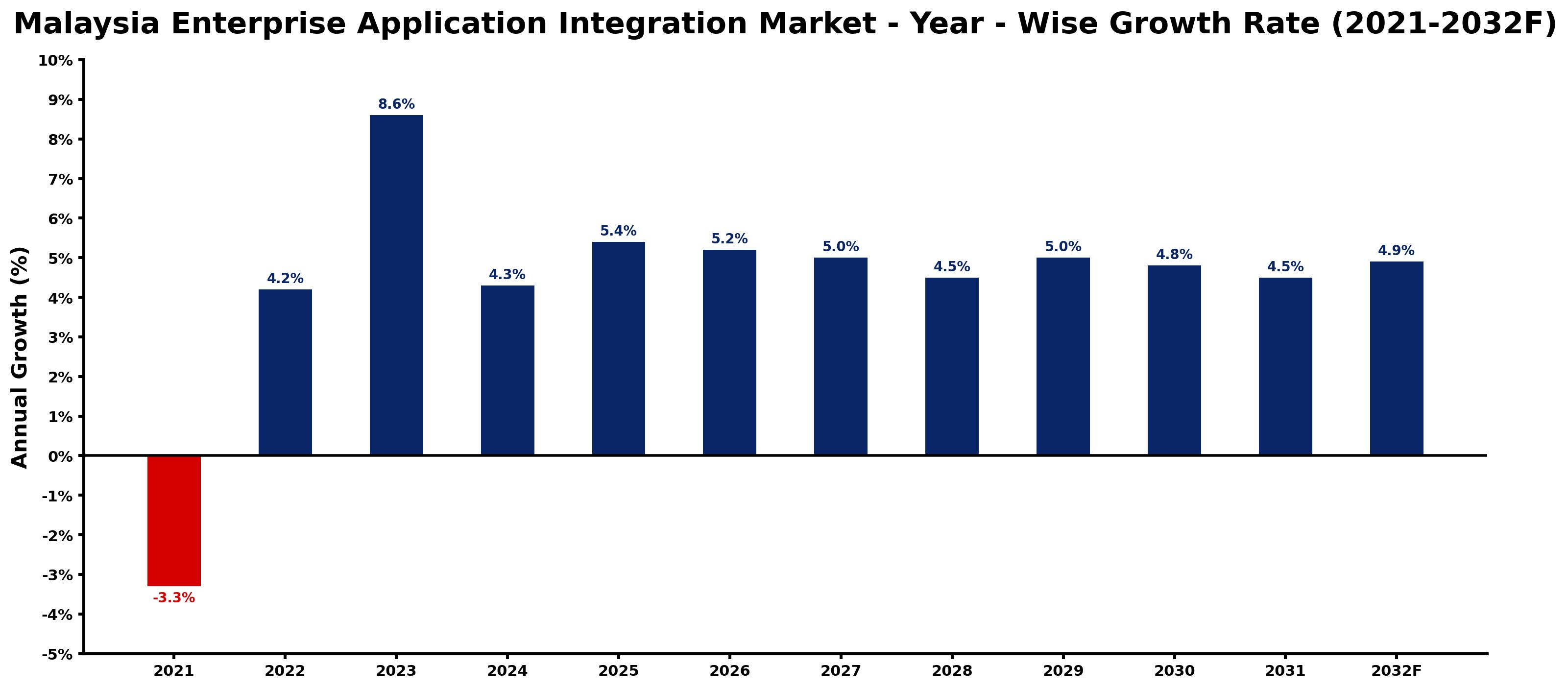
The table below presents the year‑wise growth rates along with the key drivers influencing the market
| Year | Growth Rate | Major Drivers |
| 2021 | -3.3% | Malaysia's MyDigital blueprint delayed enterprise technology adoption. |
| 2022 | 4.2% | Malaysian public sector adopting cloud integration solutions |
| 2023 | 8.6% | SMEs implementing integrated platforms for operational efficiency |
| 2024 | 4.3% | Growth in e-commerce spurring demand for application synergy |
| 2025 | 5.4% | Telecommunication sector enhancing integration for 5G services |
| 2026 | 5.2% | Government incentives boosting IoT solutions integration projects |
| 2027 | 5.0% | Increased focus on remote work driving application integrations |
| 2028 | 4.5% | Digital banking initiatives fostering need for seamless connectivity |
| 2029 | 5.0% | Healthcare sector optimizing operations through integrated systems |
| 2030 | 4.8% | Manufacturing 4.0 initiatives creating data integration requirements |
| 2031 | 4.5% | Retail sector enhancing customer experiences via app integration |
| 2032 | 4.9% | Education sector utilizing integrated tools for hybrid learning |
Note: Market size estimations and growth projections presented in this report are based on 6Wresearch's proprietary forecasting methodology, utilizing the latest available industry data, government publications, and primary research inputs.
Malaysia Enterprise Application Integration Market Key Takeaways
Below are some of the specific key takeaways from the market, including:
- Growing demand for integration solutions is driven by the need for operational efficiency.
- The surge in cloud adoption is reshaping the enterprise application integration market.
- Businesses face challenges related to legacy systems and data silos.
- Government initiatives are supporting digital transformation efforts across sectors.
- The COVID-19 pandemic has accelerated the push for effective application integration.
Evaluation of Restraints in Malaysia Enterprise Application Integration Market
The enterprise application integration market in Malaysia encounters significant hurdles that can impede its growth. One of the foremost challenges is the integration of legacy systems, which often lack compatibility with modern applications. This creates data silos that hinder the flow of information. Additionally, the high customization needs of businesses can complicate integration efforts, leading to increased time and costs. Companies must also contend with the evolving technological landscape, requiring continuous investment in updates and scalable solutions.
Malaysia Enterprise Application Integration Market Trends
Several trends are currently influencing the Malaysia Enterprise Application Integration Market. The increasing shift towards API-led integration is notable, allowing organizations to connect various applications efficiently. There's also a growing emphasis on real-time data processing, enabling businesses to make quicker, informed decisions. Finally, organizations are increasingly prioritizing security in their integration strategies, given the rising concerns around data breaches and compliance.
Malaysia Enterprise Application Integration Market Opportunities
The future holds promising opportunities for growth within the Malaysia Enterprise Application Integration Market. As organizations seek to enhance their digital capabilities, investments in advanced integration technologies will be crucial. Additionally, the expansion of IoT applications presents new avenues for integration, particularly in sectors like manufacturing and logistics. Companies that can provide scalable and flexible integration solutions will be well-positioned to capture market share.
Government Initiatives in the Malaysia Enterprise Application Integration Market
The Malaysian government plays a vital role in shaping the enterprise application integration market through various initiatives aimed at enhancing digital infrastructure and capabilities. Public policy is increasingly focused on fostering a conducive environment for businesses to adopt integration solutions, reflecting a commitment to advancing the nation’s digital economy.
- A national digital infrastructure upgrade program is currently underway, enhancing connectivity across urban and rural areas.
- In early 2025, a regulatory framework mandating data sharing standards for government agencies was introduced, facilitating smoother integration.
- Currently ongoing is a public-private initiative designed to support SMEs in adopting cloud-based solutions, promoting application integration.
- Looking ahead, a planned initiative aims to provide funding for technology startups focused on enterprise software solutions by 2026.
Future Insights of the Malaysia Enterprise Application Integration Market
From 2026 to 2032, the Malaysia Enterprise Application Integration Market is expected to evolve significantly. As businesses continue to digitize their operations, the demand for integration solutions will escalate. The growing focus on automation and artificial intelligence will also drive the development of more sophisticated integration platforms. on top of that, enhanced collaboration between public and private sectors is likely to lead to innovative solutions tailored to specific industry needs.
Malaysia Enterprise Application Integration Market Latest Developments
Recent developments in the Malaysia Enterprise Application Integration Market highlight a vibrant industry responding to the needs of digital transformation. Companies are actively enhancing their offerings to meet the growing demand for integration solutions, indicating a competitive environment.
- A major technology vendor launched a new integration platform in Q1 2025, designed to streamline data flow between cloud applications.
- In mid-2025, an ongoing partnership was announced between a leading regional operator and a software firm to develop tailored integration solutions for SMEs.
- By late 2025, a significant upgrade to existing integration tools was completed, incorporating advanced analytics capabilities.
- A rollout expected to begin in early 2026 will introduce training programs for local businesses on effective integration strategies.
Malaysia Enterprise Application Integration Market - Key Attractiveness of the Report
- 10 Years of Market Numbers
- Historical Data Starting from 2022 to 2025
- Base Year: 2025
- Forecast Data until 2032
- Key Performance Indicators Impacting the Market
- Major Upcoming Developments and Projects
Key Highlights of the Report:
- Malaysia Enterprise Application Integration Market Outlook
- Market Size of Malaysia Enterprise Application Integration Market, 2025
- Forecast of Malaysia Enterprise Application Integration Market, 2032
- Historical Data and Forecast of Malaysia Enterprise Application Integration Revenues & Volume for the Period 2022-2032F
- Malaysia Enterprise Application Integration Market Trend Evolution
- Malaysia Enterprise Application Integration Market Drivers and Challenges
- Malaysia Enterprise Application Integration Price Trends
- Malaysia Enterprise Application Integration Porter's Five Forces
- Malaysia Enterprise Application Integration Industry Life Cycle
- Historical Data and Forecast of Malaysia Enterprise Application Integration Market Revenues & Volume By Deployment type for the Period 2022-2032F
- Historical Data and Forecast of Malaysia Enterprise Application Integration Market Revenues & Volume By Hosted for the Period 2022-2032F
- Historical Data and Forecast of Malaysia Enterprise Application Integration Market Revenues & Volume By On-Premise for the Period 2022-2032F
- Historical Data and Forecast of Malaysia Enterprise Application Integration Market Revenues & Volume By Hybrid for the Period 2022-2032F
- Historical Data and Forecast of Malaysia Enterprise Application Integration Market Revenues & Volume By Organization size for the Period 2022-2032F
- Historical Data and Forecast of Malaysia Enterprise Application Integration Market Revenues & Volume By Small for the Period 2022-2032F
- Historical Data and Forecast of Malaysia Enterprise Application Integration Market Revenues & Volume By Medium for the Period 2022-2032F
- Historical Data and Forecast of Malaysia Enterprise Application Integration Market Revenues & Volume By Enterprises for the Period 2022-2032F
- Historical Data and Forecast of Malaysia Enterprise Application Integration Market Revenues & Volume By Large Enterprises for the Period 2022-2032F
- Historical Data and Forecast of Malaysia Enterprise Application Integration Market Revenues & Volume By Industry Vertical for the Period 2022-2032F
- Historical Data and Forecast of Malaysia Enterprise Application Integration Market Revenues & Volume By Banking, financial services and insurance(BFSI) for the Period 2022-2032F
- Historical Data and Forecast of Malaysia Enterprise Application Integration Market Revenues & Volume By Business services for the Period 2022-2032F
- Historical Data and Forecast of Malaysia Enterprise Application Integration Market Revenues & Volume By IT and telecom for the Period 2022-2032F
- Historical Data and Forecast of Malaysia Enterprise Application Integration Market Revenues & Volume By Manufacturing for the Period 2022-2032F
- Historical Data and Forecast of Malaysia Enterprise Application Integration Market Revenues & Volume By Retail and wholesale for the Period 2022-2032F
- Historical Data and Forecast of Malaysia Enterprise Application Integration Market Revenues & Volume By Healthcare for the Period 2022-2032F
- Historical Data and Forecast of Malaysia Enterprise Application Integration Market Revenues & Volume By Government for the Period 2022-2032F
- Historical Data and Forecast of Malaysia Enterprise Application Integration Market Revenues & Volume By Other verticals( education, entertainment and media, power and utilities) for the Period 2022-2032F
- Malaysia Enterprise Application Integration Import Export Trade Statistics
- Market Opportunity Assessment By Deployment type
- Market Opportunity Assessment By Organization size
- Market Opportunity Assessment By Industry Vertical
- Malaysia Enterprise Application Integration Top Companies Market Share
- Malaysia Enterprise Application Integration Competitive Benchmarking By Technical and Operational Parameters
- Malaysia Enterprise Application Integration Company Profiles
- Malaysia Enterprise Application Integration Key Strategic Recommendations






































