Malaysia Enterprise Data Management Market Size & Growth Rate (2026-2032)
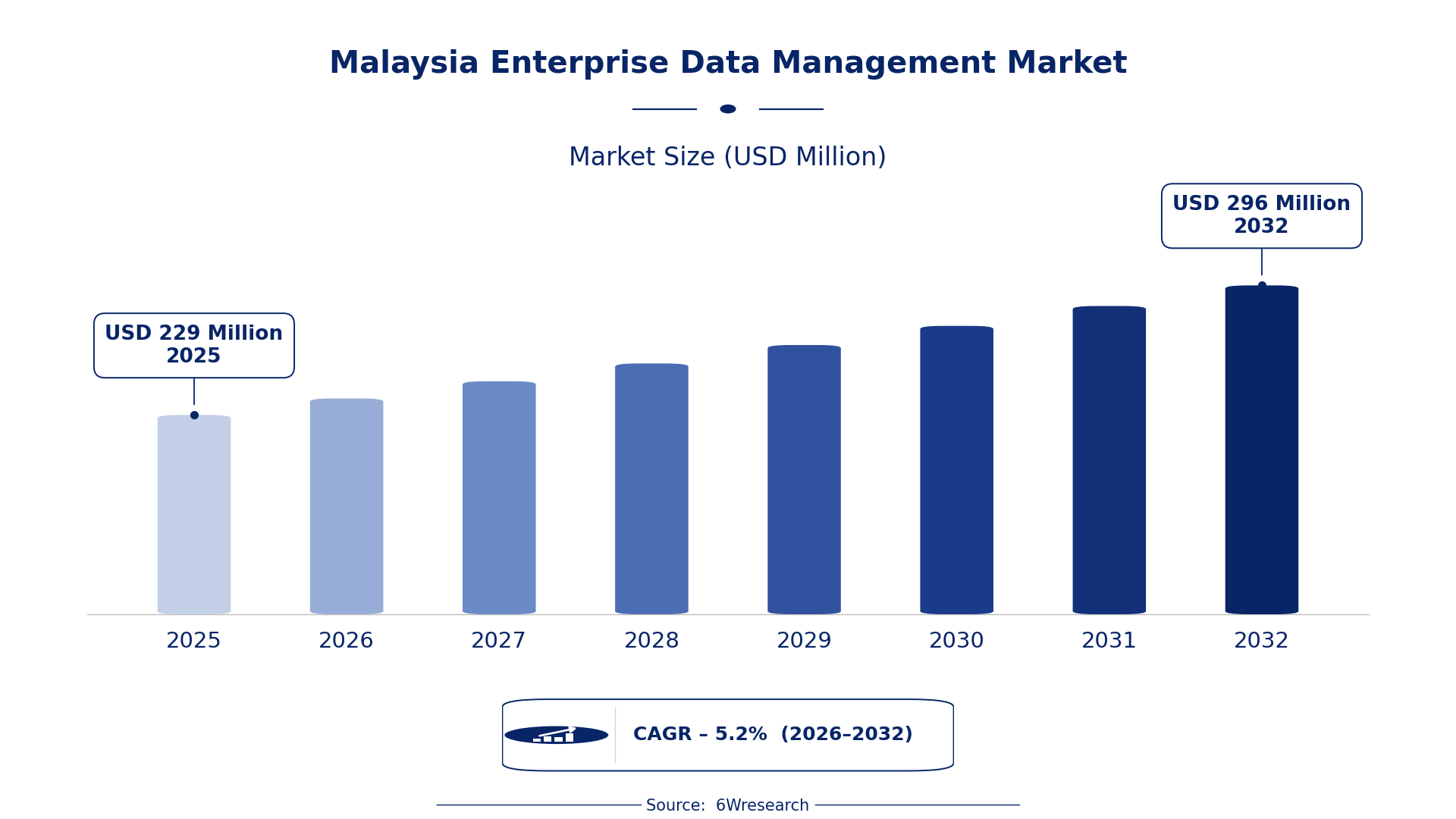
The Malaysia Enterprise Data Management Market was estimated at USD 229 Million in 2025 and is projected to reach USD 296 Million by 2032, growing at a CAGR of 5.2% from 2026 to 2032.
Malaysia Enterprise Data Management Market Synopsis
In Malaysia, the enterprise data management market is rapidly gaining traction as organizations recognize the critical role that data plays in driving operational efficiency and strategic decision-making. With businesses generating unprecedented volumes of data, the need for sophisticated data management solutions has never been greater.
The market is characterized by a growing emphasis on data governance, quality management, and analytics. As enterprises navigate the complexities of digital transformation, the demand for comprehensive data solutions that can ensure compliance and enhance data quality continues to rise.
Malaysia Enterprise Data Management Market Year-wise Growth Rate and Key Drivers
This graph illustrates the annual growth rates of the Malaysia Enterprise Data Management Market from 2021 to 2032, highlighting a steady upward trajectory and projected expansion over the forecast period.
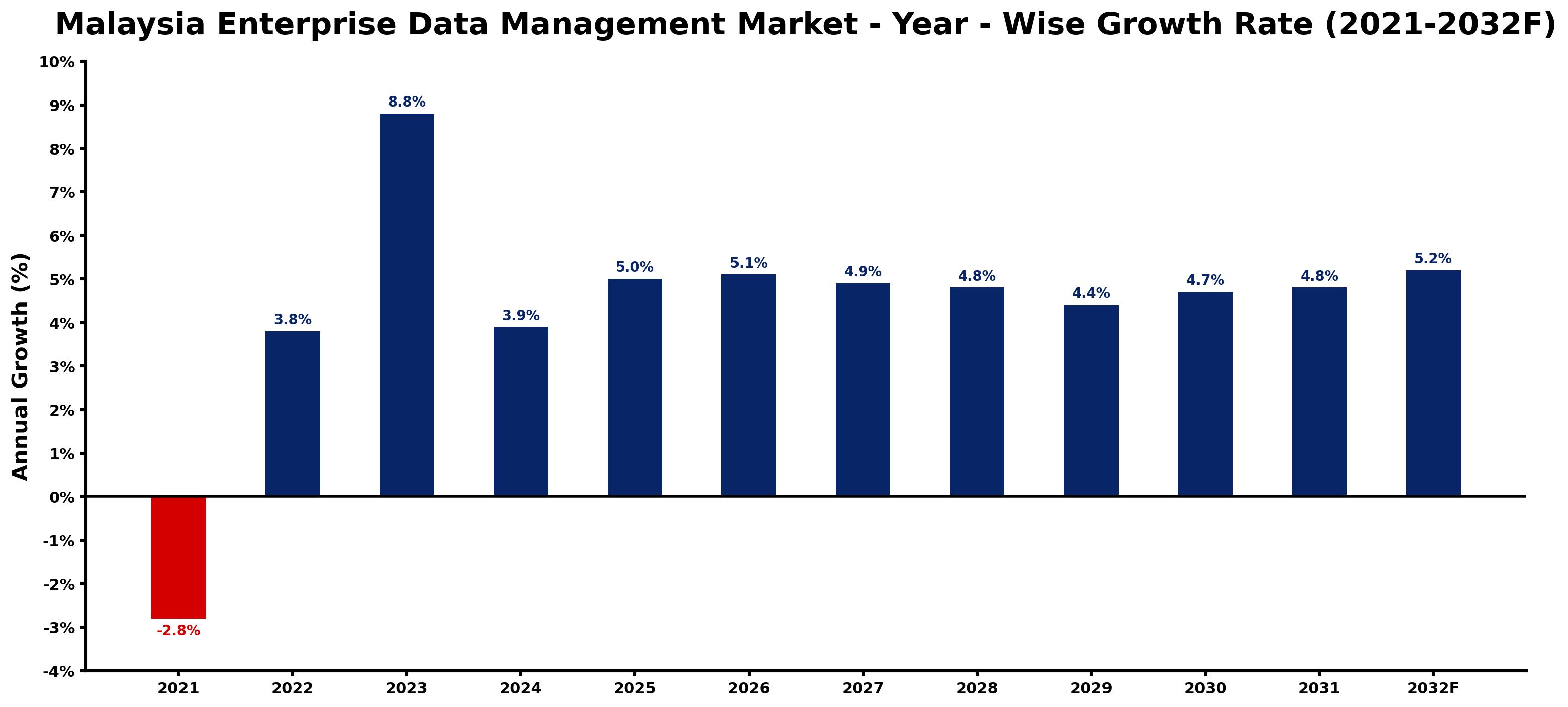
The table below presents the year‑wise growth rates along with the key drivers influencing the market
| Year | Growth Rate | Major Drivers |
| 2021 | -2.8% | Pandemic-related restrictions reduced enterprise IT spending. |
| 2022 | 3.8% | Malaysia's MyDIGITAL initiative drives data governance improvements. |
| 2023 | 8.8% | Growing remote work trend boosts cloud data management needs. |
| 2024 | 3.9% | Local enterprises adopting AI-driven data solutions widely. |
| 2025 | 5.0% | Increased investment in ecommerce platforms enhances data management. |
| 2026 | 5.1% | Rising cybersecurity incidents elevate demand for data protection. |
| 2027 | 4.9% | Local startups focus on innovative data-driven services. |
| 2028 | 4.8% | Universities emphasize data science programs boosting workforce skills. |
| 2029 | 4.4% | SMEs increasingly seek cost-effective data management solutions. |
| 2030 | 4.7% | New data localization policies support domestic data centers. |
| 2031 | 4.8% | Growing urbanization drives demand for smart city data. |
| 2032 | 5.2% | Implementation of stricter data sharing regulations enhances compliance. |
Note: Market size estimations and growth projections presented in this report are based on 6Wresearch's proprietary forecasting methodology, utilizing the latest available industry data, government publications, and primary research inputs.
Malaysia Enterprise Data Management Market Key Takeaways
Below are some of the specific key takeaways from the market, including:
- Growing awareness of data's value is driving investments in enterprise data management solutions.
- Data security and compliance concerns are reshaping the demand for robust data governance frameworks.
- The COVID-19 pandemic accelerated the adoption of data management practices across various sectors.
- Emerging technologies, including AI and machine learning, are enhancing data analytics capabilities.
- The shortage of skilled data management professionals remains a critical barrier to market growth.
Evaluation of Restraints in Malaysia Enterprise Data Management Market
Despite its growth trajectory, the Malaysia Enterprise Data Management market faces notable challenges. The increasing complexity of data types and sources presents a significant hurdle for businesses striving to maintain data integrity and utility. Concerns around data privacy and security are compounded by evolving regulations, making compliance a daunting task.
on top of that, the skills gap in data management expertise is impacting organizations' ability to fully leverage their data assets. As demand for these skilled professionals continues to outstrip supply, companies may struggle to implement effective data strategies.
Malaysia Enterprise Data Management Market Trends
Several trends are shaping the future of the enterprise data management market in Malaysia. First, there's an increasing reliance on cloud-based solutions, allowing businesses to scale their data management capabilities with agility. Integration of artificial intelligence and machine learning is also becoming commonplace, enhancing data analytics and enabling predictive insights.
on top of that, organizations are prioritizing data governance as a means to ensure compliance and quality. This focus is driving the adoption of advanced data lineage and metadata management solutions, which are essential for maintaining data integrity across complex environments.
Malaysia Enterprise Data Management Market Opportunities
The Malaysia Enterprise Data Management market is ripe with growth opportunities. Organizations looking to harness the power of big data analytics are increasingly investing in tools that facilitate real-time data processing and analysis. This shift opens doors for vendors offering innovative solutions tailored to specific industry needs.
on top of that, as businesses strive for digital transformation, there is a growing demand for integrated data management platforms that can unify disparate data sources. This represents an opportunity for providers to develop comprehensive solutions that address the unique challenges faced by different sectors.
Government Initiatives in the Malaysia Enterprise Data Management Market
Government initiatives are crucial in shaping the enterprise data management market in Malaysia. Regulatory frameworks are evolving to address data privacy and security, reflecting the growing importance of these issues. The government is also investing in digital infrastructure to enhance data accessibility and promote innovation within the sector.
- A recently completed initiative aimed to enhance data privacy regulations, setting new standards for data handling across sectors.
- A currently ongoing program is focused on upgrading national digital infrastructure, which is essential for improving data management capabilities.
- A planned public-private partnership expected to launch in 2026 aims to foster collaboration between government and industry to drive innovation in data management.
- In 2025, a regulatory framework mandating transparency in data usage was introduced, encouraging organizations to adopt better data governance practices.
- Upcoming initiatives are set to provide training programs designed to close the skills gap in data management, addressing workforce shortages.
Future Insights of the Malaysia Enterprise Data Management Market
Looking ahead to 2026-2032, the Malaysia Enterprise Data Management market is expected to continue its growth trajectory. With an increasing emphasis on data-driven decision-making, organizations will likely invest more heavily in advanced data management solutions. The integration of emerging technologies will play a significant role in shaping how data is managed and utilized.
As businesses adapt to regulatory changes and the growing importance of data ethics, the demand for comprehensive governance frameworks will rise. This creates a promising outlook for vendors capable of providing innovative, compliant, and efficient data management solutions.
Malaysia Enterprise Data Management Market Latest Developments
Recent activity in the Malaysia Enterprise Data Management market highlights a vigorous push towards innovation and efficiency. Companies are increasingly focusing on enhancing their data management capabilities to stay competitive in a data-centric economy. This trend is marked by significant investments in technology and partnerships aimed at improving data governance and analytics.
- A major technology vendor announced the launch of a new data integration tool in Q1 2025, designed to streamline data workflows for enterprises.
- An ongoing initiative is focused on the deployment of advanced analytics solutions by a leading regional operator, expected to enhance data-driven insights across multiple sectors.
- A planned rollout of a comprehensive data governance platform is set to begin in late 2026, aimed at helping organizations better manage their data compliance and quality.
- A technology partnership formed in early 2025 is currently underway, focusing on developing AI-driven data analytics tools for Malaysian businesses.
- A recent investment round in mid-2025 saw a startup focused on data management solutions secure funding to expand its product offerings and market reach.
Malaysia Enterprise Data Management Market - Key Attractiveness of the Report
- 10 Years of Market Numbers
- Historical Data Starting from 2022 to 2025
- Base Year: 2025
- Forecast Data until 2032
- Key Performance Indicators Impacting the Market
- Major Upcoming Developments and Projects
Key Highlights of the Report:
- Malaysia Enterprise Data Management Market Outlook
- Market Size of Malaysia Enterprise Data Management Market, 2025
- Forecast of Malaysia Enterprise Data Management Market, 2032
- Historical Data and Forecast of Malaysia Enterprise Data Management Revenues & Volume for the Period 2022-2032F
- Malaysia Enterprise Data Management Market Trend Evolution
- Malaysia Enterprise Data Management Market Drivers and Challenges
- Malaysia Enterprise Data Management Price Trends
- Malaysia Enterprise Data Management Porter's Five Forces
- Malaysia Enterprise Data Management Industry Life Cycle
- Historical Data and Forecast of Malaysia Enterprise Data Management Market Revenues & Volume By Component for the Period 2022-2032F
- Historical Data and Forecast of Malaysia Enterprise Data Management Market Revenues & Volume By Software for the Period 2022-2032F
- Historical Data and Forecast of Malaysia Enterprise Data Management Market Revenues & Volume By Services for the Period 2022-2032F
- Historical Data and Forecast of Malaysia Enterprise Data Management Market Revenues & Volume By Professional Services for the Period 2022-2032F
- Historical Data and Forecast of Malaysia Enterprise Data Management Market Revenues & Volume By Consulting for the Period 2022-2032F
- Historical Data and Forecast of Malaysia Enterprise Data Management Market Revenues & Volume By Deployment and Integration for the Period 2022-2032F
- Historical Data and Forecast of Malaysia Enterprise Data Management Market Revenues & Volume By Support and Maintenance for the Period 2022-2032F
- Historical Data and Forecast of Malaysia Enterprise Data Management Market Revenues & Volume By Industry Vertical for the Period 2022-2032F
- Historical Data and Forecast of Malaysia Enterprise Data Management Market Revenues & Volume By Healthcare and Life science for the Period 2022-2032F
- Historical Data and Forecast of Malaysia Enterprise Data Management Market Revenues & Volume By Banking, Financial Services and Insurance (BFSI) for the Period 2022-2032F
- Historical Data and Forecast of Malaysia Enterprise Data Management Market Revenues & Volume By Telecom and Information Technology (IT) for the Period 2022-2032F
- Historical Data and Forecast of Malaysia Enterprise Data Management Market Revenues & Volume By Retail and Consumer goods for the Period 2022-2032F
- Historical Data and Forecast of Malaysia Enterprise Data Management Market Revenues & Volume By Media and Entertainment for the Period 2022-2032F
- Historical Data and Forecast of Malaysia Enterprise Data Management Market Revenues & Volume By Manufacturing for the Period 2022-2032F
- Historical Data and Forecast of Malaysia Enterprise Data Management Market Revenues & Volume By Energy and Utilities for the Period 2022-2032F
- Historical Data and Forecast of Malaysia Enterprise Data Management Market Revenues & Volume By Transportation and Logistics for the Period 2022-2032F
- Historical Data and Forecast of Malaysia Enterprise Data Management Market Revenues & Volume By Organization Size for the Period 2022-2032F
- Historical Data and Forecast of Malaysia Enterprise Data Management Market Revenues & Volume By Small and Medium-sized Enterprises for the Period 2022-2032F
- Historical Data and Forecast of Malaysia Enterprise Data Management Market Revenues & Volume By Large enterprises for the Period 2022-2032F
- Historical Data and Forecast of Malaysia Enterprise Data Management Market Revenues & Volume By Deployment Mode for the Period 2022-2032F
- Historical Data and Forecast of Malaysia Enterprise Data Management Market Revenues & Volume By Cloud for the Period 2022-2032F
- Historical Data and Forecast of Malaysia Enterprise Data Management Market Revenues & Volume By On-premises for the Period 2022-2032F
- Malaysia Enterprise Data Management Import Export Trade Statistics
- Market Opportunity Assessment By Component
- Market Opportunity Assessment By Industry Vertical
- Market Opportunity Assessment By Organization Size
- Market Opportunity Assessment By Deployment Mode
- Malaysia Enterprise Data Management Top Companies Market Share
- Malaysia Enterprise Data Management Competitive Benchmarking By Technical and Operational Parameters
- Malaysia Enterprise Data Management Company Profiles
- Malaysia Enterprise Data Management Key Strategic Recommendations






































