Malaysia Ethane Market Size, Share & Growth Rate
The Malaysia Ethane Market was estimated at USD 374 Million in 2025 and is projected to reach USD 484 Million by 2032, growing at a CAGR of 3.8% from 2026 to 2032. This projected growth is largely propelled by the robust performance of Malaysia's petrochemical sector, which relies heavily on ethane as a key feedstock. Furthermore, the increasing demand for ethylene-based products in diverse industries such as plastics and packaging is set to provide a significant boost to the market, solidifying Malaysias role as a competitive player in the regional landscape.
Malaysia Ethane Market Year-wise Growth Rate and Key Drivers
This graph highlights how the Malaysia Ethane Market has steadily grown over the years, supported by major growth factors.
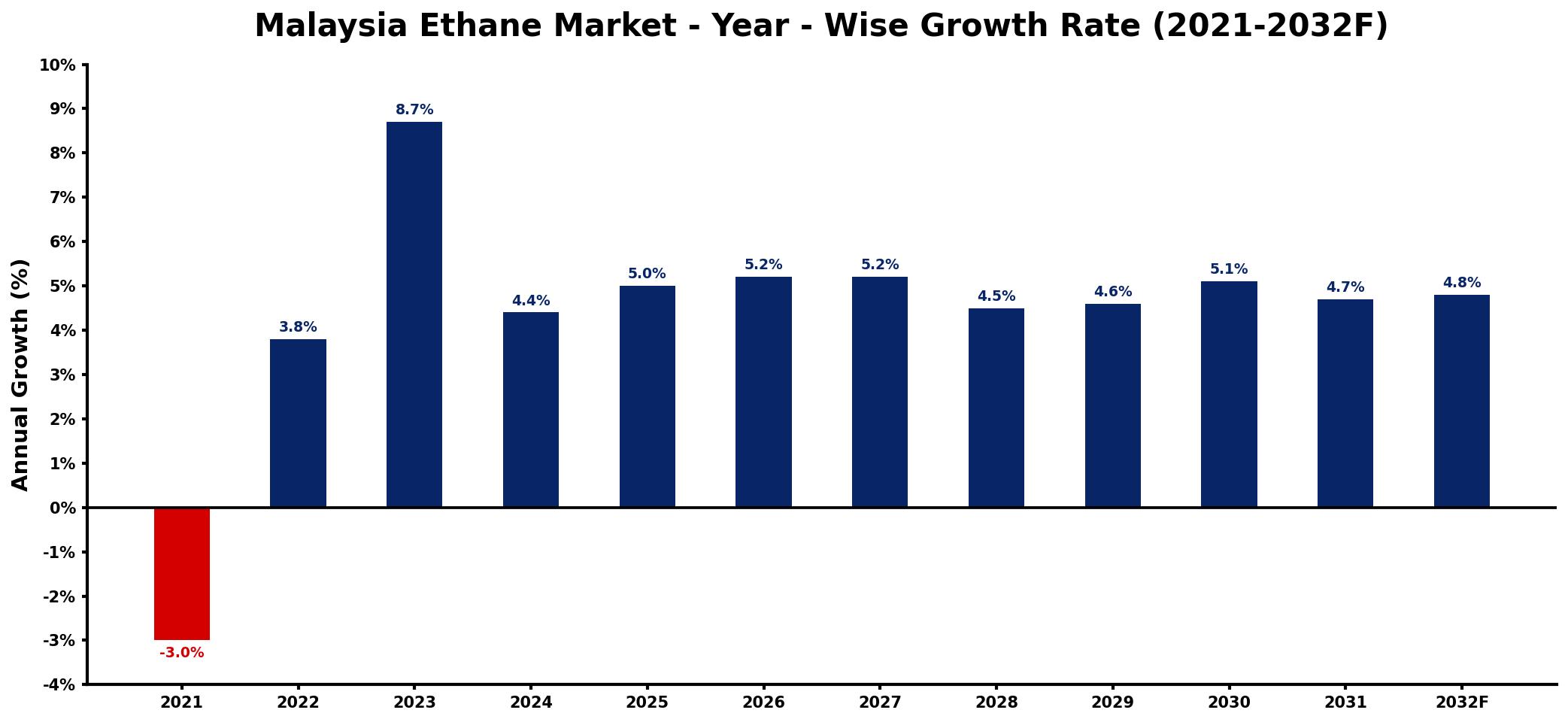
The table below presents the year‑wise growth rates along with the key drivers influencing the market
| Year | Growth Rate | Major Drivers |
| 2021 | -3.0% | decreased energy sector investments |
| 2022 | 3.8% | growing petrochemical manufacturing capacity |
| 2023 | 8.7% | increased demand for plastics |
| 2024 | 4.4% | expansion of industrial applications |
| 2025 | 5.0% | rising renewable energy initiatives |
| 2026 | 5.2% | enhanced infrastructure development projects |
| 2027 | 5.2% | growing global market integration |
| 2028 | 4.5% | increased foreign direct investments |
| 2029 | 4.6% | rising infrastructure development spending |
| 2030 | 5.1% | rising urbanization and industrialization |
| 2031 | 4.7% | increased domestic consumption patterns |
| 2032 | 4.8% | advancements in production technologies |
Note: Market size estimations and growth projections presented in this report are based on 6Wresearch's proprietary forecasting methodology, utilizing the latest available industry data, government publications, and primary research inputs.
Malaysia Ethane Market Synopsis
Ethane serves as a fundamental building block in the Malaysian petrochemical industry, with its primary application in the production of ethylene. Given Malaysia's rich natural gas reserves, the supply of ethane is both ample and vital, underpinning the countrys ambition to enhance its stature as a leading petrochemical hub in Southeast Asia.
As the global market shifts towards more sustainable and eco-friendly materials, ethane's role in producing lighter and more environmentally friendly plastics becomes increasingly relevant. This transition is expected to further drive demand for ethane in Malaysia, aligning with both local industrial strategies and international trends.
Malaysia Ethane Market Key Takeaways
- The market is experiencing growth driven by a strong demand for ethylene in various industries.
- Malaysias natural gas abundance supports a stable ethane supply for petrochemical production.
- Investment from both domestic and foreign entities highlights the sector's growth potential.
- The market's competitive edge is bolstered by strategic governmental support for the petrochemical industry.
- Environmental concerns are steering innovations toward sustainable ethane applications.
Evaluation of Restraints in Malaysia Ethane Market
Despite the positive growth outlook, the Malaysia ethane market faces certain restraints that could temper its expansion. One significant concern is the volatility of global energy prices, which can create uncertainty in long-term planning for market participants. Additionally, with the rise of renewable energy and alternative feedstocks, traditional petrochemical materials like ethane may experience fluctuations in demand, compelling companies to adapt rapidly to changing energy dynamics. Navigating these challenges will be crucial for maintaining competitive momentum in the evolving landscape.
Malaysia Ethane Market Trends
The ongoing transition towards sustainable products is reshaping the demand landscape for ethane. Innovations in recycling and alternative feedstock utilization are gaining traction, pushing traditional manufacturers to rethink their strategies. Additionally, digitalization in manufacturing processes is enhancing operational efficiency, further driving productivity in ethane-related production. These trends signal a significant shift towards modernization within the sector, aligning with global sustainability goals.
Malaysia Ethane Market Opportunities
The ethane market in Malaysia presents multiple growth and investment opportunities, particularly in the enhancement of production technologies. The focus on developing advanced ethylene derivatives can cater to emerging sectors such as biodegradable plastics and specialty chemicals. Moreover, strategic partnerships between local firms and global players can facilitate knowledge transfer and technological advancements, enabling Malaysia to strengthen its competitive position in the global petrochemical arena.
Government Initiatives in the Malaysia Ethane Market
The Malaysian government actively supports the growth of the petrochemical industry through various initiatives aimed at enhancing investment climate and infrastructure development. Policies promoting the use of natural gas as a feedstock align with national energy strategies, while incentives for research and development in green technologies are fostering innovation. Public funding for infrastructure upgrades is also enhancing the sector's capability to meet rising global demand.
Future Insights of the Malaysia Ethane Market
Looking ahead to 2026-2032, the Malaysia ethane market is expected to maintain an upward trajectory, driven by increasing demand for ethylene and its derivatives. With continuous investments and advancements in production techniques, the market can harness the potential of emerging technologies and sustainable practices. As Malaysia solidifies its place in the global petrochemical supply chain, stakeholders will need to remain agile to capitalize on shifting consumer preferences and regulatory landscapes.
Malaysia Ethane Market Latest Developments (2025 - 2026)
Recent developments indicate a significant shift in the Malaysian ethane market as companies explore innovations in production and sustainability practices. Efforts are being made to enhance the integration of renewable energy sources into the manufacturing processes, reflecting a broader trend towards sustainability. Additionally, partnerships are being formed to enhance technological capabilities and expand production capacity, ensuring that Malaysia remains competitive in the regional petrochemical landscape.
Malaysia Ethane Market - Key Attractiveness of the Report
- 10 Years of Market Numbers
- Historical Data Starting from 2022 to 2025
- Base Year: 2025
- Forecast Data until 2032
- Key Performance Indicators Impacting the Market
- Major Upcoming Developments and Projects
Key Highlights of the Report:
- Malaysia Ethane Market Outlook
- Market Size of Malaysia Ethane Market, 2025
- Forecast of Malaysia Ethane Market, 2032
- Historical Data and Forecast of Malaysia Ethane Revenues & Volume for the Period 2022-2032F
- Malaysia Ethane Market Trend Evolution
- Malaysia Ethane Market Drivers and Challenges
- Malaysia Ethane Price Trends
- Malaysia Ethane Porter's Five Forces
- Malaysia Ethane Industry Life Cycle
- Historical Data and Forecast of Malaysia Ethane Market Revenues & Volume By Application for the Period 2022-2032F
- Historical Data and Forecast of Malaysia Ethane Market Revenues & Volume By Ethylene Synthesis for the Period 2022-2032F
- Historical Data and Forecast of Malaysia Ethane Market Revenues & Volume By Acetic Acid Synthesis for the Period 2022-2032F
- Historical Data and Forecast of Malaysia Ethane Market Revenues & Volume By Refrigerant for the Period 2022-2032F
- Historical Data and Forecast of Malaysia Ethane Market Revenues & Volume By End-Use Industry for the Period 2022-2032F
- Historical Data and Forecast of Malaysia Ethane Market Revenues & Volume By Packaging for the Period 2022-2032F
- Historical Data and Forecast of Malaysia Ethane Market Revenues & Volume By Automotive & Transportation for the Period 2022-2032F
- Historical Data and Forecast of Malaysia Ethane Market Revenues & Volume By Construction for the Period 2022-2032F
- Historical Data and Forecast of Malaysia Ethane Market Revenues & Volume By Electricals & Electronics for the Period 2022-2032F
- Historical Data and Forecast of Malaysia Ethane Market Revenues & Volume By Healthcare for the Period 2022-2032F
- Malaysia Ethane Import Export Trade Statistics
- Market Opportunity Assessment By Application
- Market Opportunity Assessment By End-Use Industry
- Malaysia Ethane Top Companies Market Share
- Malaysia Ethane Competitive Benchmarking By Technical and Operational Parameters
- Malaysia Ethane Company Profiles
- Malaysia Ethane Key Strategic Recommendations






































