Malaysia Fans and Ventilators Market Summary
The malaysia fans and ventilators market was estimated at USD 151 Million in 2025 and is projected to reach USD 197 Million by 2032, growing at a CAGR of 5.4% from 2026 to 2032.
Malaysia Fans and Ventilators Market Year-wise Growth Rate and Key Drivers
This graph highlights how the Malaysia Fans and Ventilators Market has steadily grown over the past five years, supported by major growth factors.
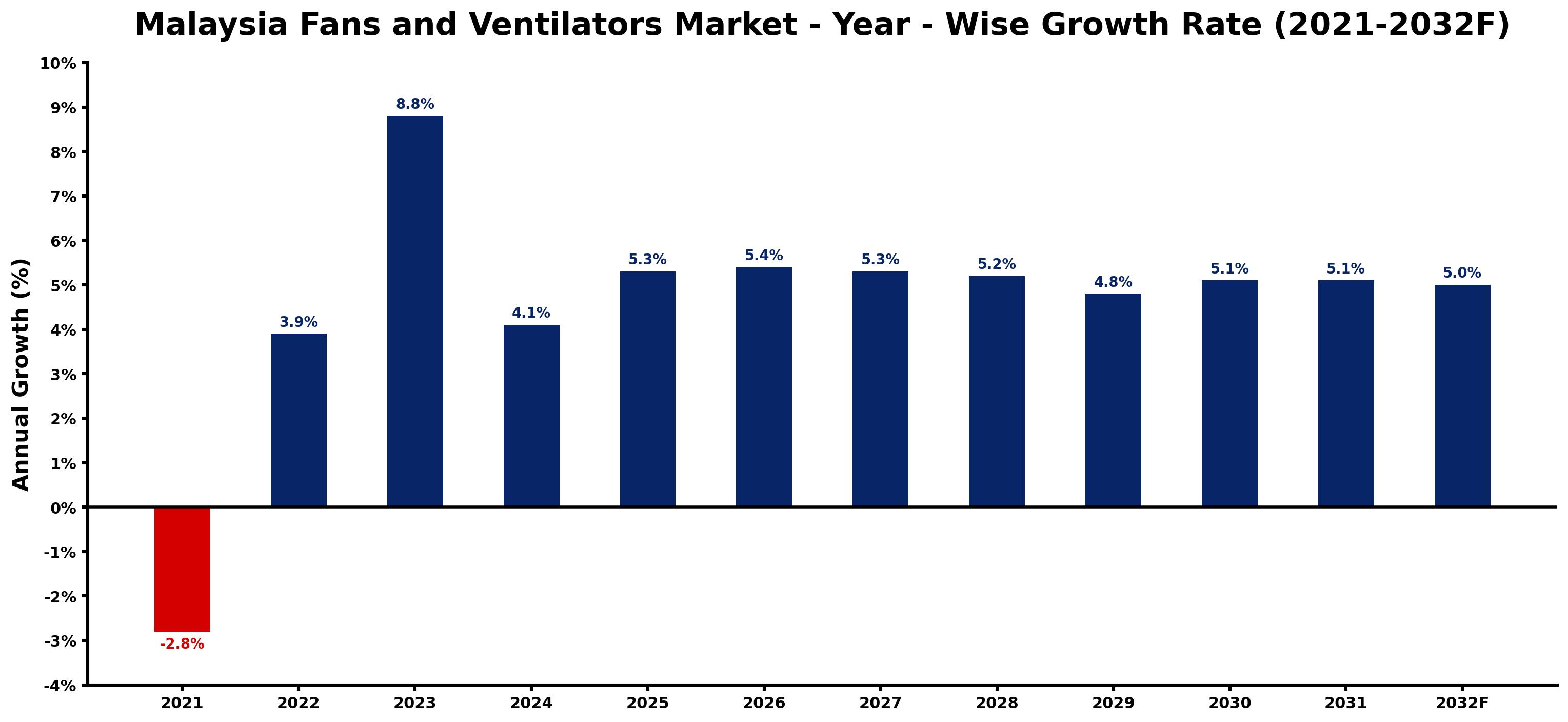
The table below presents the year wise growth rates along with the key drivers influencing the market
| Year | Growth Rate | Major Drivers |
| 2021 | -2.8% | Supply chain disruptions caused by the pandemic hindered production, leading to stock shortages and declining sales. |
| 2022 | 3.9% | Air conditioning malfunctions prompted a surge in portable fan and ventilator sales. |
| 2023 | 8.8% | Environmental awareness led consumers to prefer energy-efficient fan models over traditional options. |
| 2024 | 4.1% | Urbanization trends resulted in higher demand for ventilation solutions in residential complexes. |
| 2025 | 5.3% | Technological innovations introduced smart fans that attracted tech-savvy consumers seeking convenience. |
| 2026 | 5.4% | The rapid expansion of e-commerce platforms facilitated wider access to various cooling products. |
| 2027 | 5.3% | Inflationary pressures pushed consumers towards more affordable and versatile ventilation solutions. |
| 2028 | 5.2% | A competitive market landscape encouraged brands to offer diverse product features and pricing. |
| 2029 | 4.8% | Sustainable building practices in new developments increased interest in advanced ventilation systems. |
| 2030 | 5.1% | Post-pandemic lifestyle changes prioritized indoor air quality, boosting ventilator market appeal. |
| 2031 | 5.1% | Rural electrification projects spurred demand for reliable cooling solutions in underserved areas. |
| 2032 | 5.0% | Integration of IoT in home appliances reshaped consumer preferences towards intelligent ventilation systems. |
Note - Market size estimations and growth projections presented in this report are based on 6Wresearch's advanced forecasting approach, validated with industry datasets as of June 2026.
Malaysia Fans and Ventilators Market Synopsis
The Malaysia Fans and Ventilators Market is projected to reach 5.4% and witness significant growth during the forecast period (2026-2032). The tropical climate of Malaysia drives the high demand for fans across residential, commercial, and public domains. In the realm of ventilation, medical ventilators have gained prominence as critical devices, especially in light of the COVID-19 pandemic, underscoring their importance in healthcare settings throughout the country.
Malaysia Fans and Ventilators Market Growth Drivers
A multitude of factors contribute to the robust growth of the Malaysia Fans and Ventilators Market. Primarily, the country's consistently warm climate creates a perennial demand for effective cooling solutions. The increasing urbanization and expanding middle class are further propelling the need for various fan types.
- The growing population in urban centers is significantly increasing the need for more cooling appliances, leading to greater sales of ceiling, pedestal, and table fans.
- Consumers are becoming more environmentally conscious, spurring manufacturers to innovate in energy-efficient fan designs that cater to eco-friendly preferences.
- The rise of smart home technologies is pushing the market towards the integration of fans with IoT capabilities, enhancing convenience and energy management.
- The resurgence of the tourism sector post-pandemic has renewed demand for cooling solutions in hotels and recreational establishments, thereby stimulating market growth.
- Healthcare investments in respiratory devices have surged, particularly following the pandemic, creating a sustained demand for ventilators in hospitals and clinics across the nation.
Malaysia Fans and Ventilators Market Trends and Opportunities
The Malaysia Fans and Ventilators Market is witnessing several trends that are shaping its future. With ongoing technological advancements, the market is poised for innovation.
- There is a notable trend towards the development of energy-efficient models as consumers and businesses seek to reduce electricity costs, aligning with global sustainability goals.
- The integration of air purification technology in fans is becoming increasingly popular, catering to health-conscious consumers particularly in the wake of respiratory health concerns.
- Mobile fans and portable ventilators are gaining traction, driven by the need for flexibility and convenience in various settings, including outdoor events and temporary medical facilities.
- Increased awareness regarding indoor air quality is pushing consumers to invest in advanced ventilation systems that can provide better air circulation and reduce contaminants.
- Opportunities lie in the customization of fan designs to meet aesthetic preferences, catering to diverse consumer tastes across different regions in Malaysia.
Malaysia Fans and Ventilators Market Challenges and Restraints
While the Malaysia Fans and Ventilators Market displays promising prospects, it is not without challenges. Market participants must navigate various obstacles that could impede growth.
- The volatility in raw material prices can adversely affect production costs, making it essential for manufacturers to manage supply chain efficiencies effectively.
- Competition from low-cost imports remains a significant challenge, potentially compressing profit margins for local manufacturers.
- Consumer price sensitivity, particularly in economically challenging times, may lead to reluctance in purchasing higher-end ventilators or smart fan technologies.
- The rapid pace of technological change demands ongoing investment in research and development, posing a financial strain on smaller companies within the market.
- Market participants must also address the regulatory landscape, ensuring compliance with safety and performance standards which can vary across regions.
Malaysia Fans and Ventilators Market Government Investment and Initiatives
The government of Malaysia plays a crucial role in shaping the Fans and Ventilators Market through various initiatives and investments. The national healthcare policies prioritize the enhancement of medical facilities, including the procurement of ventilators essential for treating patients with severe respiratory issues.
- Public spending on healthcare infrastructure has been on the rise, prompting hospitals to upgrade their equipment and increase the number of operational ventilators.
- The government promotes energy efficiency and sustainable technologies, encouraging manufacturers to focus on products that align with environmental goals.
- Investment in research initiatives aimed at improving respiratory health technology focuses on developing advanced ventilators to better serve the healthcare sector.
- Incentives for local manufacturers are being introduced to ensure that they can compete effectively against foreign imports, ultimately boosting domestic production capabilities.
- Government-led awareness campaigns about indoor air quality and respiratory health are driving consumer focus towards better ventilation solutions in public spaces and private homes.
Malaysia Fans and Ventilators Market Latest Developments (May 2025 - June 2026)
Recent developments in the Malaysia Fans and Ventilators Market exhibit a dynamic shift towards innovation and improved standards of living. Over the past year, manufacturers have been increasingly focusing on integrating smart technology into their products to cater to the changing consumer landscape.
- The introduction of smart fans equipped with app-controlled features and voice activation has gained interest among tech-savvy consumers, enhancing usability.
- In response to heightened concerns about air quality, there has been a marked increase in models designed with built-in air filtration systems, addressing both comfort and health.
- Healthcare facilities have seen increased investments in critical care technologies, leading to a rise in the adoption of advanced ventilators that offer improved patient monitoring and support features.
- Trade shows and expos organized in the region have highlighted innovations in both fans and ventilators, fostering collaboration and knowledge sharing among stakeholders.
- Market responses to consumer feedback have prompted rapid iterations in product design, focusing on durability, energy efficiency, and aesthetics to meet diverse preferences.
Malaysia Fans and Ventilators Market - Key Attractiveness of the Report
- 10 Years of Market Numbers
- Historical Data Starting from 2022 to 2025
- Base Year: 2025
- Forecast Data until 2032
- Key Performance Indicators Impacting the Market
- Major Upcoming Developments and Projects
Key Highlights of the Report:
- Malaysia Fans and Ventilators Market Outlook
- Market Size of Malaysia Fans and Ventilators Market, 2025
- Forecast of Malaysia Fans and Ventilators Market, 2032F
- Historical Data and Forecast of Malaysia Fans and Ventilators Revenues & Volume for the Period 2022-2032F
- Malaysia Fans and Ventilators Market Trend Evolution
- Malaysia Fans and Ventilators Market Drivers and Challenges
- Malaysia Fans and Ventilators Price Trends
- Malaysia Fans and Ventilators Porter's Five Forces
- Malaysia Fans and Ventilators Industry Life Cycle
- Historical Data and Forecast of Malaysia Fans and Ventilators Market Revenues & Volume By Material for the Period 2022-2032F
- Historical Data and Forecast of Malaysia Fans and Ventilators Market Revenues & Volume By Metal for the Period 2022-2032F
- Historical Data and Forecast of Malaysia Fans and Ventilators Market Revenues & Volume By Composite for the Period 2022-2032F
- Historical Data and Forecast of Malaysia Fans and Ventilators Market Revenues & Volume By Rubber for the Period 2022-2032F
- Historical Data and Forecast of Malaysia Fans and Ventilators Market Revenues & Volume By Plastic for the Period 2022-2032F
- Historical Data and Forecast of Malaysia Fans and Ventilators Market Revenues & Volume By Application for the Period 2022-2032F
- Historical Data and Forecast of Malaysia Fans and Ventilators Market Revenues & Volume By Interior for the Period 2022-2032F
- Historical Data and Forecast of Malaysia Fans and Ventilators Market Revenues & Volume By Exterior for the Period 2022-2032F
- Historical Data and Forecast of Malaysia Fans and Ventilators Market Revenues & Volume By Structural for the Period 2022-2032F
- Historical Data and Forecast of Malaysia Fans and Ventilators Market Revenues & Volume By Powertrain for the Period 2022-2032F
- Historical Data and Forecast of Malaysia Fans and Ventilators Market Revenues & Volume By Vehicle Types for the Period 2022-2032F
- Historical Data and Forecast of Malaysia Fans and Ventilators Market Revenues & Volume By Passenger Vehicles for the Period 2022-2032F
- Historical Data and Forecast of Malaysia Fans and Ventilators Market Revenues & Volume By Light Commercial Vehicles for the Period 2022-2032F
- Historical Data and Forecast of Malaysia Fans and Ventilators Market Revenues & Volume By Heavy Commercial Vehicles for the Period 2022-2032F
- Malaysia Fans and Ventilators Import Export Trade Statistics
- Market Opportunity Assessment By Material
- Market Opportunity Assessment By Application
- Market Opportunity Assessment By Vehicle Types
- Malaysia Fans and Ventilators Top Companies Market Share
- Malaysia Fans and Ventilators Competitive Benchmarking By Technical and Operational Parameters
- Malaysia Fans and Ventilators Company Profiles
- Malaysia Fans and Ventilators Key Strategic Recommendations






































