Malaysia Fans Market Size Growth Rate
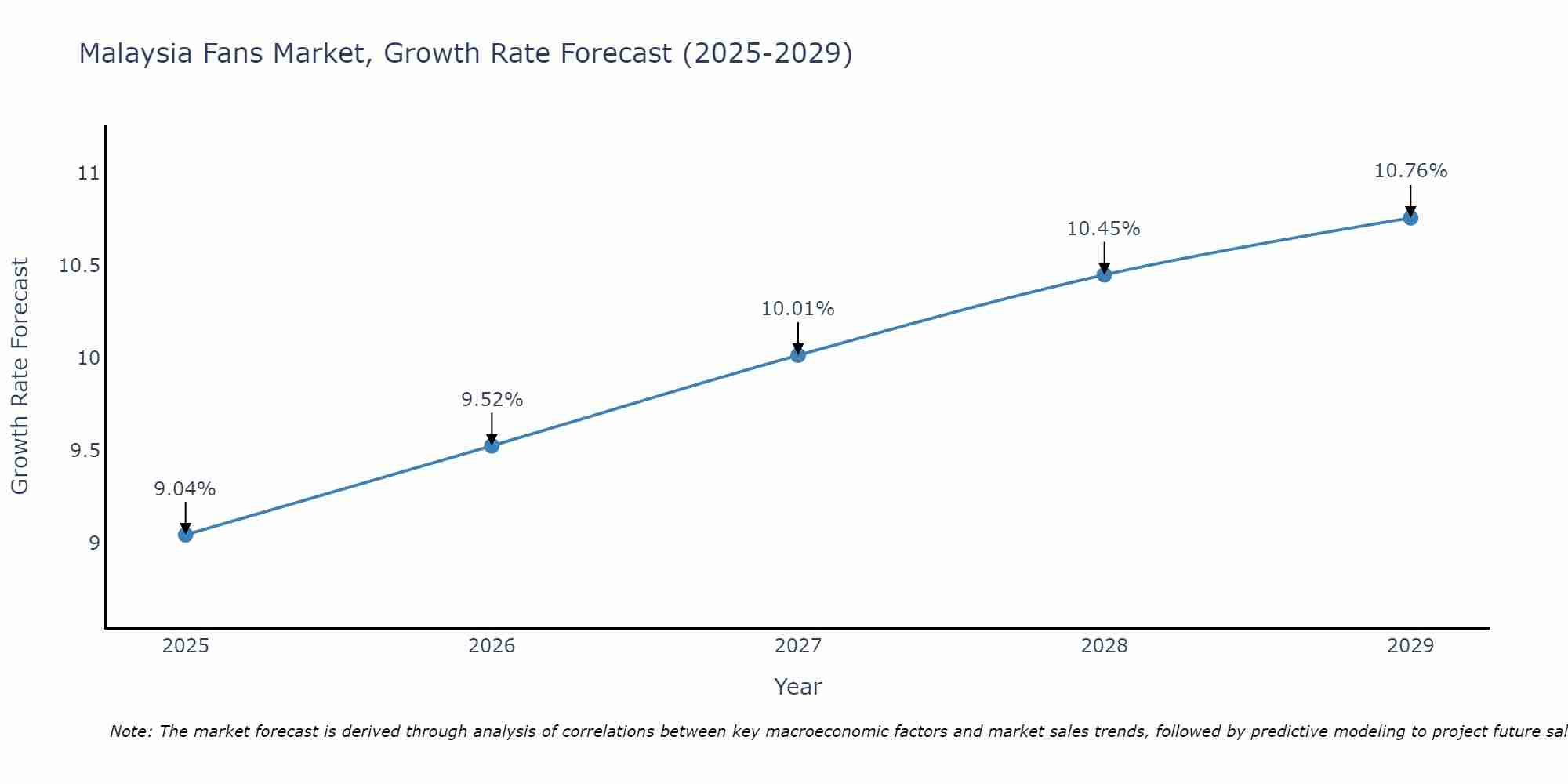
The Malaysia Fans Market is poised for steady growth rate improvements from 2025 to 2029. Commencing at 9.04% in 2025, growth builds up to 10.76% by 2029.
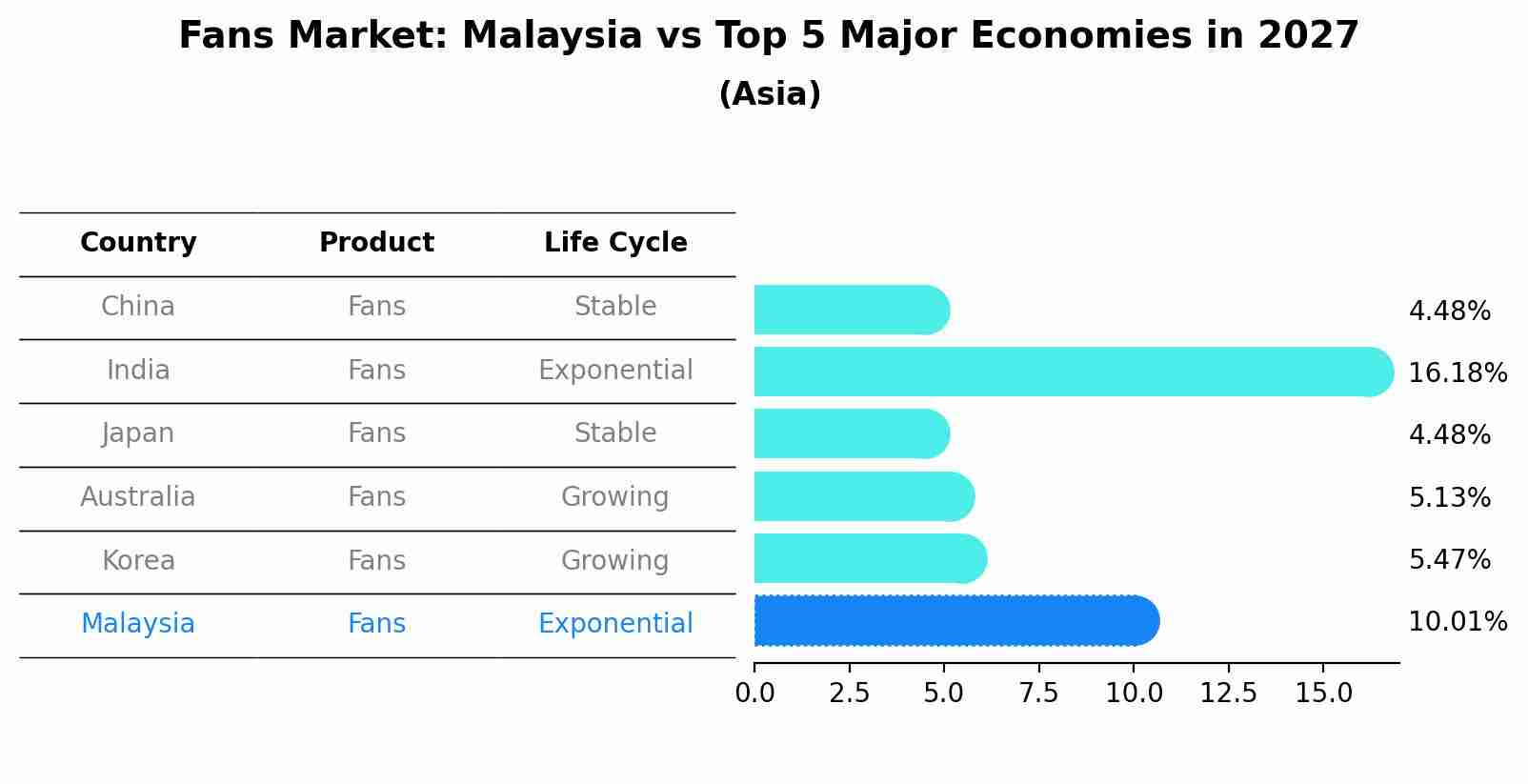
Fans Market: Malaysia vs Top 5 Major Economies in 2027 (Asia)
By 2027, the Fans market in Malaysia is anticipated to reach a growth rate of 10.01%, as part of an increasingly competitive Asia region, where China remains at the forefront, supported by India, Japan, Australia and South Korea, driving innovations and market adoption across sectors.
Malaysia Fans Market Growth Rate
According to 6Wresearch internal database and industry insights, the Malaysia Fans Market is projected to grow at a compound annual growth rate (CAGR) of 8% during the forecast period 2026–2032.
Topics Covered in the Malaysia Fans Market Report
The Malaysia Fans Market report thoroughly covers the market by fan types and applications. It provides an unbiased and detailed analysis of ongoing market trends, opportunities, challenges, and market drivers, helping stakeholders align their strategies with current and future market dynamics.
Malaysia Fans Market Highlights
| Report Name | Malaysia Fans Market |
| Forecast Period | 2026–2032 |
| CAGR | 8% |
| Growing Sector | Axial Fans |
Malaysia Fans Market Synopsis
The Malaysia Fans Market has been witnessing steady growth. Factors such as increasing urbanisation, hot weather conditions, and increased construction of residential and commercial buildings are propelling the demand for energy-saving fans. Furthermore, shifting consumers' preference towards energy-efficient and low-noise fans is also supporting the market growth as they are suitable for small living spaces. The widespread usage of fans across the industrial sector boosts the demand for high-performance fans for ventilation and cooling in factories. Moreover, increasing demand from tier 2 and tier 3 cities further supports the Malaysia Fans Market Growth.
Evaluation of Growth Drivers in the Malaysia Fans Market
Below mentioned are some prominent drivers and their influence on the Malaysia Fans Market dynamics:
| Drivers | Primary Segment Affected | Why It Matters |
| Urbanization & Housing Projects | Residential | Increased construction activities lead to higher fan installations in homes. |
| Tropical Climate Conditions | All Applications | Owing to hot and humid weather there is a consistent need for cooling atmosphere. |
| Commercial Expansion | Commercial | increase in the utilisation of fans owing to rise of malls, offices, and hotels. |
| Industrial Ventilation Needs | Industrial | Manufacturing units need effective ventilation and air movement systems. |
| Smart Home Adoption | Residential | Incorporation with smart automation systems proliferate the demand of products |
The Malaysia Fans Market is anticipated to grow at a CAGR of 8% during the forecast period 2026-2032. Several major drivers are driving the robust growth of the Malaysia fans market. The growing temperatures and the need for better indoor ventilation are major drivers supporting the robust market growth across the country. Furthermore, urban housing and industrial expansion have propelled the high demand for exhaust fans, ceiling fans, and heavy-duty industrial fans. Consumers are shifting towards energy-saving models as they save electricity and reduce electricity bills. Moreover, ongoing government efforts to promote efficient appliances and improved product designs are also contributing to the market growth.
Evaluation of Restraints in the Malaysia Fans Market
Below mentioned are some major restraints and their influence on the Malaysia Fans Market dynamics:
| Restraints | Primary Segment Affected | What This Means |
| Price Competition | All Types | Intense competition from low‑cost brands may reduce profit margins. |
| Import Dependency | All | Dependency on imported components can affect production prices. |
| Market Saturation | Residential | Growth may reduce owing to urban markets that may reach saturation. |
| Supply Chain Disruptions | Industrial & Commercial | Timely product delivery get affected owing to logistics delays. |
| Regulatory Compliance Costs | All | Aligning energy efficiency and safety regulations adds to costs. |
Malaysia Fans Market Challenges
The Malaysia Fans Industry faces several critical challenges even with the steady growth. Issues such as increasing competition from air conditioning systems pose a major challenge, as it is reducing fan usage in some sectors. Furthermore, the adoption of premium models has been limited due to Price sensitivity among consumers, further affecting the market growth. Availability of low-quality, unbranded products also poses hurdles by affecting customer satisfaction. Moreover, manufacturers need to focus on innovation and awareness to gain stable growth in the market.
Malaysia Fans Market Trends
Several key trends are shaping the Malaysia fans market. Ongoing innovation of smart ceiling fans with remote and app control, bladeless fans, and industrial fans with noise-reduction features is one major trend supporting the market growth. Additionally, consumers are also shifting towards eco-friendly models with energy-saving certifications due to rising 3environmnetal concerns among consumers. Moreover, design and aesthetics are also another emerging trend, especially for residential users. Overall, the rising demand for compact and powerful fans, mainly in urban homes and office spaces, is also boosting the market expansion.
Investment Opportunities in the Malaysia Fans Market
The Malaysia fans industry offers various strong and ample investment opportunities for investors seeking long-term growth. Robust market potential across the country is there owing to smart fan technology, energy-efficient designs, and durable industrial-grade models. Furthermore, ongoing expansion into smaller cities and rural markets is also helping I the growth of the customer base, also supports robust market growth. Moreover, investors can invest in innovative marketing, online retail partnerships, and after-sales services, as it encourages long-term growth in the market also shapes the market dynamics.
Top 5 Leading Players in the Malaysia Fans Market
Below is the list of prominent companies leading the Malaysia Fans Market:
1. Panasonic Malaysia
| Company Name | Panasonic Malaysia |
|---|---|
| Established Year | 1972 |
| Headquarters | Shah Alam, Malaysia |
| Official Website | Click Here |
Panasonic is one of the top brands in Malaysia for home appliances, including fans. The company is known for its energy-efficient and durable fan models, providing a wide range of axial, centrifugal, and industrial fans for residential, commercial, and industrial applications.
2. KDK Malaysia (Mitsubishi Electric)
| Company Name | KDK Malaysia (Mitsubishi Electric) |
|---|---|
| Established Year | 1971 |
| Headquarters | Kuala Lumpur, Malaysia |
| Official Website | - |
KDK, a subsidiary of Mitsubishi Electric, is a leading brand in the Malaysian fan market, offering high-quality ceiling fans, stand fans, and exhaust fans. Their concentration on energy efficiency and design aesthetics makes them a popular choice among consumers.
3. Sharp Electronics (Malaysia)
| Company Name | Sharp Electronics (Malaysia) |
|---|---|
| Established Year | 1988 |
| Headquarters | Shah Alam, Malaysia |
| Official Website | - |
Sharp is well-known for its broad range of home appliances, including ceiling and stand fans. The brand’s reputation for quality and innovation in air circulation products positions it as a robust player in the Malaysia Fans Market.
4. Cecilware (Malaysia)
| Company Name | Cecilware (Malaysia) |
|---|---|
| Established Year | 1984 |
| Headquarters | Kuala Lumpur, Malaysia |
| Official Website | - |
Cecilware provides a wide range of cooling solutions, including industrial fans, ventilation systems, and home-use fans. Their product range consist of powerful centrifugal and exhaust fans, catering to both residential and industrial needs.
5. Fanco (Malaysia)
| Company Name | Fanco (Malaysia) |
|---|---|
| Established Year | 2004 |
| Headquarters | Kuala Lumpur, Malaysia |
| Official Website | - |
Fanco is a leading fan manufacturer in Malaysia, specializing in ceiling fans, pedestal fans, and exhaust fans.
Government Regulations in the Malaysia Fans Market
According to the Malaysian government data, the government is implementing various strict regulations in the Malaysia fans market. These regulations has the objective to support energy-saving appliances through standards and labelling programs, and regulatory bodies also make sure that fans sold in the market must meet with energy efficiency and safety guidelines for responsible market growth. Several policies has the objective to promote the use of eco-friendly electrical products due to the rising environmental concerns. Moreover, regulations related to import and quality control set mandates for both domestic and international manufacturers.
Future Insights of the Malaysia Fans Market
The Malaysia Fans Market is expected to witness robust growth in the future. Ongoing rising demand for smart and energy-efficient fans in homes and industries will likely drive steady market growth across the country. As knowledge regarding air quality and comfort grows, more people are expected to upgrade to better fan models. This will help in shaping the market dynamics in the coming years. Factors like expanding infrastructure and new housing developments are likely to proliferate robust requirements. Active innovation and design will appeal young consumers, further supporting the market expansion in the coming years.
Market Segmentation Analysis
The report offers a comprehensive study of the following Malaysia Fans Market segments and their leading categories:
Axial Fans to dominate the market- By Types
According to Lakshita, Senior Research Analyst, 6Wresearch, axial fans are expected to lead the Malaysia Fans Market Share due to their widespread usage, cost‑effectiveness, and suitability for residential, commercial, and light industrial applications and axial fans provide efficient airflow at lower costs, making them a preferred choice for every day cooling needs.
Residential to Dominate the Market – By Application
Residential applications lead the Malaysia Fans Market Share and with hot and humid weather, households across the country depend largely on ceiling, table, and wall-mounted fans for daily cooling needs.
Key Attractiveness of the Report
- 10 Years of Market Numbers.
- Historical Data Starting from 2022 to 2025.
- Base Year: 2025.
- Forecast Data until 2032.
- Key Performance Indicators Impacting the Market.
- Major Upcoming Developments and Projects.
Key Highlights of the Report:
- · Malaysia Fans Market Outlook
- Market Size of Malaysia Fans Market, 2025
- Forecast of Malaysia Fans Market, 2032
- Historical Data and Forecast of Malaysia Fans Revenues & Volume for the Period 2022-2032
- Malaysia Fans Market Trend Evolution
- Malaysia Fans Market Drivers and Challenges
- Malaysia Fans Price Trends
- Malaysia Fans Porter's Five Forces
- Malaysia Fans Industry Life Cycle
- Historical Data and Forecast of Malaysia Fans Market Revenues & Volume By Types for the Period 2022-2032
- Historical Data and Forecast of Malaysia Fans Market Revenues & Volume By Axial for the Period 2022-2032
- Historical Data and Forecast of Malaysia Fans Market Revenues & Volume By Centrifugal for the Period 2022-2032
- Historical Data and Forecast of Malaysia Fans Market Revenues & Volume By Cross Flow for the Period 2022-2032
- Historical Data and Forecast of Malaysia Fans Market Revenues & Volume By Application for the Period 2022-2032
- Historical Data and Forecast of Malaysia Fans Market Revenues & Volume By Commercial for the Period 2022-2032
- Historical Data and Forecast of Malaysia Fans Market Revenues & Volume By Industrial for the Period 2022-2032
- Historical Data and Forecast of Malaysia Fans Market Revenues & Volume By Residential for the Period 2022-2032
- Malaysia Fans Import Export Trade Statistics
- Market Opportunity Assessment By Types
- Market Opportunity Assessment By Application
- Malaysia Fans Top Companies Market Share
- Malaysia Fans Competitive Benchmarking By Technical and Operational Parameters
- Malaysia Fans Company Profiles
- Malaysia Fans Key Strategic Recommendations
Market Covered
The report offers a comprehensive study of the following Malaysia Fans Market segments:
By Types
- Axial
- Centrifugal
- CrossFlow
By Application
- Commercial
- Industrial
- Residential






































