Malaysia Faucets, Mixers & Taps Market Summary
The malaysia faucets, mixers & taps market was estimated at USD 200 Million in 2025 and is projected to reach USD 259 Million by 2032, growing at a CAGR of 5.3% from 2026 to 2032.
Malaysia Faucets, Mixers & Taps Market Year-wise Growth Rate and Key Drivers
This graph highlights how the Malaysia Faucets, Mixers & Taps Market has steadily grown over the past five years, supported by major growth factors.
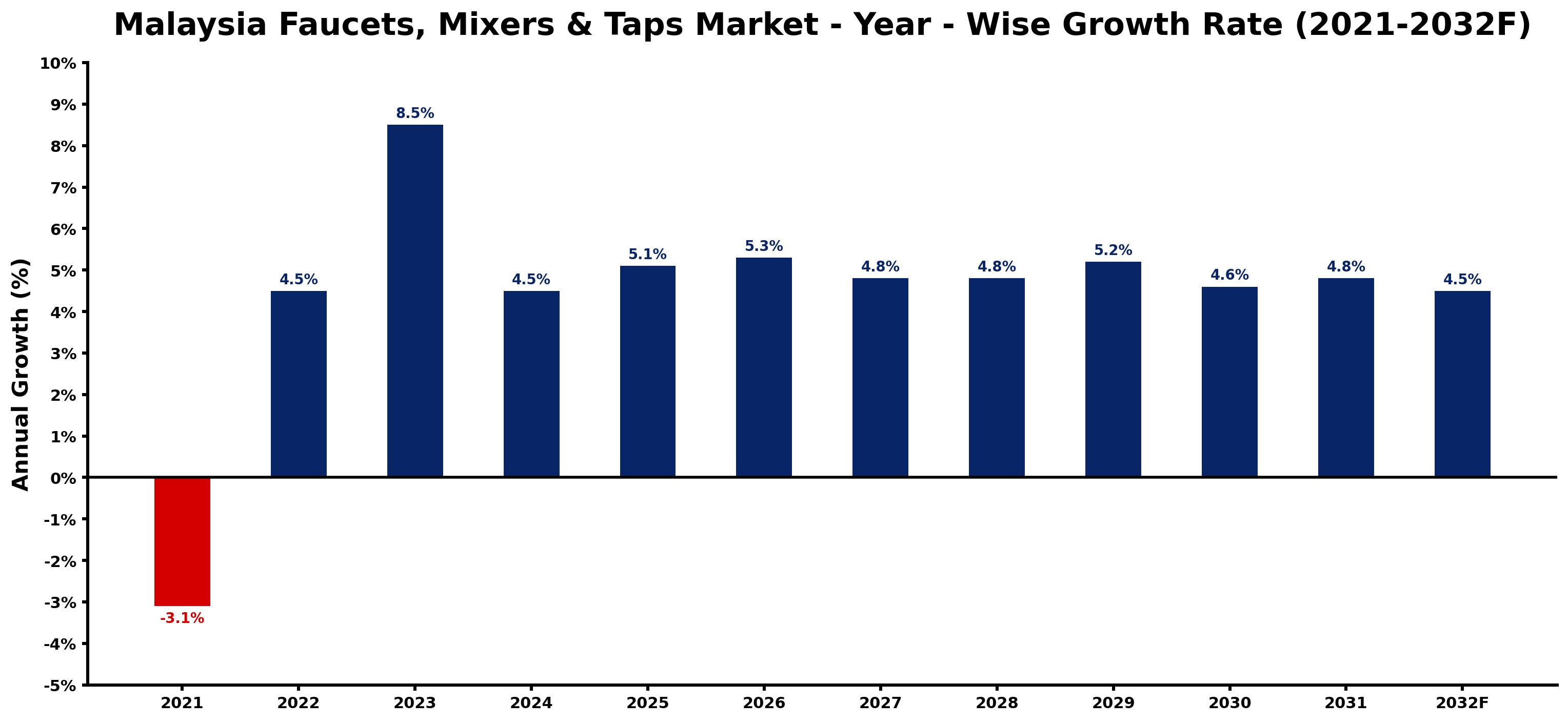
The table below presents the year wise growth rates along with the key drivers influencing the market
| Year | Growth Rate | Major Drivers |
| 2021 | -3.1% | Supply chain disruptions caused significant delays in product availability, hindering market growth in 2021. |
| 2022 | 4.5% | Emerging lifestyle trends favoring modern designs influence faucet and tap preferences. |
| 2023 | 8.5% | Construction sector rebounds, increasing demand for high-quality plumbing fixtures. |
| 2024 | 4.5% | Rising urbanization trends drive the need for efficient water management systems. |
| 2025 | 5.1% | Sustainability initiatives encourage eco-friendly faucet designs and technologies. |
| 2026 | 5.3% | Technological innovations enhance smart home integration in tap and mixer functionalities. |
| 2027 | 4.8% | Increased disposable incomes lead to premium faucet purchases among consumers. |
| 2028 | 4.8% | Architectural shifts prioritize stylish fixtures to complement contemporary interiors. |
| 2029 | 5.2% | Strong tourism growth boosts demand for high-quality fixtures in hospitality sectors. |
| 2030 | 4.6% | Local manufacturing capabilities expand, reducing dependence on imported plumbing solutions. |
| 2031 | 4.8% | Market consolidation trends emerge, as companies pursue competitive advantages strategically. |
| 2032 | 4.5% | Consumer awareness of water conservation drives interest in smart faucet technologies. |
Note - Market size estimations and growth projections presented in this report are based on 6Wresearch's advanced forecasting approach, validated with industry datasets as of June 2026.
Malaysia Faucets, Mixers & Taps Market Synopsis
The Malaysia Faucets, Mixers Taps Market is projected to reach 5.3% and witness significant growth during the forecast period (2026-2032). This growth trajectory is primarily fueled by a combination of increased construction activities, rising disposable incomes, and a burgeoning demand for luxury kitchen appliances. Furthermore, technological advancements, such as the integration of water-saving sensors and touchless systems, are enhancing the functionality and attractiveness of faucets, mixers, and taps in residential and commercial settings. Additionally, supportive government initiatives aimed at promoting energy-efficient products are playing a pivotal role in driving market expansion.
Malaysia Faucets, Mixers & Taps Market Growth Drivers
The expansion of the Malaysia Faucets, Mixers & Taps Market can be attributed to several key drivers:
- Increased construction activities in Malaysia are creating significant demand for plumbing fixtures, including faucets, mixers, and taps, particularly in new residential and commercial projects.
- The rise in disposable income among consumers is fostering a greater inclination towards premium and luxury kitchen and bathroom fittings, which fuels the demand for high-quality faucets and taps.
- Technological innovations, such as touchless faucet solutions and smart control systems, are becoming increasingly popular due to their convenience and efficiency, catering to the tech-savvy consumer segment.
- Environmental concerns are driving consumers to adopt water-saving technologies in their homes, with faucets equipped with advanced features gaining traction for their ability to reduce water waste.
- Growing health awareness has led to increased demand for touchless systems, as consumers prioritize hygiene, especially in residential applications.
Malaysia Faucets, Mixers & Taps Market Challenges and Restraints
While the Malaysia Faucets, Mixers & Taps Market is poised for growth, several challenges and restraints may hinder its expansion:
- Market saturation in urban areas may limit opportunities for new entrants, forcing existing players to innovate continuously to maintain market share.
- The fluctuating prices of raw materials essential for manufacturing faucets and mixers can impact production costs and, consequently, pricing strategies.
- Consumer preference for traditional plumbing fixtures can pose a challenge for newer, technologically advanced products, slowing the adoption of innovative solutions.
- Regulatory hurdles concerning product standards and certifications can introduce delays in product launches and escalate operational costs for manufacturers.
- Economic uncertainties stemming from global events may affect consumer spending on home improvement projects, impacting the overall market growth.
Malaysia Faucets, Mixers & Taps Market Trends and Opportunities
Several trends and opportunities are shaping the Malaysia Faucets, Mixers & Taps Market:
- The increasing popularity of sustainable and eco-friendly products among consumers presents an opportunity for manufacturers to create innovative solutions that align with environmental values.
- Urbanization trends are leading to a rise in compact and multifunctional fixtures, enhancing the appeal of space-saving designs in faucets and mixers.
- Customization in design is gaining traction, as homeowners seek unique and tailored solutions for their kitchens and bathrooms, driving demand for bespoke fittings.
- The integration of smart home technology within faucets and taps, enhancing user convenience and functionality, is expected to become a significant market trend in the coming years.
- Collaborations between manufacturers and smart technology companies offer substantial opportunities for product development and market expansion.
Malaysia Faucets, Mixers & Taps Market Government Investment and Initiatives
The government of Malaysia has implemented various initiatives to stimulate the growth of the faucets, mixers, and taps market. Investments in infrastructure and housing projects have been prioritized to boost the construction sector, directly impacting demand for plumbing fixtures. Additionally, policies aimed at encouraging the adoption of energy-efficient and water-saving products are in place, including subsidies and incentives which make these products more accessible to consumers. Public spending on sustainable development projects is also influencing market dynamics, fostering an environment conducive to the growth of eco-friendly plumbing solutions.
Malaysia Faucets, Mixers & Taps Market Latest Developments (May 2025 - June 2026)
Recent developments in the Malaysia Faucets, Mixers & Taps Market indicate a shift towards smarter and more efficient products. As consumer preferences evolve, numerous manufacturers are introducing innovative products equipped with advanced features such as touchless operation and integrated water-saving technology. The market is also experiencing an increase in collaborations between plumbing manufacturers and technology companies to enhance product functionality and appeal. Furthermore, growing environmental concerns are driving companies to focus on sustainable manufacturing practices, contributing to the overall market direction towards sustainability and innovation.
Malaysia Faucets, Mixers & Taps Market - Key Attractiveness of the Report
- 10 Years of Market Numbers
- Historical Data Starting from 2022 to 2025
- Base Year: 2025
- Forecast Data until 2032
- Key Performance Indicators Impacting the Market
- Major Upcoming Developments and Projects
Key Highlights of the Report:
- Malaysia Faucets, Mixers & Taps Market Outlook
- Market Size of Malaysia Faucets, Mixers & Taps Market, 2025
- Forecast of Malaysia Faucets, Mixers & Taps Market, 2032F
- Historical Data and Forecast of Malaysia Faucets, Mixers & Taps Revenues & Volume for the Period 2022-2032F
- Malaysia Faucets, Mixers & Taps Market Trend Evolution
- Malaysia Faucets, Mixers & Taps Market Drivers and Challenges
- Malaysia Faucets, Mixers & Taps Price Trends
- Malaysia Faucets, Mixers & Taps Porter's Five Forces
- Malaysia Faucets, Mixers & Taps Industry Life Cycle
- Historical Data and Forecast of Malaysia Faucets, Mixers & Taps Market Revenues & Volume By Technology for the Period 2022-2032F
- Historical Data and Forecast of Malaysia Faucets, Mixers & Taps Market Revenues & Volume By Sensor for the Period 2022-2032F
- Historical Data and Forecast of Malaysia Faucets, Mixers & Taps Market Revenues & Volume By Non-Sensor for the Period 2022-2032F
- Historical Data and Forecast of Malaysia Faucets, Mixers & Taps Market Revenues & Volume By Product Type for the Period 2022-2032F
- Historical Data and Forecast of Malaysia Faucets, Mixers & Taps Market Revenues & Volume By One-hand mixer for the Period 2022-2032F
- Historical Data and Forecast of Malaysia Faucets, Mixers & Taps Market Revenues & Volume By Two-hand mixer for the Period 2022-2032F
- Historical Data and Forecast of Malaysia Faucets, Mixers & Taps Market Revenues & Volume By Others for the Period 2022-2032F
- Historical Data and Forecast of Malaysia Faucets, Mixers & Taps Market Revenues & Volume By End-Users for the Period 2022-2032F
- Historical Data and Forecast of Malaysia Faucets, Mixers & Taps Market Revenues & Volume By Residential for the Period 2022-2032F
- Historical Data and Forecast of Malaysia Faucets, Mixers & Taps Market Revenues & Volume By Commercial for the Period 2022-2032F
- Historical Data and Forecast of Malaysia Faucets, Mixers & Taps Market Revenues & Volume By Industrial for the Period 2022-2032F
- Historical Data and Forecast of Malaysia Faucets, Mixers & Taps Market Revenues & Volume By Applications for the Period 2022-2032F
- Historical Data and Forecast of Malaysia Faucets, Mixers & Taps Market Revenues & Volume By Bathroom Faucets for the Period 2022-2032F
- Historical Data and Forecast of Malaysia Faucets, Mixers & Taps Market Revenues & Volume By Kitchen Faucets for the Period 2022-2032F
- Malaysia Faucets, Mixers & Taps Import Export Trade Statistics
- Market Opportunity Assessment By Technology
- Market Opportunity Assessment By Product Type
- Market Opportunity Assessment By End-Users
- Market Opportunity Assessment By Applications
- Malaysia Faucets, Mixers & Taps Top Companies Market Share
- Malaysia Faucets, Mixers & Taps Competitive Benchmarking By Technical and Operational Parameters
- Malaysia Faucets, Mixers & Taps Company Profiles
- Malaysia Faucets, Mixers & Taps Key Strategic Recommendations






































