Malaysia Fish Farming Market Size, Share & Growth Rate
The Malaysia Fish Farming Market was estimated at USD 269 Million in 2025 and is projected to reach USD 350 Million by 2032, growing at a CAGR of 3.8% from 2026 to 2032. This growth is driven by rising domestic consumption as well as increased export demand for fish products. With an emphasis on sustainable aquaculture practices and government support, the sector is expected to bolster its production efficiency, addressing the challenges posed by environmental sustainability and disease management.
Malaysia Fish Farming Market Year-wise Growth Rate and Key Drivers
This graph highlights how the Malaysia Fish Farming Market has steadily grown over the years, supported by major growth factors.
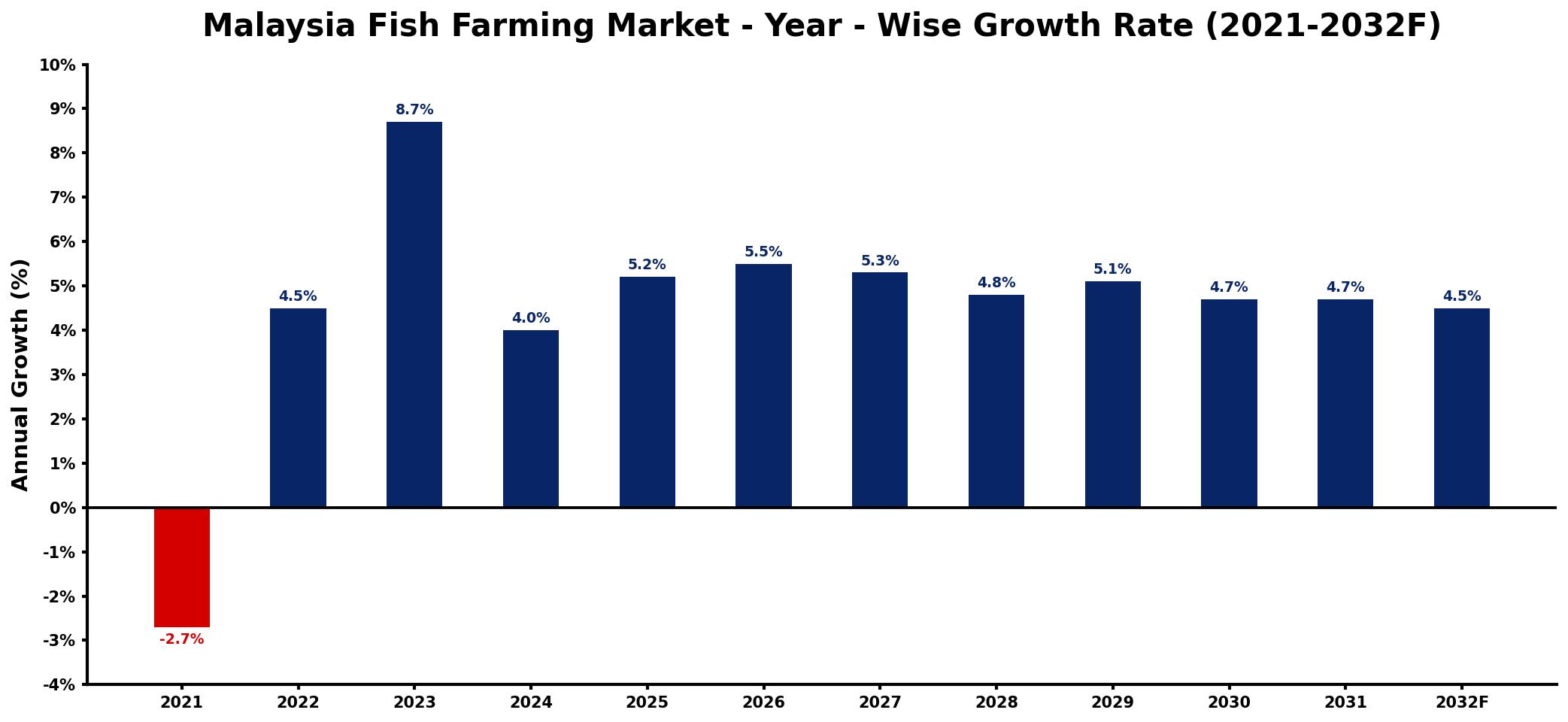
The table below presents the year‑wise growth rates along with the key drivers influencing the market
| Year | Growth Rate | Major Drivers |
| 2021 | -2.7% | decline in consumer spending habits |
| 2022 | 4.5% | increased investment in aquaculture technology |
| 2023 | 8.7% | growing demand for sustainable protein |
| 2024 | 4.0% | expansion of export markets availability |
| 2025 | 5.2% | rise in health-conscious consumer trends |
| 2026 | 5.5% | enhanced supply chain efficiencies realized |
| 2027 | 5.3% | development of innovative feed solutions |
| 2028 | 4.8% | growing popularity of local products |
| 2029 | 5.1% | increased governmental support initiatives |
| 2030 | 4.7% | rising interest in aquaponics systems |
| 2031 | 4.7% | rising export shipment volumes |
| 2032 | 4.5% | growing awareness of food security |
Note: Market size estimations and growth projections presented in this report are based on 6Wresearch's proprietary forecasting methodology, utilizing the latest available industry data, government publications, and primary research inputs.
Malaysia Fish Farming Market Synopsis
In Malaysia, fish farming has emerged as a pivotal segment within the broader seafood industry, supplying a significant proportion of the nations protein needs. The integration of advanced technology and best practices in aquaculture enhances both yield and quality, catering to a growing consumer base eager for sustainable seafood options.
However, the industry faces a dual challenge: maintaining environmental sustainability while effectively managing diseases that can devastate fish populations. As the sector matures, addressing these challenges becomes crucial for long-term growth and viability.
Malaysia Fish Farming Market Key Takeaways
- The market is experiencing steady growth fueled by rising domestic and export demands.
- Government initiatives aim to support sustainable aquaculture practices.
- Technological advancements play a key role in enhancing production efficiency.
- Environmental sustainability and disease management remain significant challenges.
- Investments in modern aquaculture technologies are expected to continue shaping the market's future.
Evaluation of Restraints in Malaysia Fish Farming Market
Despite its promising outlook, the Malaysia Fish Farming Market is constrained by several key factors. Disease outbreaks can severely impact production, leading to financial losses for farmers and supply shortages in the market. Moreover, the need to balance productivity with environmental concerns creates a complex landscape for operators. Achieving sustainable growth while managing the ecological footprint of fish farming is imperative, necessitating innovative solutions and continuous improvements in farming practices.
Malaysia Fish Farming Market Trends
Emerging trends in the Malaysia Fish Farming Market include a shift towards eco-friendly practices and the adoption of smart aquaculture technologies. Farmers are increasingly leveraging data analytics and IoT for better monitoring of water quality and fish health. There is also a growing interest in alternative feeds, such as insect-based products, to promote sustainability. The trend towards local sourcing is becoming more prominent, with consumers favoring domestically produced seafood over imported options.
Malaysia Fish Farming Market Opportunities
The potential for growth in the Malaysia Fish Farming Market lies significantly in expanding export avenues, particularly in regions where demand for sustainable seafood is on the rise. Enhancements in aquaculture practices, coupled with government backing for innovation, provide fertile ground for investment. Additionally, the increasing consumer preference for fresh and locally sourced seafood presents an opportunity for fish farmers to tap into new market segments and strengthen their positioning.
Government Initiatives in the Malaysia Fish Farming Market
The Malaysian government has recognized the importance of aquaculture in bolstering food security and economic growth. Various initiatives are in place aimed at promoting sustainable fish farming practices, including grants for technology adoption and training programs for farmers. These programs encourage the use of best practices in fish husbandry and environmental management, ensuring that the sector contributes positively to both the economy and ecological health.
Future Insights of the Malaysia Fish Farming Market
Looking forward to the years 2026-2032, the Malaysia Fish Farming Market is poised for notable growth driven by continuous advancements in aquaculture technology and a proactive approach towards sustainability. As consumer preferences evolve towards healthier and eco-friendly food sources, the market will adapt by enhancing production methods and strengthening supply chains. The focus will likely remain on addressing disease management and reducing environmental impacts, ensuring that the industry can meet rising demand effectively.
Malaysia Fish Farming Market Latest Developments (2025 - 2026)
Recent developments in the fish farming sector indicate a stronger commitment to sustainability and innovation. Many producers are adopting cutting-edge technologies for real-time monitoring of fish health and environmental conditions. Collaborative efforts among industry stakeholders aim to establish best practices for disease control and water management. Furthermore, awareness campaigns targeting consumers are gaining traction, promoting the benefits of locally sourced seafood and encouraging responsible consumption.
Malaysia Fish Farming Market - Key Attractiveness of the Report
- 10 Years of Market Numbers
- Historical Data Starting from 2022 to 2025
- Base Year: 2025
- Forecast Data until 2032
- Key Performance Indicators Impacting the Market
- Major Upcoming Developments and Projects
Key Highlights of the Report:
- Malaysia Fish Farming Market Outlook
- Market Size of Malaysia Fish Farming Market, 2025
- Forecast of Malaysia Fish Farming Market, 2032
- Historical Data and Forecast of Malaysia Fish Farming Revenues & Volume for the Period 2022-2032F
- Malaysia Fish Farming Market Trend Evolution
- Malaysia Fish Farming Market Drivers and Challenges
- Malaysia Fish Farming Price Trends
- Malaysia Fish Farming Porter's Five Forces
- Malaysia Fish Farming Industry Life Cycle
- Historical Data and Forecast of Malaysia Fish Farming Market Revenues & Volume By Environment for the Period 2022-2032F
- Historical Data and Forecast of Malaysia Fish Farming Market Revenues & Volume By Marine Water for the Period 2022-2032F
- Historical Data and Forecast of Malaysia Fish Farming Market Revenues & Volume By Fresh Water for the Period 2022-2032F
- Historical Data and Forecast of Malaysia Fish Farming Market Revenues & Volume By Brackish Water for the Period 2022-2032F
- Historical Data and Forecast of Malaysia Fish Farming Market Revenues & Volume By Fish Type for the Period 2022-2032F
- Historical Data and Forecast of Malaysia Fish Farming Market Revenues & Volume By Pompano for the Period 2022-2032F
- Historical Data and Forecast of Malaysia Fish Farming Market Revenues & Volume By Snappers for the Period 2022-2032F
- Historical Data and Forecast of Malaysia Fish Farming Market Revenues & Volume By Groupers for the Period 2022-2032F
- Historical Data and Forecast of Malaysia Fish Farming Market Revenues & Volume By Salmon for the Period 2022-2032F
- Historical Data and Forecast of Malaysia Fish Farming Market Revenues & Volume By Milkfish for the Period 2022-2032F
- Historical Data and Forecast of Malaysia Fish Farming Market Revenues & Volume By Tuna for the Period 2022-2032F
- Historical Data and Forecast of Malaysia Fish Farming Market Revenues & Volume By Tilapia for the Period 2022-2032F
- Historical Data and Forecast of Malaysia Fish Farming Market Revenues & Volume By Others for the Period 2022-2032F
- Malaysia Fish Farming Import Export Trade Statistics
- Market Opportunity Assessment By Environment
- Market Opportunity Assessment By Fish Type
- Malaysia Fish Farming Top Companies Market Share
- Malaysia Fish Farming Competitive Benchmarking By Technical and Operational Parameters
- Malaysia Fish Farming Company Profiles
- Malaysia Fish Farming Key Strategic Recommendations






































