Malaysia Food And Beverage Vending Machine Market Size, Share & Growth Rate
The Malaysia Food And Beverage Vending Machine Market was estimated at USD 1322 Million in 2025 and is projected to reach USD 1964 Million by 2032, growing at a CAGR of 5.8% from 2026 to 2032. This growth is largely driven by evolving consumer preferences that favor convenience and quick access to food and beverages, particularly in busy urban environments. The integration of innovative technology, such as cashless payment systems and enhanced product offerings, positions the market for sustained expansion.
Malaysia Food And Beverage Vending Machine Market Year-wise Growth Rate and Key Drivers
This graph highlights how the Malaysia Food And Beverage Vending Machine Market has steadily grown over the years, supported by major growth factors.
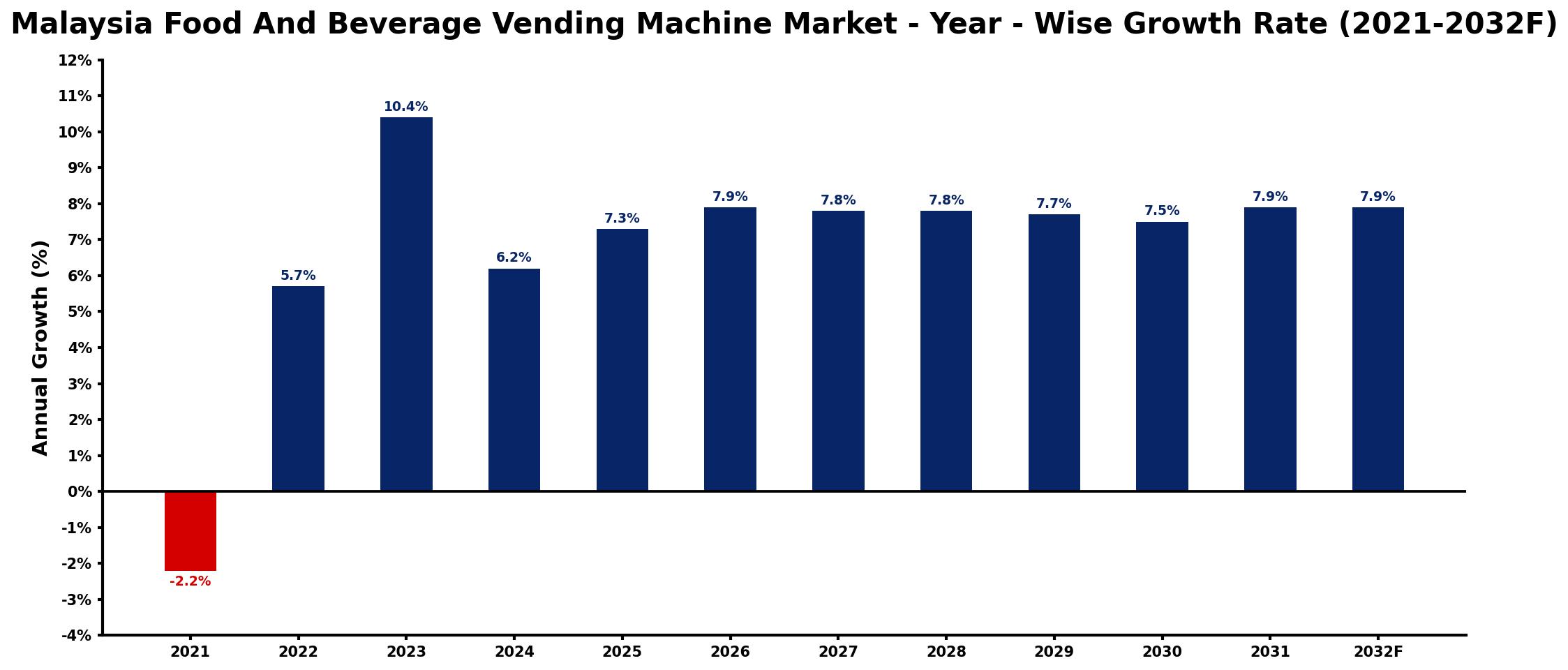
The table below presents the year‑wise growth rates along with the key drivers influencing the market
| Year | Growth Rate | Major Drivers |
| 2021 | -2.2% | decreased consumer spending habits |
| 2022 | 5.7% | rising demand for convenience options |
| 2023 | 10.4% | expansion of urban population centers |
| 2024 | 6.2% | increased health-conscious consumer choices |
| 2025 | 7.3% | growing interest in cashless transactions |
| 2026 | 7.9% | enhanced technological innovations adoption |
| 2027 | 7.8% | wider acceptance of autonomous retail |
| 2028 | 7.8% | increased investment in smart solutions |
| 2029 | 7.7% | growing trend of contactless payments |
| 2030 | 7.5% | expanding presence in tourist areas |
| 2031 | 7.9% | increased focus on sustainability practices |
| 2032 | 7.9% | rising popularity of on-the-go consumption |
Note: Market size estimations and growth projections presented in this report are based on 6Wresearch's proprietary forecasting methodology, utilizing the latest available industry data, government publications, and primary research inputs.
Malaysia Food And Beverage Vending Machine Market Synopsis
Malaysia's food and beverage vending machine market is characterized by a rich array of product offerings, reflecting the country's diverse culinary culture. From local snacks to international beverages, these machines cater to a broad demographic, enhancing their appeal across various consumer segments.
In the wake of the COVID-19 pandemic, there has been an increased focus on hygiene and safety within the vending machine landscape. Operators have swiftly adapted to these demands by implementing contactless transactions and ensuring the cleanliness of products, thereby fostering consumer confidence.
Malaysia Food And Beverage Vending Machine Market Key Takeaways
- Consumer preference for convenience is a key driver of market growth.
- Technology advancements, including cashless payments, are reshaping the vending experience.
- The COVID-19 pandemic has accelerated the adoption of hygienic practices and contactless transactions.
- A focus on healthier product options is becoming essential for market players.
- Strategic placement of machines in high-traffic locations enhances visibility and sales potential.
Evaluation of Restraints in Malaysia Food And Beverage Vending Machine Market
While the Malaysia Food and Beverage Vending Machine Market is on a growth trajectory, it encounters certain restraints. A significant challenge lies in aligning product offerings with shifting consumer preferences, particularly as health-conscious trends gain traction. Operators must continuously innovate to provide diverse, nutritious options that cater to evolving tastes. Additionally, the high competition in securing prime locations for vending machines can restrict market entry for new players. Ensuring consistent product quality and hygiene is paramount, especially in a post-pandemic world, adding complexity to operational logistics.
Malaysia Food And Beverage Vending Machine Market Trends
The Malaysian vending machine landscape is witnessing a shift towards smart technology, with operators increasingly integrating features like real-time inventory management and remote monitoring. This transformation enhances operational efficiency and improves the customer experience. Moreover, an uptick in demand for healthy snacks is leading to the introduction of organic and low-calorie options, catering to the health-conscious consumer. Environmental sustainability is also becoming a priority, with many vendors exploring eco-friendly packaging solutions to resonate with environmentally aware customers.
Malaysia Food And Beverage Vending Machine Market Opportunities
The market presents substantial growth opportunities, particularly for operators willing to embrace innovation. The introduction of smart vending machines equipped with interactive screens and personalization capabilities can create an engaging consumer experience. Furthermore, partnerships with local producers can enhance product offerings, tapping into the growing demand for local flavors and sustainable practices. Expanding into underserved areas, including rural regions or locations with limited access to food outlets, can also present lucrative opportunities for market players.
Government Initiatives in the Malaysia Food And Beverage Vending Machine Market
The Malaysian government has been supportive of the vending machine industry through various policies aimed at promoting technological advancement and entrepreneurship. Initiatives encouraging the adoption of cashless payments align with national goals for digital transformation, which is crucial for the vending sector. Public spending directed towards improving infrastructure, such as the development of transport hubs and public spaces, further facilitates the placement and accessibility of vending machines, ultimately benefiting the market.
Future Insights of the Malaysia Food And Beverage Vending Machine Market
Looking ahead to 2026-2032, the Malaysia Food And Beverage Vending Machine Market is poised for significant transformation. The drive for convenience will likely continue to fuel demand, particularly in urban settings. As technology advances, the integration of artificial intelligence and machine learning may enable personalized consumer experiences, with machines capable of recommending products based on past purchases. Additionally, the ongoing focus on health and wellness will push operators to innovate with a broader range of nutritious options, ensuring they meet the diverse preferences of Malaysian consumers.
Malaysia Food And Beverage Vending Machine Market Latest Developments (2025 - 2026)
Recent developments in the Malaysian vending machine market have centered on enhancing consumer engagement and expanding product ranges. Operators have increasingly integrated advanced payment systems to accommodate digital wallets and contactless payment methods. Furthermore, there has been a noticeable increase in collaborations with local food producers to diversify offerings and introduce novel products tailored to regional tastes. The focus on health-oriented snacks continues to grow, with many vendors experimenting with organic and natural product lines to attract a wider customer base.
Malaysia Food And Beverage Vending Machine Market - Key Attractiveness of the Report
- 10 Years of Market Numbers
- Historical Data Starting from 2022 to 2025
- Base Year: 2025
- Forecast Data until 2032
- Key Performance Indicators Impacting the Market
- Major Upcoming Developments and Projects
Key Highlights of the Report:
- Malaysia Food And Beverage Vending Machine Market Outlook
- Market Size of Malaysia Food And Beverage Vending Machine Market, 2025
- Forecast of Malaysia Food And Beverage Vending Machine Market, 2032
- Historical Data and Forecast of Malaysia Food And Beverage Vending Machine Revenues & Volume for the Period 2022-2032F
- Malaysia Food And Beverage Vending Machine Market Trend Evolution
- Malaysia Food And Beverage Vending Machine Market Drivers and Challenges
- Malaysia Food And Beverage Vending Machine Price Trends
- Malaysia Food And Beverage Vending Machine Porter's Five Forces
- Malaysia Food And Beverage Vending Machine Industry Life Cycle
- Historical Data and Forecast of Malaysia Food And Beverage Vending Machine Market Revenues & Volume By Product Type for the Period 2022-2032F
- Historical Data and Forecast of Malaysia Food And Beverage Vending Machine Market Revenues & Volume By Beverage Vending machine for the Period 2022-2032F
- Historical Data and Forecast of Malaysia Food And Beverage Vending Machine Market Revenues & Volume By Food Vending Machine for the Period 2022-2032F
- Historical Data and Forecast of Malaysia Food And Beverage Vending Machine Market Revenues & Volume By Payment Mode for the Period 2022-2032F
- Historical Data and Forecast of Malaysia Food And Beverage Vending Machine Market Revenues & Volume By Cash for the Period 2022-2032F
- Historical Data and Forecast of Malaysia Food And Beverage Vending Machine Market Revenues & Volume By Cashless for the Period 2022-2032F
- Historical Data and Forecast of Malaysia Food And Beverage Vending Machine Market Revenues & Volume By Application for the Period 2022-2032F
- Historical Data and Forecast of Malaysia Food And Beverage Vending Machine Market Revenues & Volume By Schools for the Period 2022-2032F
- Historical Data and Forecast of Malaysia Food And Beverage Vending Machine Market Revenues & Volume By Offices for the Period 2022-2032F
- Historical Data and Forecast of Malaysia Food And Beverage Vending Machine Market Revenues & Volume By Shopping Complex for the Period 2022-2032F
- Historical Data and Forecast of Malaysia Food And Beverage Vending Machine Market Revenues & Volume By Others for the Period 2022-2032F
- Malaysia Food And Beverage Vending Machine Import Export Trade Statistics
- Market Opportunity Assessment By Product Type
- Market Opportunity Assessment By Payment Mode
- Market Opportunity Assessment By Application
- Malaysia Food And Beverage Vending Machine Top Companies Market Share
- Malaysia Food And Beverage Vending Machine Competitive Benchmarking By Technical and Operational Parameters
- Malaysia Food And Beverage Vending Machine Company Profiles
- Malaysia Food And Beverage Vending Machine Key Strategic Recommendations






































