Malaysia Food & Beverages Processing Equipment Market Summary
The malaysia food & beverages processing equipment market was estimated at USD 925 Million in 2025 and is projected to reach USD 1366 Million by 2032, growing at a CAGR of 7.6% from 2026 to 2032.
Malaysia Food & Beverages Processing Equipment Market Year-wise Growth Rate and Key Drivers
This graph highlights how the Malaysia Food & Beverages Processing Equipment Market has steadily grown over the past five years, supported by major growth factors.
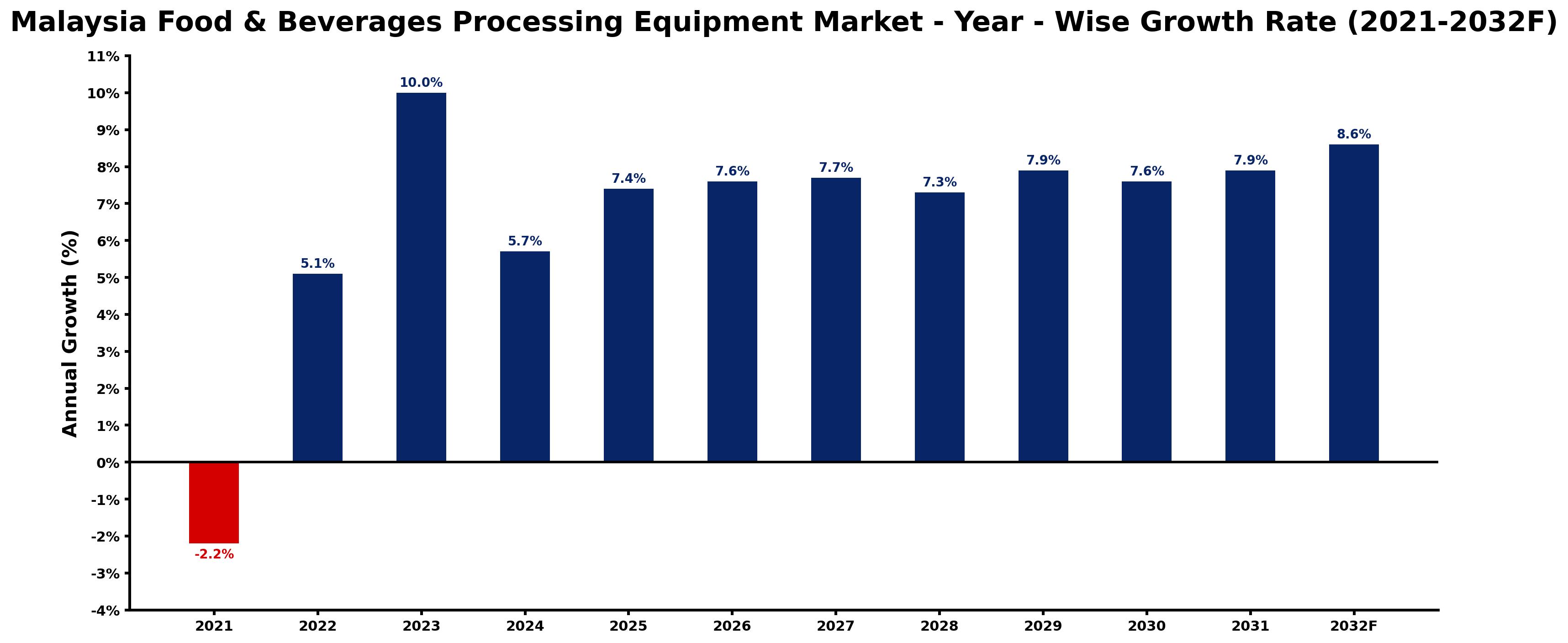
The table below presents the year wise growth rates along with the key drivers influencing the market
| Year | Growth Rate | Major Drivers |
| 2021 | -2.2% | Supply chain disruptions due to the pandemic hindered equipment availability, leading to decreased investment from businesses. |
| 2022 | 5.1% | Consumer preferences shifted towards healthier products, boosting demand for innovative processing equipment. |
| 2023 | 10.0% | Local manufacturers increasingly focus on automation to enhance production efficiency and reduce costs. |
| 2024 | 5.7% | Sustainable practices gain traction, leading to investments in eco-friendly processing solutions. |
| 2025 | 7.4% | Growing export opportunities prompt Malaysian firms to upgrade their processing capabilities significantly. |
| 2026 | 7.6% | Technological advancements in food safety regulations encourage equipment upgrades for compliance. |
| 2027 | 7.7% | Emerging food trends, including plant-based products, influence equipment design and functionality. |
| 2028 | 7.3% | Investment in research and development enhances the competitiveness of local processing firms. |
| 2029 | 7.9% | Urbanization drives the demand for convenient, ready-to-eat food products and related equipment. |
| 2030 | 7.6% | Collaborations between startups and established companies boost innovation in processing technologies. |
| 2031 | 7.9% | The digital transformation of industries facilitates real-time monitoring and efficient operations. |
| 2032 | 8.6% | Market consolidation among processing equipment manufacturers improves competition and technology sharing. |
Note - Market size estimations and growth projections presented in this report are based on 6Wresearch's advanced forecasting approach, validated with industry datasets as of June 2026.
Malaysia Food & Beverages Processing Equipment Market Synopsis
The Malaysia Food Beverages Processing Equipment Market is projected to reach 7.6% and witness significant growth during the forecast period (2026-2032). This upward trajectory is driven by several key factors including enhanced investments in research and development tailored towards innovative solutions that meet consumer demands, particularly within the thriving hospitality sector. Moreover, an increase in economic prosperity has resulted in higher disposable incomes among Malaysian households, further propelling the demand for advanced food and beverage processing technologies.
Malaysia Food & Beverages Processing Equipment Market Growth Drivers
The Malaysia Food & Beverages Processing Equipment Market is witnessing a remarkable upsurge due to various growth drivers. First, the growing trend of healthy eating habits among millennials is reshaping consumer preferences, prompting manufacturers to invest in state-of-the-art equipment that can cater to these evolving needs. Second, with increasing urbanization and a busy lifestyle, the demand for online grocery delivery services has surged, leading to further innovations in food processing technologies that ensure quality and freshness in products.
- Research and development investments are pivotal in creating innovative processing solutions that respond effectively to changing consumer behaviors.
- Government initiatives aimed at bolstering agro-industrial activities through various incentives and subsidies provide a conducive environment for market growth.
- Heightened awareness about nutrition and health among the population encourages food processors to adopt advanced technologies for healthier food options.
- The rising disposable income among Malaysian households facilitates greater spending on processed food and beverages, subsequently increasing equipment demand.
- Supportive regulations promoting foreign investment are enhancing competition and innovation within the local processing equipment market.
Malaysia Food & Beverages Processing Equipment Market Trends and Opportunities
Current trends in the Malaysia Food & Beverages Processing Equipment Market highlight a shift towards automation and smart technologies. As manufacturers increasingly adopt Industry 4.0 principles, the integration of advanced robotics, artificial intelligence, and the Internet of Things (IoT) is becoming more prevalent. These advancements enable companies to improve efficiency, reduce operational costs, and enhance product quality, thereby capturing a larger market share.
- The automation of food processing operations is evolving, with intelligent systems reducing labor costs while improving output and precision.
- Smart packaging solutions are gaining traction as companies seek to extend product shelf life and ensure safety throughout the supply chain.
- Sustainability practices, such as waste reduction and eco-friendly packaging, are becoming crucial as consumers demand more environmentally responsible options.
- The convergence of technology and food processing is leading to the development of personalized nutrition offerings, catering specifically to individual dietary needs.
- Collaboration between technology providers and food manufacturers allows for the exploration of innovative solutions that can effectively address complex processing challenges.
Malaysia Food & Beverages Processing Equipment Market Government Investment and Initiatives
The Malaysian government plays an instrumental role in fostering the growth of the food and beverages processing sector through various initiatives. Public spending on agro-industrial development has been prioritized, with the introduction of financial incentives and subsidies designed to attract both local and international players. Moreover, the government's long-term development plans focus on enhancing infrastructure and expanding access to modern technology, which is crucial for improving the efficiency of food processing operations.
- Investment in research and innovation is encouraged through grants and funding programs aimed at developing cutting-edge technologies in the food processing industry.
- Government policies promoting public-private partnerships are creating opportunities for collaborative projects that can drive the market forward.
- Supporting regulations are established to streamline processes and reduce barriers for foreign investments, thus enhancing market competitiveness.
- Training programs and workshops are being implemented to upskill the workforce, ensuring that skill gaps in food processing technologies are addressed.
- Efforts to promote sustainable practices within the agro-industrial sector are receiving Government backing, driving the adoption of eco-friendly processing solutions.
Malaysia Food & Beverages Processing Equipment Market Latest Developments (May 2025 - June 2026)
Recent developments in the Malaysia Food & Beverages Processing Equipment Market indicate a continuous shift towards innovation and modernization. Companies are focusing on enhancing operational efficiencies through the incorporation of advanced technologies such as automation and IoT in their processing systems. There has been a noticeable increase in collaborative partnerships, wherein local firms team up with technology developers to co-create solutions that meet market demands.
- Investment initiatives are gaining momentum as firms seek to upgrade their equipment and processes to remain competitive in an evolving market landscape.
- The adoption of sustainable technologies is on the rise, with many companies implementing practices to minimize their environmental impact.
- Industry events and expos have become platforms for showcasing innovative processing technologies, bringing stakeholders together to explore collaboration opportunities.
- Consumer awareness surrounding health and nutrition continues to drive demand for processed foods, prompting manufacturers to innovate their offerings.
- Strategic government policies appear to be effectively supporting the growth of the food processing sector, creating a favorable climate for investment.
Malaysia Food & Beverages Processing Equipment Market - Key Attractiveness of the Report
- 10 Years of Market Numbers
- Historical Data Starting from 2022 to 2025
- Base Year: 2025
- Forecast Data until 2032
- Key Performance Indicators Impacting the Market
- Major Upcoming Developments and Projects
Key Highlights of the Report:
- Malaysia Food & Beverages Processing Equipment Market Outlook
- Market Size of Malaysia Food & Beverages Processing Equipment Market, 2025
- Forecast of Malaysia Food & Beverages Processing Equipment Market, 2032F
- Historical Data and Forecast of Malaysia Food & Beverages Processing Equipment Revenues & Volume for the Period 2022-2032F
- Malaysia Food & Beverages Processing Equipment Market Trend Evolution
- Malaysia Food & Beverages Processing Equipment Market Drivers and Challenges
- Malaysia Food & Beverages Processing Equipment Price Trends
- Malaysia Food & Beverages Processing Equipment Porter's Five Forces
- Malaysia Food & Beverages Processing Equipment Industry Life Cycle
- Historical Data and Forecast of Malaysia Food & Beverages Processing Equipment Market Revenues & Volume By Types for the Period 2022-2032F
- Historical Data and Forecast of Malaysia Food & Beverages Processing Equipment Market Revenues & Volume By Pre-processing Equipment for the Period 2022-2032F
- Historical Data and Forecast of Malaysia Food & Beverages Processing Equipment Market Revenues & Volume By Sorting & Grading for the Period 2022-2032F
- Historical Data and Forecast of Malaysia Food & Beverages Processing Equipment Market Revenues & Volume By Processing Equipment for the Period 2022-2032F
- Historical Data and Forecast of Malaysia Food & Beverages Processing Equipment Market Revenues & Volume By Mode of Operations for the Period 2022-2032F
- Historical Data and Forecast of Malaysia Food & Beverages Processing Equipment Market Revenues & Volume By Automatic for the Period 2022-2032F
- Historical Data and Forecast of Malaysia Food & Beverages Processing Equipment Market Revenues & Volume By Semi-Automatic for the Period 2022-2032F
- Historical Data and Forecast of Malaysia Food & Beverages Processing Equipment Market Revenues & Volume By Forms for the Period 2022-2032F
- Historical Data and Forecast of Malaysia Food & Beverages Processing Equipment Market Revenues & Volume By Liquid for the Period 2022-2032F
- Historical Data and Forecast of Malaysia Food & Beverages Processing Equipment Market Revenues & Volume By Solid for the Period 2022-2032F
- Historical Data and Forecast of Malaysia Food & Beverages Processing Equipment Market Revenues & Volume By Semi-Solid for the Period 2022-2032F
- Historical Data and Forecast of Malaysia Food & Beverages Processing Equipment Market Revenues & Volume By Applications for the Period 2022-2032F
- Historical Data and Forecast of Malaysia Food & Beverages Processing Equipment Market Revenues & Volume By Bakery & Confectionery Products for the Period 2022-2032F
- Historical Data and Forecast of Malaysia Food & Beverages Processing Equipment Market Revenues & Volume By Meat & Poultry Products for the Period 2022-2032F
- Historical Data and Forecast of Malaysia Food & Beverages Processing Equipment Market Revenues & Volume By Fish & Sea food for the Period 2022-2032F
- Historical Data and Forecast of Malaysia Food & Beverages Processing Equipment Market Revenues & Volume By Dairy Products for the Period 2022-2032F
- Historical Data and Forecast of Malaysia Food & Beverages Processing Equipment Market Revenues & Volume By Alcoholic Beverages for the Period 2022-2032F
- Historical Data and Forecast of Malaysia Food & Beverages Processing Equipment Market Revenues & Volume By Non-Alcoholic Beverages for the Period 2022-2032F
- Historical Data and Forecast of Malaysia Food & Beverages Processing Equipment Market Revenues & Volume By Others for the Period 2022-2032F
- Malaysia Food & Beverages Processing Equipment Import Export Trade Statistics
- Market Opportunity Assessment By Types
- Market Opportunity Assessment By Mode of Operations
- Market Opportunity Assessment By Forms
- Market Opportunity Assessment By Applications
- Malaysia Food & Beverages Processing Equipment Top Companies Market Share
- Malaysia Food & Beverages Processing Equipment Competitive Benchmarking By Technical and Operational Parameters
- Malaysia Food & Beverages Processing Equipment Company Profiles
- Malaysia Food & Beverages Processing Equipment Key Strategic Recommendations






































