Malaysia Food Dehydrators Market Size, Share & Growth Rate
The Malaysia Food Dehydrators Market was estimated at USD 314 Million in 2025 and is projected to reach USD 408 Million by 2032, growing at a CAGR of 3.8% from 2026 to 2032. The growth trajectory is driven by an increasing consumer inclination towards healthier food options, coupled with a rise in home cooking and DIY food preservation. The convenience of food dehydrators allows consumers to extend the shelf life of their favorite produce while avoiding chemical additives.
Malaysia Food Dehydrators Market Year-wise Growth Rate and Key Drivers
This graph highlights how the Malaysia Food Dehydrators Market has steadily grown over the years, supported by major growth factors.
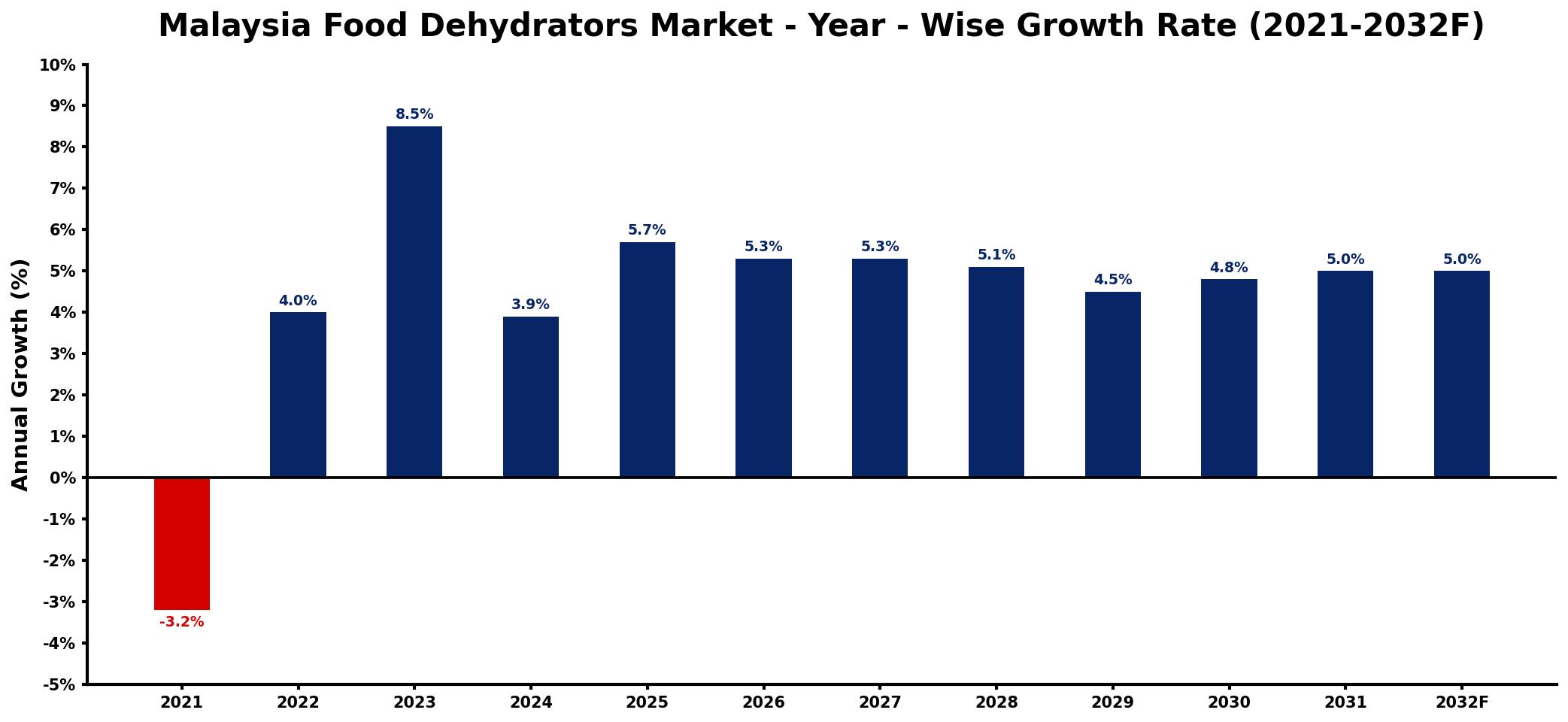
The table below presents the year‑wise growth rates along with the key drivers influencing the market
| Year | Growth Rate | Major Drivers |
| 2021 | -3.2% | decreased consumer disposable income |
| 2022 | 4.0% | rising health consciousness trends |
| 2023 | 8.5% | increased home cooking popularity |
| 2024 | 3.9% | growing interest in sustainability |
| 2025 | 5.7% | expansion of online retail platforms |
| 2026 | 5.3% | increased investment in home appliances |
| 2027 | 5.3% | growing demand for healthy snacks |
| 2028 | 5.1% | rising infrastructure development spending |
| 2029 | 4.5% | increased urban population growth |
| 2030 | 4.8% | enhanced product quality standards |
| 2031 | 5.0% | rising procurement volume requirements |
| 2032 | 5.0% | increased focus on energy efficiency |
Note: Market size estimations and growth projections presented in this report are based on 6Wresearch's proprietary forecasting methodology, utilizing the latest available industry data, government publications, and primary research inputs.
Malaysia Food Dehydrators Market Synopsis
In Malaysia, the food dehydrators market has gained momentum as individuals seek ways to preserve food naturally and healthily. The rising awareness of nutrition and the shift towards homemade snacks have led to a surge in demand for food dehydrators, which facilitate the drying of fruits, vegetables, and meats without compromising on quality.
Moreover, the governments initiatives to promote food processing technologies have created a favorable environment for manufacturers and end-users alike. The increasing popularity of food preservation methods through innovative appliances is reshaping kitchen habits and driving market expansion.
Malaysia Food Dehydrators Market Key Takeaways
- Health-conscious consumers are shifting towards food dehydrators for home snack production.
- Government support for food processing technology enhances market growth potential.
- Increased home cooking trends contribute to sustained demand for food dehydrators.
- The preference for preservative-free options is boosting market appeal.
- Energy-efficient models are gaining traction as consumers prioritize affordability.
Evaluation of Restraints in Malaysia Food Dehydrators Market
While the food dehydrators market in Malaysia is flourishing, certain constraints could impede its growth. A primary concern is the energy consumption associated with these appliances, which may deter price-sensitive consumers. Additionally, the initial investment cost for high-quality dehydrators can be a hurdle for some households. Addressing these issues through the development of more energy-efficient models and competitive pricing strategies will be crucial for sustained market growth.
Malaysia Food Dehydrators Market Trends
Emerging trends in the Malaysia Food Dehydrators Market include a growing preference for multifunctional appliances that combine dehydration with other cooking techniques. Innovations in technology, such as smart dehydrators integrated with IoT features, are also gaining attention. Furthermore, there is an increasing interest in organic and sustainably sourced raw materials, aligning with the health-conscious consumer trend.
Malaysia Food Dehydrators Market Opportunities
The landscape presents substantial opportunities for growth, particularly through expanding product lines that cater to diverse consumer needs. As more individuals engage in home cooking, manufacturers can capitalize on this trend by offering user-friendly models and targeted marketing strategies. Additionally, partnerships with local farmers and suppliers could enhance product visibility and create a unique selling proposition focused on freshness and sustainability.
Government Initiatives in the Malaysia Food Dehydrators Market
The Malaysian government has been active in promoting food processing and preservation technologies through various initiatives. These include grants and subsidies aimed at improving food safety and quality, as well as programs that encourage the adoption of modern kitchen appliances among households. Such policies not only support the growth of the food dehydrators market but also emphasize the importance of local production and food security.
Future Insights of the Malaysia Food Dehydrators Market
Looking ahead to 2026-2032, the Malaysia Food Dehydrators Market is poised for continued expansion. With a significant emphasis on health and wellness, consumer demand for dehydrators is likely to remain robust. Innovations in energy efficiency and product design will enhance market attractiveness. Additionally, as the trend toward home cooking persists, food dehydrators will play an integral role in the kitchen, establishing themselves as essential tools for health-conscious consumers.
Malaysia Food Dehydrators Market Latest Developments (2025 - 2026)
Recent developments in the Malaysia Food Dehydrators Market indicate a shift towards more advanced technology, with several manufacturers exploring smart dehydrator options. These innovations are designed to simplify the dehydration process, enabling users to monitor their food remotely. There has also been a noticeable increase in consumer education initiatives focusing on the benefits of food preservation at home, further promoting market engagement.
Malaysia Food Dehydrators Market - Key Attractiveness of the Report
- 10 Years of Market Numbers
- Historical Data Starting from 2022 to 2025
- Base Year: 2025
- Forecast Data until 2032
- Key Performance Indicators Impacting the Market
- Major Upcoming Developments and Projects
Key Highlights of the Report:
- Malaysia Food Dehydrators Market Outlook
- Market Size of Malaysia Food Dehydrators Market, 2025
- Forecast of Malaysia Food Dehydrators Market, 2032
- Historical Data and Forecast of Malaysia Food Dehydrators Revenues & Volume for the Period 2022-2032F
- Malaysia Food Dehydrators Market Trend Evolution
- Malaysia Food Dehydrators Market Drivers and Challenges
- Malaysia Food Dehydrators Price Trends
- Malaysia Food Dehydrators Porter's Five Forces
- Malaysia Food Dehydrators Industry Life Cycle
- Historical Data and Forecast of Malaysia Food Dehydrators Market Revenues & Volume By Technology for the Period 2022-2032F
- Historical Data and Forecast of Malaysia Food Dehydrators Market Revenues & Volume By Vertical Flow for the Period 2022-2032F
- Historical Data and Forecast of Malaysia Food Dehydrators Market Revenues & Volume By Horizontal Flow for the Period 2022-2032F
- Historical Data and Forecast of Malaysia Food Dehydrators Market Revenues & Volume By End-Use for the Period 2022-2032F
- Historical Data and Forecast of Malaysia Food Dehydrators Market Revenues & Volume By Industrial for the Period 2022-2032F
- Historical Data and Forecast of Malaysia Food Dehydrators Market Revenues & Volume By Commercial for the Period 2022-2032F
- Historical Data and Forecast of Malaysia Food Dehydrators Market Revenues & Volume By Residential for the Period 2022-2032F
- Historical Data and Forecast of Malaysia Food Dehydrators Market Revenues & Volume By Others for the Period 2022-2032F
- Historical Data and Forecast of Malaysia Food Dehydrators Market Revenues & Volume By Energy Source for the Period 2022-2032F
- Historical Data and Forecast of Malaysia Food Dehydrators Market Revenues & Volume By Electricity for the Period 2022-2032F
- Historical Data and Forecast of Malaysia Food Dehydrators Market Revenues & Volume By Biofuel for the Period 2022-2032F
- Historical Data and Forecast of Malaysia Food Dehydrators Market Revenues & Volume By Solar for the Period 2022-2032F
- Historical Data and Forecast of Malaysia Food Dehydrators Market Revenues & Volume By Others for the Period 2022-2032F
- Malaysia Food Dehydrators Import Export Trade Statistics
- Market Opportunity Assessment By Technology
- Market Opportunity Assessment By End-Use
- Market Opportunity Assessment By Energy Source
- Malaysia Food Dehydrators Top Companies Market Share
- Malaysia Food Dehydrators Competitive Benchmarking By Technical and Operational Parameters
- Malaysia Food Dehydrators Company Profiles
- Malaysia Food Dehydrators Key Strategic Recommendations






































