Malaysia Food products machinery Market Summary
The malaysia food products machinery market was estimated at USD 427 Million in 2025 and is projected to reach USD 553 Million by 2032, growing at a CAGR of 5.7% from 2026 to 2032.
Malaysia Food products machinery Market Year-wise Growth Rate and Key Drivers
This graph highlights how the Malaysia Food products machinery Market has steadily grown over the past five years, supported by major growth factors.
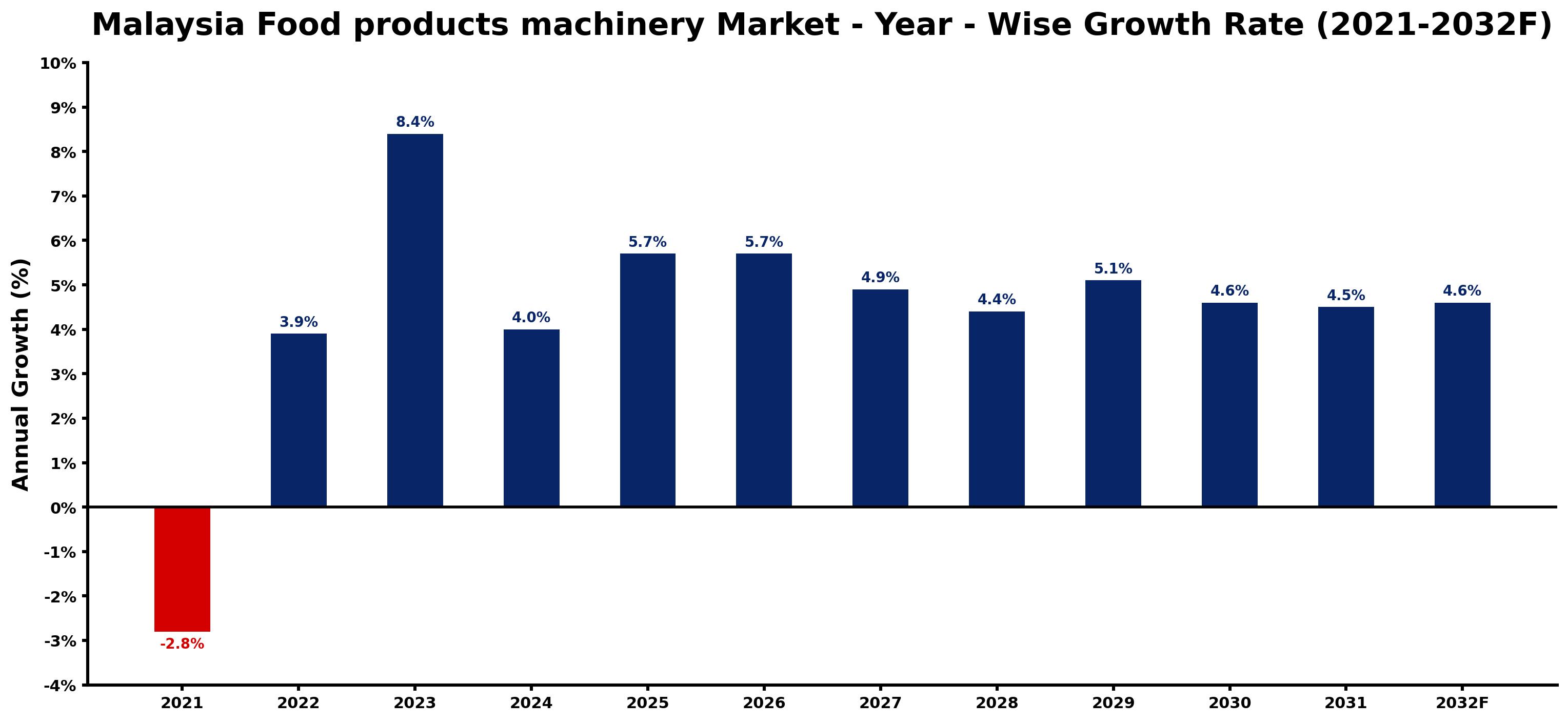
The table below presents the year wise growth rates along with the key drivers influencing the market
| Year | Growth Rate | Major Drivers |
| 2021 | -2.8% | Supply chain disruptions triggered by the pandemic significantly hampered machinery production and delivery timelines. |
| 2022 | 3.9% | Local manufacturers increasingly sought automation to enhance operational efficiency and quality. |
| 2023 | 8.4% | Emerging trends in healthy eating prompted machinery upgrades for organic food production. |
| 2024 | 4.0% | Consumer preference for convenience foods influenced investments in packaging machinery innovations. |
| 2025 | 5.7% | Industry consolidation resulted in larger players acquiring cutting-edge technology to expand offerings. |
| 2026 | 5.7% | Sustainability goals drove the need for machinery that reduces energy consumption and waste. |
| 2027 | 4.9% | Malaysia's strategic location attracted foreign investment in food machinery manufacturing sectors. |
| 2028 | 4.4% | Technological advancements in AI improved predictive maintenance, enhancing machinery reliability and uptime. |
| 2029 | 5.1% | Decentralized food production models gained traction, requiring adaptable, modular machinery solutions. |
| 2030 | 4.6% | E-commerce growth compelled food processors to adopt flexible machinery for rapid fulfillment. |
| 2031 | 4.5% | The need for compliance with international food safety standards spurred machinery updates significantly. |
| 2032 | 4.6% | Collaboration between academia and industry fostered innovation in food product machinery technologies. |
Note - Market size estimations and growth projections presented in this report are based on 6Wresearch's advanced forecasting approach, validated with industry datasets as of June 2026.
Malaysia Food products machinery Market Synopsis
The Malaysia Food products machinery Market is projected to reach 5.7% and witness significant growth during the forecast period (2026-2032). This growth trajectory is largely attributed to an increasing demand for innovative food solutions amid evolving consumer preferences, which has necessitated the adoption of advanced machinery. As manufacturers pivot towards automated processes to enhance efficiency, the market is poised for substantial expansion, catalyzed by rising disposable incomes and heightened consumer spending on packaged foods, further supporting the broader trends in the food products machinery domain.
Malaysia Food products machinery Market Growth Drivers
The growth of the Malaysia Food products machinery Market can be attributed to various factors that are reshaping the landscape of food production. Firstly, increased consumer inclination towards convenient and packaged food products necessitates sophisticated machinery to meet these demands. Secondly, the emphasis on food safety standards is prompting manufacturers to invest in high-quality machinery that ensures product integrity. Thirdly, the push for sustainability and eco-friendly manufacturing processes is driving innovation in machinery design and functionality. Fourthly, the rising trend of automation within manufacturing facilities is critical in optimizing production efficiency and reducing labor costs. Lastly, the ongoing diversification of food products further fuels the need for advanced machinery capable of handling varied production requirements.
Malaysia Food products machinery Market Challenges and Restraints
While the Malaysia Food products machinery Market is experiencing growth, several challenges persist that could impede progress. One notable challenge is the high initial capital investment required for advanced machinery, which may deter smaller manufacturers from upgrading their equipment. Additionally, the rapid pace of technological advancements can lead to obsolescence, leaving manufacturers in a constant need to reinvest in newer technologies. Supply chain disruptions, especially in light of recent global events, also pose risks to the timely procurement of machinery components. Moreover, the skilled labor required to operate sophisticated machinery is in short supply, which can hinder productivity. Lastly, fluctuating raw material prices can impact the overall cost structure for machinery manufacturers, posing financial challenges.
Malaysia Food products machinery Market Trends and Opportunities
Emerging trends in the Malaysia Food products machinery Market are presenting a plethora of opportunities for growth and innovation. The integration of Industry 4.0 technologies, including the Internet of Things (IoT) and artificial intelligence (AI), is enhancing the efficiency and monitoring capabilities of food production machinery. Additionally, a growing emphasis on health-related food products is driving manufacturers to adopt machinery that can cater to specific processing needs, such as gluten-free or organic products. Furthermore, there is an increasing focus on energy efficiency in machinery, which not only reduces operational costs but also aligns with global sustainability goals. The expansion of e-commerce platforms also offers new avenues for food product distribution, necessitating adaptable machinery that can handle diverse packaging and delivery requirements.
Malaysia Food products machinery Market Government Investment and Initiatives
The Malaysian government has initiated several policies and investments to enhance the food products machinery sector. One such initiative is Industry4WRD, which aims to modernize manufacturing processes and boost productivity across various industries, including food manufacturing. This initiative focuses on creating a conducive environment for technological advancements and high-value job creation. Furthermore, the government is offering various incentives, including grants and subsidies, to encourage local manufacturing and investment in research and development for food machinery. Collaborative efforts between public and private sectors are also being fostered to improve supply chain efficiency and develop a skilled workforce capable of supporting advanced manufacturing technologies.
Malaysia Food products machinery Market Latest Developments (May 2025 - June 2026)
In a span of May 2025 to June 2026, the Malaysia Food products machinery Market has witnessed significant developments aimed at enhancing production capabilities. Many manufacturers have begun adopting smart machinery equipped with IoT applications to streamline operations and improve traceability in food production processes. Additionally, there have been several partnerships formed between technology firms and machinery manufacturers to co-develop innovative automated solutions aimed at reducing waste and enhancing efficiency. Companies are increasingly focusing on incorporating sustainable practices, leading to investments in machinery designed for energy conservation and waste reduction. The sector has seen growing interest in customized machinery solutions that cater to specific industry needs, thereby enhancing flexibility and productivity in food manufacturing.
Malaysia Food products machinery Market - Key Attractiveness of the Report
- 10 Years of Market Numbers
- Historical Data Starting from 2022 to 2025
- Base Year: 2025
- Forecast Data until 2032
- Key Performance Indicators Impacting the Market
- Major Upcoming Developments and Projects
Key Highlights of the Report:
- Malaysia Food products machinery Market Outlook
- Market Size of Malaysia Food products machinery Market, 2025
- Forecast of Malaysia Food products machinery Market, 2032F
- Historical Data and Forecast of Malaysia Food products machinery Revenues & Volume for the Period 2022-2032F
- Malaysia Food products machinery Market Trend Evolution
- Malaysia Food products machinery Market Drivers and Challenges
- Malaysia Food products machinery Price Trends
- Malaysia Food products machinery Porter's Five Forces
- Malaysia Food products machinery Industry Life Cycle
- Historical Data and Forecast of Malaysia Food products machinery Market Revenues & Volume By Type for the Period 2022-2032F
- Historical Data and Forecast of Malaysia Food products machinery Market Revenues & Volume By Dairy Product Plant Machinery and Equipment for the Period 2022-2032F
- Historical Data and Forecast of Malaysia Food products machinery Market Revenues & Volume By Bakery Machinery and Equipment for the Period 2022-2032F
- Historical Data and Forecast of Malaysia Food products machinery Market Revenues & Volume By Meat and Poultry Processing And Preparation Machinery for the Period 2022-2032F
- Historical Data and Forecast of Malaysia Food products machinery Market Revenues & Volume By Other Commercial Food Products Machinery for the Period 2022-2032F
- Historical Data and Forecast of Malaysia Food products machinery Market Revenues & Volume By Applications for the Period 2022-2032F
- Historical Data and Forecast of Malaysia Food products machinery Market Revenues & Volume By Bakery & Confectionery for the Period 2022-2032F
- Historical Data and Forecast of Malaysia Food products machinery Market Revenues & Volume By Meat, Poultry, and Seafood for the Period 2022-2032F
- Historical Data and Forecast of Malaysia Food products machinery Market Revenues & Volume By Dairy for the Period 2022-2032F
- Historical Data and Forecast of Malaysia Food products machinery Market Revenues & Volume By Beverages for the Period 2022-2032F
- Historical Data and Forecast of Malaysia Food products machinery Market Revenues & Volume By Others for the Period 2022-2032F
- Malaysia Food products machinery Import Export Trade Statistics
- Market Opportunity Assessment By Type
- Market Opportunity Assessment By Applications
- Malaysia Food products machinery Top Companies Market Share
- Malaysia Food products machinery Competitive Benchmarking By Technical and Operational Parameters
- Malaysia Food products machinery Company Profiles
- Malaysia Food products machinery Key Strategic Recommendations






































