Malaysia Footwear Manufacturing Machinery Market Size, Share & Growth Rate
The Malaysia Footwear Manufacturing Machinery Market was estimated at USD 274 Million in 2025 and is projected to reach USD 358 Million by 2032, growing at a CAGR of 3.9% from 2026 to 2032. This growth trajectory is underpinned by a robust domestic demand for innovative and stylish footwear, coupled with Malaysia's reputation as a cost-effective manufacturing hub. The increasing trend towards automation and customization further fuels investments in advanced machinery.
Malaysia Footwear Manufacturing Machinery Market Year-wise Growth Rate and Key Drivers
This graph highlights how the Malaysia Footwear Manufacturing Machinery Market has steadily grown over the years, supported by major growth factors.
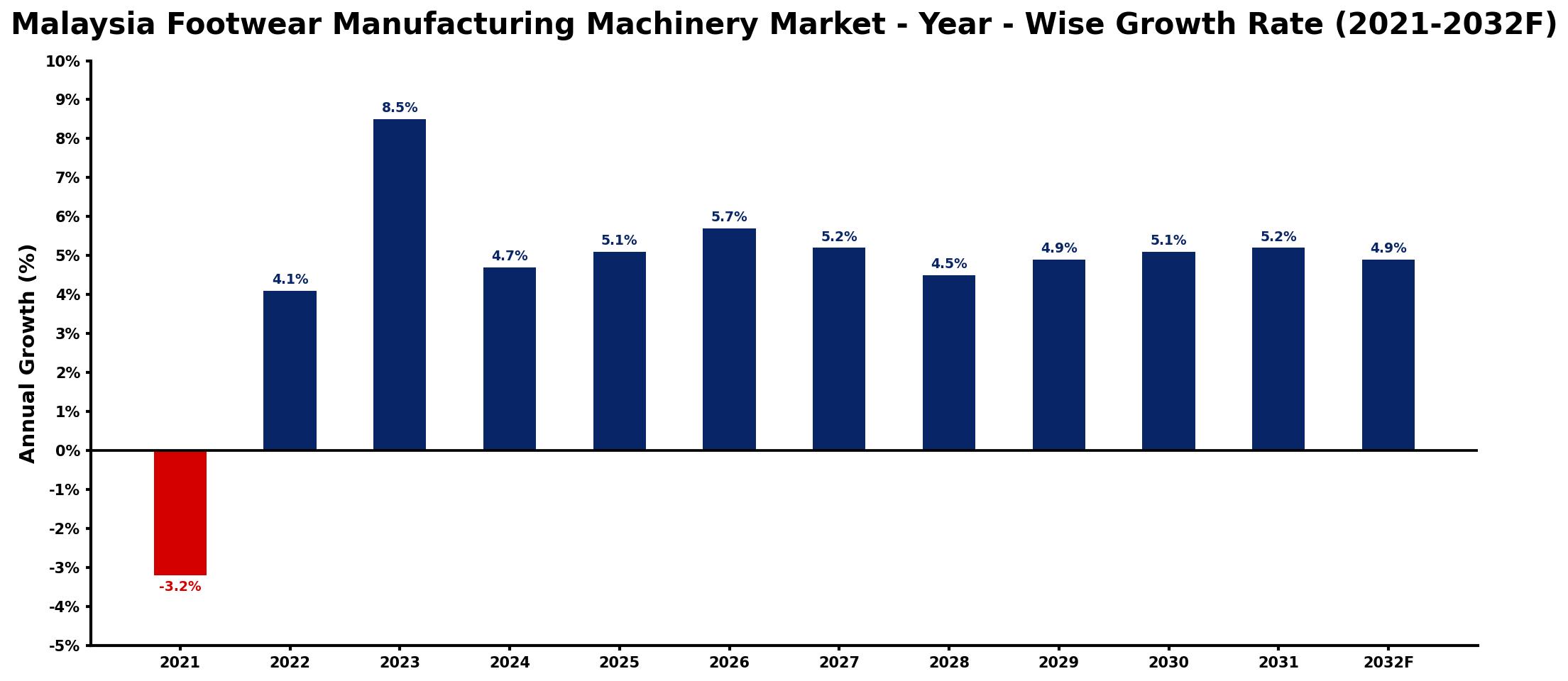
The table below presents the year‑wise growth rates along with the key drivers influencing the market
| Year | Growth Rate | Major Drivers |
| 2021 | -3.2% | global supply chain disruptions impact |
| 2022 | 4.1% | rising consumer demand for sustainability |
| 2023 | 8.5% | technological advancements drive investments |
| 2024 | 4.7% | increased automation in production processes |
| 2025 | 5.1% | expansion of e-commerce market presence |
| 2026 | 5.7% | growing downstream application demand |
| 2027 | 5.2% | emerging markets require upgraded equipment |
| 2028 | 4.5% | strengthened regulatory framework enhances standards |
| 2029 | 4.9% | enhanced production efficiency through upgrades |
| 2030 | 5.1% | collaborations with tech startups increase |
| 2031 | 5.2% | shift towards eco-friendly materials adoption |
| 2032 | 4.9% | growing global demand for customization |
Note: Market size estimations and growth projections presented in this report are based on 6Wresearch's proprietary forecasting methodology, utilizing the latest available industry data, government publications, and primary research inputs.
Malaysia Footwear Manufacturing Machinery Market Synopsis
In Malaysia, the footwear manufacturing sector is experiencing a paradigm shift, largely driven by consumers' appetite for quality and stylish footwear options. The need for advanced machinery in cutting, stitching, and molding processes is vital to meeting these escalating demands. As manufacturers look to enhance production efficiency, investments in state-of-the-art machinery are becoming increasingly important.
This market is also influenced by Malaysia's skilled labor force, which plays a significant role in enabling companies to adopt more complex manufacturing processes. The strategic positioning of Malaysia as an export-oriented hub further bolsters the demand for high-quality footwear machinery, making the sector ripe for growth.
Malaysia Footwear Manufacturing Machinery Market Key Takeaways
- The market is set for steady growth, supported by rising domestic and international footwear demand.
- Automation and digitalization are key trends driving the adoption of advanced manufacturing technologies.
- Malaysia's competitive labor costs enhance its attractiveness for manufacturers considering investment in new machinery.
- Government initiatives aimed at boosting the manufacturing sector create a supportive environment for market expansion.
- Environmental sustainability is becoming increasingly important, prompting the need for eco-friendly machinery solutions.
Evaluation of Restraints in Malaysia Footwear Manufacturing Machinery Market
While the Malaysia Footwear Manufacturing Machinery Market is poised for growth, it is not without its hurdles. One significant limitation is the rapid pace of technological advancement required to stay competitive. Manufacturers must continuously innovate to meet evolving consumer expectations, which can strain resources. Furthermore, the competitive landscape from low-cost production nations necessitates that Malaysian manufacturers focus on maintaining cost efficiency without compromising quality. Lastly, environmental considerations regarding waste management and machinery disposal are increasingly becoming a pressing challenge that requires strategic solutions.
Malaysia Footwear Manufacturing Machinery Market Trends
The market is currently witnessing notable trends, including a shift towards automation, which enhances production efficiency and flexibility. Manufacturers are increasingly investing in smart technologies that integrate IoT and AI, allowing for data-driven decision-making and real-time monitoring of production processes. Moreover, customization is becoming a key consumer demand, driving the need for machinery capable of producing tailored footwear solutions. As sustainability gains traction, eco-friendly production methods and machinery are also being prioritized within the industry.
Malaysia Footwear Manufacturing Machinery Market Opportunities
The prospects for growth in the Malaysia Footwear Manufacturing Machinery Market are significant. Investment in automation and digital technologies offers vast potential to enhance operational efficiency. Additionally, the increasing consumer preference for sustainable products presents opportunities for manufacturers to invest in eco-friendly machinery. Furthermore, tapping into niche markets for bespoke footwear can yield substantial returns for companies willing to innovate and adapt their machinery accordingly.
Government Initiatives in the Malaysia Footwear Manufacturing Machinery Market
The Malaysian government is taking active steps to promote the growth of the manufacturing sector, including footwear production. Initiatives include tax incentives for companies that invest in modern machinery and technology, as well as funding programs that support research and development in the manufacturing domain. Policies aimed at enhancing skill development within the workforce are also pivotal in ensuring that manufacturers can effectively implement advanced production methods and maintain global competitiveness.
Future Insights of the Malaysia Footwear Manufacturing Machinery Market
Looking towards 2026-2032, the Malaysia Footwear Manufacturing Machinery Market is expected to evolve in alignment with global trends emphasizing automation and customization. As manufacturers adapt to consumer demands for innovative footwear, there will be an increased focus on smart manufacturing solutions. Moreover, sustainability will drive machinery development and procurement strategies, as companies aim to reduce their environmental impact while remaining competitive in the international marketplace. Overall, the market's future is bright, marked by growth opportunities and technological advancements.
Malaysia Footwear Manufacturing Machinery Market Latest Developments (2025 - 2026)
In recent months, the footwear manufacturing machinery sector has seen a surge in investments focused on integrating automation technologies. Companies are increasingly exploring partnerships with technology firms to enhance their production capabilities. Furthermore, sustainability initiatives are gaining momentum, leading to the introduction of innovative, eco-friendly machinery that meets stringent environmental standards. The market is also witnessing a rise in demand for modular machinery that allows for flexibility in production, catering to changing consumer preferences.
Malaysia Footwear Manufacturing Machinery Market - Key Attractiveness of the Report
- 10 Years of Market Numbers
- Historical Data Starting from 2022 to 2025
- Base Year: 2025
- Forecast Data until 2032
- Key Performance Indicators Impacting the Market
- Major Upcoming Developments and Projects
Key Highlights of the Report:
- Malaysia Footwear Manufacturing Machinery Market Outlook
- Market Size of Malaysia Footwear Manufacturing Machinery Market, 2025
- Forecast of Malaysia Footwear Manufacturing Machinery Market, 2032
- Historical Data and Forecast of Malaysia Footwear Manufacturing Machinery Revenues & Volume for the Period 2022-2032F
- Malaysia Footwear Manufacturing Machinery Market Trend Evolution
- Malaysia Footwear Manufacturing Machinery Market Drivers and Challenges
- Malaysia Footwear Manufacturing Machinery Price Trends
- Malaysia Footwear Manufacturing Machinery Porter's Five Forces
- Malaysia Footwear Manufacturing Machinery Industry Life Cycle
- Historical Data and Forecast of Malaysia Footwear Manufacturing Machinery Market Revenues & Volume By Type for the Period 2022-2032F
- Historical Data and Forecast of Malaysia Footwear Manufacturing Machinery Market Revenues & Volume By Pattern-making for the Period 2022-2032F
- Historical Data and Forecast of Malaysia Footwear Manufacturing Machinery Market Revenues & Volume By Cutting for the Period 2022-2032F
- Historical Data and Forecast of Malaysia Footwear Manufacturing Machinery Market Revenues & Volume By Finishing for the Period 2022-2032F
- Historical Data and Forecast of Malaysia Footwear Manufacturing Machinery Market Revenues & Volume By Molds for the Period 2022-2032F
- Historical Data and Forecast of Malaysia Footwear Manufacturing Machinery Market Revenues & Volume By Repair for the Period 2022-2032F
- Historical Data and Forecast of Malaysia Footwear Manufacturing Machinery Market Revenues & Volume By Component Preparation for the Period 2022-2032F
- Historical Data and Forecast of Malaysia Footwear Manufacturing Machinery Market Revenues & Volume By Stitching Machinery for the Period 2022-2032F
- Historical Data and Forecast of Malaysia Pattern-making Footwear Manufacturing Machinery Market Revenues & Volume By Others for the Period 2022-2032F
- Historical Data and Forecast of Malaysia Footwear Manufacturing Machinery Market Revenues & Volume By Technology for the Period 2022-2032F
- Historical Data and Forecast of Malaysia Footwear Manufacturing Machinery Market Revenues & Volume By Manual for the Period 2022-2032F
- Historical Data and Forecast of Malaysia Footwear Manufacturing Machinery Market Revenues & Volume By Semi-Automatic for the Period 2022-2032F
- Historical Data and Forecast of Malaysia Footwear Manufacturing Machinery Market Revenues & Volume By Fully-Automatic for the Period 2022-2032F
- Historical Data and Forecast of Malaysia Footwear Manufacturing Machinery Market Revenues & Volume By Application for the Period 2022-2032F
- Historical Data and Forecast of Malaysia Footwear Manufacturing Machinery Market Revenues & Volume By Athletic for the Period 2022-2032F
- Historical Data and Forecast of Malaysia Footwear Manufacturing Machinery Market Revenues & Volume By Casual for the Period 2022-2032F
- Historical Data and Forecast of Malaysia Footwear Manufacturing Machinery Market Revenues & Volume By Military for the Period 2022-2032F
- Historical Data and Forecast of Malaysia Footwear Manufacturing Machinery Market Revenues & Volume By Others for the Period 2022-2032F
- Malaysia Footwear Manufacturing Machinery Import Export Trade Statistics
- Market Opportunity Assessment By Type
- Market Opportunity Assessment By Technology
- Malaysia Footwear Manufacturing Machinery Top Companies Market Share
- Malaysia Footwear Manufacturing Machinery Competitive Benchmarking By Technical and Operational Parameters
- Malaysia Footwear Manufacturing Machinery Company Profiles
- Malaysia Footwear Manufacturing Machinery Key Strategic Recommendations






































