Malaysia Frozen Fish Market Size, Share & Growth Rate
The Malaysia Frozen Fish Market was estimated at USD 233 Million in 2025 and is projected to reach USD 303 Million by 2032, growing at a CAGR of 3.8% from 2026 to 2032. This growth trajectory is propelled by rising consumer preferences for convenience and extended shelf life in food products. Furthermore, heightened awareness around the nutritional benefits of fish as a source of lean protein and omega-3 fatty acids continues to stimulate demand across diverse demographic segments.
Malaysia Frozen Fish Market Year-wise Growth Rate and Key Drivers
This graph highlights how the Malaysia Frozen Fish Market has steadily grown over the years, supported by major growth factors.
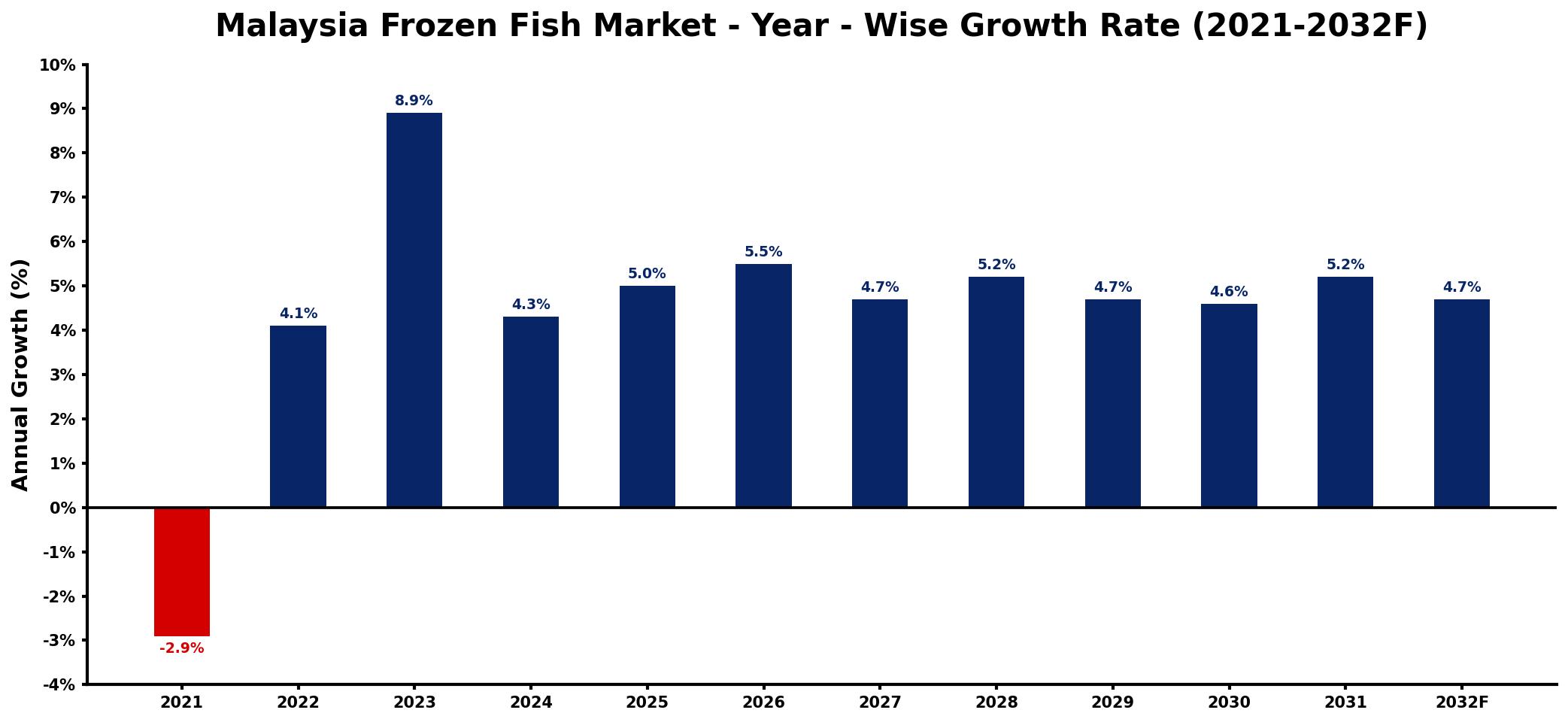
The table below presents the year‑wise growth rates along with the key drivers influencing the market
| Year | Growth Rate | Major Drivers |
| 2021 | -2.9% | Supply chain disruptions impact availability |
| 2022 | 4.1% | Rising consumer interest in seafood |
| 2023 | 8.9% | Improved distribution network efficiency |
| 2024 | 4.3% | enhanced product quality standards |
| 2025 | 5.0% | Growing health consciousness among consumers |
| 2026 | 5.5% | Expansion of online retail platforms |
| 2027 | 4.7% | Enhanced quality control measures implemented |
| 2028 | 5.2% | Emerging markets expanding consumer base |
| 2029 | 4.7% | Innovative packaging solutions gaining traction |
| 2030 | 4.6% | Sustainable sourcing practices becoming standard |
| 2031 | 5.2% | Investment in aquaculture technologies rising |
| 2032 | 4.7% | Government support for industry growth |
Note: Market size estimations and growth projections presented in this report are based on 6Wresearch's proprietary forecasting methodology, utilizing the latest available industry data, government publications, and primary research inputs.
Malaysia Frozen Fish Market Synopsis
The frozen fish market in Malaysia has exhibited consistent growth in recent years, bolstered by evolving consumer preferences towards more convenient meal solutions. As urban lifestyles become increasingly hectic, the appeal of frozen fish—which addresses storage challenges and reduces waste—grows significantly. This momentum is set to transition into a more expansive phase as the market adapts to post-pandemic dynamics.
The diversity within the frozen fish segment, including popular varieties such as mackerel and haddock, further enriches consumer choices. Additionally, the broader expansion of the frozen seafood sector, encompassing other seafood products like molluscs, is expected to sustain this growth trajectory, catering to a discerning consumer base eager for quality and variety.
Malaysia Frozen Fish Market Key Takeaways
- Increasing demand for convenient seafood options is reshaping consumer preferences.
- Growth in the frozen fish market aligns with rising health consciousness regarding the benefits of fish consumption.
- Improvements in cold chain logistics are enhancing product availability nationwide.
- Online grocery shopping trends, accelerated by COVID-19, are redefining market access.
- Urban lifestyles and busy consumers are driving the demand for frozen fish products.
Evaluation of Restraints in Malaysia Frozen Fish Market
Despite the promising outlook, certain restraints impede the rapid expansion of the frozen fish market in Malaysia. A significant challenge lies in maintaining product integrity throughout storage and distribution processes, as inconsistent quality can undermine consumer trust. Preventing freezer burn and ensuring optimal temperature controls are critical factors that industry stakeholders must navigate to uphold product standards. Additionally, fluctuations in supply chains can pose threats to timely availability, impacting consumer satisfaction and market dynamics.
Malaysia Frozen Fish Market Trends
Several emerging trends are currently shaping the Malaysia Frozen Fish Market. Consumers are increasingly seeking sustainable seafood options, prompting a shift towards responsibly sourced products. Additionally, the convenience of ready-to-cook frozen fish meals is gaining traction, appealing to busy households. Moreover, advancements in freezing technologies are allowing for improved flavor retention and nutritional value, further enticing health-conscious consumers. The integration of e-commerce platforms is also revolutionizing distribution strategies, making frozen fish more accessible than ever before.
Malaysia Frozen Fish Market Opportunities
Genuine growth opportunities lie within the expansion of product offerings and innovative marketing strategies. There is potential for introducing premium frozen fish products that cater to niche markets, such as organic or sustainably sourced options. Additionally, investment in advanced cold chain technologies can enhance the supply chain efficiency, reducing waste and improving profitability. The rise of online shopping platforms represents a significant channel for reaching tech-savvy consumers, further bolstering market potential. Businesses can also capitalize on collaborations with local restaurants and food services to broaden their reach.
Government Initiatives in the Malaysia Frozen Fish Market
The Malaysian government has recognized the importance of the seafood sector, including the frozen fish market, as a vital component of the nations economy. Various initiatives focus on supporting sustainable fishing practices and improving cold chain logistics to bolster product quality and safety. Additionally, public spending aimed at enhancing infrastructure for seafood processing and distribution is expected to provide a further impetus for growth. Government incentives for research and development in seafood technology are also fostering innovation within the sector.
Future Insights of the Malaysia Frozen Fish Market
Looking ahead to 2026-2032, the Malaysia Frozen Fish Market is poised for sustained growth. The convergence of health trends emphasizing nutritious diets with convenience-driven purchasing behavior indicates a favorable environment for frozen fish products. Additionally, technological advancements in freezing and packaging are expected to enhance product quality, allowing for greater consumer satisfaction. As the market evolves, companies that effectively leverage online platforms and align with sustainability trends will likely find lucrative opportunities in an increasingly competitive landscape.
Malaysia Frozen Fish Market Latest Developments (2025 - 2026)
Recent developments within the frozen fish market underscore a shift towards more sophisticated distribution channels. Many businesses are increasingly adopting e-commerce strategies, aimed at capturing the growing segment of consumers preferring online shopping. Innovations in packaging designed to preserve quality and freshness during transit are becoming more prevalent. Additionally, collaborations between suppliers and retailers are emerging, creating new avenues for product promotions and customer engagement in both physical and digital markets.
Malaysia Frozen Fish Market - Key Attractiveness of the Report
- 10 Years of Market Numbers
- Historical Data Starting from 2022 to 2025
- Base Year: 2025
- Forecast Data until 2032
- Key Performance Indicators Impacting the Market
- Major Upcoming Developments and Projects
Key Highlights of the Report:
- Malaysia Frozen Fish Market Outlook
- Market Size of Malaysia Frozen Fish Market, 2025
- Forecast of Malaysia Frozen Fish Market, 2032
- Historical Data and Forecast of Malaysia Frozen Fish Revenues & Volume for the Period 2022-2032F
- Malaysia Frozen Fish Market Trend Evolution
- Malaysia Frozen Fish Market Drivers and Challenges
- Malaysia Frozen Fish Price Trends
- Malaysia Frozen Fish Porter's Five Forces
- Malaysia Frozen Fish Industry Life Cycle
- Historical Data and Forecast of Malaysia Frozen Fish Market Revenues & Volume By Type for the Period 2022-2032F
- Historical Data and Forecast of Malaysia Frozen Fish Market Revenues & Volume By Fish Fingers for the Period 2022-2032F
- Historical Data and Forecast of Malaysia Frozen Fish Market Revenues & Volume By Fish Cakes for the Period 2022-2032F
- Historical Data and Forecast of Malaysia Frozen Fish Market Revenues & Volume By Breaded/Battered Fish for the Period 2022-2032F
- Historical Data and Forecast of Malaysia Frozen Fish Market Revenues & Volume By Whole Fish & Drawn Fish for the Period 2022-2032F
- Historical Data and Forecast of Malaysia Frozen Fish Market Revenues & Volume By Single Fillet & Butterfly Fillet for the Period 2022-2032F
- Historical Data and Forecast of Malaysia Frozen Fish Market Revenues & Volume By Dressed Fish for the Period 2022-2032F
- Historical Data and Forecast of Malaysia Frozen Fish Market Revenues & Volume By Steaks Fish for the Period 2022-2032F
- Historical Data and Forecast of Malaysia Fish Fingers Frozen Fish Market Revenues & Volume By Others for the Period 2022-2032F
- Historical Data and Forecast of Malaysia Frozen Fish Market Revenues & Volume By Application for the Period 2022-2032F
- Historical Data and Forecast of Malaysia Frozen Fish Market Revenues & Volume By Direct Consumption for the Period 2022-2032F
- Historical Data and Forecast of Malaysia Frozen Fish Market Revenues & Volume By Restaurants for the Period 2022-2032F
- Historical Data and Forecast of Malaysia Frozen Fish Market Revenues & Volume By Food Processing Factories for the Period 2022-2032F
- Historical Data and Forecast of Malaysia Frozen Fish Market Revenues & Volume By Others for the Period 2022-2032F
- Historical Data and Forecast of Malaysia Frozen Fish Market Revenues & Volume By Distribution Channel for the Period 2022-2032F
- Historical Data and Forecast of Malaysia Frozen Fish Market Revenues & Volume By Supermarkets & Hypermarkets for the Period 2022-2032F
- Historical Data and Forecast of Malaysia Frozen Fish Market Revenues & Volume By Convenience Stores for the Period 2022-2032F
- Historical Data and Forecast of Malaysia Frozen Fish Market Revenues & Volume By Speciality Retailers for the Period 2022-2032F
- Historical Data and Forecast of Malaysia Frozen Fish Market Revenues & Volume By Online for the Period 2022-2032F
- Historical Data and Forecast of Malaysia Frozen Fish Market Revenues & Volume By Others for the Period 2022-2032F
- Malaysia Frozen Fish Import Export Trade Statistics
- Market Opportunity Assessment By Type
- Market Opportunity Assessment By Application
- Market Opportunity Assessment By Distribution Channel
- Malaysia Frozen Fish Top Companies Market Share
- Malaysia Frozen Fish Competitive Benchmarking By Technical and Operational Parameters
- Malaysia Frozen Fish Company Profiles
- Malaysia Frozen Fish Key Strategic Recommendations






































