Malaysia Fruit Powder Market Size, Share & Growth Rate
The Malaysia Fruit Powder Market was estimated at USD 392 Million in 2025 and is projected to reach USD 512 Million by 2032, growing at a CAGR of 3.9% from 2026 to 2032. This growth trajectory is primarily driven by a surge in health-conscious consumer behavior, as well as an increasing preference for convenience foods that are rich in nutritional value. Additionally, the rising use of fruit powders in various culinary applications further propels market demand.
Malaysia Fruit Powder Market Year-wise Growth Rate and Key Drivers
This graph highlights how the Malaysia Fruit Powder Market has steadily grown over the years, supported by major growth factors.
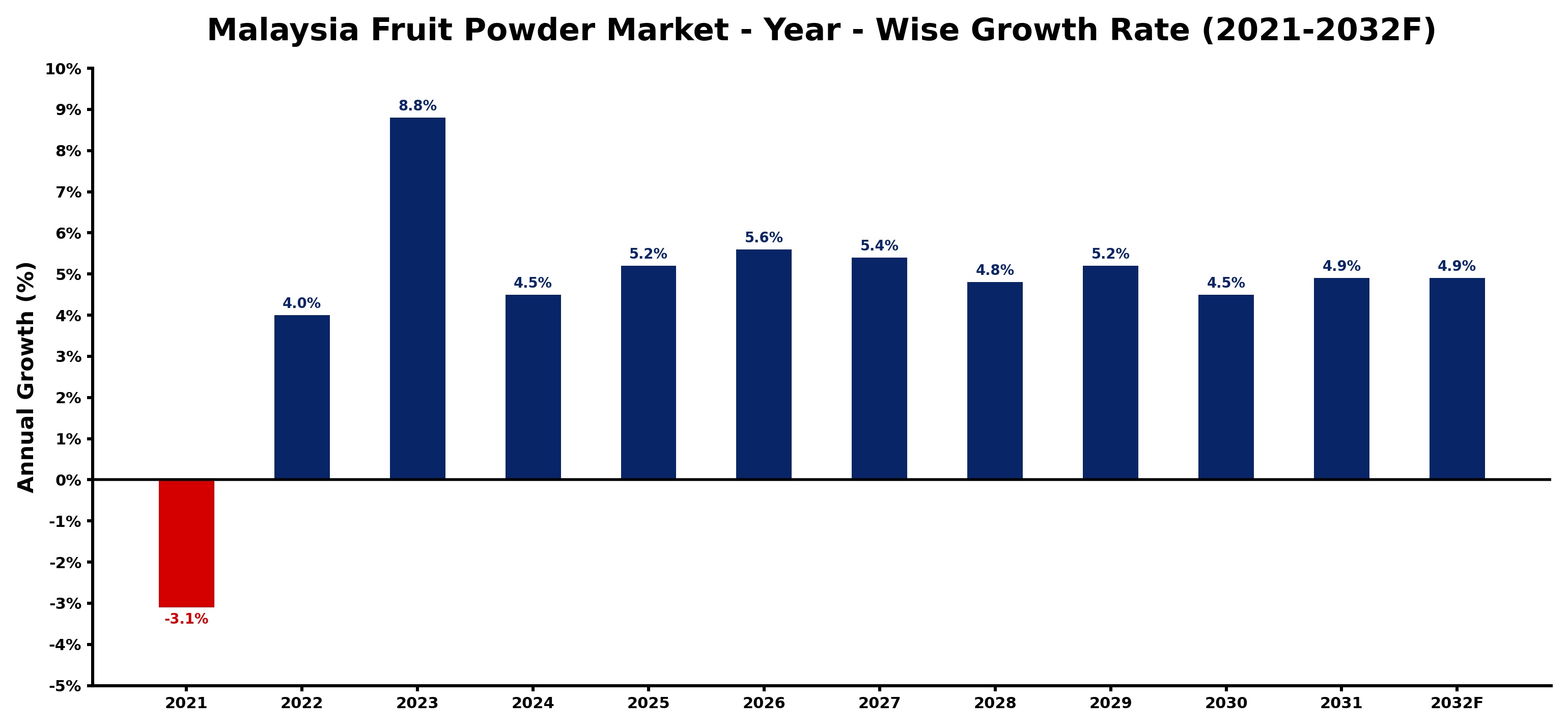
The table below presents the year‑wise growth rates along with the key drivers influencing the market
| Year | Growth Rate | Major Drivers |
| 2021 | -3.1% | Manufacturing slowdowns decreased demand for Malaysia's fruit powder exports |
| 2022 | 4.0% | Export oriented fruit powder production aligns with international health trends |
| 2023 | 8.8% | Investment in fruit processing facilities boosts export market competitiveness |
| 2024 | 4.5% | Improved production efficiency boosted demand for premium fruit powders |
| 2025 | 5.2% | Precision agriculture technology boosts fruit powder production efficiency |
| 2026 | 5.6% | Export demand drives investment in fruit powder manufacturing capacity |
| 2027 | 5.4% | Modern production techniques boost Malaysia’s fruit powder export capabilities |
| 2028 | 4.8% | Export demand surge boosts fruit powder processing equipment orders |
| 2029 | 5.2% | Fruit powder production efficiency drives export market competitiveness |
| 2030 | 4.5% | Fruit powder production scalability enhances export capabilities and market access |
| 2031 | 4.9% | Investment in fruit powder facilities boosts export manufacturing capabilities |
| 2032 | 4.9% | Precision engineering investments boost Malaysian fruit powder processing capacity |
Note - Market size estimations and growth projections presented in this report are based on 6Wresearch’s advanced forecasting approach, validated with industry datasets as of June 2026.
Malaysia Fruit Powder Market Synopsis
The primary force shaping the Malaysia Fruit Powder Market today is the booming demand for health and wellness products. Consumers are increasingly seeking natural and fruit-based alternatives to meet their nutritional needs, favoring fruit powders for their convenience and versatility.
Moreover, the food and beverage industry is undergoing a transformation, with fruit powders being embraced for flavor enhancement and nutritional fortification in a variety of products. This trend is indicative of a broader consumer shift towards healthier eating habits and greater awareness of dietary choices.
Malaysia Fruit Powder Market Key Takeaways
- The market is experiencing robust growth due to heightened demand for health-oriented food products.
- Fruit powders are increasingly favored in smoothies, juices, jams, and sauces due to their nutritional benefits.
- Consumer disposable incomes are on the rise, leading to greater expenditure on premium food products.
- There is a growing trend towards natural sourcing and quality in fruit powder production.
- Challenges in sourcing high-quality fruits may impact supply dynamics and pricing strategies.
Evaluation of Restraints in Malaysia Fruit Powder Market
Despite promising growth prospects, the Malaysia Fruit Powder Market faces several constraints. A significant challenge is the seasonal nature of fruit production, which can lead to fluctuations in availability and impact pricing strategies. Additionally, ensuring consistent quality during the sourcing and processing stages remains a critical hurdle for market participants. Companies must also navigate stringent food safety regulations to ensure compliance, which can further complicate production efforts and increase operational costs.
Malaysia Fruit Powder Market Trends
Current trends indicate a shift towards clean-label products, with consumers showing a preference for fruit powders that are free from additives and preservatives. The incorporation of fruit powders in functional foods, snacks, and dietary supplements is becoming increasingly common as health awareness rises. Innovative applications, such as the use of fruit powders in plant-based products and desserts, are also on the rise, further diversifying the market landscape.
Malaysia Fruit Powder Market Opportunities
The market presents substantial opportunities, particularly for businesses that emphasize quality and sustainability. There is a notable demand for organic fruit powders, as consumers seek natural and health-oriented options. Additionally, the growing popularity of e-commerce platforms for food products offers an expanded channel for reaching health-conscious customers. Collaborations between food manufacturers and fruit powder suppliers could also yield innovative product offerings and enhance market penetration.
Government Initiatives in the Malaysia Fruit Powder Market
The Malaysian government has introduced various initiatives aimed at promoting agricultural sustainability and enhancing the quality of food products. Public spending on agriculture and food processing technology has been increasing, providing support to local producers. Additionally, there are programs designed to boost export capabilities for Malaysian food products, which could positively impact the fruit powder market by increasing its global competitiveness.
Future Insights of the Malaysia Fruit Powder Market
Looking ahead to 2026-2032, the Malaysia Fruit Powder Market is set to experience transformative changes. The convergence of health trends and technological advancements in food processing will likely lead to innovative product launches and improved supply chain efficiencies. A growing focus on natural, nutrient-rich ingredients will drive demand, positioning fruit powders as a staple in health-conscious diets. As consumer preferences continue to evolve, companies that adapt swiftly will find themselves at the forefront of market growth.
Malaysia Fruit Powder Market Latest Developments (May 2025 - June 2026)
The fruit powder industry in Malaysia is witnessing a surge in new product launches as companies respond to consumer demands for healthier food options. Innovations in processing technologies are enhancing the quality and shelf-life of fruit powders, making them more attractive to food manufacturers. Additionally, partnerships within the agri-food sector are becoming common as businesses aim to secure high-quality raw materials for production.
Malaysia Fruit Powder Market - Key Attractiveness of the Report
- 10 Years of Market Numbers
- Historical Data Starting from 2022 to 2025
- Base Year: 2025
- Forecast Data until 2032
- Key Performance Indicators Impacting the Market
- Major Upcoming Developments and Projects
Key Highlights of the Report:
- Malaysia Fruit Powder Market Outlook
- Market Size of Malaysia Fruit Powder Market, 2025
- Forecast of Malaysia Fruit Powder Market, 2032
- Historical Data and Forecast of Malaysia Fruit Powder Revenues & Volume for the Period 2022-2032F
- Malaysia Fruit Powder Market Trend Evolution
- Malaysia Fruit Powder Market Drivers and Challenges
- Malaysia Fruit Powder Price Trends
- Malaysia Fruit Powder Porter's Five Forces
- Malaysia Fruit Powder Industry Life Cycle
- Historical Data and Forecast of Malaysia Fruit Powder Market Revenues & Volume By Type for the Period 2022-2032F
- Historical Data and Forecast of Malaysia Fruit Powder Market Revenues & Volume By Banana for the Period 2022-2032F
- Historical Data and Forecast of Malaysia Fruit Powder Market Revenues & Volume By Grapes for the Period 2022-2032F
- Historical Data and Forecast of Malaysia Fruit Powder Market Revenues & Volume By Blueberry for the Period 2022-2032F
- Historical Data and Forecast of Malaysia Fruit Powder Market Revenues & Volume By Mango for the Period 2022-2032F
- Historical Data and Forecast of Malaysia Fruit Powder Market Revenues & Volume By others for the Period 2022-2032F
- Historical Data and Forecast of Malaysia Fruit Powder Market Revenues & Volume By Application for the Period 2022-2032F
- Historical Data and Forecast of Malaysia Fruit Powder Market Revenues & Volume By Bakery & Confectionery for the Period 2022-2032F
- Historical Data and Forecast of Malaysia Fruit Powder Market Revenues & Volume By Dairy & Frozen Desserts for the Period 2022-2032F
- Historical Data and Forecast of Malaysia Fruit Powder Market Revenues & Volume By Beverages for the Period 2022-2032F
- Historical Data and Forecast of Malaysia Fruit Powder Market Revenues & Volume By Food Supplements for the Period 2022-2032F
- Historical Data and Forecast of Malaysia Fruit Powder Market Revenues & Volume By others for the Period 2022-2032F
- Malaysia Fruit Powder Import Export Trade Statistics
- Market Opportunity Assessment By Type
- Market Opportunity Assessment By Application
- Malaysia Fruit Powder Top Companies Market Share
- Malaysia Fruit Powder Competitive Benchmarking By Technical and Operational Parameters
- Malaysia Fruit Powder Company Profiles
- Malaysia Fruit Powder Key Strategic Recommendations






































