Malaysia Fruit Pulp Market Size, Share & Growth Rate
The Malaysia Fruit Pulp Market was estimated at USD 155 Million in 2025 and is projected to reach USD 201 Million by 2032, growing at a CAGR of 3.8% from 2026 to 2032. This upward trajectory is predominantly driven by an increasing consumer preference for natural ingredients, particularly in the food and beverage sector. Additionally, the rise of tropical fruit flavors, alongside a notable shift towards clean-label products, is significantly bolstering the demand for fruit pulps.
Malaysia Fruit Pulp Market Year-wise Growth Rate and Key Drivers
This graph highlights how the Malaysia Fruit Pulp Market has steadily grown over the years, supported by major growth factors.
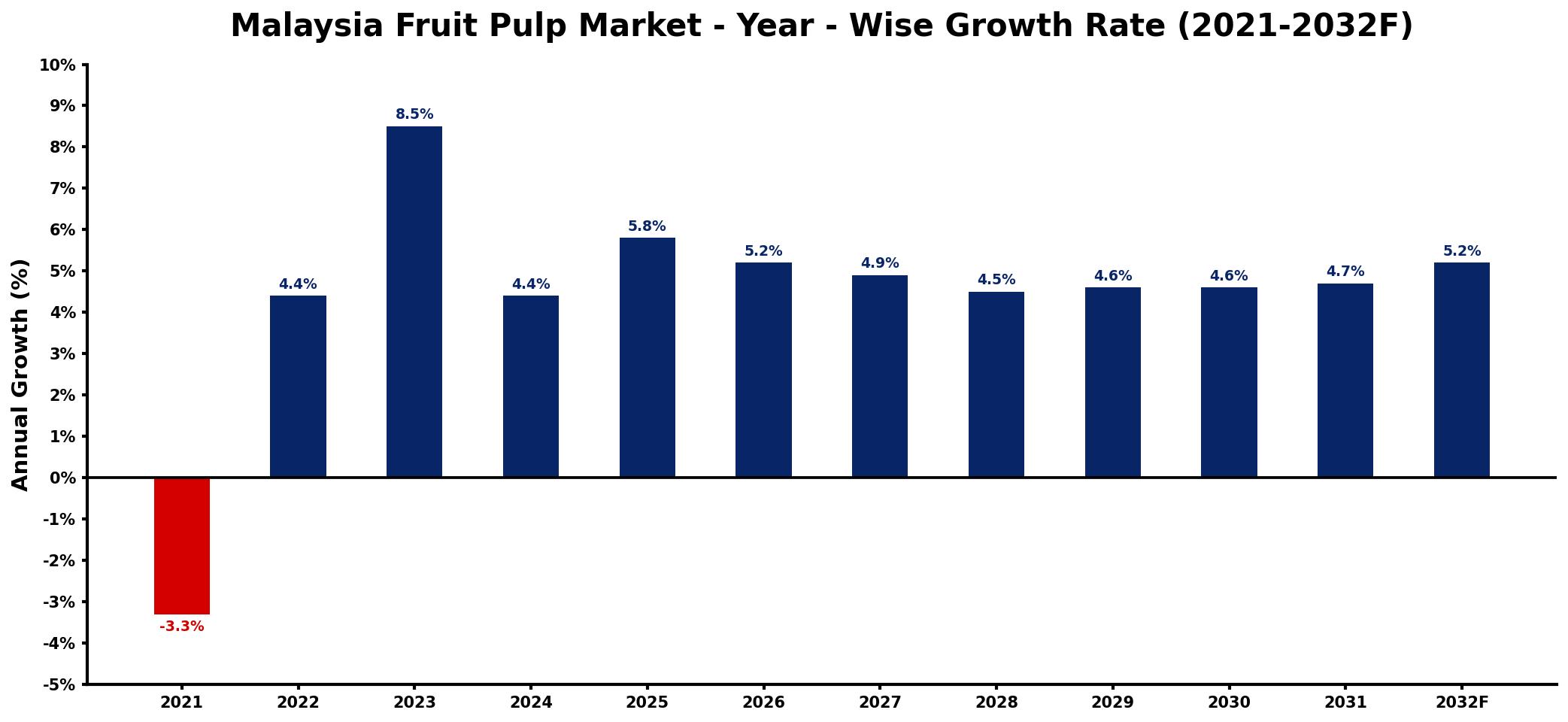
The table below presents the year‑wise growth rates along with the key drivers influencing the market
| Year | Growth Rate | Major Drivers |
| 2021 | -3.3% | Supply chain disruptions impact availability |
| 2022 | 4.4% | Rising health consciousness among consumers |
| 2023 | 8.5% | Increased demand for innovative beverages |
| 2024 | 4.4% | Expansion of food service sector |
| 2025 | 5.8% | Growing popularity of natural ingredients |
| 2026 | 5.2% | Investment in processing technologies |
| 2027 | 4.9% | Emerging export markets for products |
| 2028 | 4.5% | Rising consumer interest in sustainability |
| 2029 | 4.6% | Adoption of online retail platforms |
| 2030 | 4.6% | Development of new product lines |
| 2031 | 4.7% | Strengthening distribution networks nationwide |
| 2032 | 5.2% | Collaborations with local farmers increase |
Note: Market size estimations and growth projections presented in this report are based on 6Wresearch's proprietary forecasting methodology, utilizing the latest available industry data, government publications, and primary research inputs.
Malaysia Fruit Pulp Market Synopsis
The strongest force shaping the Malaysia fruit pulp market right now is the burgeoning demand for healthier and more natural food options. As consumers become more health-conscious, the appeal of fruit pulp as a natural ingredient in a variety of applications, from smoothies to desserts, is becoming increasingly compelling.
Moreover, the trend towards exotic and tropical fruit flavors is expanding the consumer base, as these unique tastes gain popularity. Manufacturers are responding by diversifying their product offerings, which aligns with the growing demand for innovative food experiences that fruit pulps can provide.
Malaysia Fruit Pulp Market Key Takeaways
- The market is experiencing steady growth fueled by health trends favoring natural ingredients.
- Exotic fruit flavors are becoming mainstream, enhancing demand for diverse fruit pulps.
- Manufacturers are emphasizing clean-label products, increasing the appeal of fruit pulp.
- Sustainable packaging solutions are emerging as essential for maintaining product quality.
- Investment in technology is crucial for improving supply chain resilience and efficiency.
Evaluation of Restraints in Malaysia Fruit Pulp Market
While the Malaysia fruit pulp market is positioned for growth, it faces certain restraints that could hinder its full potential. One of the primary challenges relates to the shelf life of fruit pulps, which can be influenced by natural degradation processes. Additionally, the need for innovative and effective packaging solutions to enhance shelf life and maintain quality is critical. Market players must also navigate fluctuating fruit prices and ensure consistent supply chains to meet the growing consumer demand.
Malaysia Fruit Pulp Market Trends
Current trends indicate a significant shift toward plant-based and natural ingredients across the food and beverage industry. This has led to an increasing incorporation of fruit pulps in products like yogurt, ice cream, and smoothies. Moreover, there is a noticeable rise in consumer awareness regarding sourcing and sustainability, pushing manufacturers to adopt environmentally friendly practices. The digitalization of supply chains and marketing strategies is also emerging as a key trend, allowing companies to connect better with consumers.
Malaysia Fruit Pulp Market Opportunities
Genuine growth opportunities exist in the Malaysia fruit pulp market, particularly in the development of premium and organic fruit pulps. As health trends intensify, theres a market niche for products that emphasize health benefits and quality sourcing. Collaborations with food manufacturers for bespoke fruit pulp formulations can also drive innovation. Moreover, tapping into export markets, particularly in Asia-Pacific regions where demand for tropical flavors is high, presents another significant opportunity for market players.
Government Initiatives in the Malaysia Fruit Pulp Market
The Malaysian government has been proactive in promoting the agricultural sector, which indirectly supports the fruit pulp market. Various initiatives focus on enhancing agricultural productivity and sustainability, encouraging local sourcing of raw materials for fruit pulp production. Public spending on food security and local food systems is expected to bolster the market as policymakers recognize the importance of local supply chains and food sovereignty.
Future Insights of the Malaysia Fruit Pulp Market
From 2026 to 2032, the Malaysia fruit pulp market is anticipated to evolve significantly, characterized by increased consumer demand for innovative products and flavors. The emphasis on health and wellness will continue to shape purchasing decisions, encouraging manufacturers to explore new formulations. As technological advancements in processing and packaging mature, companies will likely enhance product offerings while ensuring quality and sustainability remain top priorities.
Malaysia Fruit Pulp Market Latest Developments (2025 - 2026)
Recently, the fruit pulp industry has seen a surge in new product launches, focusing on unique flavor profiles that incorporate local and exotic fruits. Companies are investing in improved processing technologies to extend product shelf life and enhance flavor retention. Additionally, several manufacturers have begun collaborating with health and wellness brands to create synergistic products, further driving the market's direction towards innovation and consumer engagement.
Malaysia Fruit Pulp Market - Key Attractiveness of the Report
- 10 Years of Market Numbers
- Historical Data Starting from 2022 to 2025
- Base Year: 2025
- Forecast Data until 2032
- Key Performance Indicators Impacting the Market
- Major Upcoming Developments and Projects
Key Highlights of the Report:
- Malaysia Fruit Pulp Market Outlook
- Market Size of Malaysia Fruit Pulp Market, 2025
- Forecast of Malaysia Fruit Pulp Market, 2032
- Historical Data and Forecast of Malaysia Fruit Pulp Revenues & Volume for the Period 2022-2032F
- Malaysia Fruit Pulp Market Trend Evolution
- Malaysia Fruit Pulp Market Drivers and Challenges
- Malaysia Fruit Pulp Price Trends
- Malaysia Fruit Pulp Porter's Five Forces
- Malaysia Fruit Pulp Industry Life Cycle
- Historical Data and Forecast of Malaysia Fruit Pulp Market Revenues & Volume By Fruit Type for the Period 2022-2032F
- Historical Data and Forecast of Malaysia Fruit Pulp Market Revenues & Volume By Mango for the Period 2022-2032F
- Historical Data and Forecast of Malaysia Fruit Pulp Market Revenues & Volume By Strawberry for the Period 2022-2032F
- Historical Data and Forecast of Malaysia Fruit Pulp Market Revenues & Volume By Apple for the Period 2022-2032F
- Historical Data and Forecast of Malaysia Fruit Pulp Market Revenues & Volume By Guava for the Period 2022-2032F
- Historical Data and Forecast of Malaysia Fruit Pulp Market Revenues & Volume By Berries for the Period 2022-2032F
- Historical Data and Forecast of Malaysia Fruit Pulp Market Revenues & Volume By Citrus Fruits for the Period 2022-2032F
- Historical Data and Forecast of Malaysia Fruit Pulp Market Revenues & Volume By Others for the Period 2022-2032F
- Historical Data and Forecast of Malaysia Fruit Pulp Market Revenues & Volume By Form for the Period 2022-2032F
- Historical Data and Forecast of Malaysia Fruit Pulp Market Revenues & Volume By Liquid for the Period 2022-2032F
- Historical Data and Forecast of Malaysia Fruit Pulp Market Revenues & Volume By Powder for the Period 2022-2032F
- Historical Data and Forecast of Malaysia Fruit Pulp Market Revenues & Volume By Application for the Period 2022-2032F
- Historical Data and Forecast of Malaysia Fruit Pulp Market Revenues & Volume By Food and Beverages for the Period 2022-2032F
- Historical Data and Forecast of Malaysia Fruit Pulp Market Revenues & Volume By Distribution for the Period 2022-2032F
- Historical Data and Forecast of Malaysia Fruit Pulp Market Revenues & Volume By E-Commerce for the Period 2022-2032F
- Historical Data and Forecast of Malaysia Fruit Pulp Market Revenues & Volume By Convenience Stores for the Period 2022-2032F
- Historical Data and Forecast of Malaysia Fruit Pulp Market Revenues & Volume By Supermarkets/Hypermarkets for the Period 2022-2032F
- Historical Data and Forecast of Malaysia Fruit Pulp Market Revenues & Volume By Specialty Stores for the Period 2022-2032F
- Historical Data and Forecast of Malaysia Fruit Pulp Market Revenues & Volume By Others for the Period 2022-2032F
- Malaysia Fruit Pulp Import Export Trade Statistics
- Market Opportunity Assessment By Fruit Type
- Market Opportunity Assessment By Form
- Market Opportunity Assessment By Application
- Market Opportunity Assessment By Distribution
- Malaysia Fruit Pulp Top Companies Market Share
- Malaysia Fruit Pulp Competitive Benchmarking By Technical and Operational Parameters
- Malaysia Fruit Pulp Company Profiles
- Malaysia Fruit Pulp Key Strategic Recommendations






































