Malaysia Gas Equipment Market Size, Share & Growth Rate
The Malaysia Gas Equipment Market was estimated at USD 278 Million in 2025 and is projected to reach USD 363 Million by 2032, growing at a CAGR of 3.9% from 2026 to 2032. This growth trajectory is primarily fueled by the escalating demand for liquefied natural gas (LNG) and compressed natural gas (CNG). Additionally, the drive towards enhancing infrastructure and a growing industrial base, along with government initiatives promoting cleaner energy alternatives, are significantly propelling the market forward.
Malaysia Gas Equipment Market Year-wise Growth Rate and Key Drivers
This graph highlights how the Malaysia Gas Equipment Market has steadily grown over the years, supported by major growth factors.
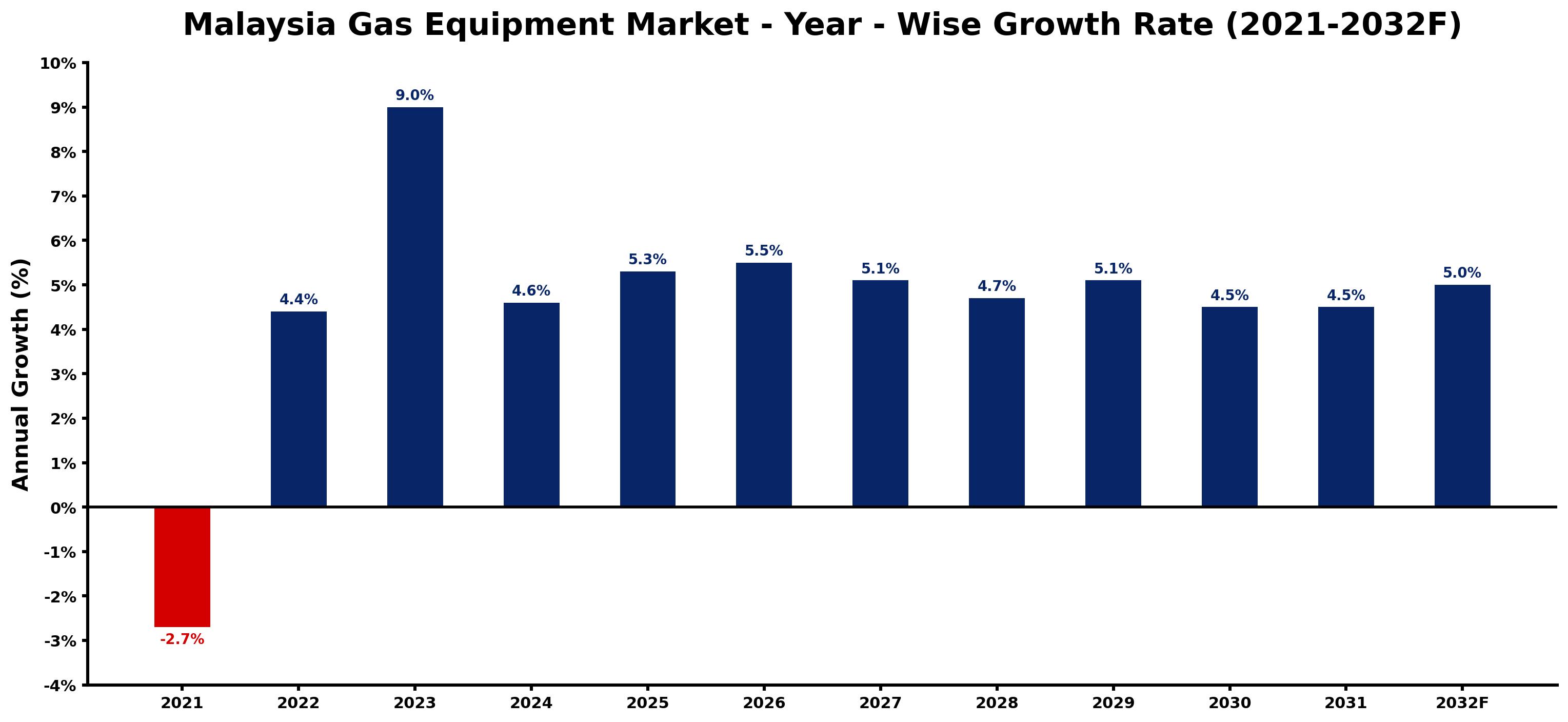
The table below presents the year‑wise growth rates along with the key drivers influencing the market
| Year | Growth Rate | Major Drivers |
| 2021 | -2.7% | Increasing industrial infrastructure investments |
| 2022 | 4.4% | Rising electricity demand across industries |
| 2023 | 9.0% | Increasing adoption of advanced technologies |
| 2024 | 4.6% | Rapid growth in telecom and data center sectors |
| 2025 | 5.3% | Increasing smart city development projects |
| 2026 | 5.5% | Increasing industrial automation investments |
| 2027 | 5.1% | Expansion of manufacturing activities |
| 2028 | 4.7% | Government infrastructure modernization initiatives |
| 2029 | 5.1% | Growing renewable energy integration projects |
| 2030 | 4.5% | Expansion of manufacturing activities |
| 2031 | 4.5% | Growing urbanization and commercial development |
| 2032 | 5.0% | Rising electricity demand across industries |
Note - Market size estimations and growth projections presented in this report are based on 6Wresearch’s advanced forecasting approach, validated with industry datasets as of June 2026.
Malaysia Gas Equipment Market Synopsis
The most influential factor currently shaping the Malaysia Gas Equipment Market is the increasing demand for cleaner and more efficient energy sources. The transition from traditional petroleum fuels to LNG and CNG is not only a response to rising environmental concerns but also aligns with government policies aimed at fostering sustainability.
Moreover, as Malaysia continues to industrialize and urbanize, the necessity for robust gas infrastructure becomes increasingly imperative. Population growth and the need for reliable energy solutions further amplify the demand for gas equipment, creating a conducive environment for market expansion.
Malaysia Gas Equipment Market Key Takeaways
- The market is anticipated to grow steadily, supported by robust demand for LNG and CNG.
- Government incentives are critical in promoting the adoption of cleaner energy solutions.
- Infrastructure development remains a major driver of market growth and innovation.
- Rising environmental awareness is steering consumers and industries towards greener alternatives.
- Investment in gas equipment technology is set to escalate to meet evolving demands.
Evaluation of Restraints in Malaysia Gas Equipment Market
Despite promising growth, the Malaysia Gas Equipment Market faces several restraints that could hinder its potential. The dependency on fossil fuel subsidies can create a barrier for the adoption of greener alternatives, as industries may be reluctant to transition without significant economic incentives. Additionally, infrastructural limitations in rural areas and the high upfront costs of advanced gas equipment may also deter investments. Navigating regulatory challenges and local content requirements could further complicate market dynamics, necessitating strategic responses from stakeholders.
Malaysia Gas Equipment Market Trends
A notable trend influencing the Malaysia Gas Equipment Market is the increasing integration of technology within gas systems. Smart gas metering and monitoring solutions are gaining traction, enhancing operational efficiency and safety. Furthermore, the rising focus on environmental sustainability is prompting companies to invest in alternative gas solutions such as biogas and hydrogen. These trends reflect a significant shift towards innovation that meets both consumer demands and regulatory requirements.
Malaysia Gas Equipment Market Opportunities
The transition towards sustainable energy sources presents substantial opportunities within the Malaysia Gas Equipment Market. Companies specializing in the development of cutting-edge gas technologies stand to benefit greatly as industries pivot towards LNG and CNG. Additionally, investment in rural gas infrastructure can yield significant returns, considering the untapped potential in less developed regions. Partnerships with governmental bodies for infrastructure projects could further amplify growth prospects in this evolving landscape.
Government Initiatives in the Malaysia Gas Equipment Market
The Malaysian government plays a vital role in shaping the gas equipment market through various initiatives aimed at promoting cleaner energy. Policies supporting local content requirements and fuel subsidies are designed to foster local production capabilities and reduce dependence on imports. Additionally, incentives for the development of green technology and investments in infrastructure upgrades reflect a strong commitment to enhancing the national energy landscape.
Future Insights of the Malaysia Gas Equipment Market
Looking ahead, the Malaysia Gas Equipment Market is poised for significant developments between 2026 and 2032. As global energy demands shift towards sustainability, the market is likely to embrace technological advancements and innovative gas solutions. The alignment of government policies with industry objectives will be crucial in driving growth, particularly in rural and underserved regions. In this evolving environment, stakeholders must remain adaptive to capitalize on emerging trends and opportunities.
Malaysia Gas Equipment Market Latest Developments (May 2025 - June 2026)
In recent months, the Malaysia Gas Equipment Market has seen a flurry of activity focusing on infrastructure development and technological innovation. Companies are increasingly investing in advanced gas monitoring systems, which enhance safety and efficiency. Meanwhile, collaborative efforts between public and private sectors are becoming more common, aimed at scaling up infrastructure and supporting cleaner energy solutions. These developments signify a dynamic market responding to both domestic and global energy demands.
Malaysia Gas Equipment Market - Key Attractiveness of the Report
- 10 Years of Market Numbers
- Historical Data Starting from 2022 to 2025
- Base Year: 2025
- Forecast Data until 2032
- Key Performance Indicators Impacting the Market
- Major Upcoming Developments and Projects
Key Highlights of the Report:
- Malaysia Gas Equipment Market Outlook
- Market Size of Malaysia Gas Equipment Market, 2025
- Forecast of Malaysia Gas Equipment Market, 2032F
- Historical Data and Forecast of Malaysia Gas Equipment Revenues & Volume for the Period 2022-2032F
- Malaysia Gas Equipment Market Trend Evolution
- Malaysia Gas Equipment Market Drivers and Challenges
- Malaysia Gas Equipment Price Trends
- Malaysia Gas Equipment Porter's Five Forces
- Malaysia Gas Equipment Industry Life Cycle
- Historical Data and Forecast of Malaysia Gas Equipment Market Revenues & Volume By Equipment Type for the Period 2022-2032F
- Historical Data and Forecast of Malaysia Gas Equipment Market Revenues & Volume By Gas Delivery Systems for the Period 2022-2032F
- Historical Data and Forecast of Malaysia Gas Equipment Market Revenues & Volume By Gas Regulators for the Period 2022-2032F
- Historical Data and Forecast of Malaysia Gas Equipment Market Revenues & Volume By Flow Devices for the Period 2022-2032F
- Historical Data and Forecast of Malaysia Gas Equipment Market Revenues & Volume By Purifiers & Filters for the Period 2022-2032F
- Historical Data and Forecast of Malaysia Gas Equipment Market Revenues & Volume By Gas Generating Systems for the Period 2022-2032F
- Historical Data and Forecast of Malaysia Gas Equipment Market Revenues & Volume By Gas Detection Systems for the Period 2022-2032F
- Historical Data and Forecast of Malaysia Gas Equipment Market Revenues & Volume By Cryogenic Products for the Period 2022-2032F
- Historical Data and Forecast of Malaysia Gas Delivery Systems Gas Equipment Market Revenues & Volume By Accessories for the Period 2022-2032F
- Historical Data and Forecast of Malaysia Gas Equipment Market Revenues & Volume By Process for the Period 2022-2032F
- Historical Data and Forecast of Malaysia Gas Equipment Market Revenues & Volume By Gas Generation for the Period 2022-2032F
- Historical Data and Forecast of Malaysia Gas Equipment Market Revenues & Volume By Gas Storage for the Period 2022-2032F
- Historical Data and Forecast of Malaysia Gas Equipment Market Revenues & Volume By Gas Detection for the Period 2022-2032F
- Historical Data and Forecast of Malaysia Gas Equipment Market Revenues & Volume By Gas Transportation for the Period 2022-2032F
- Historical Data and Forecast of Malaysia Gas Equipment Market Revenues & Volume By End-Gas for the Period 2022-2032F
- Historical Data and Forecast of Malaysia Gas Equipment Market Revenues & Volume By Nitrogen for the Period 2022-2032F
- Historical Data and Forecast of Malaysia Gas Equipment Market Revenues & Volume By Hydrogen for the Period 2022-2032F
- Historical Data and Forecast of Malaysia Gas Equipment Market Revenues & Volume By Helium for the Period 2022-2032F
- Historical Data and Forecast of Malaysia Gas Equipment Market Revenues & Volume By Oxygen for the Period 2022-2032F
- Historical Data and Forecast of Malaysia Gas Equipment Market Revenues & Volume By Carbon Dioxide for the Period 2022-2032F
- Historical Data and Forecast of Malaysia Gas Equipment Market Revenues & Volume By Others for the Period 2022-2032F
- Historical Data and Forecast of Malaysia Gas Equipment Market Revenues & Volume By End-Users for the Period 2022-2032F
- Historical Data and Forecast of Malaysia Gas Equipment Market Revenues & Volume By Metal Fabrication for the Period 2022-2032F
- Historical Data and Forecast of Malaysia Gas Equipment Market Revenues & Volume By Chemicals for the Period 2022-2032F
- Historical Data and Forecast of Malaysia Gas Equipment Market Revenues & Volume By Healthcare for the Period 2022-2032F
- Historical Data and Forecast of Malaysia Gas Equipment Market Revenues & Volume By Oil and Gas for the Period 2022-2032F
- Historical Data and Forecast of Malaysia Gas Equipment Market Revenues & Volume By Food and Beverage for the Period 2022-2032F
- Historical Data and Forecast of Malaysia Gas Equipment Market Revenues & Volume By Others for the Period 2022-2032F
- Malaysia Gas Equipment Import Export Trade Statistics
- Market Opportunity Assessment By Equipment Type
- Market Opportunity Assessment By Process
- Market Opportunity Assessment By End-Gas
- Market Opportunity Assessment By End-Users
- Malaysia Gas Equipment Top Companies Market Share
- Malaysia Gas Equipment Competitive Benchmarking By Technical and Operational Parameters
- Malaysia Gas Equipment Company Profiles
- Malaysia Gas Equipment Key Strategic Recommendations






































