Malaysia Glass Fiber Reinforced Concrete Market Summary
The malaysia glass fiber reinforced concrete market was estimated at USD 215 Million in 2025 and is projected to reach USD 281 Million by 2032, growing at a CAGR of 5.3% from 2026 to 2032.
Malaysia Glass Fiber Reinforced Concrete Market Year-wise Growth Rate and Key Drivers
This graph highlights how the Malaysia Glass Fiber Reinforced Concrete Market has steadily grown over the past five years, supported by major growth factors.
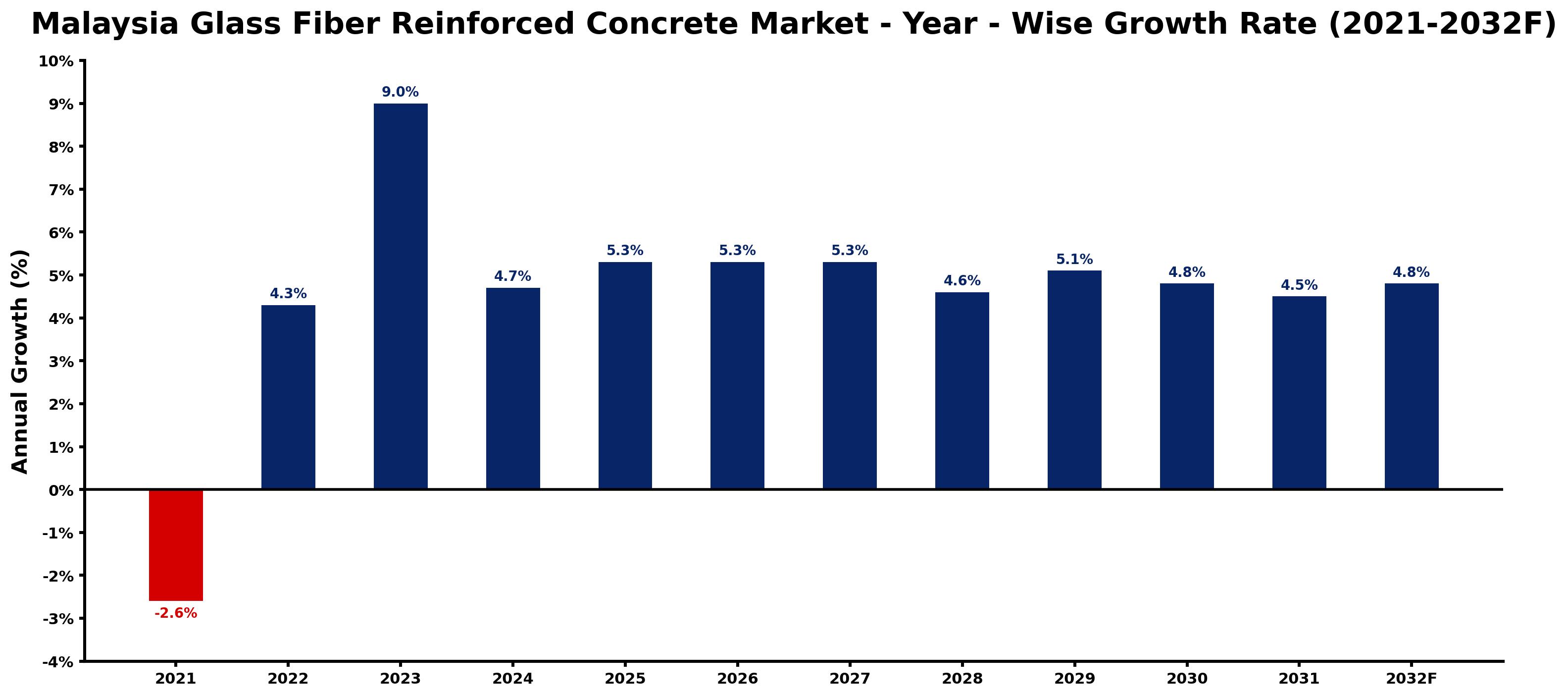
The table below presents the year wise growth rates along with the key drivers influencing the market
| Year | Growth Rate | Major Drivers |
| 2021 | -2.6% | Supply chain disruptions caused by the pandemic led to prolonged project delays in the construction sector. |
| 2022 | 4.3% | Urbanization trends prompted a heightened focus on durable and aesthetic construction solutions. |
| 2023 | 9.0% | Infrastructure investment surged, highlighting the need for innovative concrete alternatives in Malaysia. |
| 2024 | 4.7% | Eco-conscious consumer behavior shifted preferences toward environmentally friendly building materials. |
| 2025 | 5.3% | Major urban projects initiated, requiring lightweight yet strong materials for effective use. |
| 2026 | 5.3% | Technological advancements in manufacturing processes improved the quality and affordability of materials. |
| 2027 | 5.3% | Collaboration between local manufacturers and international firms strengthened market capabilities and offerings. |
| 2028 | 4.6% | An increase in luxury residential projects showcased the versatility of glass fiber reinforced concrete. |
| 2029 | 5.1% | Expansion of public infrastructure projects necessitated reliable materials for long-term durability. |
| 2030 | 4.8% | Rising construction costs encouraged stakeholders to explore cost-effective material alternatives. |
| 2031 | 4.5% | Architectural trends favored unique designs, driving interest in custom glass fiber concrete solutions. |
| 2032 | 4.8% | Market maturity led to increased competition and innovation among existing product providers. |
Note - Market size estimations and growth projections presented in this report are based on 6Wresearch's advanced forecasting approach, validated with industry datasets as of June 2026.
Malaysia Glass Fiber Reinforced Concrete Market Synopsis
The Malaysia Glass Fiber Reinforced Concrete Market is projected to reach 5.3% and witness significant growth during the forecast period (2026-2032). The market is anticipated to grow at a compound annual growth rate (CAGR) of 5.2% driven by the rising demand for glass fiber reinforced concrete (GFRC) across diverse end-user sectors, including automotive, construction, infrastructure, and furniture. The ongoing government initiatives aimed at enhancing infrastructure development in Malaysia further contribute to the positive outlook of the GFRC market. Additionally, an increasing preference for eco-friendly building materials among residential consumers is expected to boost the adoption of GFRC products in the Malaysia glass fiber reinforced concrete market during the forecast period.
Malaysia Glass Fiber Reinforced Concrete Market Growth Drivers
The growth trajectory of the Malaysia glass fiber reinforced concrete market is underpinned by several key drivers:
- The surge in construction activities, supported by urbanization and economic development, has catalyzed the demand for durable and aesthetically pleasing materials like GFRC.
- Increasing investments in infrastructure projects by the Malaysian government are propelling the need for high-performance construction materials, inclusive of GFRC.
- The automotive industry's adoption of GFRC for vehicle components is on the rise, enhancing material performance and offering weight-saving advantages.
- Residential consumers are increasingly favoring eco-friendly materials, prompting builders to incorporate GFRC for sustainability in construction practices.
- The ability of GFRC to withstand harsh environmental conditions while maintaining structural integrity makes it an attractive choice for various applications.
Malaysia Glass Fiber Reinforced Concrete Market Challenges and Restraints
Despite the promising growth prospects, the Malaysia glass fiber reinforced concrete market faces notable challenges:
- The high cost of GFRC production can deter adoption among sectors with tight budgets, thereby limiting market expansion.
- A lack of awareness regarding the benefits and applications of GFRC in certain industries may hinder market penetration.
- Availability of cheaper alternatives could impact the competitive landscape, especially in price-sensitive regions.
- Economic fluctuations and uncertainties can affect infrastructure spending, directly influencing the demand for GFRC.
- The complexity involved in the manufacturing and installation processes of GFRC poses challenges for implementation in various projects.
Malaysia Glass Fiber Reinforced Concrete Market Government Investment and Initiatives
The Malaysian government has been proactive in fostering a conducive environment for the growth of the glass fiber reinforced concrete market. Significant initiatives include:
- The introduction of policies aimed at enhancing infrastructure development, which includes allocating funds for modern construction materials like GFRC.
- Government-backed programs promoting sustainability in building practices have led to increased usage of eco-friendly materials, including GFRC.
- Investment in research and development projects focused on innovative construction technologies that utilize GFRC to improve durability and performance.
- Strategic partnerships between governmental agencies and private sectors to facilitate the integration of GFRC in various infrastructure projects.
- Public awareness campaigns aimed at educating stakeholders about the benefits and applications of GFRC in diverse industries.
Malaysia Glass Fiber Reinforced Concrete Market Latest Developments (May 2025 - June 2026)
In the period from May 2025 to June 2026, the Malaysia glass fiber reinforced concrete market has experienced several noteworthy developments:
- Increased collaborations between government bodies and private firms are leading to innovative applications of GFRC in major infrastructure projects.
- The implementation of new guidelines and standards for the use of GFRC in construction has enhanced safety and reliability in various building projects.
- Growing emphasis on sustainable construction practices has spurred product development focused on eco-friendly GFRC solutions.
- Industry forums and exhibitions have played a critical role in sharing knowledge and advancements related to GFRC technologies.
- The continued rise in demand for GFRC in the automotive sector reflects the material's versatility in meeting stringent performance benchmarks.
Malaysia Glass Fiber Reinforced Concrete Market - Key Attractiveness of the Report
- 10 Years of Market Numbers
- Historical Data Starting from 2022 to 2025
- Base Year: 2025
- Forecast Data until 2032
- Key Performance Indicators Impacting the Market
- Major Upcoming Developments and Projects
Key Highlights of the Report:
- Malaysia Glass Fiber Reinforced Concrete Market Outlook
- Market Size of Malaysia Glass Fiber Reinforced Concrete Market, 2025
- Forecast of Malaysia Glass Fiber Reinforced Concrete Market, 2032F
- Historical Data and Forecast of Malaysia Glass Fiber Reinforced Concrete Revenues & Volume for the Period 2022-2032F
- Malaysia Glass Fiber Reinforced Concrete Market Trend Evolution
- Malaysia Glass Fiber Reinforced Concrete Market Drivers and Challenges
- Malaysia Glass Fiber Reinforced Concrete Price Trends
- Malaysia Glass Fiber Reinforced Concrete Porter's Five Forces
- Malaysia Glass Fiber Reinforced Concrete Industry Life Cycle
- Historical Data and Forecast of Malaysia Glass Fiber Reinforced Concrete Market Revenues & Volume By Process for the Period 2022-2032F
- Historical Data and Forecast of Malaysia Glass Fiber Reinforced Concrete Market Revenues & Volume By Spray for the Period 2022-2032F
- Historical Data and Forecast of Malaysia Glass Fiber Reinforced Concrete Market Revenues & Volume By Premix for the Period 2022-2032F
- Historical Data and Forecast of Malaysia Glass Fiber Reinforced Concrete Market Revenues & Volume By Hybrid for the Period 2022-2032F
- Historical Data and Forecast of Malaysia Glass Fiber Reinforced Concrete Market Revenues & Volume By Applications for the Period 2022-2032F
- Historical Data and Forecast of Malaysia Glass Fiber Reinforced Concrete Market Revenues & Volume By Architecture for the Period 2022-2032F
- Historical Data and Forecast of Malaysia Glass Fiber Reinforced Concrete Market Revenues & Volume By Civil Construction for the Period 2022-2032F
- Historical Data and Forecast of Malaysia Glass Fiber Reinforced Concrete Market Revenues & Volume By Engineering for the Period 2022-2032F
- Historical Data and Forecast of Malaysia Glass Fiber Reinforced Concrete Market Revenues & Volume By Commercial for the Period 2022-2032F
- Historical Data and Forecast of Malaysia Glass Fiber Reinforced Concrete Market Revenues & Volume By Residential for the Period 2022-2032F
- Historical Data and Forecast of Malaysia Glass Fiber Reinforced Concrete Market Revenues & Volume By Building for the Period 2022-2032F
- Historical Data and Forecast of Malaysia Glass Fiber Reinforced Concrete Market Revenues & Volume By Defense for the Period 2022-2032F
- Historical Data and Forecast of Malaysia Glass Fiber Reinforced Concrete Market Revenues & Volume By Others for the Period 2022-2032F
- Malaysia Glass Fiber Reinforced Concrete Import Export Trade Statistics
- Market Opportunity Assessment By Process
- Market Opportunity Assessment By Applications
- Malaysia Glass Fiber Reinforced Concrete Top Companies Market Share
- Malaysia Glass Fiber Reinforced Concrete Competitive Benchmarking By Technical and Operational Parameters
- Malaysia Glass Fiber Reinforced Concrete Company Profiles
- Malaysia Glass Fiber Reinforced Concrete Key Strategic Recommendations






































