Malaysia Glass Tiles Market Size, Share & Growth Rate
The Malaysia Glass Tiles Market was estimated at USD 497 Million in 2025 and is projected to reach USD 646 Million by 2032, growing at a CAGR of 3.8% from 2026 to 2032. This promising growth trajectory is primarily driven by the rising demand for aesthetically pleasing and versatile materials in both residential and commercial construction. As interior design trends evolve towards modern elegance, glass tiles are increasingly being adopted for their visual appeal and practical benefits.
Malaysia Glass Tiles Market Year-wise Growth Rate and Key Drivers
This graph highlights how the Malaysia Glass Tiles Market has steadily grown over the years, supported by major growth factors.
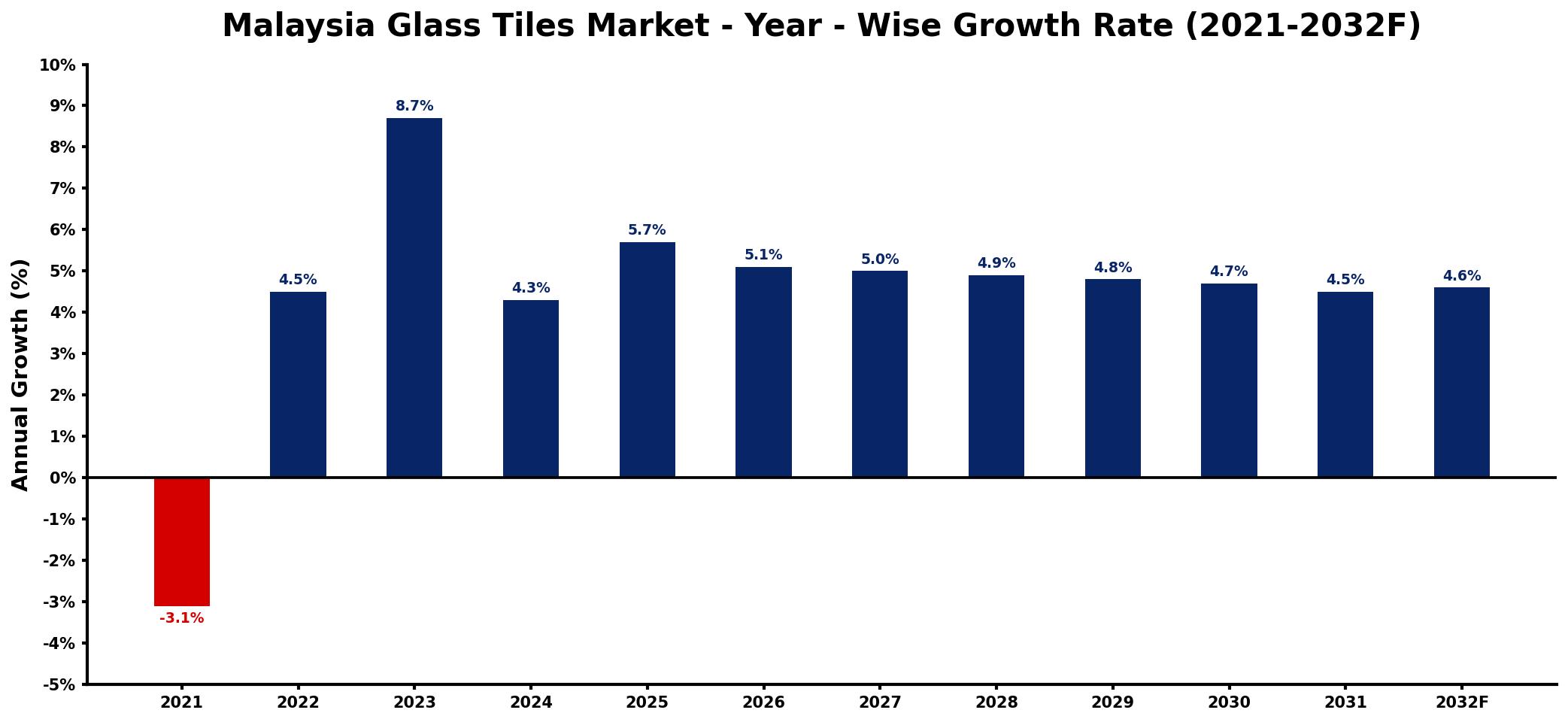
The table below presents the year‑wise growth rates along with the key drivers influencing the market
| Year | Growth Rate | Major Drivers |
| 2021 | -3.1% | decrease in construction projects |
| 2022 | 4.5% | rise in home renovation activities |
| 2023 | 8.7% | increased demand for aesthetics |
| 2024 | 4.3% | growth in commercial developments |
| 2025 | 5.7% | surge in eco-friendly materials |
| 2026 | 5.1% | expansion of luxury housing market |
| 2027 | 5.0% | investments in urban infrastructure |
| 2028 | 4.9% | enhanced focus on interior design |
| 2029 | 4.8% | growing popularity of DIY projects |
| 2030 | 4.7% | increase in export opportunities |
| 2031 | 4.5% | rising demand for custom solutions |
| 2032 | 4.6% | increased capital investment inflows |
Note: Market size estimations and growth projections presented in this report are based on 6Wresearch's proprietary forecasting methodology, utilizing the latest available industry data, government publications, and primary research inputs.
Malaysia Glass Tiles Market Synopsis
The glass tiles market in Malaysia has witnessed considerable momentum in recent years, fueled by the country's expanding construction and interior design sectors. As developers and homeowners seek innovative ways to enhance their spaces, the demand for glass tiles continues to grow, bolstered by advancements in manufacturing techniques and design options.
Looking ahead, the market is poised for further growth, driven by an increasing inclination towards sustainable and durable building materials. This shift towards high-quality, stylish options in tile products is expected to further cement glass tiles as a preferred choice for both residential and commercial projects in Malaysia.
Malaysia Glass Tiles Market Key Takeaways
- The market is projected to grow steadily, reaching USD 646 Million by 2032.
- Modern design trends significantly influence the increasing demand for glass tiles.
- Advanced manufacturing techniques are expanding the variety of designs available.
- Glass tiles resistance to water, stains, and wear make them suitable for diverse applications.
- There is a rising need for market education on the benefits of glass tiles to stimulate demand.
Evaluation of Restraints in Malaysia Glass Tiles Market
Despite the growth potential, several restraints challenge the market's full realization. The higher price point of glass tiles compared to traditional ceramic alternatives may deter price-sensitive consumers, limiting market penetration. Additionally, concerns regarding the durability of glass tiles, particularly in terms of breakage during transportation and installation, may present hurdles to wider adoption. Moreover, increased competition from alternative tile materials poses a significant challenge, emphasizing the need for innovative marketing strategies to highlight the unique advantages of glass tiles.
Malaysia Glass Tiles Market Trends
Current trends in the Malaysia glass tiles market point towards a burgeoning demand for eco-friendly materials. Sustainable manufacturing processes and responsible sourcing of glass have gained traction as consumers become more environmentally conscious. Moreover, the rise of smart homes and technological integration in interior design are influencing tile innovation, paving the way for advanced designs and functionalities that cater to modern lifestyles.
Malaysia Glass Tiles Market Opportunities
The opportunities in the Malaysia glass tiles market are substantial. With ongoing government initiatives to boost infrastructure and affordable housing, there is an increasing demand for stylish, durable materials. Investing in market education can further unlock potential by addressing consumer misconceptions and highlighting the advantages of glass tiles. Additionally, expanding into niche markets such as decorative tiles for high-end residential projects could yield significant returns for businesses looking to capitalize on this evolving landscape.
Government Initiatives in the Malaysia Glass Tiles Market
The Malaysian government has been proactive in promoting sustainable construction through various policies and initiatives. Infrastructure projects aimed at affordable housing have been prioritized, creating a conducive environment for the glass tiles market to flourish. Support for research and development in eco-friendly materials and technologies has also been emphasized, which is likely to benefit local manufacturers and encourage innovation in glass tile production.
Future Insights of the Malaysia Glass Tiles Market
Looking forward to 2026-2032, the Malaysia glass tiles market is expected to maintain its growth momentum, supported by the rising trends in interior design and construction. As consumers increasingly favor elegant aesthetics and durable materials, glass tiles will likely secure a stronger foothold across various applications. The ongoing development of new designs and sustainable manufacturing practices will further reinforce glass tiles as a preferred choice in both residential and commercial spaces.
Malaysia Glass Tiles Market Latest Developments (2025 - 2026)
In the latest developments within the Malaysia glass tiles market, there has been a notable shift towards integrating advanced technology in manufacturing processes. Companies have begun investing in innovative designs that reflect modern aesthetics and functionality. Additionally, the market has seen increased collaboration between manufacturers and designers to create bespoke glass tile solutions for high-end projects, catering to the evolving demands of consumers.
Malaysia Glass Tiles Market - Key Attractiveness of the Report
- 10 Years of Market Numbers
- Historical Data Starting from 2022 to 2025
- Base Year: 2025
- Forecast Data until 2032
- Key Performance Indicators Impacting the Market
- Major Upcoming Developments and Projects
Key Highlights of the Report:
- Malaysia Glass Tiles Market Outlook
- Market Size of Malaysia Glass Tiles Market, 2025
- Forecast of Malaysia Glass Tiles Market, 2032
- Historical Data and Forecast of Malaysia Glass Tiles Revenues & Volume for the Period 2022-2032F
- Malaysia Glass Tiles Market Trend Evolution
- Malaysia Glass Tiles Market Drivers and Challenges
- Malaysia Glass Tiles Price Trends
- Malaysia Glass Tiles Porter's Five Forces
- Malaysia Glass Tiles Industry Life Cycle
- Historical Data and Forecast of Malaysia Glass Tiles Market Revenues & Volume By Manufacturing Process for the Period 2022-2032F
- Historical Data and Forecast of Malaysia Glass Tiles Market Revenues & Volume By Smalti Tiles for the Period 2022-2032F
- Historical Data and Forecast of Malaysia Glass Tiles Market Revenues & Volume By Fused Tiles for the Period 2022-2032F
- Historical Data and Forecast of Malaysia Glass Tiles Market Revenues & Volume By Sintered Tiles for the Period 2022-2032F
- Historical Data and Forecast of Malaysia Glass Tiles Market Revenues & Volume By Cast Tiles for the Period 2022-2032F
- Historical Data and Forecast of Malaysia Glass Tiles Market Revenues & Volume By Other for the Period 2022-2032F
- Historical Data and Forecast of Malaysia Glass Tiles Market Revenues & Volume By Product Type for the Period 2022-2032F
- Historical Data and Forecast of Malaysia Glass Tiles Market Revenues & Volume By Matte-finished Glass Tile for the Period 2022-2032F
- Historical Data and Forecast of Malaysia Glass Tiles Market Revenues & Volume By Smooth Glass Tile for the Period 2022-2032F
- Historical Data and Forecast of Malaysia Glass Tiles Market Revenues & Volume By End-User Industry for the Period 2022-2032F
- Historical Data and Forecast of Malaysia Glass Tiles Market Revenues & Volume By Residential for the Period 2022-2032F
- Historical Data and Forecast of Malaysia Glass Tiles Market Revenues & Volume By Commercial for the Period 2022-2032F
- Historical Data and Forecast of Malaysia Glass Tiles Market Revenues & Volume By Infrastructure for the Period 2022-2032F
- Malaysia Glass Tiles Import Export Trade Statistics
- Market Opportunity Assessment By Manufacturing Process
- Market Opportunity Assessment By Product Type
- Market Opportunity Assessment By End-User Industry
- Malaysia Glass Tiles Top Companies Market Share
- Malaysia Glass Tiles Competitive Benchmarking By Technical and Operational Parameters
- Malaysia Glass Tiles Company Profiles
- Malaysia Glass Tiles Key Strategic Recommendations






































