Malaysia Gold Bullion Market Size, Share & Growth Rate
The Malaysia Gold Bullion Market was estimated at USD 257 Million in 2025 and is projected to reach USD 335 Million by 2032, growing at a CAGR of 3.9% from 2026 to 2032. This trajectory is fueled by a growing cultural affinity for gold as a store of value, coupled with an increasing inclination among investors to use gold as a hedge against inflation and economic uncertainties. As financial markets experience volatility, the demand for gold bullion is anticipated to remain robust.
Malaysia Gold Bullion Market Year-wise Growth Rate and Key Drivers
This graph highlights how the Malaysia Gold Bullion Market has steadily grown over the years, supported by major growth factors.
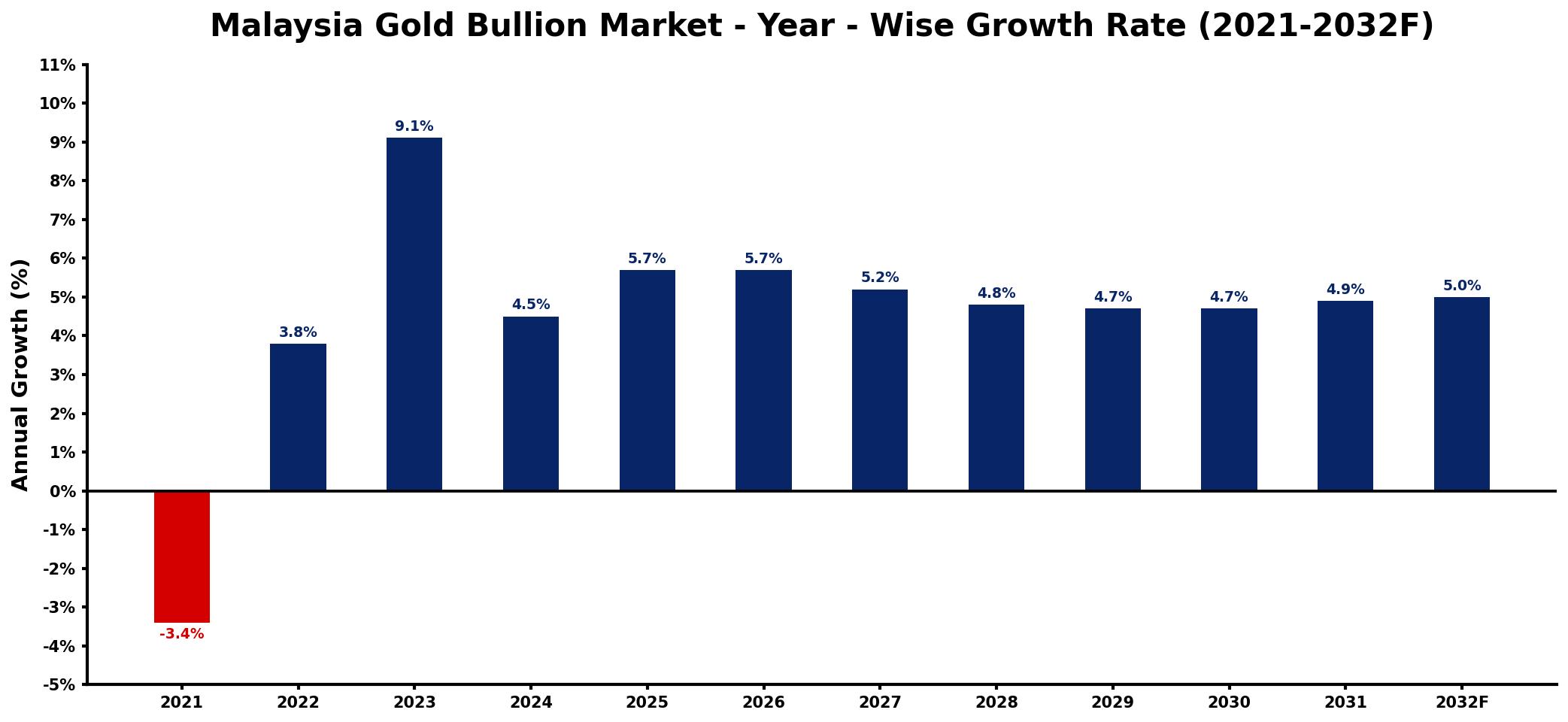
The table below presents the year‑wise growth rates along with the key drivers influencing the market
| Year | Growth Rate | Major Drivers |
| 2021 | -3.4% | decreased consumer investment interest |
| 2022 | 3.8% | rising investment in safe assets |
| 2023 | 9.1% | increased demand for wealth protection |
| 2024 | 4.5% | growing interest in alternative investments |
| 2025 | 5.7% | expansion of retail investor base |
| 2026 | 5.7% | strengthened economic recovery momentum |
| 2027 | 5.2% | increased global economic stability |
| 2028 | 4.8% | higher demand from affluent investors |
| 2029 | 4.7% | growing popularity of financial diversification |
| 2030 | 4.7% | increased institutional investment activity |
| 2031 | 4.9% | increased overall sector activity |
| 2032 | 5.0% | enhanced market accessibility for investors |
Note: Market size estimations and growth projections presented in this report are based on 6Wresearch's proprietary forecasting methodology, utilizing the latest available industry data, government publications, and primary research inputs.
Malaysia Gold Bullion Market Synopsis
The most significant force shaping the Malaysia Gold Bullion Market today is its status as a safe-haven asset. Investors in Malaysia are increasingly turning to gold bullion not only to safeguard their wealth but also to capitalize on its historical stability amidst financial turbulence.
The landscape is further influenced by global economic trends and domestic policy adjustments that cater to the growing interest in gold investments. This trend reflects a broader shift towards long-term value preservation, appealing to both seasoned investors and new entrants seeking to diversify their portfolios.
Malaysia Gold Bullion Market Key Takeaways
- Steady market growth driven by cultural appreciation for gold.
- Increased demand as a hedge against economic uncertainties and inflation.
- Diverse range of gold products attracting retail investors.
- Global economic factors and regulatory policies shape market accessibility.
- Continued interest in investment-grade gold among Malaysian consumers.
Evaluation of Restraints in Malaysia Gold Bullion Market
While the Malaysia Gold Bullion Market shows promise, it faces several restraints that could temper growth. Volatile international gold prices can deter potential investors, creating hesitation in buying and holding physical bullion. Additionally, as consumer preferences evolve towards digital assets and cryptocurrencies, traditional gold investments may encounter competition. Regulatory hurdles surrounding import and export policies also pose challenges, impacting the fluidity with which investors can engage with gold bullion.
Malaysia Gold Bullion Market Trends
Emerging trends indicate a shift towards technology-driven solutions in the gold investment landscape. Increasingly, investors are utilizing online platforms to access gold bullion, enhancing convenience and transparency in transactions. Moreover, eco-conscious consumers are showing interest in ethically sourced gold, pushing the market towards sustainable practices. The interplay between global economic conditions and local sentiments is poised to further influence demand dynamics in the coming years.
Malaysia Gold Bullion Market Opportunities
The future appears bright for investors looking at opportunities within the Malaysia Gold Bullion Market. The growing demand for investment-grade gold presents avenues for market expansion, particularly among retail investors who are becoming increasingly knowledgeable about the benefits of gold ownership. Financial institutions are likely to explore innovative products and services that facilitate gold investment, tapping into the heightened interest in this precious metal.
Government Initiatives in the Malaysia Gold Bullion Market
The Malaysian government is keenly aware of the role gold plays in the economy and is thus considering policies to promote investment in this sector. Initiatives may include regulatory frameworks that enhance market access, investor education programs, and incentives for sustainable gold sourcing. Such measures are designed to bolster confidence among investors and enhance the overall market environment.
Future Insights of the Malaysia Gold Bullion Market
Looking ahead to the period from 2026 to 2032, the Malaysia Gold Bullion Market is expected to experience a steady rise fueled by ongoing economic fluctuations and an unwavering trust in gold as a reliable store of value. Factors such as inflationary pressures, shifts in consumer behavior, and the potential for increased investment-grade product offerings will play a pivotal role in shaping the market's future. The evolving relationship between global markets and domestic investor sentiment will be key in navigating this landscape.
Malaysia Gold Bullion Market Latest Developments (2025 - 2026)
Recent developments in the Malaysia Gold Bullion Market showcase a burgeoning interest in technology-led investments and an increasing number of educational initiatives aimed at new investors. This period has witnessed a noticeable uptick in gold awareness campaigns, fostering deeper understanding among consumers. Innovations in transactional platforms are enhancing access to gold bullion, aligning with broader financial literacy efforts within the community.
Malaysia Gold Bullion Market - Key Attractiveness of the Report
- 10 Years of Market Numbers
- Historical Data Starting from 2022 to 2025
- Base Year: 2025
- Forecast Data until 2032
- Key Performance Indicators Impacting the Market
- Major Upcoming Developments and Projects
Key Highlights of the Report:
- Malaysia Gold Bullion Market Outlook
- Market Size of Malaysia Gold Bullion Market, 2025
- Forecast of Malaysia Gold Bullion Market, 2032
- Historical Data and Forecast of Malaysia Gold Bullion Revenues & Volume for the Period 2022-2032F
- Malaysia Gold Bullion Market Trend Evolution
- Malaysia Gold Bullion Market Drivers and Challenges
- Malaysia Gold Bullion Price Trends
- Malaysia Gold Bullion Porter's Five Forces
- Malaysia Gold Bullion Industry Life Cycle
- Historical Data and Forecast of Malaysia Gold Bullion Market Revenues & Volume By Type for the Period 2022-2032F
- Historical Data and Forecast of Malaysia Gold Bullion Market Revenues & Volume By Gold Bar for the Period 2022-2032F
- Historical Data and Forecast of Malaysia Gold Bullion Market Revenues & Volume By Gold Coin for the Period 2022-2032F
- Historical Data and Forecast of Malaysia Gold Bullion Market Revenues & Volume By Distribution Channel for the Period 2022-2032F
- Historical Data and Forecast of Malaysia Gold Bullion Market Revenues & Volume By Online for the Period 2022-2032F
- Historical Data and Forecast of Malaysia Gold Bullion Market Revenues & Volume By Offline for the Period 2022-2032F
- Malaysia Gold Bullion Import Export Trade Statistics
- Market Opportunity Assessment By Type
- Market Opportunity Assessment By Distribution Channel
- Malaysia Gold Bullion Top Companies Market Share
- Malaysia Gold Bullion Competitive Benchmarking By Technical and Operational Parameters
- Malaysia Gold Bullion Company Profiles
- Malaysia Gold Bullion Key Strategic Recommendations






































