Malaysia Grape Wine Lees Market Size, Share & Growth Rate
The Malaysia Grape Wine Lees Market was estimated at USD 407 Million in 2025 and is projected to reach USD 530 Million by 2032, growing at a CAGR of 3.8% from 2026 to 2032. This upward trajectory is driven by the increasing appreciation for wine culture and the sustainable practices that are becoming more prevalent in the region. As Malaysian consumers increasingly seek out innovative uses for byproducts like grape wine lees, the market is poised for robust expansion across diverse industries.
Malaysia Grape Wine Lees Market Year-wise Growth Rate and Key Drivers
This graph highlights how the Malaysia Grape Wine Lees Market has steadily grown over the years, supported by major growth factors.
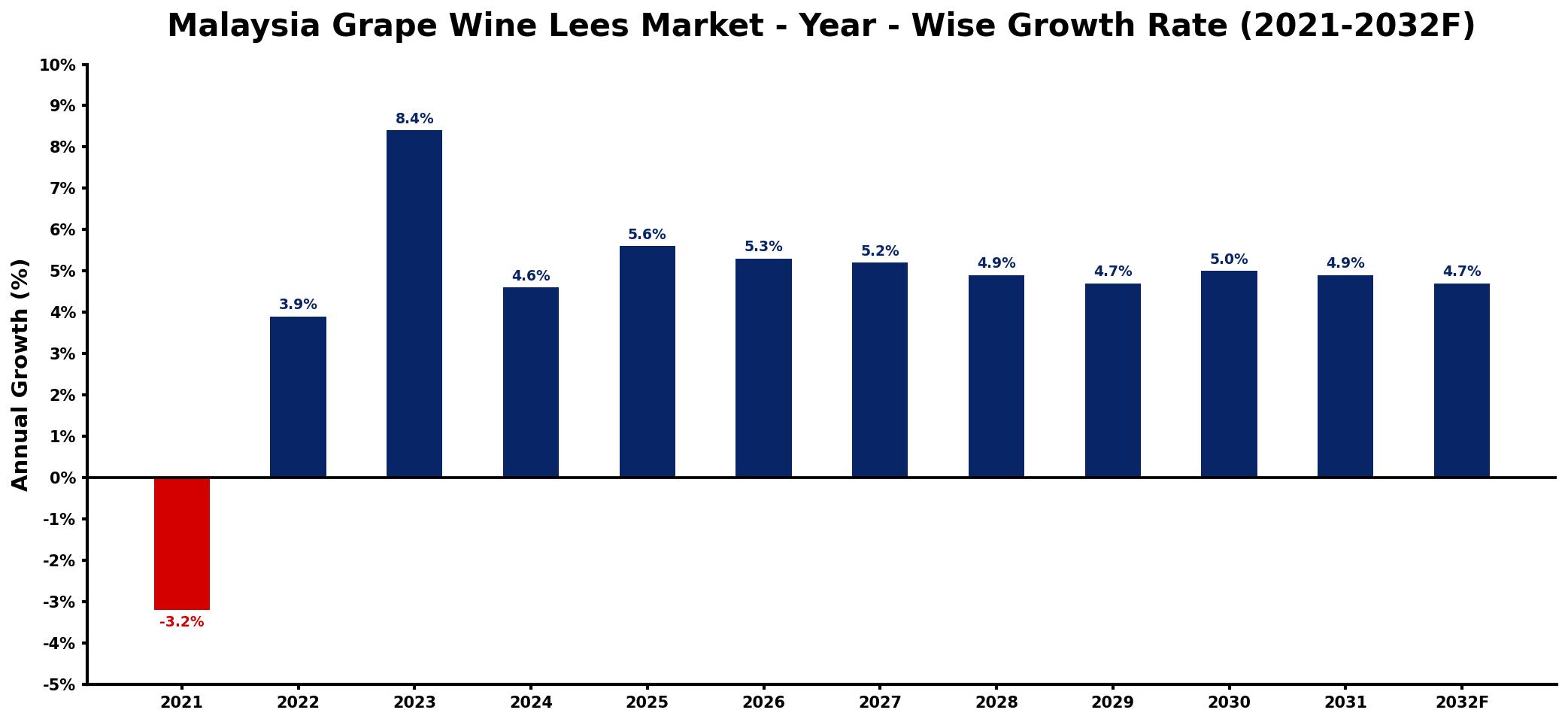
The table below presents the year‑wise growth rates along with the key drivers influencing the market
| Year | Growth Rate | Major Drivers |
| 2021 | -3.2% | decrease in consumer interest |
| 2022 | 3.9% | increased health awareness trends |
| 2023 | 8.4% | rising popularity of organic products |
| 2024 | 4.6% | growing demand for premium beverages |
| 2025 | 5.6% | expansion of local production facilities |
| 2026 | 5.3% | increased investment in sustainable practices |
| 2027 | 5.2% | emerging trends in flavor experimentation |
| 2028 | 4.9% | growth in online purchasing channels |
| 2029 | 4.7% | rising interest in craft production |
| 2030 | 5.0% | increased capital investment inflows |
| 2031 | 4.9% | increased collaboration with restaurants |
| 2032 | 4.7% | growing consumer interest in heritage |
Note: Market size estimations and growth projections presented in this report are based on 6Wresearch's proprietary forecasting methodology, utilizing the latest available industry data, government publications, and primary research inputs.
Malaysia Grape Wine Lees Market Synopsis
In Malaysia, the grape wine lees market is evolving as consumers exhibit a growing interest in both premium wines and the byproducts of the winemaking process. This increased awareness presents a unique opportunity for businesses to explore applications of grape wine lees in food, cosmetics, and health supplements.
Furthermore, the trend towards sustainability is further encouraging the utilization of grape wine lees, highlighting their potential to contribute to eco-friendly practices within various industries. As wine culture continues to flourish in Malaysia, the demand for these fermented byproducts is expected to rise.
Malaysia Grape Wine Lees Market Key Takeaways
- The Malaysian grape wine lees market is experiencing steady growth driven by wine culture appreciation.
- Applications of grape wine lees in cosmetics and dietary supplements are emerging as lucrative opportunities.
- Government regulations play a vital role in shaping the dynamics of the market.
- Despite current challenges, consumer interest in culinary uses for grape wine lees is on the rise.
- Key wineries are investing in advanced techniques to maximize the value derived from grape wine lees.
Evaluation of Restraints in Malaysia Grape Wine Lees Market
Despite the positive outlook, the Malaysia grape wine lees market faces several constraints. One of the primary challenges is the limited consumer awareness regarding the benefits and applications of grape wine lees. This lack of familiarity can restrict market growth as potential buyers remain unaware of the diverse possibilities this byproduct offers. Moreover, the relatively small wine market in Malaysia may limit the volume of grape wine lees available for repurposing. As the sector matures, these barriers need to be addressed to unlock the full potential of grape wine lees.
Malaysia Grape Wine Lees Market Trends
Several trends are shaping the demand and technology within the Malaysia grape wine lees market. The growing consumer focus on health and wellness is driving interest in the potential health benefits of grape wine lees, such as their antioxidant properties. Additionally, the rise of home cooking, especially post-COVID-19, has spurred interest in innovative culinary uses for these byproducts. The cosmetics industry is also adapting, with a notable shift towards incorporating natural ingredients, where grape wine lees can play a pivotal role.
Malaysia Grape Wine Lees Market Opportunities
The genuine growth opportunities in the Malaysian grape wine lees market lie in the repurposing of this byproduct for various applications. The food industry is exploring creative uses for grape wine lees in gourmet cooking, while the cosmetics sector is increasingly recognizing their value as a natural ingredient. Furthermore, educational initiatives aimed at increasing consumer awareness could catalyze market expansion, creating potential niches for businesses willing to innovate with grape wine lees.
Government Initiatives in the Malaysia Grape Wine Lees Market
Government initiatives supporting the grape wine lees market in Malaysia primarily revolve around promoting sustainable agricultural practices and enhancing the quality of local wine production. There is a growing emphasis on eco-friendly practices within the agricultural sector, which includes the repurposing of winemaking byproducts. Additionally, policies encouraging local wineries to engage in innovative practices can contribute to a more robust market for grape wine lees.
Future Insights of the Malaysia Grape Wine Lees Market
Looking ahead to the period between 2026 and 2032, the Malaysia grape wine lees market is expected to witness significant advancements. As awareness increases and consumer preferences shift towards sustainable and health-oriented products, the market is likely to attract investment for research and product development. Companies focusing on innovative applications of grape wine lees will likely lead the charge, carving out a substantial place within the broader landscape of both the food and cosmetic industries.
Malaysia Grape Wine Lees Market Latest Developments (2025 - 2026)
The grape wine lees market in Malaysia has recently seen increased activity, particularly as more local wineries experiment with eco-friendly processing methods. As the interest in sustainable and innovative products grows, companies are beginning to introduce new applications for grape wine lees in both culinary and cosmetic products. Moreover, educational campaigns are being implemented to raise awareness about the benefits of this byproduct, further stimulating market activity and interest.
Malaysia Grape Wine Lees Market - Key Attractiveness of the Report
- 10 Years of Market Numbers
- Historical Data Starting from 2022 to 2025
- Base Year: 2025
- Forecast Data until 2032
- Key Performance Indicators Impacting the Market
- Major Upcoming Developments and Projects
Key Highlights of the Report:
- Malaysia Grape Wine Lees Market Outlook
- Market Size of Malaysia Grape Wine Lees Market, 2025
- Forecast of Malaysia Grape Wine Lees Market, 2032
- Historical Data and Forecast of Malaysia Grape Wine Lees Revenues & Volume for the Period 2022-2032F
- Malaysia Grape Wine Lees Market Trend Evolution
- Malaysia Grape Wine Lees Market Drivers and Challenges
- Malaysia Grape Wine Lees Price Trends
- Malaysia Grape Wine Lees Porter's Five Forces
- Malaysia Grape Wine Lees Industry Life Cycle
- Historical Data and Forecast of Malaysia Grape Wine Lees Market Revenues & Volume By Vinification for the Period 2022-2032F
- Historical Data and Forecast of Malaysia Grape Wine Lees Market Revenues & Volume By First Fermentation Lees for the Period 2022-2032F
- Historical Data and Forecast of Malaysia Grape Wine Lees Market Revenues & Volume By Second Fermentation Lees for the Period 2022-2032F
- Historical Data and Forecast of Malaysia Grape Wine Lees Market Revenues & Volume By Aging Wine Lees for the Period 2022-2032F
- Historical Data and Forecast of Malaysia Grape Wine Lees Market Revenues & Volume By Particle Size for the Period 2022-2032F
- Historical Data and Forecast of Malaysia Grape Wine Lees Market Revenues & Volume By Heavy Lees for the Period 2022-2032F
- Historical Data and Forecast of Malaysia Grape Wine Lees Market Revenues & Volume By Light Lees for the Period 2022-2032F
- Malaysia Grape Wine Lees Import Export Trade Statistics
- Market Opportunity Assessment By Vinification
- Market Opportunity Assessment By Particle Size
- Malaysia Grape Wine Lees Top Companies Market Share
- Malaysia Grape Wine Lees Competitive Benchmarking By Technical and Operational Parameters
- Malaysia Grape Wine Lees Company Profiles
- Malaysia Grape Wine Lees Key Strategic Recommendations






































