Malaysia Greasy Wool Market Size, Share & Growth Rate
The Malaysia Greasy Wool Market was estimated at USD 333 Million in 2025 and is projected to reach USD 433 Million by 2032, growing at a CAGR of 3.8% from 2026 to 2032. This growth trajectory is propelled by a burgeoning textile sector that increasingly relies on natural fibers, particularly as global demand for sustainable fabrics escalates. Furthermore, Malaysia's strategic position as a major importer of greasy wool allows it to adapt rapidly to the shifting dynamics of the global wool market.
Malaysia Greasy Wool Market Year-wise Growth Rate and Key Drivers
This graph highlights how the Malaysia Greasy Wool Market has steadily grown over the years, supported by major growth factors.
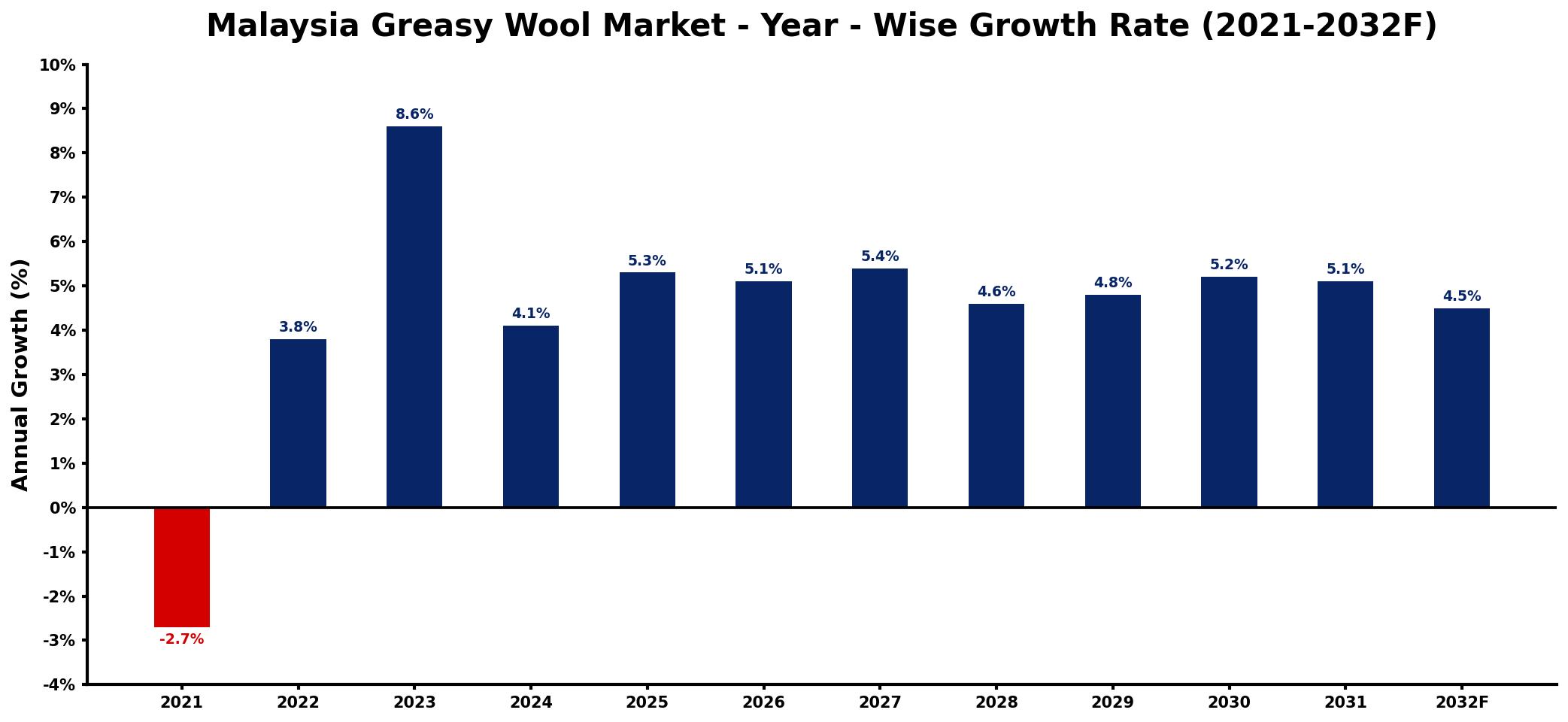
The table below presents the year‑wise growth rates along with the key drivers influencing the market
| Year | Growth Rate | Major Drivers |
| 2021 | -2.7% | decreased global textile demand |
| 2022 | 3.8% | rising interest in sustainable fibers |
| 2023 | 8.6% | increased production capacity expansion |
| 2024 | 4.1% | growing exports to Asian markets |
| 2025 | 5.3% | enhanced technological advancements adoption |
| 2026 | 5.1% | expanding consumer base awareness |
| 2027 | 5.4% | strengthening global supply chains |
| 2028 | 4.6% | increased investment in processing facilities |
| 2029 | 4.8% | growing collaboration with fashion brands |
| 2030 | 5.2% | rising popularity of eco-friendly materials |
| 2031 | 5.1% | expanding applications in automotive industry |
| 2032 | 4.5% | increased focus on renewable resources |
Note: Market size estimations and growth projections presented in this report are based on 6Wresearch's proprietary forecasting methodology, utilizing the latest available industry data, government publications, and primary research inputs.
Malaysia Greasy Wool Market Synopsis
The greasy wool market in Malaysia is essential for the textile industry, which relies heavily on imported raw materials to meet production demands. As the country continues to enhance its manufacturing capabilities, the demand for quality greasy wool has shown consistent growth, reflecting the overall health of the textile sector.
Despite challenges like competition from synthetic fibers, there is a palpable shift towards environmentally friendly practices, which positively influences greasy wool's appeal. As manufacturers prioritize sustainable sourcing, the demand for ethically produced greasy wool is expected to rise, further cementing its role in the textile supply chain.
Malaysia Greasy Wool Market Key Takeaways
- The market is anticipated to grow steadily due to increasing demand for natural fibers in textiles.
- Sustainability initiatives are influencing purchasing decisions and market dynamics.
- Malaysia's strategic importation routes allow for adaptability to global market fluctuations.
- Technological advancements in processing may enhance product quality and efficiency.
- Partnerships with ethical suppliers are becoming increasingly crucial for market players.
Evaluation of Restraints in Malaysia Greasy Wool Market
The Malaysian greasy wool market faces several constraints that could hinder its growth trajectory. One of the primary concerns is the volatility in global wool prices, which can impact local procurement costs and profit margins for manufacturers. Additionally, the rising competition from synthetic alternatives poses a significant challenge, particularly among eco-conscious consumers who may opt for cheaper and more readily available synthetic fibers. Lastly, the heightened demand for sustainable and ethically sourced materials is placing pressure on suppliers to comply with new industry standards, potentially leading to increased operational costs.
Malaysia Greasy Wool Market Trends
Several key trends are shaping the Malaysia greasy wool market. The growing preference for sustainable and organic textiles is a major driving force, as consumers are increasingly aware of environmental issues. As a result, manufacturers are exploring partnerships with suppliers who emphasize eco-friendly practices. Additionally, technological advancements in wool processing are enabling the production of higher-quality greasy wool, which in turn supports innovation within the textile sector. The integration of digital platforms for sourcing and supply chain management is also gaining traction, enhancing the efficiency and transparency of transactions.
Malaysia Greasy Wool Market Opportunities
Opportunities within the Malaysia greasy wool market lie primarily in the realm of sustainability and innovation. As the global textile industry pivots towards more sustainable practices, there is significant potential for local manufacturers to develop eco-friendly products that appeal to the environmentally conscious consumer. Moreover, investing in cutting-edge processing technologies can improve the quality of greasy wool and reduce production costs. Collaborations with international producers and researchers can also yield advancements that position Malaysian greasy wool favorably in the global market.
Government Initiatives in the Malaysia Greasy Wool Market
The Malaysian government has shown increasing interest in enhancing the local textile industry, which indirectly benefits the greasy wool market. Initiatives aimed at promoting sustainable practices within the textile sector are being prioritized, alongside incentives for research and development in fiber production. By supporting farmers and manufacturers through funding and training programs, the government seeks to boost the quality and competitiveness of Malaysian greasy wool on the international stage.
Future Insights of the Malaysia Greasy Wool Market
Looking ahead to the period from 2026 to 2032, the Malaysia greasy wool market is poised for growth fueled by an ongoing shift towards natural and sustainable materials in the textile industry. The expected recovery of global demand, following the disruptions caused by the pandemic, will likely enhance import activities and invigorate local manufacturing. Moreover, as sustainability becomes increasingly integral to consumer preferences, players in the greasy wool market that adapt to these trends will find themselves well-positioned for success. Overall, the future of the market appears promising, contingent upon strategic partnerships and continued innovation.
Malaysia Greasy Wool Market Latest Developments (2025 - 2026)
Recent developments in the Malaysia greasy wool market have highlighted an increased focus on sustainability and quality. Numerous manufacturers are exploring technological upgrades in processing methods to enhance product quality and appeal to eco-conscious consumers. Additionally, trade agreements between Malaysia and wool-producing nations have facilitated smoother import processes, ensuring a steadier supply of greasy wool. The ongoing collaboration between industry stakeholders underscores a collective commitment to overcoming the challenges posed by global market dynamics.
Malaysia Greasy Wool Market - Key Attractiveness of the Report
- 10 Years of Market Numbers
- Historical Data Starting from 2022 to 2025
- Base Year: 2025
- Forecast Data until 2032
- Key Performance Indicators Impacting the Market
- Major Upcoming Developments and Projects
Key Highlights of the Report:
- Malaysia Greasy Wool Market Outlook
- Market Size of Malaysia Greasy Wool Market, 2025
- Forecast of Malaysia Greasy Wool Market, 2032
- Historical Data and Forecast of Malaysia Greasy Wool Revenues & Volume for the Period 2022-2032F
- Malaysia Greasy Wool Market Trend Evolution
- Malaysia Greasy Wool Market Drivers and Challenges
- Malaysia Greasy Wool Price Trends
- Malaysia Greasy Wool Porter's Five Forces
- Malaysia Greasy Wool Industry Life Cycle
- Historical Data and Forecast of Malaysia Greasy Wool Market Revenues & Volume By Application for the Period 2022-2032F
- Historical Data and Forecast of Malaysia Greasy Wool Market Revenues & Volume By Apparel for the Period 2022-2032F
- Historical Data and Forecast of Malaysia Greasy Wool Market Revenues & Volume By Sports for the Period 2022-2032F
- Historical Data and Forecast of Malaysia Greasy Wool Market Revenues & Volume By Blazers for the Period 2022-2032F
- Historical Data and Forecast of Malaysia Greasy Wool Market Revenues & Volume By Jacketing for the Period 2022-2032F
- Historical Data and Forecast of Malaysia Greasy Wool Market Revenues & Volume By Others for the Period 2022-2032F
- Historical Data and Forecast of Malaysia Greasy Wool Market Revenues & Volume By Upholstery Fabrics for the Period 2022-2032F
- Historical Data and Forecast of Malaysia Greasy Wool Market Revenues & Volume By Blankets for the Period 2022-2032F
- Historical Data and Forecast of Malaysia Apparel Greasy Wool Market Revenues & Volume By Flooring for the Period 2022-2032F
- Malaysia Greasy Wool Import Export Trade Statistics
- Market Opportunity Assessment By Application
- Malaysia Greasy Wool Top Companies Market Share
- Malaysia Greasy Wool Competitive Benchmarking By Technical and Operational Parameters
- Malaysia Greasy Wool Company Profiles
- Malaysia Greasy Wool Key Strategic Recommendations






































