Malaysia Greenhouse Horticulture Market Size, Share & Growth Rate
The Malaysia Greenhouse Horticulture Market was estimated at USD 427 Million in 2025 and is projected to reach USD 554 Million by 2032, growing at a CAGR of 3.8% from 2026 to 2032. This upward trajectory is largely attributed to the urgent need for sustainable agricultural practices that can ensure food security amid climate variability. As urbanization accelerates, the demand for fresh, locally sourced produce continues to rise, further propelling the greenhouse horticulture sector into prominence.
Malaysia Greenhouse Horticulture Market Year-wise Growth Rate and Key Drivers
This graph highlights how the Malaysia Greenhouse Horticulture Market has steadily grown over the years, supported by major growth factors.
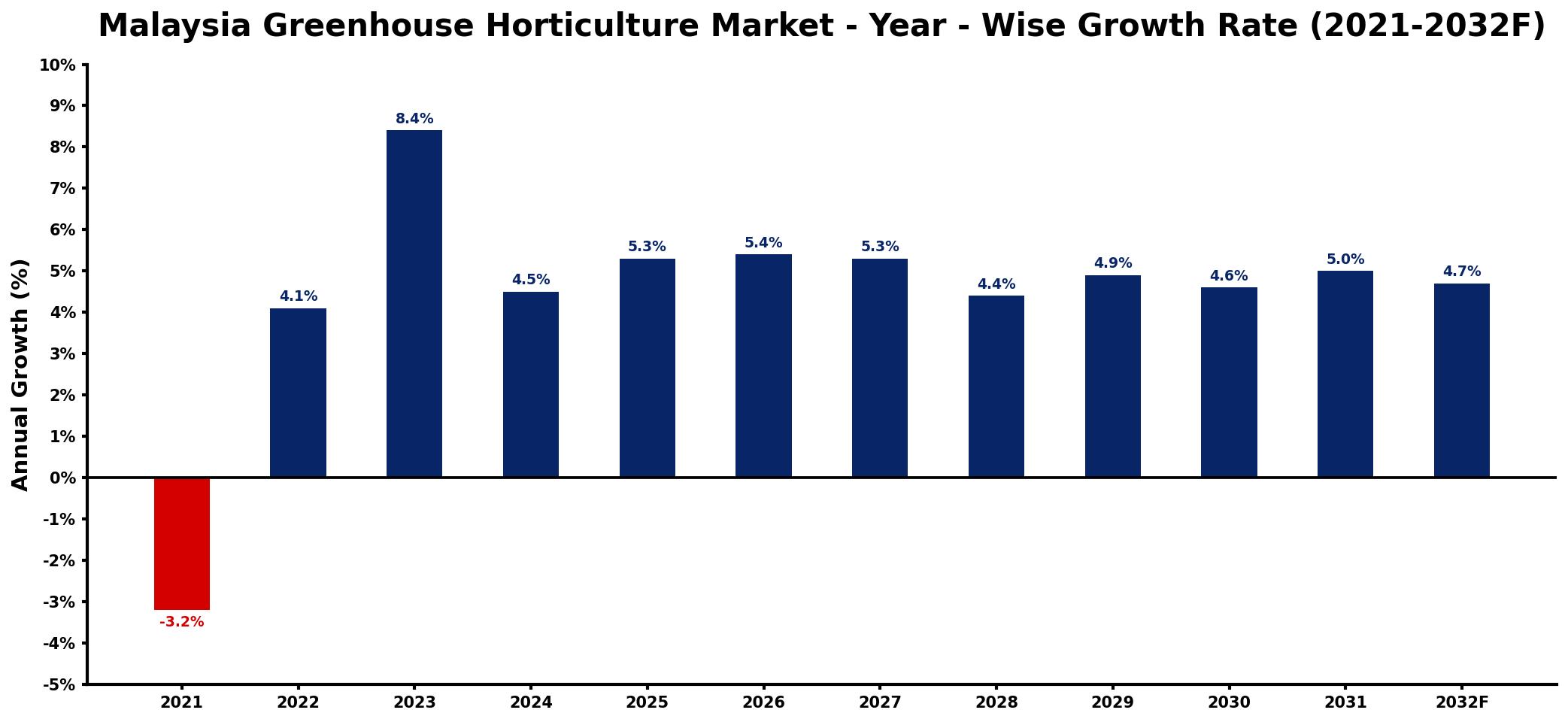
The table below presents the year‑wise growth rates along with the key drivers influencing the market
| Year | Growth Rate | Major Drivers |
| 2021 | -3.2% | Supply chain disruptions affecting availability |
| 2022 | 4.1% | Rising consumer interest in sustainability |
| 2023 | 8.4% | Increased investment in technology adoption |
| 2024 | 4.5% | Growing demand for organic produce |
| 2025 | 5.3% | Expansion of urban farming initiatives |
| 2026 | 5.4% | Government support for agricultural innovation |
| 2027 | 5.3% | Enhanced distribution networks emerging |
| 2028 | 4.4% | Rising health consciousness among consumers |
| 2029 | 4.9% | Development of export markets expanding |
| 2030 | 4.6% | Technological advancements improving efficiency |
| 2031 | 5.0% | Surge in local food movements |
| 2032 | 4.7% | Collaboration between agro-tech startups |
Note: Market size estimations and growth projections presented in this report are based on 6Wresearch's proprietary forecasting methodology, utilizing the latest available industry data, government publications, and primary research inputs.
Malaysia Greenhouse Horticulture Market Synopsis
The strongest force shaping the Malaysia Greenhouse Horticulture Market is the critical focus on food security. The increasing awareness regarding sustainability in agriculture has led to an influx of investments in greenhouse technology, offering farmers a pathway to consistent crop yields regardless of external climatic factors.
With innovative solutions for climate control and resource management, greenhouse horticulture is well-positioned to meet the evolving consumer preferences for fresh fruits and vegetables. This shift not only bolsters local economies but also promotes sustainable farming practices, making greenhouse horticulture an essential component of Malaysia's agricultural future.
Malaysia Greenhouse Horticulture Market Key Takeaways
- The market is driven by a growing demand for fresh produce and sustainable agricultural practices.
- Technological advancements in greenhouse management are enhancing operational efficiencies.
- Consumers increasingly prefer locally sourced products, pushing demand for greenhouse-grown crops.
- Government initiatives are expected to support investments in greenhouse infrastructure.
- Adoption of climate-resilient agricultural practices is essential for long-term market growth.
Evaluation of Restraints in Malaysia Greenhouse Horticulture Market
Despite the promising growth trajectory, the Malaysia Greenhouse Horticulture Market faces several restraints that can hinder its potential. High initial setup costs deter many small to medium-sized farmers from transitioning to greenhouse systems. Additionally, efficient resource management, particularly regarding water and energy consumption, is paramount for maintaining sustainability and profitability. The sector must also navigate regulatory challenges and skill gaps in greenhouse management to optimize operations and ensure successful adoption of this agricultural method.
Malaysia Greenhouse Horticulture Market Trends
Several key trends are currently influencing the Malaysia Greenhouse Horticulture Market. Firstly, there is a marked shift towards automation and smart farming technologies that enhance operational efficiency and crop monitoring. Secondly, the integration of hydroponics and vertical farming techniques within greenhouse settings is gaining traction, allowing for higher density crop production in urban areas. Lastly, consumer preferences for organic and pesticide-free produce are leading to a rise in demand for greenhouses employing sustainable practices.
Malaysia Greenhouse Horticulture Market Opportunities
The potential for growth in the Malaysia Greenhouse Horticulture Market is significant. There are ample opportunities for investment in advanced greenhouse technologies that improve crop yield and reduce resource consumption. Collaborations between private sectors and governmental bodies can also enhance research and development initiatives, enabling innovations in crop management. Furthermore, as urban populations expand, the demand for local produce can be effectively met through strategically placed greenhouse farms.
Government Initiatives in the Malaysia Greenhouse Horticulture Market
The Malaysian government is actively promoting greenhouse horticulture through various initiatives aimed at encouraging sustainable agricultural practices. Programs designed to offer financial assistance and technical support to farmers adopting greenhouse technologies are being implemented. Furthermore, policies focused on enhancing food security are driving public spending towards the development of infrastructure that supports greenhouse farming, ultimately benefiting the local agricultural landscape.
Future Insights of the Malaysia Greenhouse Horticulture Market
Looking ahead, the Malaysia Greenhouse Horticulture Market is expected to continue its growth trajectory from 2026 to 2032. Advances in technology, combined with supportive governmental policies, will play crucial roles in this development. As the market matures, the focus on sustainable practices will intensify, catering to the increasing consumer demand for fresh, locally grown produce. The continued investment in research and development will lead to innovative solutions that address the challenges of climate change, ultimately strengthening the resilience of the agricultural sector.
Malaysia Greenhouse Horticulture Market Latest Developments (2025 - 2026)
Recent developments in the Malaysia Greenhouse Horticulture Market have focused on enhancing operational efficiency through the adoption of smart farming technologies. Noteworthy strides have been made in the automation of irrigation systems and climate control mechanisms. Additionally, stakeholders are placing greater emphasis on sustainable farming practices, thereby fostering a more eco-friendly approach to agriculture. Investment in training programs for farmers regarding advanced greenhouse management is also on the rise, aiming to improve crop yield and operational sustainability.
Malaysia Greenhouse Horticulture Market - Key Attractiveness of the Report
- 10 Years of Market Numbers
- Historical Data Starting from 2022 to 2025
- Base Year: 2025
- Forecast Data until 2032
- Key Performance Indicators Impacting the Market
- Major Upcoming Developments and Projects
Key Highlights of the Report:
- Malaysia Greenhouse Horticulture Market Outlook
- Market Size of Malaysia Greenhouse Horticulture Market, 2025
- Forecast of Malaysia Greenhouse Horticulture Market, 2032
- Historical Data and Forecast of Malaysia Greenhouse Horticulture Revenues & Volume for the Period 2022-2032F
- Malaysia Greenhouse Horticulture Market Trend Evolution
- Malaysia Greenhouse Horticulture Market Drivers and Challenges
- Malaysia Greenhouse Horticulture Price Trends
- Malaysia Greenhouse Horticulture Porter's Five Forces
- Malaysia Greenhouse Horticulture Industry Life Cycle
- Historical Data and Forecast of Malaysia Greenhouse Horticulture Market Revenues & Volume By Material Type for the Period 2022-2032F
- Historical Data and Forecast of Malaysia Greenhouse Horticulture Market Revenues & Volume By Glass for the Period 2022-2032F
- Historical Data and Forecast of Malaysia Greenhouse Horticulture Market Revenues & Volume By Plastic for the Period 2022-2032F
- Historical Data and Forecast of Malaysia Greenhouse Horticulture Market Revenues & Volume By Crop Type for the Period 2022-2032F
- Historical Data and Forecast of Malaysia Greenhouse Horticulture Market Revenues & Volume By Fruits and Vegetables for the Period 2022-2032F
- Historical Data and Forecast of Malaysia Greenhouse Horticulture Market Revenues & Volume By Flowers and Ornamentals for the Period 2022-2032F
- Historical Data and Forecast of Malaysia Greenhouse Horticulture Market Revenues & Volume By Nursery Crops for the Period 2022-2032F
- Historical Data and Forecast of Malaysia Greenhouse Horticulture Market Revenues & Volume By Others for the Period 2022-2032F
- Historical Data and Forecast of Malaysia Greenhouse Horticulture Market Revenues & Volume By Technology for the Period 2022-2032F
- Historical Data and Forecast of Malaysia Greenhouse Horticulture Market Revenues & Volume By Heating System for the Period 2022-2032F
- Historical Data and Forecast of Malaysia Greenhouse Horticulture Market Revenues & Volume By Cooling System for the Period 2022-2032F
- Malaysia Greenhouse Horticulture Import Export Trade Statistics
- Market Opportunity Assessment By Material Type
- Market Opportunity Assessment By Crop Type
- Market Opportunity Assessment By Technology
- Malaysia Greenhouse Horticulture Top Companies Market Share
- Malaysia Greenhouse Horticulture Competitive Benchmarking By Technical and Operational Parameters
- Malaysia Greenhouse Horticulture Company Profiles
- Malaysia Greenhouse Horticulture Key Strategic Recommendations






































