Malaysia Greenhouse, Nursery, And Flowers Market Size, Share & Growth Rate
The Malaysia Greenhouse, Nursery, And Flowers Market was estimated at USD 467 Million in 2025 and is projected to reach USD 609 Million by 2032, growing at a CAGR of 3.9% from 2026 to 2032. This growth trajectory can be attributed to the increasing consumer preference for ornamental plants, driven largely by urban gardening trends and landscaping initiatives across the country. Additionally, advancements in greenhouse technologies that improve plant quality and sustainability are further propelling market expansion.
Malaysia Greenhouse, Nursery, And Flowers Market Year-wise Growth Rate and Key Drivers
This graph highlights how the Malaysia Greenhouse, Nursery, And Flowers Market has steadily grown over the years, supported by major growth factors.
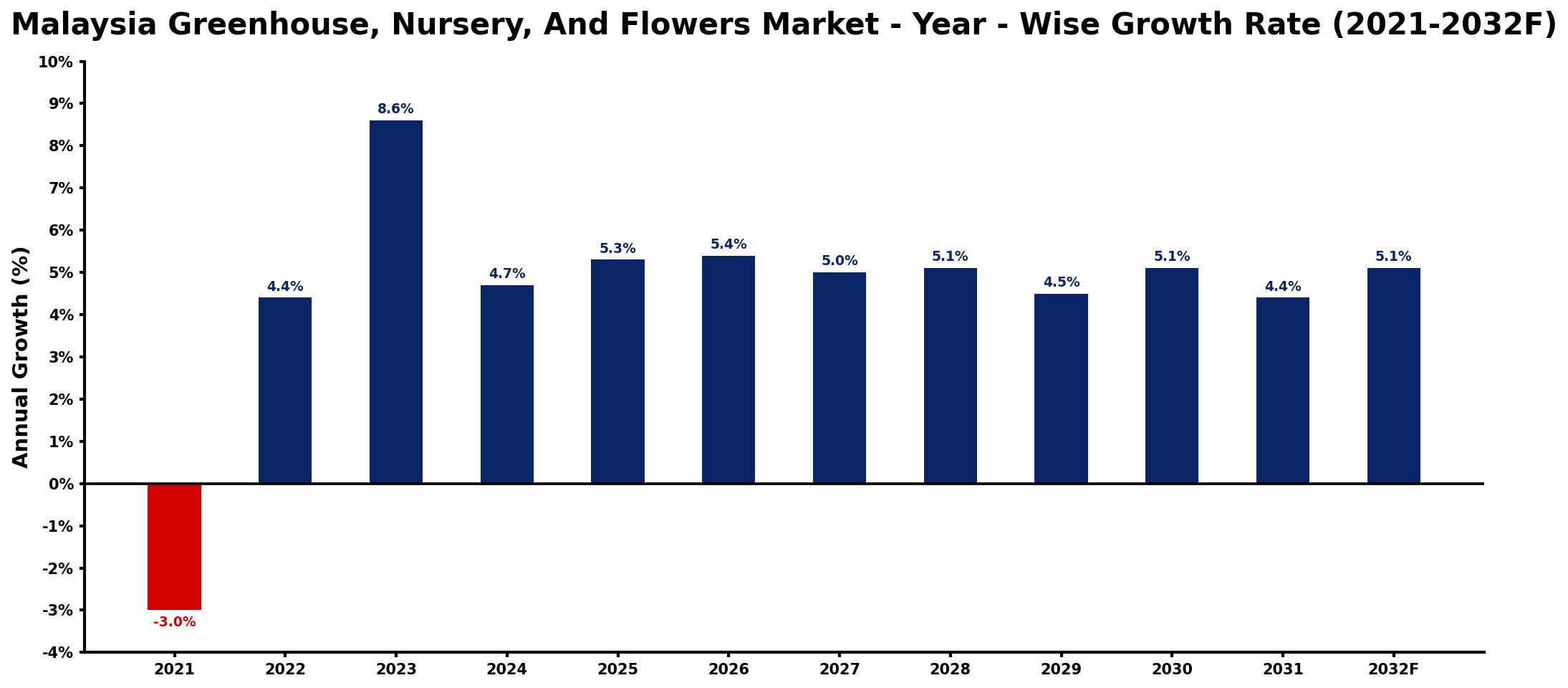
The table below presents the year‑wise growth rates along with the key drivers influencing the market
| Year | Growth Rate | Major Drivers |
| 2021 | -3.0% | decreased consumer spending on horticulture |
| 2022 | 4.4% | increased investment in urban gardening |
| 2023 | 8.6% | growing popularity of indoor plants |
| 2024 | 4.7% | rise in sustainable farming practices |
| 2025 | 5.3% | expansion of eco-friendly landscaping services |
| 2026 | 5.4% | increased demand for organic produce |
| 2027 | 5.0% | growth in home gardening trends |
| 2028 | 5.1% | enhanced focus on climate resilience |
| 2029 | 4.5% | boost in community gardening initiatives |
| 2030 | 5.1% | rising interest in landscape architecture |
| 2031 | 4.4% | emergence of plant-based lifestyle trends |
| 2032 | 5.1% | rising end-use demand growth |
Note: Market size estimations and growth projections presented in this report are based on 6Wresearch's proprietary forecasting methodology, utilizing the latest available industry data, government publications, and primary research inputs.
Malaysia Greenhouse, Nursery, And Flowers Market Synopsis
A significant force shaping the Malaysia Greenhouse, Nursery, And Flowers Market today is the surge in demand for high-quality ornamental plants. As urban dwellers increasingly seek to beautify their living spaces, greenhouse nurseries are ideally positioned to supply a variety of exotic and delicate flora suited for both indoor and outdoor environments.
Moreover, the rising trend of indoor gardening has transformed the market landscape. Consumers are not just looking for plants to enhance their gardens but also to bring greenery into their homes, thus driving demand for greenhouse-grown flora that ensures longevity and vibrancy.
Malaysia Greenhouse, Nursery, And Flowers Market Key Takeaways
- The market is driven by an increased preference for ornamental plants and urban gardening.
- Technological advancements are enhancing greenhouse management and plant quality.
- Demand for exotic and rare plants is on the rise, influenced by changing consumer preferences.
- The COVID-19 pandemic has accelerated interest in home gardening as people seek solace in nature.
- Sustainable practices are becoming central to greenhouse operations, appealing to environmentally conscious consumers.
Evaluation of Restraints in Malaysia Greenhouse, Nursery, And Flowers Market
Despite its promising growth, the Malaysia Greenhouse, Nursery, And Flowers Market faces notable restraints. Competition from traditional nurseries poses a challenge, as they may offer lower-priced alternatives and established consumer loyalty. Additionally, the need for efficient supply chain management is critical; any disruptions can hinder the timely availability of greenhouse products, particularly as consumer interest in gardening rises.
Malaysia Greenhouse, Nursery, And Flowers Market Trends
Emerging trends significantly shaping the Malaysia Greenhouse, Nursery, And Flowers Market include a growing inclination towards sustainable gardening practices and eco-friendly products. Consumers are increasingly seeking locally sourced plants that not only support local economies but also reduce carbon footprints. Furthermore, the integration of smart technology within greenhouses is facilitating better crop management and higher yields, appealing to both commercial growers and hobbyists alike.
Malaysia Greenhouse, Nursery, And Flowers Market Opportunities
Genuine growth and investment opportunities within the Malaysia Greenhouse, Nursery, And Flowers Market lie primarily in the development of urban gardening initiatives and landscaping projects. As cities expand, there is a greater focus on improving green spaces which, in turn, drives demand for a variety of plants. Additionally, tapping into the market for specialized floral arrangements and services for events and corporate functions presents another avenue for growth.
Government Initiatives in the Malaysia Greenhouse, Nursery, And Flowers Market
The Malaysian government has been proactive in promoting sustainable agricultural practices, providing support and incentives for greenhouse operations. Policies aimed at enhancing urban greenery, such as grants and subsidies for local nurseries, play a crucial role in encouraging investment in this sector. Public spending directed towards beautification projects in urban areas further underscores the importance of the greenhouse nursery segment in national development agendas.
Future Insights of the Malaysia Greenhouse, Nursery, And Flowers Market
Looking ahead to 2026-2032, the Malaysia Greenhouse, Nursery, And Flowers Market is poised for steady advancement, driven by continuous innovation in greenhouse technologies and an expanding consumer base. As public awareness of environmental sustainability grows, more individuals are likely to engage in gardening, thereby enhancing demand. Additionally, the blending of traditional horticulture with modern agricultural practices will likely redefine cultivation methods, promising exciting developments in plant varieties available in the market.
Malaysia Greenhouse, Nursery, And Flowers Market Latest Developments (2025 - 2026)
Recent developments in the Malaysia Greenhouse, Nursery, And Flowers Market indicate a significant shift towards automation and smart technologies in greenhouse management. Many nurseries are exploring partnerships with tech companies to enhance operational efficiency and plant care. Furthermore, initiatives aimed at improving the genetic diversity of plants to meet market demand for unique and exotic varieties are gaining momentum, enriching the product offerings available to consumers.
Malaysia Greenhouse, Nursery, And Flowers Market - Key Attractiveness of the Report
- 10 Years of Market Numbers
- Historical Data Starting from 2022 to 2025
- Base Year: 2025
- Forecast Data until 2032
- Key Performance Indicators Impacting the Market
- Major Upcoming Developments and Projects
Key Highlights of the Report:
- Malaysia Greenhouse, Nursery, And Flowers Market Outlook
- Market Size of Malaysia Greenhouse, Nursery, And Flowers Market, 2025
- Forecast of Malaysia Greenhouse, Nursery, And Flowers Market, 2032
- Historical Data and Forecast of Malaysia Greenhouse, Nursery, And Flowers Revenues & Volume for the Period 2022-2032F
- Malaysia Greenhouse, Nursery, And Flowers Market Trend Evolution
- Malaysia Greenhouse, Nursery, And Flowers Market Drivers and Challenges
- Malaysia Greenhouse, Nursery, And Flowers Price Trends
- Malaysia Greenhouse, Nursery, And Flowers Porter's Five Forces
- Malaysia Greenhouse, Nursery, And Flowers Industry Life Cycle
- Historical Data and Forecast of Malaysia Greenhouse, Nursery, And Flowers Market Revenues & Volume By Type for the Period 2022-2032F
- Historical Data and Forecast of Malaysia Greenhouse, Nursery, And Flowers Market Revenues & Volume By Food Crops Grown Under Cover for the Period 2022-2032F
- Historical Data and Forecast of Malaysia Greenhouse, Nursery, And Flowers Market Revenues & Volume By Nursery and Floriculture Production for the Period 2022-2032F
- Historical Data and Forecast of Malaysia Greenhouse, Nursery, And Flowers Market Revenues & Volume By End-User for the Period 2022-2032F
- Historical Data and Forecast of Malaysia Greenhouse, Nursery, And Flowers Market Revenues & Volume By B2B for the Period 2022-2032F
- Historical Data and Forecast of Malaysia Greenhouse, Nursery, And Flowers Market Revenues & Volume By B2C for the Period 2022-2032F
- Malaysia Greenhouse, Nursery, And Flowers Import Export Trade Statistics
- Market Opportunity Assessment By Type
- Market Opportunity Assessment By End-User
- Malaysia Greenhouse, Nursery, And Flowers Top Companies Market Share
- Malaysia Greenhouse, Nursery, And Flowers Competitive Benchmarking By Technical and Operational Parameters
- Malaysia Greenhouse, Nursery, And Flowers Company Profiles
- Malaysia Greenhouse, Nursery, And Flowers Key Strategic Recommendations






































