Malaysia Hafnium Market Size, Share & Growth Rate
The Malaysia Hafnium Market was estimated at USD 451 Million in 2025 and is projected to reach USD 587 Million by 2032, growing at a CAGR of 3.8% from 2026 to 2032. This growth trajectory is primarily fueled by the burgeoning demand for hafnium in aerospace, nuclear applications, and the electronics sector. As industries increasingly recognize the value of hafnium's unique properties, including its high melting point and superior neutron absorption capabilities, market prospects are positioned for a robust upward trend.
Malaysia Hafnium Market Year-wise Growth Rate and Key Drivers
This graph highlights how the Malaysia Hafnium Market has steadily grown over the years, supported by major growth factors.
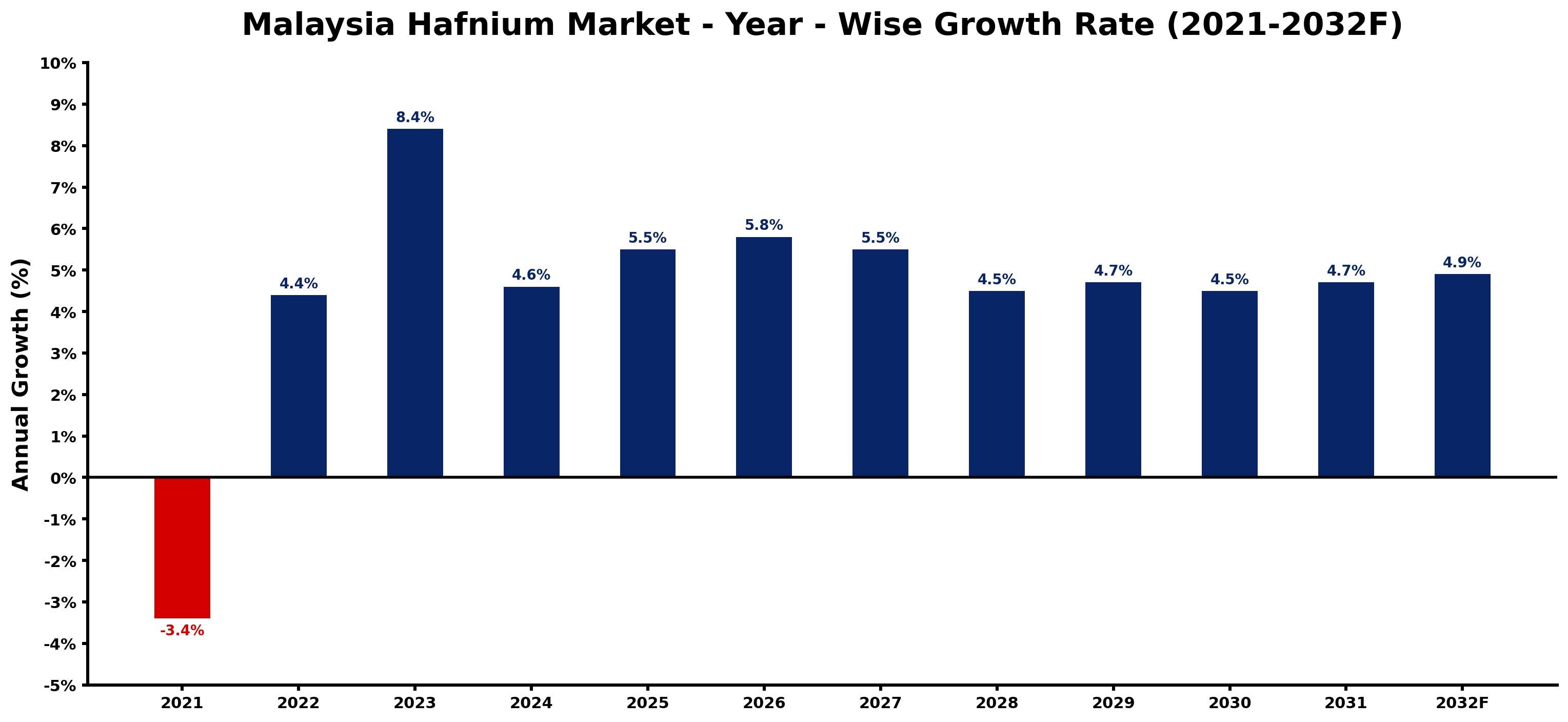
The table below presents the year‑wise growth rates along with the key drivers influencing the market
| Year | Growth Rate | Major Drivers |
| 2021 | -3.4% | decreased industrial investment activities |
| 2022 | 4.4% | increased demand from aerospace sector |
| 2023 | 8.4% | growing electronics manufacturing activities |
| 2024 | 4.6% | expansion in renewable energy projects |
| 2025 | 5.5% | rising global tech production needs |
| 2026 | 5.8% | enhanced automotive industry requirements |
| 2027 | 5.5% | growth in defense manufacturing sectors |
| 2028 | 4.5% | increased research and development funding |
| 2029 | 4.7% | demand from advanced materials sector |
| 2030 | 4.5% | strengthening semiconductor industry investments |
| 2031 | 4.7% | development of new industrial applications |
| 2032 | 4.9% | surge in high-performance electronics demand |
Note: Market size estimations and growth projections presented in this report are based on 6Wresearch's proprietary forecasting methodology, utilizing the latest available industry data, government publications, and primary research inputs.
Malaysia Hafnium Market Synopsis
In recent years, the Malaysian hafnium market has gained momentum, largely driven by increased applications in aerospace and electronics. The expanding metalworking industry and heightened demand for electronic components underscore hafnium's relevance in contemporary manufacturing. However, as market dynamics shift, the future of hafnium in Malaysia appears promising, with opportunities for growth across diverse sectors.
The market's evolution will be characterized by ongoing investments in exploration and production, particularly as companies seek reliable sources of hafnium amidst changing technological demands. Additionally, the anticipated recovery from pandemic-related disruptions is set to further invigorate market activity, ensuring that hafnium remains a critical component in Malaysia's industrial landscape.
Malaysia Hafnium Market Key Takeaways
- The market is positioned for strong growth, driven by increasing hafnium applications in aerospace, nuclear, and electronics.
- Hafnium's unique properties, including high corrosion resistance, enhance its value in multiple sectors.
- Recent trends indicate a shift towards sustainable and advanced manufacturing processes that utilize hafnium.
- Investment in exploration and production is essential to meet the rising demand for hafnium in Malaysia.
- Post-pandemic recovery is anticipated to strengthen market dynamics and boost overall consumption levels.
Evaluation of Restraints in Malaysia Hafnium Market
The Malaysia hafnium market faces several restraints that could limit its growth potential. Notably, fluctuations in demand across key sectors like aerospace, electronics, and nuclear applications present challenges in maintaining a consistent supply chain. Additionally, technological advancements can shift market dynamics, necessitating investments in new exploration and production techniques. As companies adapt to these changes, a strategic approach will be crucial for navigating the evolving landscape.
Malaysia Hafnium Market Trends
A prominent trend shaping the Malaysia hafnium market is the growing emphasis on high-performance materials in aerospace applications. As manufacturers seek to enhance efficiency and safety, hafnium's role as a critical component in advanced jet engine designs is becoming increasingly vital. Additionally, the electronic sector is witnessing a surge in hafnium's usage, particularly in semiconductor fabrication as a dopant. These trends underline the importance of hafnium in innovative technologies and suggest a promising future for its market.
Malaysia Hafnium Market Opportunities
The Malaysian hafnium market holds significant growth and investment opportunities, particularly in the aerospace and nuclear sectors. As global demand for advanced aerospace technologies continues to rise, hafnium's unique properties position it as an essential material for next-generation aircraft components. Furthermore, with ongoing advancements in nuclear technology, hafniums role as a neutron absorber is expected to drive increased utilization. Companies that focus on strategic partnerships and technological innovation will likely capitalize on these emerging opportunities.
Government Initiatives in the Malaysia Hafnium Market
The Malaysian government is actively promoting initiatives that support the hafnium market through various policies aimed at enhancing industrial capabilities. Public spending in research and development, particularly in advanced materials and manufacturing processes, demonstrates a commitment to fostering innovation. Incentives for businesses focusing on sustainable practices and technological advancements further create a conducive environment for hafnium market growth. This supportive framework is anticipated to attract both local and foreign investments.
Future Insights of the Malaysia Hafnium Market
Looking ahead to 2026-2032, the Malaysia hafnium market is expected to continue on its growth trajectory, bolstered by advancements in technology and increasing application demands. As industries evolve, hafnium will likely find new use cases, particularly in energy-efficient technologies and aerospace innovation. The market's adaptability to changing requirements will be crucial in determining its long-term success. Continuous investment in production capabilities and exploration will also play a significant role in sustaining growth.
Malaysia Hafnium Market Latest Developments (2025 - 2026)
Recent developments in the Malaysian hafnium market reflect a strategic pivot towards sustainability and advanced manufacturing. Companies are increasingly collaborating on research initiatives that focus on improving hafnium extraction methods and expanding its application range. Efforts to streamline supply chains have also gained momentum, addressing previous disruptions and ensuring a more resilient market structure. These directions indicate a proactive approach to adapting to evolving industry needs.
Malaysia Hafnium Market - Key Attractiveness of the Report
- 10 Years of Market Numbers
- Historical Data Starting from 2022 to 2025
- Base Year: 2025
- Forecast Data until 2032
- Key Performance Indicators Impacting the Market
- Major Upcoming Developments and Projects
Key Highlights of the Report:
- Malaysia Hafnium Market Outlook
- Market Size of Malaysia Hafnium Market, 2025
- Forecast of Malaysia Hafnium Market, 2032
- Historical Data and Forecast of Malaysia Hafnium Revenues & Volume for the Period 2022-2032F
- Malaysia Hafnium Market Trend Evolution
- Malaysia Hafnium Market Drivers and Challenges
- Malaysia Hafnium Price Trends
- Malaysia Hafnium Porter's Five Forces
- Malaysia Hafnium Industry Life Cycle
- Historical Data and Forecast of Malaysia Hafnium Market Revenues & Volume By Type for the Period 2022-2032F
- Historical Data and Forecast of Malaysia Hafnium Market Revenues & Volume By Hafnium Oxide for the Period 2022-2032F
- Historical Data and Forecast of Malaysia Hafnium Market Revenues & Volume By Hafnium Carbide for the Period 2022-2032F
- Historical Data and Forecast of Malaysia Hafnium Market Revenues & Volume By Other for the Period 2022-2032F
- Historical Data and Forecast of Malaysia Hafnium Market Revenues & Volume By Application for the Period 2022-2032F
- Historical Data and Forecast of Malaysia Hafnium Market Revenues & Volume By Super Alloy for the Period 2022-2032F
- Historical Data and Forecast of Malaysia Hafnium Market Revenues & Volume By Optical Coating for the Period 2022-2032F
- Historical Data and Forecast of Malaysia Hafnium Market Revenues & Volume By Nuclear for the Period 2022-2032F
- Historical Data and Forecast of Malaysia Hafnium Market Revenues & Volume By Plasma Cutting for the Period 2022-2032F
- Historical Data and Forecast of Malaysia Hafnium Market Revenues & Volume By Other for the Period 2022-2032F
- Malaysia Hafnium Import Export Trade Statistics
- Market Opportunity Assessment By Type
- Market Opportunity Assessment By Application
- Malaysia Hafnium Top Companies Market Share
- Malaysia Hafnium Competitive Benchmarking By Technical and Operational Parameters
- Malaysia Hafnium Company Profiles
- Malaysia Hafnium Key Strategic Recommendations






































