Malaysia Halogenated Solvents Market Size, Share & Growth Rate
The Malaysia Halogenated Solvents Market was estimated at USD 288 Million in 2025 and is projected to reach USD 374 Million by 2032, growing at a CAGR of 3.8% from 2026 to 2032. This growth trajectory is primarily driven by the increasing demand for halogenated solvents in precision cleaning and degreasing applications, particularly in the electronics and automotive sectors. Moreover, advancements in manufacturing processes that require high-purity solvents are further propelling the market forward.
Malaysia Halogenated Solvents Market Year-wise Growth Rate and Key Drivers
This graph highlights how the Malaysia Halogenated Solvents Market has steadily grown over the years, supported by major growth factors.
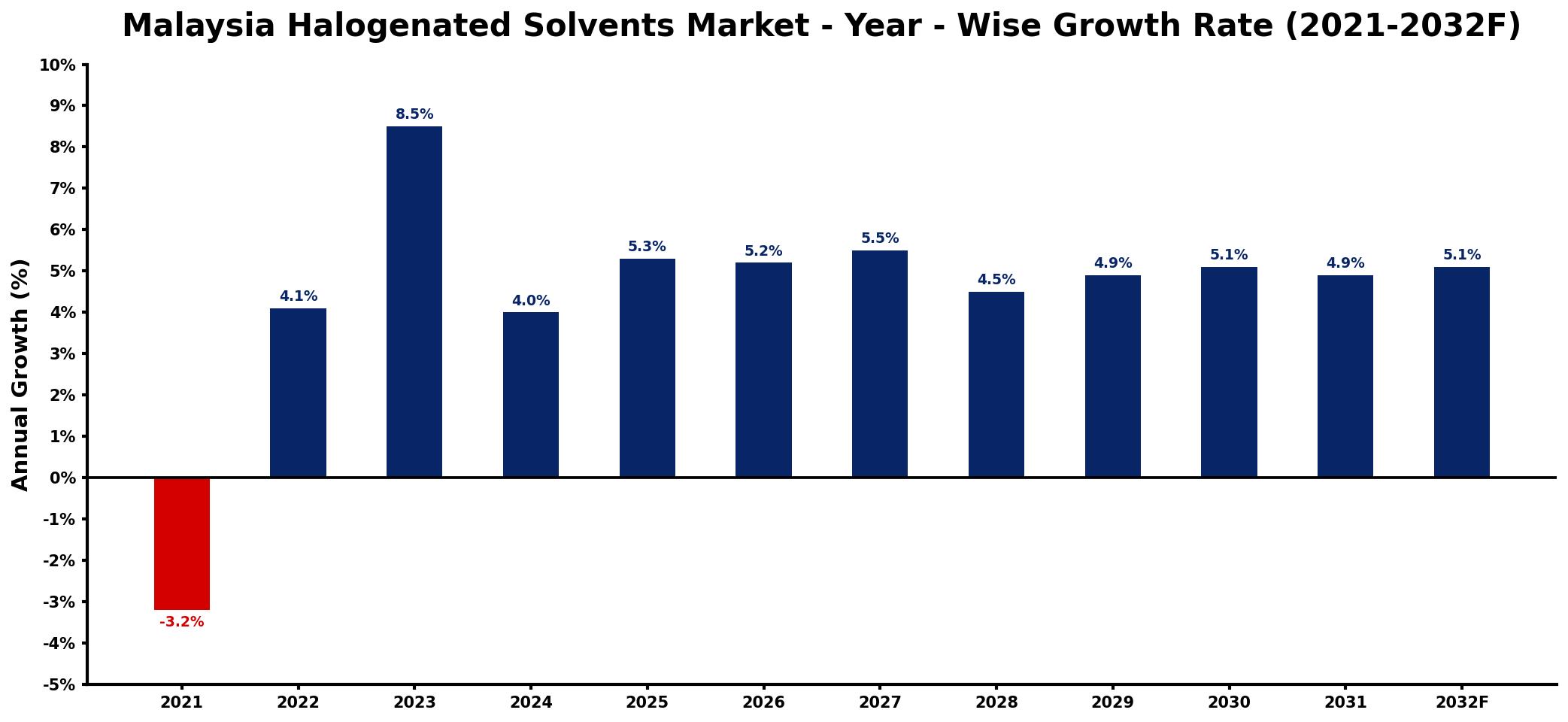
The table below presents the year‑wise growth rates along with the key drivers influencing the market
| Year | Growth Rate | Major Drivers |
| 2021 | -3.2% | decreased industrial manufacturing activities |
| 2022 | 4.1% | increased demand from automotive sector |
| 2023 | 8.5% | expansion of electronics manufacturing industry |
| 2024 | 4.0% | growth in construction sector investments |
| 2025 | 5.3% | rising demand from healthcare applications |
| 2026 | 5.2% | surge in aerospace sector projects |
| 2027 | 5.5% | increased utilization in cleaning products |
| 2028 | 4.5% | expanding healthcare application demand |
| 2029 | 4.9% | growing emerging market penetration |
| 2030 | 5.1% | rising investments in R&D activities |
| 2031 | 4.9% | rising export shipment volumes |
| 2032 | 5.1% | increased capital investment inflows |
Note: Market size estimations and growth projections presented in this report are based on 6Wresearch's proprietary forecasting methodology, utilizing the latest available industry data, government publications, and primary research inputs.
Malaysia Halogenated Solvents Market Synopsis
In Malaysia, halogenated solvents are integral to numerous industrial applications ranging from cleaning and degreasing to serving as chemical intermediates. The market's dynamic landscape is shaped by an interplay of environmental regulations and the urgent need for efficient industrial processes. As companies look to enhance productivity while adhering to stricter environmental standards, the demand for halogenated solvents is experiencing renewed focus.
Recent shifts towards eco-friendly alternatives pose both a challenge and an opportunity for the halogenated solvents market. As industries evolve, the demand for traditional solvents may wane, pushing manufacturers to innovate and adapt to sustainable practices. This shift is a critical focal point for stakeholders looking to maintain competitive edge in a rapidly changing regulatory environment.
Malaysia Halogenated Solvents Market Key Takeaways
- Halogenated solvents are crucial for cleaning and degreasing in high-tech sectors like electronics.
- Environmental regulations are pushing companies towards more sustainable solvent options.
- COVID-19 pandemic disrupted manufacturing but the market is gradually recovering.
- Technological advancements are enhancing the efficiency and purity of solvents.
- Growth is anticipated across diverse applications, including chemicals and pharmaceuticals.
Evaluation of Restraints in Malaysia Halogenated Solvents Market
The Malaysia Halogenated Solvents Market faces notable restraints due to increasing regulatory scrutiny aimed at reducing the environmental impact of solvent use. These regulations may lead to higher compliance costs and push industries to adopt alternatives, slowing market growth. Additionally, fluctuating raw material prices and supply chain vulnerabilities can hinder consistent product availability, thereby impacting manufacturers' ability to meet demand. As companies strive to navigate these challenges, a strategic approach to innovation and sustainability will be essential for maintaining market viability.
Malaysia Halogenated Solvents Market Trends
Current trends in the Malaysia Halogenated Solvents Market are increasingly focused on sustainability and operational efficiency. Industries are investing in research and development to create more environmentally friendly solvent formulations, spurred by both consumer demand and regulatory pressure. Moreover, automation and digitalization in manufacturing processes are enhancing the precision and effectiveness of solvent use, leading to significant cost savings and productivity enhancements.
Malaysia Halogenated Solvents Market Opportunities
There exist significant growth opportunities within the Malaysia Halogenated Solvents Market, particularly in sectors that require stringent cleaning standards, such as electronics and automotive manufacturing. As industries increasingly prioritize quality and efficiency, there is a notable demand for high-purity halogenated solvents. Furthermore, expanding applications in pharmaceuticals and chemical synthesis are poised to drive further investments in this market. Stakeholders who align their strategies with sustainability initiatives will likely capture a growing share of this evolving market.
Government Initiatives in the Malaysia Halogenated Solvents Market
The Malaysian government is actively promoting environmental sustainability through various initiatives aimed at reducing pollution and enhancing industrial efficiency. Incentives for research in green chemistry and sustainable practices are being introduced to encourage the development of eco-friendly solvent alternatives. Additionally, regulatory frameworks are being established to guide industries toward compliance with international environmental standards, ultimately aiming to minimize the ecological footprint of industrial activities.
Future Insights of the Malaysia Halogenated Solvents Market
Looking ahead to 2026-2032, the Malaysia Halogenated Solvents Market is set to navigate a transformative phase driven by technological advancements and a growing emphasis on sustainability. The increasing adoption of stringent environmental regulations will necessitate innovation, pushing manufacturers to develop alternative solvents and optimize existing products. This evolving landscape presents both challenges and opportunities, where successful players will likely focus on developing high-performance, environmentally compliant solvents that cater to the changing demands of diverse industries.
Malaysia Halogenated Solvents Market Latest Developments (2025 - 2026)
In recent months, the Malaysia Halogenated Solvents Market has seen a noticeable trend towards collaborations between industry players and research institutions aimed at developing sustainable solvent solutions. Companies are increasingly participating in initiatives that focus on refining production processes to reduce environmental impact. Furthermore, emerging startups are entering the market with innovative products designed to meet the stringent cleaning requirements of high-tech industries, signalling a shift towards a more diverse and competitive landscape.
Malaysia Halogenated Solvents Market - Key Attractiveness of the Report
- 10 Years of Market Numbers
- Historical Data Starting from 2022 to 2025
- Base Year: 2025
- Forecast Data until 2032
- Key Performance Indicators Impacting the Market
- Major Upcoming Developments and Projects
Key Highlights of the Report:
- Malaysia Halogenated Solvents Market Outlook
- Market Size of Malaysia Halogenated Solvents Market, 2025
- Forecast of Malaysia Halogenated Solvents Market, 2032
- Historical Data and Forecast of Malaysia Halogenated Solvents Revenues & Volume for the Period 2022-2032F
- Malaysia Halogenated Solvents Market Trend Evolution
- Malaysia Halogenated Solvents Market Drivers and Challenges
- Malaysia Halogenated Solvents Price Trends
- Malaysia Halogenated Solvents Porter's Five Forces
- Malaysia Halogenated Solvents Industry Life Cycle
- Historical Data and Forecast of Malaysia Halogenated Solvents Market Revenues & Volume By Product for the Period 2022-2032F
- Historical Data and Forecast of Malaysia Halogenated Solvents Market Revenues & Volume By Methylene Chloride for the Period 2022-2032F
- Historical Data and Forecast of Malaysia Halogenated Solvents Market Revenues & Volume By Perchloroethylene for the Period 2022-2032F
- Historical Data and Forecast of Malaysia Halogenated Solvents Market Revenues & Volume By Trichloroethylene for the Period 2022-2032F
- Historical Data and Forecast of Malaysia Halogenated Solvents Market Revenues & Volume By End-use for the Period 2022-2032F
- Historical Data and Forecast of Malaysia Halogenated Solvents Market Revenues & Volume By Paint & Coatings for the Period 2022-2032F
- Historical Data and Forecast of Malaysia Halogenated Solvents Market Revenues & Volume By Printing Inks for the Period 2022-2032F
- Historical Data and Forecast of Malaysia Halogenated Solvents Market Revenues & Volume By Cosmetics & Toiletries for the Period 2022-2032F
- Historical Data and Forecast of Malaysia Halogenated Solvents Market Revenues & Volume By Other for the Period 2022-2032F
- Malaysia Halogenated Solvents Import Export Trade Statistics
- Market Opportunity Assessment By Product
- Market Opportunity Assessment By End-use
- Malaysia Halogenated Solvents Top Companies Market Share
- Malaysia Halogenated Solvents Competitive Benchmarking By Technical and Operational Parameters
- Malaysia Halogenated Solvents Company Profiles
- Malaysia Halogenated Solvents Key Strategic Recommendations






































