Malaysia Helicopter Market Size, Share & Growth Rate
The Malaysia Helicopter Market was estimated at USD 168 Million in 2025 and is projected to reach USD 218 Million by 2032, growing at a CAGR of 3.8% from 2026 to 2032. This growth trajectory is largely attributed to increasing demand for efficient transportation solutions across key sectors, including oil & gas, emergency services, and tourism. As the government enhances infrastructure and invests in defense capabilities, helicopter usage is anticipated to rise further, driving market expansion.
Malaysia Helicopter Market Year-wise Growth Rate and Key Drivers
This graph highlights how the Malaysia Helicopter Market has steadily grown over the years, supported by major growth factors.
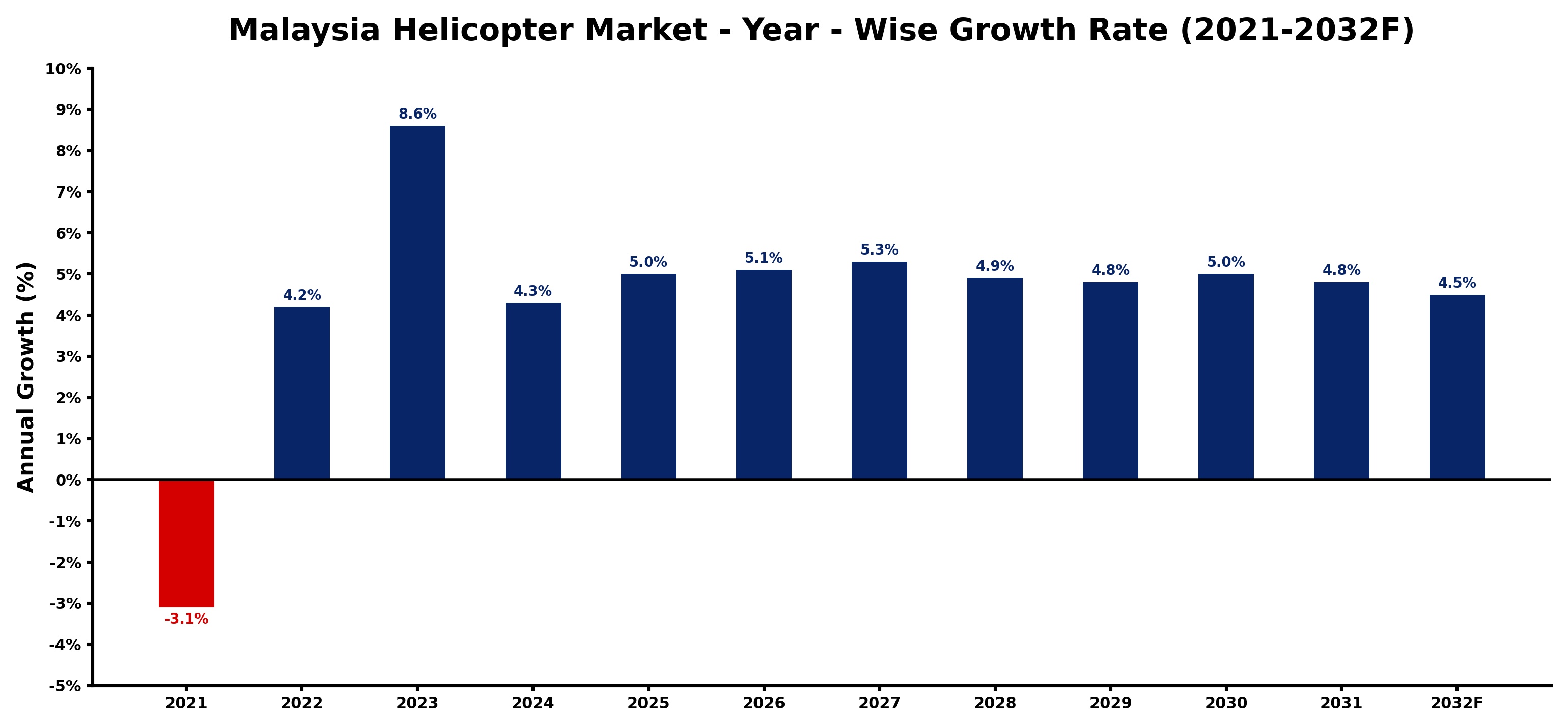
The table below presents the year‑wise growth rates along with the key drivers influencing the market
| Year | Growth Rate | Major Drivers |
| 2021 | -3.1% | Supply chain disruptions hindered timely deliveries of helicopter components |
| 2022 | 4.2% | Increased helicopter production contracts boost precision engineering investments |
| 2023 | 8.6% | Precision engineering investments boost helicopter component manufacturing capabilities |
| 2024 | 4.3% | Increased precision engineering investments boosted helicopter component manufacturing capacity |
| 2025 | 5.0% | Export driven demand for advanced helicopters boosts precision engineering investments |
| 2026 | 5.1% | Strengthened precision engineering capabilities boosted helicopter component exports |
| 2027 | 5.3% | Precision engineering advancements bolster Malaysia's aerospace manufacturing capabilities |
| 2028 | 4.9% | Manufacturing investments boost Malaysia's precision engineering sector growth |
| 2029 | 4.8% | Export driven demand for helicopter components boosts local manufacturing capacity |
| 2030 | 5.0% | Precision engineering advancements boosted helicopter component manufacturing capabilities |
| 2031 | 4.8% | Precision engineering advancements boosted helicopter component production capacity |
| 2032 | 4.5% | Modernized supply chain logistics boost Malaysia's helicopter component exports |
Note - Market size estimations and growth projections presented in this report are based on 6Wresearch’s advanced forecasting approach, validated with industry datasets as of June 2026.
Malaysia Helicopter Market Synopsis
The helicopter industry in Malaysia has been on an upward trajectory, with 634 helicopters registered as of 2017, valued at approximately USD 2.9 billion. Government agencies and private sector players dominate the market, employing helicopters for vital operations ranging from aerial surveillance and search and rescue to medical evacuations and offshore activities.
As Malaysia continues to develop its aviation infrastructure and increase its reliance on advanced technologies, the helicopter market is poised for further growth. Factors such as rising consumer expectations for rapid transit and the critical need for versatile transport solutions across various industries are driving the ongoing demand.
Malaysia Helicopter Market Key Takeaways
- The market is expected to grow steadily, with an increasing focus on efficiency and technological advancements.
- Key sectors driving demand include oil & gas, tourism, and emergency response services.
- Government investments in aviation infrastructure are likely to enhance market dynamics.
- Challenges related to acquisition and operational costs could impact growth in the short term.
- Companies in the market are prioritizing safety standards and technical expertise.
Evaluation of Restraints in Malaysia Helicopter Market
Despite the growth prospects, the Malaysia Helicopter Market faces notable restraints. The high costs associated with purchasing and maintaining helicopters can deter potential users, especially within budget-constrained industries. Moreover, fluctuating economic conditions can lead to uncertainties in demand, particularly within the oil and gas sector, which is sensitive to global market shifts. Additionally, compliance with rigorous safety regulations presents a significant operational challenge for market participants, necessitating ongoing investments in training and equipment to maintain standards.
Malaysia Helicopter Market Trends
Several trends are currently influencing the Malaysian helicopter market. There is a marked increase in the integration of advanced technology, including automation and enhanced navigation systems, improving operational safety and efficiency. The growing trend of utilizing helicopters for urban air mobility is also emerging, as cities seek innovative transportation solutions. Furthermore, a rising emphasis on sustainable aviation practices is pushing manufacturers and service providers to explore greener technologies, aligning with global environmental standards.
Malaysia Helicopter Market Opportunities
The helicopter market in Malaysia presents several promising opportunities. The increasing demand for air medical services, driven by a growing population and urbanization, highlights a significant growth area. Moreover, the expansion of oil and gas exploration activities in offshore regions is expected to further stimulate demand for helicopter transportation. Additionally, the tourism sector, particularly eco-tourism and adventure tourism, presents a burgeoning market for helicopter operators, as travelers seek unique aerial experiences.
Government Initiatives in the Malaysia Helicopter Market
The Malaysian government is actively supporting the aviation sector through various initiatives aimed at bolstering infrastructure and enhancing safety regulations. Investments in air traffic management and airport upgrades are critical components of the government's strategy to improve connectivity and efficiency. Additionally, there are ongoing programs focusing on developing local aviation talent and enhancing training facilities, which are crucial for maintaining high safety standards and operational competency within the helicopter market.
Future Insights of the Malaysia Helicopter Market
Looking ahead to the period from 2026 to 2032, the Malaysia Helicopter Market is set to experience a blend of challenges and opportunities. With government backing and rising sector demands, the market is poised for steady growth. The continued evolution of technology will likely enhance operational efficiencies and safety, driving more sectors to adopt helicopter services. Furthermore, as the nation prioritizes its defense capabilities, the demand for helicopters in government operations may surge, contributing significantly to market growth.
Malaysia Helicopter Market Latest Developments (May 2025 - June 2026)
Recent developments in the Malaysia Helicopter Market indicate a shift towards increased collaboration between private operators and government agencies, aimed at enhancing service capabilities for emergency response and medical evacuation. Furthermore, advancements in drone technology are prompting traditional helicopter operators to explore integration possibilities, which could reshape operational dynamics. Additionally, industry players are focusing on enhancing pilot training programs and maintenance facilities to meet stringent safety regulations and improve service reliability.
Malaysia Helicopter Market - Key Attractiveness of the Report
- 10 Years of Market Numbers
- Historical Data Starting from 2022 to 2025
- Base Year: 2025
- Forecast Data until 2032
- Key Performance Indicators Impacting the Market
- Major Upcoming Developments and Projects
Key Highlights of the Report:
- Malaysia Helicopter Market Outlook
- Market Size of Malaysia Helicopter Market, 2025
- Forecast of Malaysia Helicopter Market, 2032
- Historical Data and Forecast of Malaysia Helicopter Revenues & Volume for the Period 2022-2032F
- Malaysia Helicopter Market Trend Evolution
- Malaysia Helicopter Market Drivers and Challenges
- Malaysia Helicopter Price Trends
- Malaysia Helicopter Porter's Five Forces
- Malaysia Helicopter Industry Life Cycle
- Historical Data and Forecast of Malaysia Helicopter Market Revenues & Volume By End-users for the Period 2022-2032F
- Historical Data and Forecast of Malaysia Helicopter Market Revenues & Volume By Commercial for the Period 2022-2032F
- Historical Data and Forecast of Malaysia Helicopter Market Revenues & Volume By Military for the Period 2022-2032F
- Historical Data and Forecast of Malaysia Helicopter Market Revenues & Volume By Component for the Period 2022-2032F
- Historical Data and Forecast of Malaysia Helicopter Market Revenues & Volume By Aerostructures/Airframes for the Period 2022-2032F
- Historical Data and Forecast of Malaysia Helicopter Market Revenues & Volume By Rotary System for the Period 2022-2032F
- Historical Data and Forecast of Malaysia Helicopter Market Revenues & Volume By Engine for the Period 2022-2032F
- Historical Data and Forecast of Malaysia Helicopter Market Revenues & Volume By Undercarriage for the Period 2022-2032F
- Historical Data and Forecast of Malaysia Helicopter Market Revenues & Volume By Avionics for the Period 2022-2032F
- Historical Data and Forecast of Malaysia Helicopter Market Revenues & Volume By Cabin Interiors for the Period 2022-2032F
- Historical Data and Forecast of Malaysia Helicopter Market Revenues & Volume By Environmental Control System for the Period 2022-2032F
- Historical Data and Forecast of Malaysia Helicopter Market Revenues & Volume By Sales Channels for the Period 2022-2032F
- Historical Data and Forecast of Malaysia Helicopter Market Revenues & Volume By OEM for the Period 2022-2032F
- Historical Data and Forecast of Malaysia Helicopter Market Revenues & Volume By Maintenance for the Period 2022-2032F
- Historical Data and Forecast of Malaysia Helicopter Market Revenues & Volume By Repair for the Period 2022-2032F
- Historical Data and Forecast of Malaysia Helicopter Market Revenues & Volume By Overhaul for the Period 2022-2032F
- Malaysia Helicopter Import Export Trade Statistics
- Market Opportunity Assessment By End-users
- Market Opportunity Assessment By Component
- Market Opportunity Assessment By Sales Channels
- Malaysia Helicopter Top Companies Market Share
- Malaysia Helicopter Competitive Benchmarking By Technical and Operational Parameters
- Malaysia Helicopter Company Profiles
- Malaysia Helicopter Key Strategic Recommendations






































