Malaysia Hepatitis Vaccine Market Size, Share & Growth Rate
The Malaysia Hepatitis Vaccine Market was estimated at USD 432 Million in 2025 and is projected to reach USD 561 Million by 2032, growing at a CAGR of 3.8% from 2026 to 2032. This growth trajectory is largely driven by heightened public health initiatives focused on eradicating hepatitis infections through widespread vaccination. Increasing collaboration between government entities and healthcare organizations is expected to enhance vaccine access, particularly for vulnerable populations.
Malaysia Hepatitis Vaccine Market Year-wise Growth Rate and Key Drivers
This graph highlights how the Malaysia Hepatitis Vaccine Market has steadily grown over the years, supported by major growth factors.
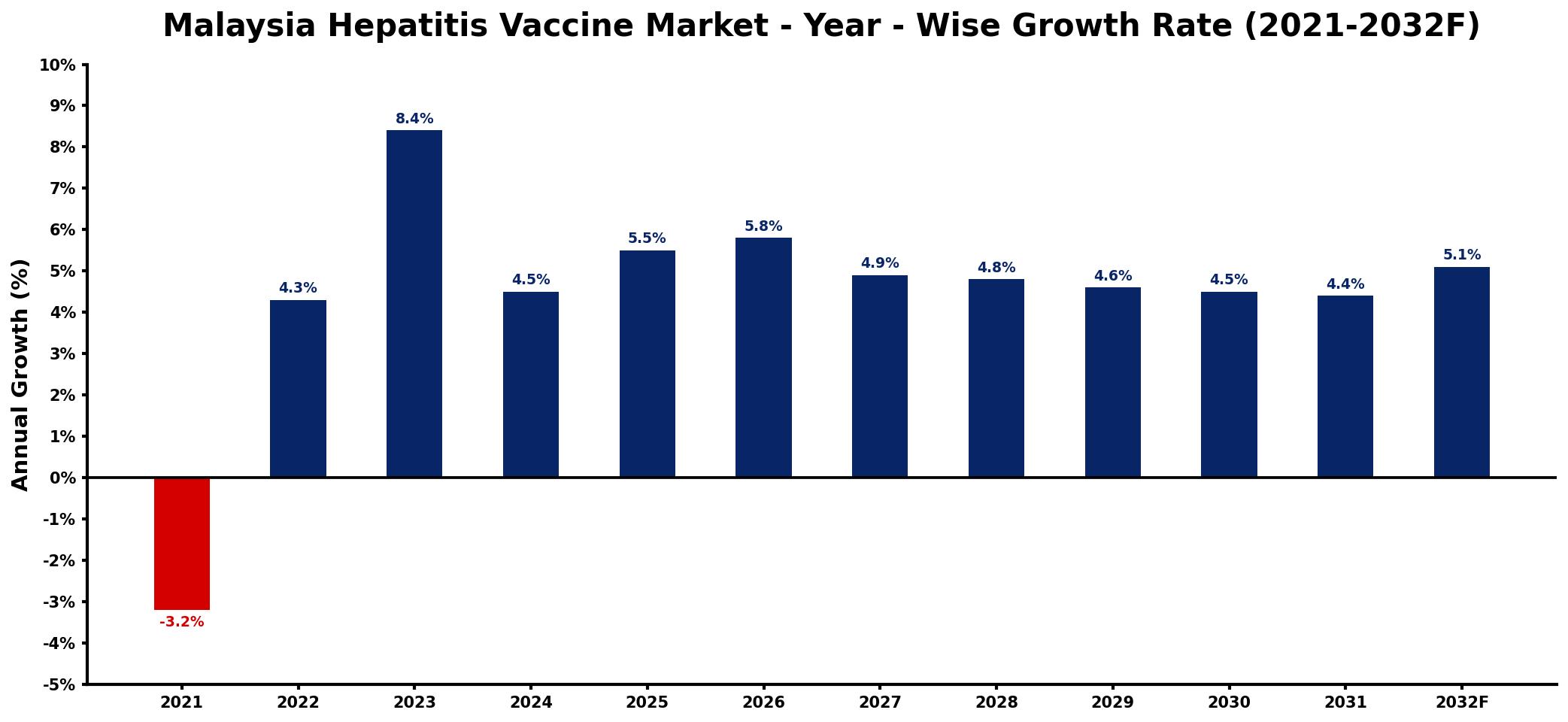
The table below presents the year‑wise growth rates along with the key drivers influencing the market
| Year | Growth Rate | Major Drivers |
| 2021 | -3.2% | decreased healthcare spending by consumers |
| 2022 | 4.3% | increased public health initiatives funding |
| 2023 | 8.4% | growing awareness of preventive care |
| 2024 | 4.5% | expansion of healthcare infrastructure investments |
| 2025 | 5.5% | rising demand for preventive treatments |
| 2026 | 5.8% | enhanced government health policies support |
| 2027 | 4.9% | growing partnerships with healthcare providers |
| 2028 | 4.8% | advancements in medical technology adoption |
| 2029 | 4.6% | growing downstream application demand |
| 2030 | 4.5% | rising prevalence of chronic diseases |
| 2031 | 4.4% | strengthened public-private collaboration efforts |
| 2032 | 5.1% | growth in health education programs |
Note: Market size estimations and growth projections presented in this report are based on 6Wresearch's proprietary forecasting methodology, utilizing the latest available industry data, government publications, and primary research inputs.
Malaysia Hepatitis Vaccine Market Synopsis
In Malaysia, vaccination against hepatitis has seen significant strides due to organized public health campaigns and immunization programs. These initiatives are crucial in addressing the high incidence of hepatitis infections, particularly in at-risk communities. The proactive stance taken by the Malaysian government is central to ensuring that these vaccines are both accessible and widely accepted.
Moreover, ongoing research and development efforts continue to play a vital role in advancing vaccine formulations. The introduction of improved vaccines is expected to cater to different demographic needs and mitigate concerns around efficacy and safety, further driving vaccination rates in Malaysia.
Malaysia Hepatitis Vaccine Market Key Takeaways
- The market is poised for growth as public health initiatives gain momentum.
- Increased awareness and education about hepatitis vaccinations are driving demand.
- Research and development are leading to enhanced vaccine formulations.
- Government collaboration with healthcare providers is crucial for expanding coverage.
- Continued efforts post-COVID-19 pandemic emphasize the importance of vaccinations for various diseases.
Evaluation of Restraints in Malaysia Hepatitis Vaccine Market
Despite the positive growth outlook, several challenges hinder the rapid expansion of the hepatitis vaccine market in Malaysia. A significant barrier is the persistent vaccine hesitancy fueled by misinformation and safety concerns. Additionally, achieving broad public awareness and ensuring comprehensive vaccination coverage remain critical challenges. Effective education and outreach strategies are essential for overcoming these obstacles, as healthcare authorities work diligently to enhance public trust in vaccination efforts.
Malaysia Hepatitis Vaccine Market Trends
Current trends indicate a shift towards digital health solutions, including mobile applications and online platforms, to facilitate vaccination tracking and awareness. These technologies enable real-time monitoring of vaccination rates and can help identify gaps in coverage. Additionally, an increased focus on preventive healthcare is shaping policy decisions and funding allocations toward hepatitis vaccine research, signaling a commitment to long-term disease management.
Malaysia Hepatitis Vaccine Market Opportunities
The Malaysian market presents genuine growth opportunities particularly in improving vaccination outreach to under-served populations. Investments in community health programs and partnerships with non-governmental organizations (NGOs) can significantly enhance vaccine uptake. Moreover, the potential for introducing combination vaccines that target multiple hepatitis strains offers additional avenues for market expansion and improved public health outcomes.
Government Initiatives in the Malaysia Hepatitis Vaccine Market
The Malaysian government has implemented various policies aimed at enhancing hepatitis vaccination rates. Funding for public health campaigns, collaboration with international health organizations, and the establishment of vaccination clinics are part of a strategic approach to mitigate the incidence of hepatitis. Such initiatives demonstrate a commitment to integrating hepatitis vaccination into broader public health objectives, ensuring that resources are allocated effectively for maximum impact.
Future Insights of the Malaysia Hepatitis Vaccine Market
Looking ahead to 2026-2032, the Malaysia Hepatitis Vaccine Market is expected to continue its upward trajectory driven by enhanced public awareness and government policies focused on immunization. The integration of innovative healthcare technologies and collaborations with pharmaceutical companies will be pivotal in making vaccinations more accessible. Continued focus on education and overcoming vaccine hesitancy will ensure that Malaysia moves closer to its goal of reducing hepatitis prevalence significantly.
Malaysia Hepatitis Vaccine Market Latest Developments (2025 - 2026)
Recent developments in the Malaysia hepatitis vaccine market highlight a renewed focus on vaccination programs amid ongoing health initiatives. Efforts are underway to streamline the distribution of vaccines to rural areas, ensuring equitable access for all demographics. The emphasis on safety and efficacy continues to guide public health communications, while partnerships with educational institutions are being explored to further bolster awareness campaigns.
Malaysia Hepatitis Vaccine Market - Key Attractiveness of the Report
- 10 Years of Market Numbers
- Historical Data Starting from 2022 to 2025
- Base Year: 2025
- Forecast Data until 2032
- Key Performance Indicators Impacting the Market
- Major Upcoming Developments and Projects
Key Highlights of the Report:
- Malaysia Hepatitis Vaccine Market Outlook
- Market Size of Malaysia Hepatitis Vaccine Market, 2025
- Forecast of Malaysia Hepatitis Vaccine Market, 2032
- Historical Data and Forecast of Malaysia Hepatitis Vaccine Revenues & Volume for the Period 2022-2032F
- Malaysia Hepatitis Vaccine Market Trend Evolution
- Malaysia Hepatitis Vaccine Market Drivers and Challenges
- Malaysia Hepatitis Vaccine Price Trends
- Malaysia Hepatitis Vaccine Porter's Five Forces
- Malaysia Hepatitis Vaccine Industry Life Cycle
- Historical Data and Forecast of Malaysia Hepatitis Vaccine Market Revenues & Volume By Indication for the Period 2022-2032F
- Historical Data and Forecast of Malaysia Hepatitis Vaccine Market Revenues & Volume By Hepatitis A for the Period 2022-2032F
- Historical Data and Forecast of Malaysia Hepatitis Vaccine Market Revenues & Volume By Hepatitis B for the Period 2022-2032F
- Historical Data and Forecast of Malaysia Hepatitis Vaccine Market Revenues & Volume By Vaccine Type for the Period 2022-2032F
- Historical Data and Forecast of Malaysia Hepatitis Vaccine Market Revenues & Volume By Recombinant Vaccine for the Period 2022-2032F
- Historical Data and Forecast of Malaysia Hepatitis Vaccine Market Revenues & Volume By Inactivated Vaccine for the Period 2022-2032F
- Historical Data and Forecast of Malaysia Hepatitis Vaccine Market Revenues & Volume By Distribution Channel for the Period 2022-2032F
- Historical Data and Forecast of Malaysia Hepatitis Vaccine Market Revenues & Volume By Hospitals for the Period 2022-2032F
- Historical Data and Forecast of Malaysia Hepatitis Vaccine Market Revenues & Volume By Retail Pharmacy for the Period 2022-2032F
- Historical Data and Forecast of Malaysia Hepatitis Vaccine Market Revenues & Volume By Online Pharmacy for the Period 2022-2032F
- Malaysia Hepatitis Vaccine Import Export Trade Statistics
- Market Opportunity Assessment By Indication
- Market Opportunity Assessment By Vaccine Type
- Market Opportunity Assessment By Distribution Channel
- Malaysia Hepatitis Vaccine Top Companies Market Share
- Malaysia Hepatitis Vaccine Competitive Benchmarking By Technical and Operational Parameters
- Malaysia Hepatitis Vaccine Company Profiles
- Malaysia Hepatitis Vaccine Key Strategic Recommendations






































