Malaysia Herbal Cosmetics Market Size, Share & Growth Rate
The Malaysia Herbal Cosmetics Market was estimated at USD 317 Million in 2025 and is projected to reach USD 413 Million by 2032, growing at a CAGR of 3.9% from 2026 to 2032. This trajectory reflects a burgeoning interest in natural beauty solutions among Malaysian consumers, driven by heightened awareness of the benefits associated with herbal ingredients. As eco-consciousness escalates, the demand for products free from harmful chemicals is propelling the growth of the herbal cosmetics sector.
Malaysia Herbal Cosmetics Market Year-wise Growth Rate and Key Drivers
This graph highlights how the Malaysia Herbal Cosmetics Market has steadily grown over the years, supported by major growth factors.
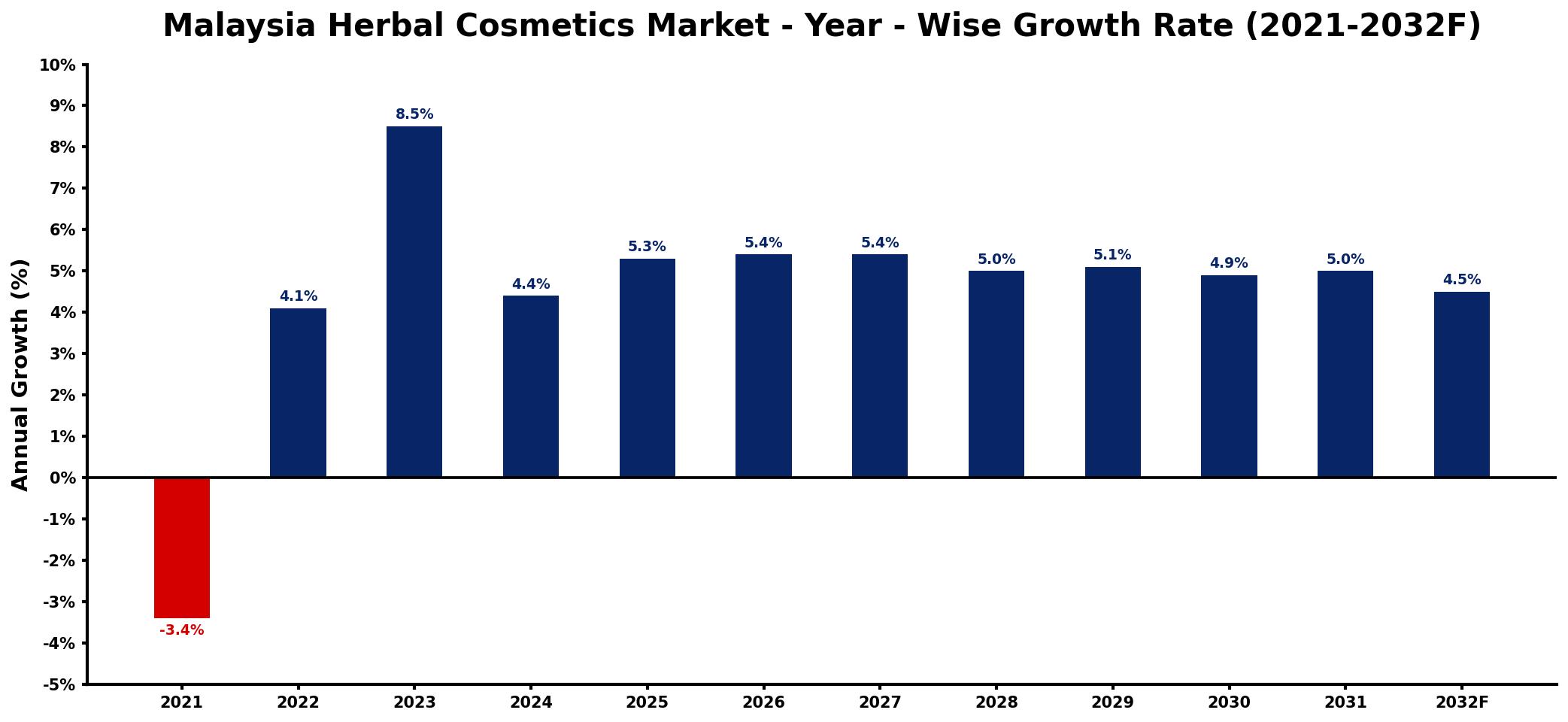
The table below presents the year‑wise growth rates along with the key drivers influencing the market
| Year | Growth Rate | Major Drivers |
| 2021 | -3.4% | Consumer interest in natural alternatives |
| 2022 | 4.1% | Rising awareness of skincare benefits |
| 2023 | 8.5% | Increase in sustainable sourcing practices |
| 2024 | 4.4% | Growing demand for eco-friendly products |
| 2025 | 5.3% | Expansion of online retail platforms |
| 2026 | 5.4% | Investment in innovative product development |
| 2027 | 5.4% | Emerging trends in plant-based solutions |
| 2028 | 5.0% | Strengthening of distribution networks |
| 2029 | 5.1% | Collaborations with local artisans |
| 2030 | 4.9% | Focus on holistic wellness approaches |
| 2031 | 5.0% | Enhanced marketing strategies for outreach |
| 2032 | 4.5% | Adaptation to changing consumer preferences |
Note: Market size estimations and growth projections presented in this report are based on 6Wresearch's proprietary forecasting methodology, utilizing the latest available industry data, government publications, and primary research inputs.
Malaysia Herbal Cosmetics Market Synopsis
In recent years, the Malaysia Herbal Cosmetics Market has experienced significant shifts as consumers increasingly prioritize natural ingredients over synthetic alternatives. This trend stems from a growing health consciousness, where individuals actively seek products that align with their wellness values. As a result, herbal cosmetics have gained substantial traction, attracting both loyal consumers and new entrants to the market.
Additionally, the intersection of tradition and modernity in Malaysian culture fuels interest in herbal cosmetics, as traditional beauty practices are integrated into contemporary skincare routines. Companies are responding with innovative formulations that address specific skin concerns while emphasizing sustainability and eco-friendliness, aligning perfectly with consumer expectations.
Malaysia Herbal Cosmetics Market Key Takeaways
- The market is increasingly driven by consumer preference for natural and organic products.
- Research and development initiatives are vital for continuous innovation in herbal cosmetics.
- Government support for herbal ingredient usage positively influences market growth.
- Challenges in labeling and competition from mainstream brands necessitate strategic positioning.
- Heightened awareness of health and wellness drives consumer engagement and product loyalty.
Evaluation of Restraints in Malaysia Herbal Cosmetics Market
Despite the promising growth trajectory, the Malaysia Herbal Cosmetics Market faces notable restraints. A significant challenge comes from the intense competition posed by mainstream cosmetics brands, which often incorporate herbal elements into their offerings. This practice can confuse consumers who may not distinguish between dedicated herbal products and those that merely feature herbal ingredients. Furthermore, the lack of standardized regulations for herbal product labeling can hinder consumer trust and complicate market entry for new brands. Ensuring compliance with accurate labeling and efficacy claims will be crucial for building confidence among consumers in this evolving landscape.
Malaysia Herbal Cosmetics Market Trends
A notable trend within the Malaysia Herbal Cosmetics Market is the rising popularity of personalized skincare solutions, where consumers seek products tailored to their specific needs. This customization trend encourages brands to harness local botanicals and traditional wisdom, creating unique formulations that resonate with consumers. Moreover, the demand for transparency regarding ingredient sourcing is leading companies to adopt more sustainable practices, including eco-friendly packaging and ethically sourced materials. Digital platforms are also playing an increasingly vital role, as consumers leverage online channels to research and purchase herbal products, further transforming the purchasing landscape.
Malaysia Herbal Cosmetics Market Opportunities
Opportunities in the Malaysia Herbal Cosmetics Market are abundant, particularly in the realm of product innovation. Companies can explore niche segments, such as herbal cosmetics targeted at specific demographics or skin conditions, which can attract a diverse consumer base. The increasing inclination towards sustainable and cruelty-free products presents a significant opportunity for brands that prioritize eco-conscious practices. Collaborations with local herbalists and traditional practitioners can also enhance product authenticity, appealing to consumers seeking a genuine connection with their beauty products. With a growing emphasis on health and wellness, brands that articulate their unique value propositions effectively stand to benefit substantially from this evolving market landscape.
Government Initiatives in the Malaysia Herbal Cosmetics Market
The Malaysian government has demonstrated a commitment to promoting the use of herbal and traditional ingredients in cosmetics, recognizing their potential to bolster local industries. Initiatives aimed at providing regulatory support and encouraging research into herbal formulations are crucial in fostering innovation within this sector. Moreover, public spending on awareness campaigns about the benefits of herbal products plays a significant role in educating consumers and promoting the shift towards natural beauty solutions. Such government backing enhances the market's growth potential, offering a conducive environment for brands focused on herbal cosmetics.
Future Insights of the Malaysia Herbal Cosmetics Market
Looking ahead to 2026-2032, the Malaysia Herbal Cosmetics Market is poised for continued growth, bolstered by an increasingly health-conscious consumer base. As more individuals prioritize wellness and self-care, the demand for herbal cosmetics is expected to rise steadily. Furthermore, advancements in technology and product development will likely enable brands to create even more effective and targeted solutions. The integration of traditional practices with modern innovation will enhance product appeal, ensuring that the market remains dynamic and responsive to evolving consumer preferences.
Malaysia Herbal Cosmetics Market Latest Developments (2025 - 2026)
In the recent months, the Malaysia Herbal Cosmetics Market has witnessed various strategic movements as brands adapt to changing consumer preferences. Several companies have launched new product lines focusing on specific skincare concerns, utilizing localized ingredients that resonate with Malaysian culture. Additionally, there has been a noticeable uptick in collaborations between herbal cosmetic brands and digital influencers, significantly enhancing brand visibility and consumer engagement. Furthermore, sustainability efforts have gained momentum, with brands implementing eco-friendly practices in their packaging and sourcing, positioning themselves favorably in a competitive market landscape.
Malaysia Herbal Cosmetics Market - Key Attractiveness of the Report
- 10 Years of Market Numbers
- Historical Data Starting from 2022 to 2025
- Base Year: 2025
- Forecast Data until 2032
- Key Performance Indicators Impacting the Market
- Major Upcoming Developments and Projects
Key Highlights of the Report:
- Malaysia Herbal Cosmetics Market Outlook
- Market Size of Malaysia Herbal Cosmetics Market, 2025
- Forecast of Malaysia Herbal Cosmetics Market, 2032
- Historical Data and Forecast of Malaysia Herbal Cosmetics Revenues & Volume for the Period 2022-2032F
- Malaysia Herbal Cosmetics Market Trend Evolution
- Malaysia Herbal Cosmetics Market Drivers and Challenges
- Malaysia Herbal Cosmetics Price Trends
- Malaysia Herbal Cosmetics Porter's Five Forces
- Malaysia Herbal Cosmetics Industry Life Cycle
- Historical Data and Forecast of Malaysia Herbal Cosmetics Market Revenues & Volume By Physical State for the Period 2022-2032F
- Historical Data and Forecast of Malaysia Herbal Cosmetics Market Revenues & Volume By Solid for the Period 2022-2032F
- Historical Data and Forecast of Malaysia Herbal Cosmetics Market Revenues & Volume By Semi-solid for the Period 2022-2032F
- Historical Data and Forecast of Malaysia Herbal Cosmetics Market Revenues & Volume By Liquid for the Period 2022-2032F
- Historical Data and Forecast of Malaysia Herbal Cosmetics Market Revenues & Volume By Product for the Period 2022-2032F
- Historical Data and Forecast of Malaysia Herbal Cosmetics Market Revenues & Volume By Skin Care Product for the Period 2022-2032F
- Historical Data and Forecast of Malaysia Herbal Cosmetics Market Revenues & Volume By Hair Care Product for the Period 2022-2032F
- Historical Data and Forecast of Malaysia Herbal Cosmetics Market Revenues & Volume By Baby Care Product for the Period 2022-2032F
- Historical Data and Forecast of Malaysia Herbal Cosmetics Market Revenues & Volume By Oral Care Product for the Period 2022-2032F
- Historical Data and Forecast of Malaysia Herbal Cosmetics Market Revenues & Volume By Make-up Product for the Period 2022-2032F
- Historical Data and Forecast of Malaysia Herbal Cosmetics Market Revenues & Volume By Distribution Channel for the Period 2022-2032F
- Historical Data and Forecast of Malaysia Herbal Cosmetics Market Revenues & Volume By Supermarket for the Period 2022-2032F
- Historical Data and Forecast of Malaysia Herbal Cosmetics Market Revenues & Volume By Pharmacy for the Period 2022-2032F
- Historical Data and Forecast of Malaysia Herbal Cosmetics Market Revenues & Volume By Departmental Store for the Period 2022-2032F
- Historical Data and Forecast of Malaysia Herbal Cosmetics Market Revenues & Volume By Beauty Spa/Salon for the Period 2022-2032F
- Historical Data and Forecast of Malaysia Herbal Cosmetics Market Revenues & Volume By Internet Retailing for the Period 2022-2032F
- Historical Data and Forecast of Malaysia Herbal Cosmetics Market Revenues & Volume By Specialty Store for the Period 2022-2032F
- Malaysia Herbal Cosmetics Import Export Trade Statistics
- Market Opportunity Assessment By Physical State
- Market Opportunity Assessment By Product
- Market Opportunity Assessment By Distribution Channel
- Malaysia Herbal Cosmetics Top Companies Market Share
- Malaysia Herbal Cosmetics Competitive Benchmarking By Technical and Operational Parameters
- Malaysia Herbal Cosmetics Company Profiles
- Malaysia Herbal Cosmetics Key Strategic Recommendations






































