Malaysia Home Furniture and Bedding Market Size, Share & Growth Rate
The Malaysia Home Furniture and Bedding Market was estimated at USD 316 Million in 2025 and is projected to reach USD 411 Million by 2032, growing at a CAGR of 3.8% from 2026 to 2032. This growth trajectory is fueled by rising urbanization, increasing disposable incomes, and evolving consumer preferences that emphasize aesthetics and functionality in home environments. Furthermore, the surge in e-commerce activities and the availability of innovative designs cater to a burgeoning demand for personalized and high-quality furniture solutions.
Malaysia Home Furniture and Bedding Market Year-wise Growth Rate and Key Drivers
This graph highlights how the Malaysia Home Furniture and Bedding Market has steadily grown over the years, supported by major growth factors.
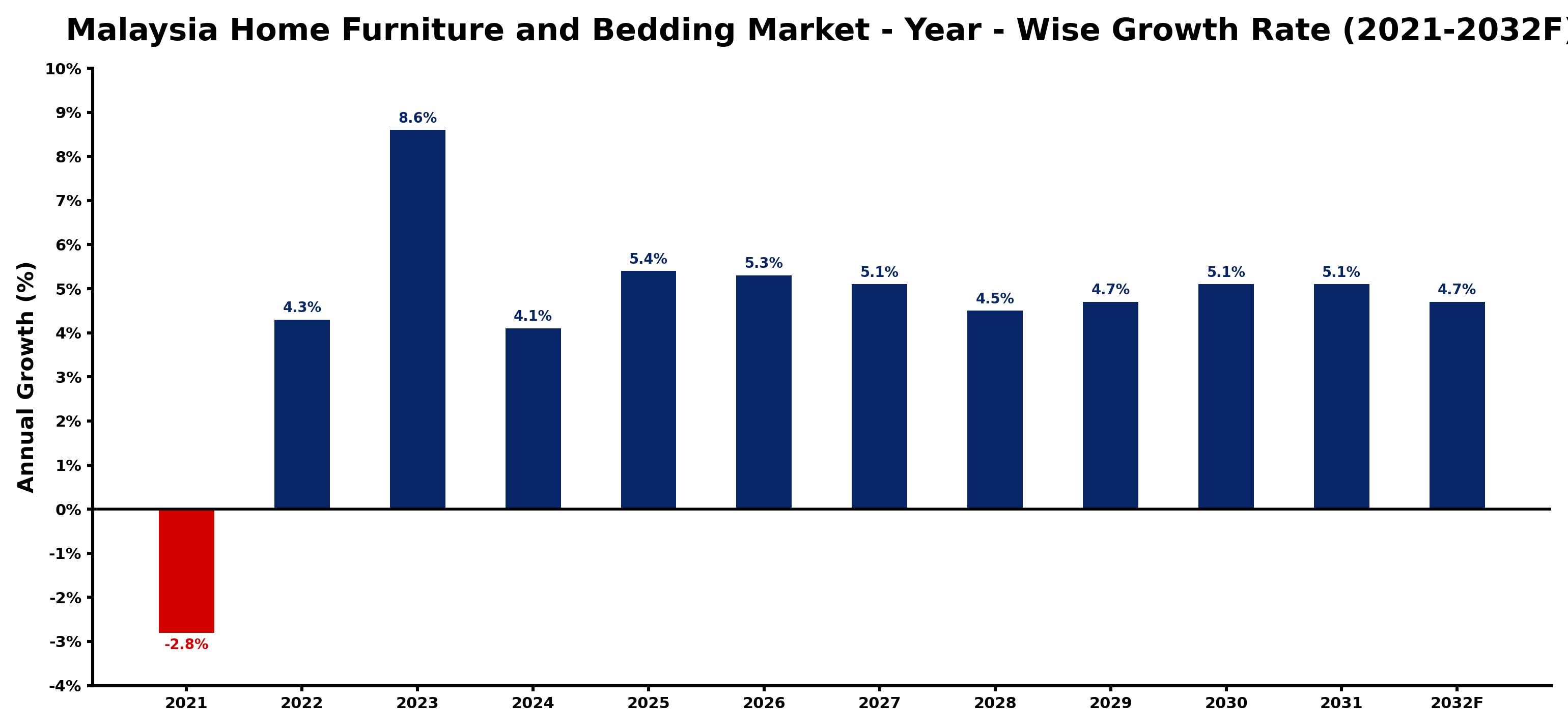
The table below presents the year‑wise growth rates along with the key drivers influencing the market
| Year | Growth Rate | Major Drivers |
| 2021 | -2.8% | Consumer spending decreased significantly |
| 2022 | 4.3% | Home renovation projects increased demand |
| 2023 | 8.6% | E-commerce growth expanded market reach |
| 2024 | 4.1% | Sustainable materials gained popularity |
| 2025 | 5.4% | Urbanization drove furniture purchases |
| 2026 | 5.3% | Smart home integration enhanced appeal |
| 2027 | 5.1% | Design trends influenced consumer choices |
| 2028 | 4.5% | Health and wellness focus expanded |
| 2029 | 4.7% | Customization options attracted buyers |
| 2030 | 5.1% | Luxury furniture market expanded rapidly |
| 2031 | 5.1% | Collaborations with designers increased sales |
| 2032 | 4.7% | Online shopping convenience boosted sales |
Note - Market size estimations and growth projections presented in this report are based on 6Wresearch’s advanced forecasting approach, validated with industry datasets as of June 2026.
Malaysia Home Furniture and Bedding Market Synopsis
The home furniture and bedding market in Malaysia is experiencing a transformative phase, characterized by heightened consumer interest in enhancing their living spaces. With the pandemic driving longer hours spent at home, there has been a notable uptick in demand for various furniture and bedding products that combine style with comfort.
Key market drivers include urbanization trends leading to more housing developments and the increasing penchant for modern home aesthetics. As consumers prioritize both utility and design, the market is poised for substantial growth, with ongoing investments into e-commerce platforms making products more accessible to a broader audience.
Malaysia Home Furniture and Bedding Market Key Takeaways
- The market is set to grow to USD 411 Million by 2032, reflecting evolving consumer behaviors.
- Urbanization and rising disposable incomes are crucial factors driving market demand.
- Increased e-commerce penetration facilitates greater access to diverse product offerings.
- Innovative designs and customizable options are key trends attracting consumers.
- Companies are increasingly focusing on sustainability in production to align with consumer expectations.
Evaluation of Restraints in Malaysia Home Furniture and Bedding Market
Despite its promising outlook, the Malaysia home furniture and bedding market grapples with several restraints that could hinder growth. Economic uncertainties, stemming from fluctuating disposable incomes, often make consumers cautious about spending on non-essential items like furniture. Additionally, shifting consumer preferences and rapidly evolving interior design trends necessitate that manufacturers adapt quickly while managing production costs. These factors can pose significant challenges to maintaining a competitive edge in the market.
Malaysia Home Furniture and Bedding Market Trends
Current trends in the Malaysian home furniture and bedding market are indicative of a broader shift towards multifunctional and space-saving designs, particularly among urban dwellers. The rise of digital platforms has not only made shopping more convenient but has also influenced consumer preferences, with many leaning towards online purchases for customization options. Sustainability is gaining traction, prompting manufacturers to adopt eco-friendly materials and production methods in response to consumer demand for environmentally responsible choices.
Malaysia Home Furniture and Bedding Market Opportunities
There are significant growth opportunities within the Malaysia home furniture and bedding market, particularly in the realm of innovative product design and customization. As consumers seek unique solutions that reflect their personal style, companies that invest in R&D to create customizable and smart furniture will likely capture substantial market share. Moreover, the expansion of e-commerce provides a robust platform for reaching a wider audience, potentially leading to increased sales and brand loyalty.
Government Initiatives in the Malaysia Home Furniture and Bedding Market
The Malaysian government has recognized the potential of the home furniture and bedding sector and is actively supporting initiatives aimed at fostering growth in this industry. Policies focused on promoting local manufacturing and exports are in place, coupled with incentives for businesses to adopt sustainable practices. Additionally, public spending on housing developments creates a favorable environment for furniture sales, driving demand within this segment.
Future Insights of the Malaysia Home Furniture and Bedding Market
Looking ahead to 2026-2032, the Malaysia home furniture and bedding market is set to evolve further with an emphasis on technology integration in products. Smart furniture that offers convenience alongside traditional functionality is likely to gain traction. Consumer focus will increasingly shift towards sustainable products, encouraging brands to innovate and adapt to these preferences. The overall outlook remains positive, supported by continual growth in urban housing and lifestyle changes that prioritize comfort and aesthetic appeal.
Malaysia Home Furniture and Bedding Market Latest Developments (May 2025 - June 2026)
The home furniture and bedding market in Malaysia has witnessed significant developments as of mid-2026, characterized by a notable increase in online furniture sales facilitated by enhanced logistics and digital marketing strategies. Companies are also launching new product lines that emphasize ergonomic design and sustainability, meeting the evolving demands of environmentally conscious consumers. Additionally, partnerships with interior designers are becoming more common as brands look to integrate more personalized solutions into their offerings.
Malaysia Home Furniture and Bedding Market - Key Attractiveness of the Report
- 10 Years of Market Numbers
- Historical Data Starting from 2022 to 2025
- Base Year: 2025
- Forecast Data until 2032
- Key Performance Indicators Impacting the Market
- Major Upcoming Developments and Projects
Key Highlights of the Report:
- Malaysia Home Furniture and Bedding Market Outlook
- Market Size of Malaysia Home Furniture and Bedding Market, 2025
- Forecast of Malaysia Home Furniture and Bedding Market, 2032
- Historical Data and Forecast of Malaysia Home Furniture and Bedding Revenues & Volume for the Period 2022-2032F
- Malaysia Home Furniture and Bedding Market Trend Evolution
- Malaysia Home Furniture and Bedding Market Drivers and Challenges
- Malaysia Home Furniture and Bedding Price Trends
- Malaysia Home Furniture and Bedding Porter's Five Forces
- Malaysia Home Furniture and Bedding Industry Life Cycle
- Historical Data and Forecast of Malaysia Home Furniture and Bedding Market Revenues & Volume By Product Type for the Period 2022-2032F
- Historical Data and Forecast of Malaysia Home Furniture and Bedding Market Revenues & Volume By Sofa for the Period 2022-2032F
- Historical Data and Forecast of Malaysia Home Furniture and Bedding Market Revenues & Volume By Bed for the Period 2022-2032F
- Historical Data and Forecast of Malaysia Home Furniture and Bedding Market Revenues & Volume By Chair for the Period 2022-2032F
- Historical Data and Forecast of Malaysia Home Furniture and Bedding Market Revenues & Volume By Cupboard for the Period 2022-2032F
- Historical Data and Forecast of Malaysia Home Furniture and Bedding Market Revenues & Volume By Others for the Period 2022-2032F
- Historical Data and Forecast of Malaysia Home Furniture and Bedding Market Revenues & Volume By Sales Channel for the Period 2022-2032F
- Historical Data and Forecast of Malaysia Home Furniture and Bedding Market Revenues & Volume By Online for the Period 2022-2032F
- Historical Data and Forecast of Malaysia Home Furniture and Bedding Market Revenues & Volume By Offline for the Period 2022-2032F
- Malaysia Home Furniture and Bedding Import Export Trade Statistics
- Market Opportunity Assessment By Product Type
- Market Opportunity Assessment By Sales Channel
- Malaysia Home Furniture and Bedding Top Companies Market Share
- Malaysia Home Furniture and Bedding Competitive Benchmarking By Technical and Operational Parameters
- Malaysia Home Furniture and Bedding Company Profiles
- Malaysia Home Furniture and Bedding Key Strategic Recommendations






































